-
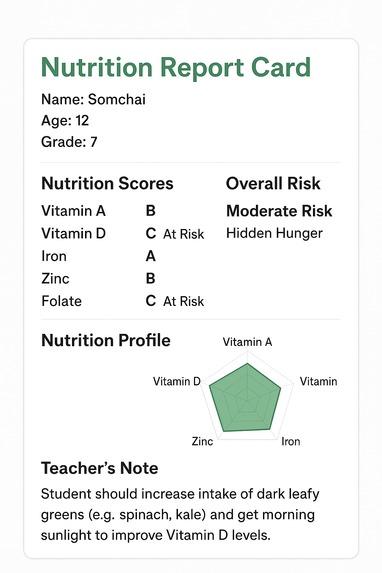
Nutrition Report Card: Visualizing Hidden Hunger in Students
Inspiration
Hidden hunger silently affects over 2 billion people worldwide, particularly children.
We realized that while schools regularly track academic performance, they rarely track nutritional health in an equally systematic way. This inspired us to create a Nutrition Report Card — a simple, familiar format for teachers, parents, and students to visualize hidden hunger risks just like grades in school.
What it does
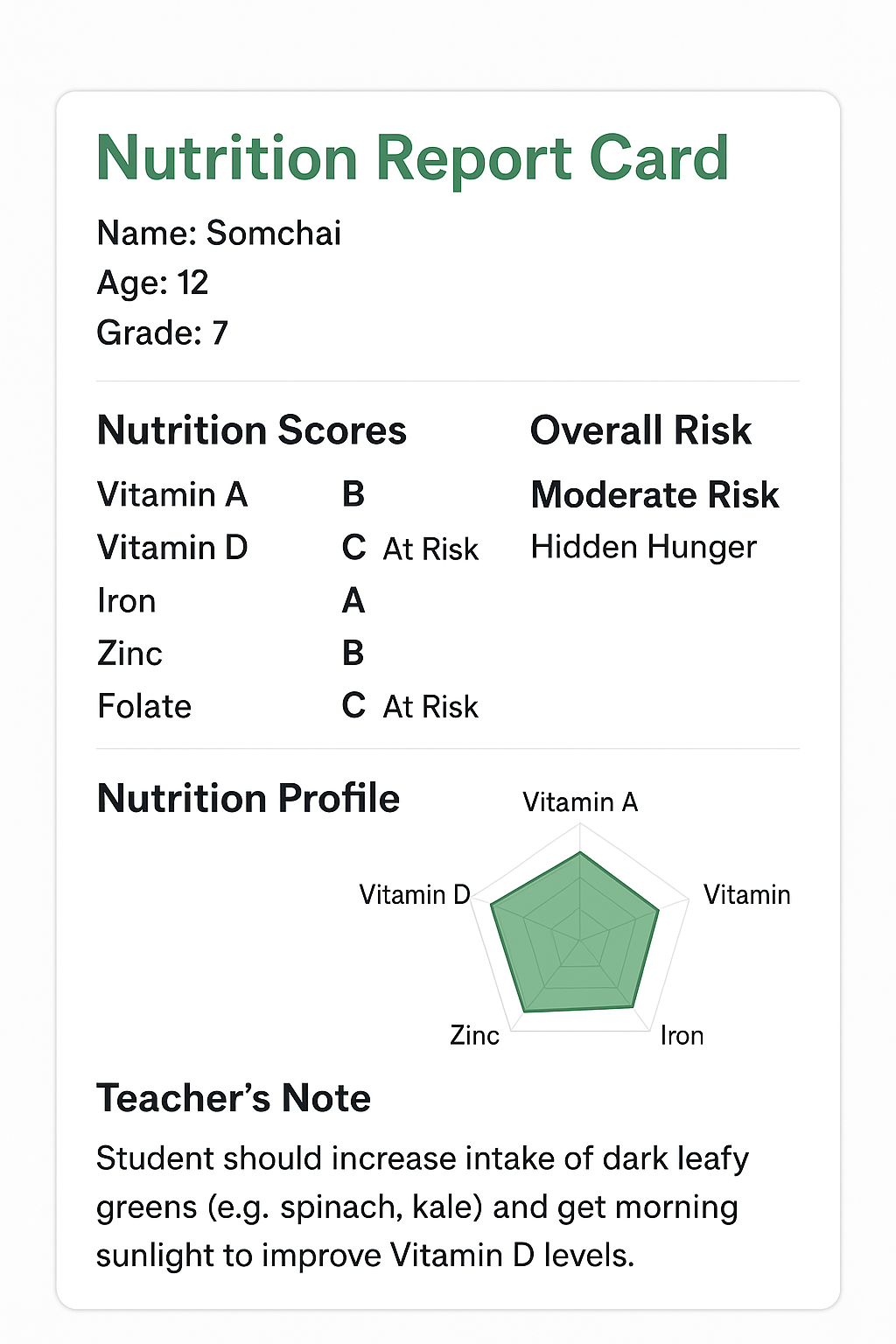
Our project transforms demographic and dietary intake data into a personalized nutrition report card.
- Each micronutrient (Vitamin A, Vitamin D, Iron, Zinc, Folate) is graded like a subject (A–D).
- A risk score highlights whether a student is at low risk, at risk, or deficient.
- Charts (radar plots, bar graphs) show overall nutrient balance.
- Teacher-style comments provide actionable recommendations (e.g., “Increase leafy greens for folate” or “Morning sunlight for Vitamin D”).
This bridges the gap between complex data analysis and accessible communication for schools and families.
How we built it
- Data preprocessing: Cleaned and encoded demographic + nutrient intake data.
- Modeling:
- Logistic regression baseline.
- Random Forest and XGBoost for feature importance.
- Evaluation with F1 and ROC-AUC (compulsory metrics).
- Logistic regression baseline.
- Feature analysis: Used SHAP values and correlation heatmaps to identify key predictors.
- Report Card Mockup: Designed a visual dashboard that auto-generates a PDF/PNG report card for each student.
- Policy component: Drafted a concept note and policy brief on integrating the report card into school health programs.
Challenges we ran into
- Balancing technical accuracy with accessibility: translating ML model outputs into a format that teachers and parents can understand.
- Data limitations: synthetic dataset simplified hidden hunger into binary classes, which limited the nuance of real-world biology.
- Time constraints: building both predictive modeling and a user-friendly mockup in a short hackathon timeline.
Accomplishments that we're proud of
- Built a working predictive model that achieved strong F1 and ROC-AUC scores.
- Designed a unique, culturally familiar communication tool (the school report card) that resonates with both educators and parents.
- Proposed scalable policy interventions to integrate nutrition monitoring into school systems.
- Collaborated effectively as a team, combining data science, design, and public health perspectives.
What we learned
- Technical: how to apply ML models (Random Forest, SHAP) for interpretable public health predictions.
- Policy: the importance of cultural context — a solution must fit the daily life of families, not just be technically correct.
- Collaboration: merging ideas from computer science, nutrition, and education leads to stronger, more holistic solutions.
What's next for Nutrition Report Card: Hidden Hunger Detector
- Pilot testing in schools: Partner with local schools to trial the report card system and gather feedback.
- Mobile integration: Build an app where parents can log meals and receive a nutrition report card in real-time.
- Policy adoption: Work with ministries of education and health to integrate hidden hunger tracking into national school health programs.
- Expanded data: Incorporate biomarkers, growth data, and meal logs for more accurate predictions.
The vision is to make nutrition monitoring as routine as academic grading — ensuring that every child grows up both educated and nourished.
Built With
- canva
- csv
- excel
- excel-documentation:-markdown
- figma
- github
- jupyter
- latex
- markdown
- matplotlib
- numpy
- numpy-(data-preprocessing)-matplotlib
- pandas
- plotly-(visualizations-&-charts)-shap-(model-interpretability)-platforms-&-tools:-jupyter-notebook-/-google-colab-(development)-github-(version-control-&-collaboration)-figma-/-canva-(mockup-design-for-the-report-card)-databases-/-data-handling:-csv
- python
- r-(??????-data-analysis-???-ml)-frameworks-&-libraries:-scikit-learn-(machine-learning)-xgboost-(gradient-boosting-models)-pandas
- scikit-learn
- seaborn
- shap
- xgboost

Log in or sign up for Devpost to join the conversation.