-
-
NutriSight Review Lab — evidence-aware workflow
-
NutriSight Review Lab — evidence-aware workflow
-
NutriSight Review Lab — evidence-aware workflow
-
NutriSight Review Lab — evidence-aware workflow
-
NutriSight Review Lab — evidence-aware workflow
Inspiration
What it does
How we built it
Challenges we ran into
Accomplishments that we're proud of
What we learned
What's next for NutriSight Review Lab
Inspiration
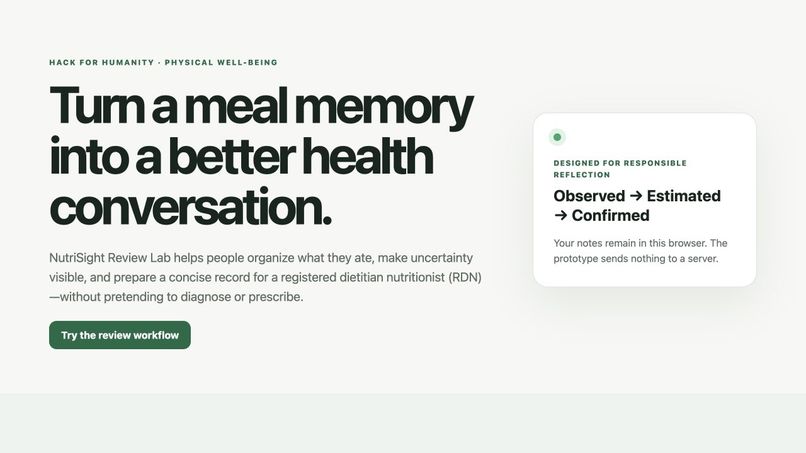
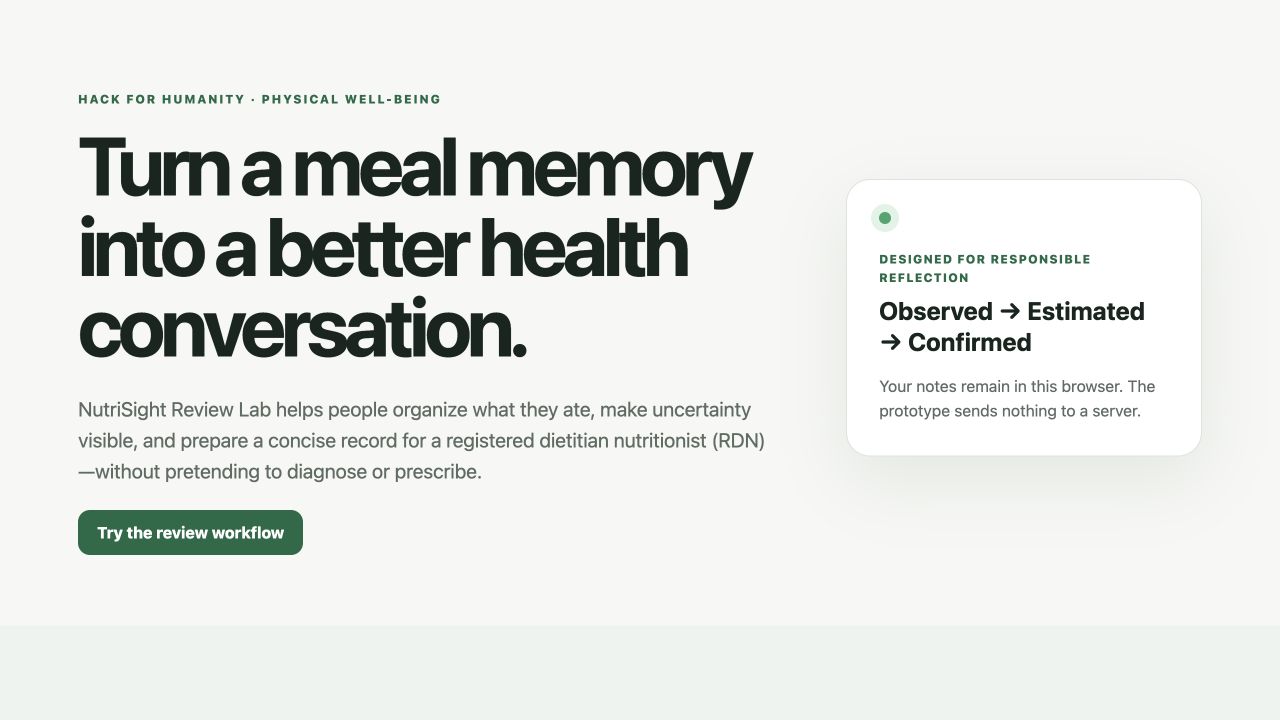
Food logging is often too tedious to sustain, while automated nutrition tools can make uncertain inputs look more precise than they really are. A meal photo or memory cannot reliably reveal portion size, hidden ingredients, preparation methods, health effects, or a person's clinical context. NutriSight Review Lab explores a more honest role for technology: organize the evidence, keep uncertainty visible, and help a person prepare better questions for a qualified professional.
What it does
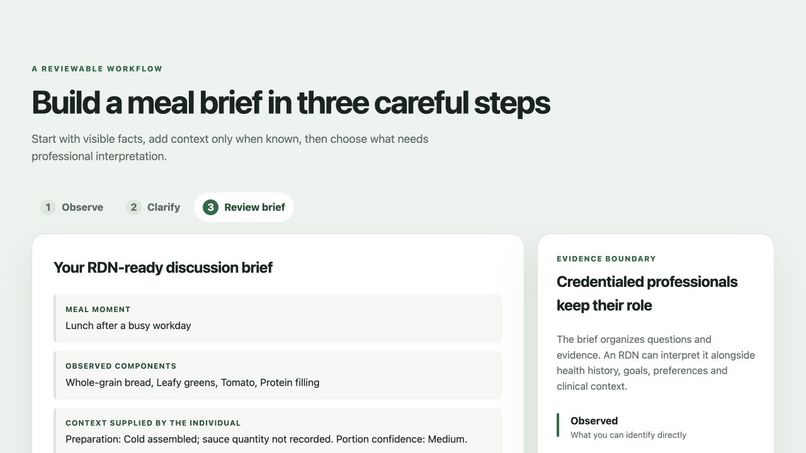
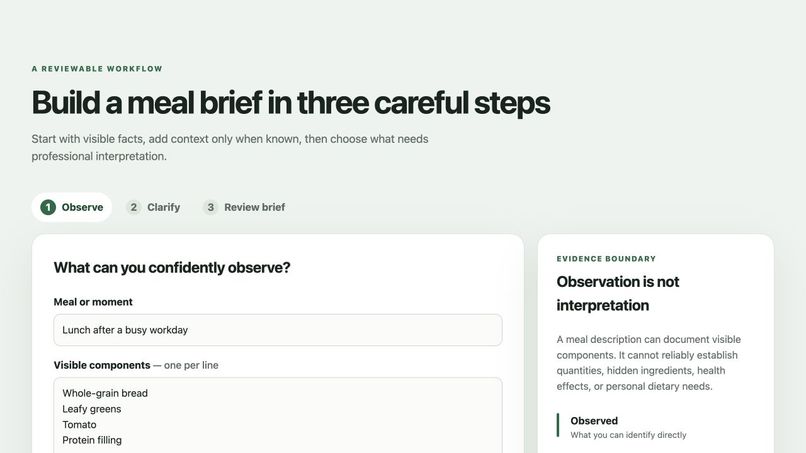
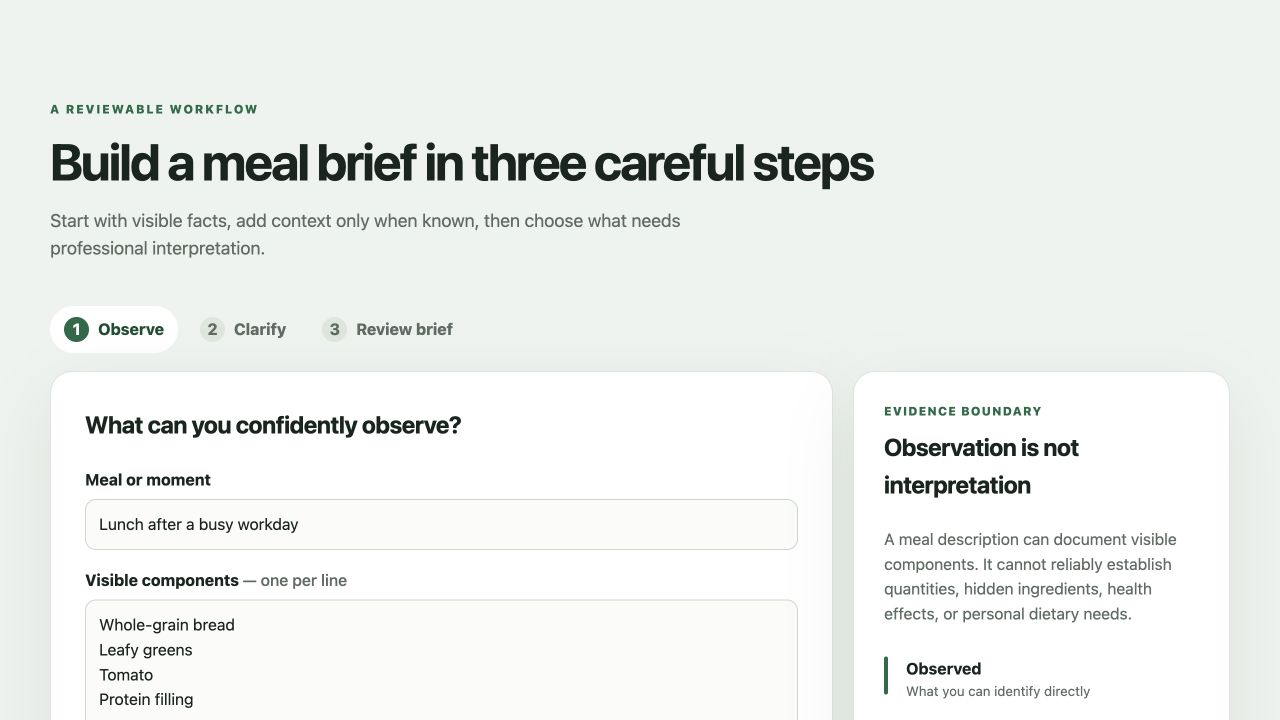
NutriSight Review Lab guides a person through three steps:
- Observe: record the meal moment, visible components, and confidence in the portion description.
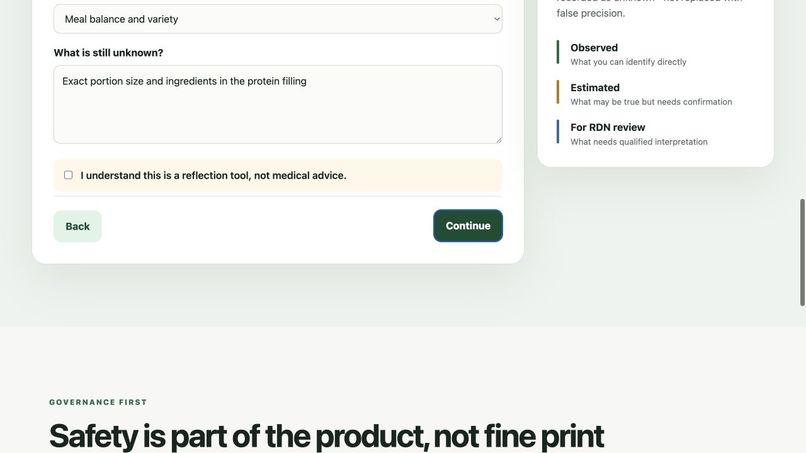
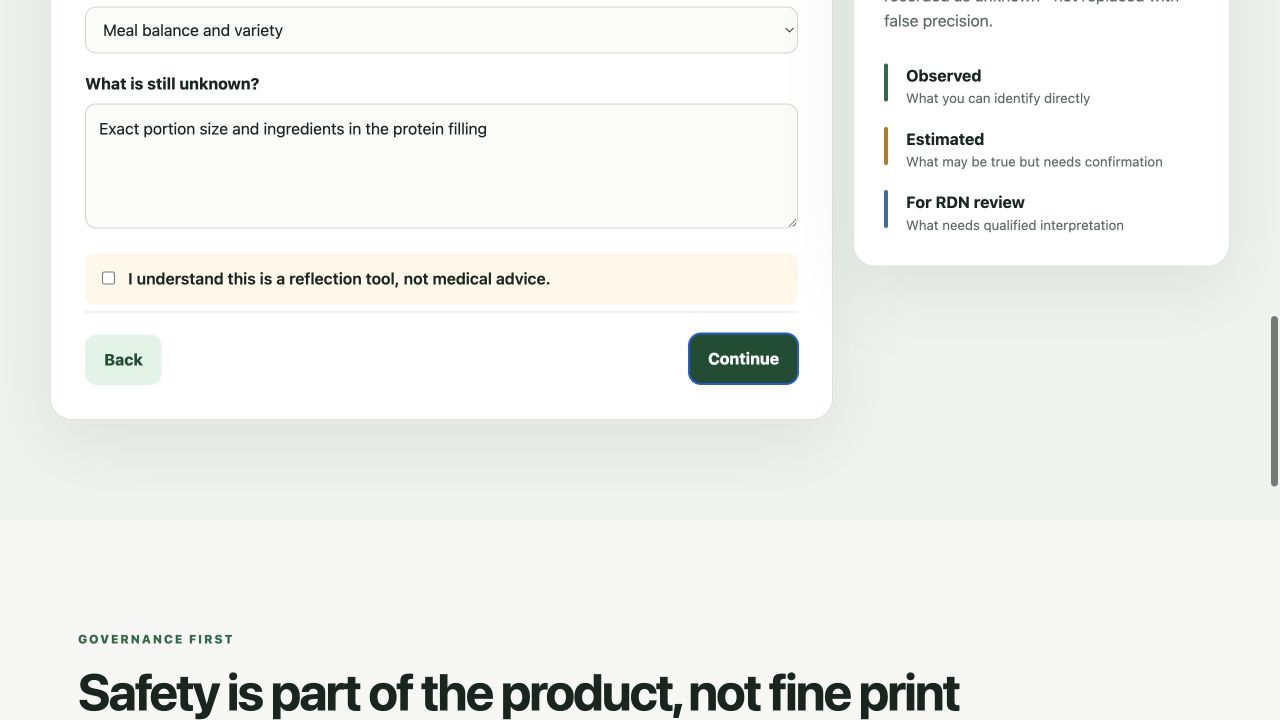
- Clarify: add preparation details, choose the question to explore, and explicitly record missing context.
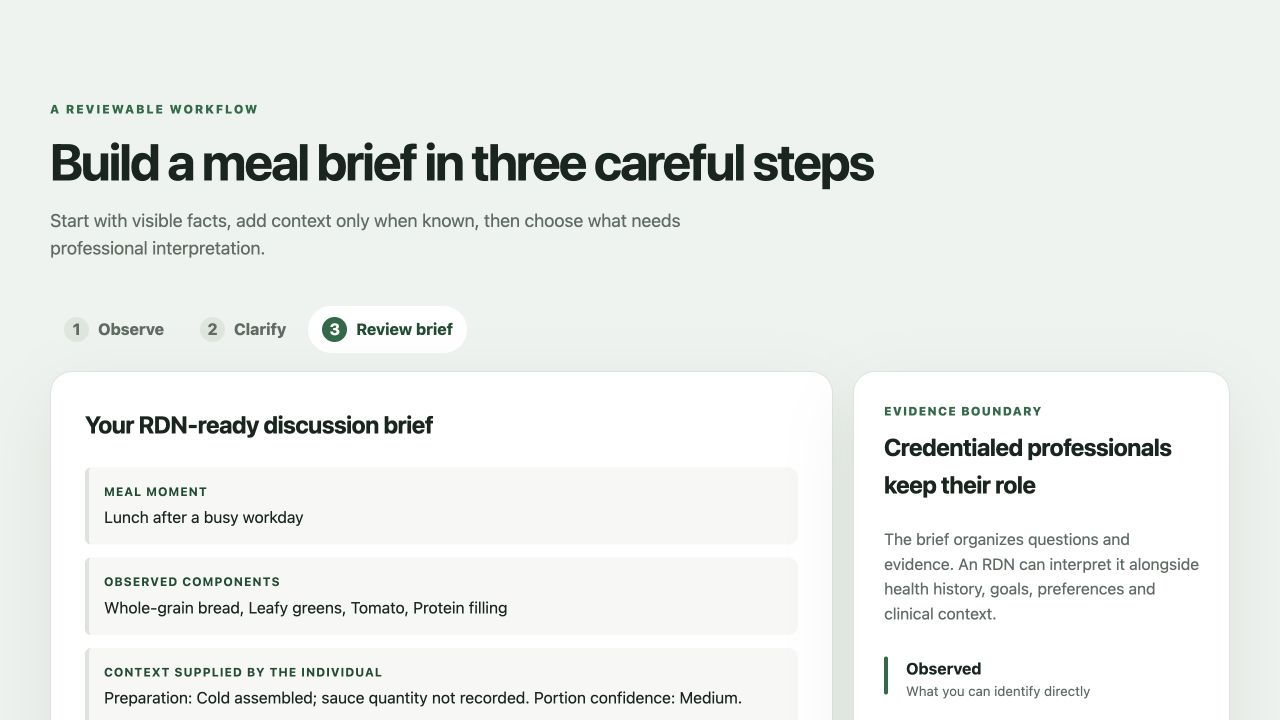
- Review brief: generate a structured summary that separates observations, user-supplied context, uncertainty, and the question for RDN review.
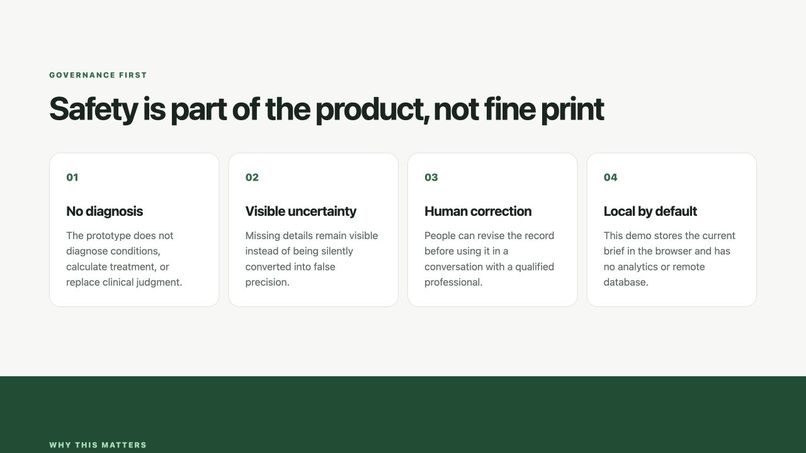
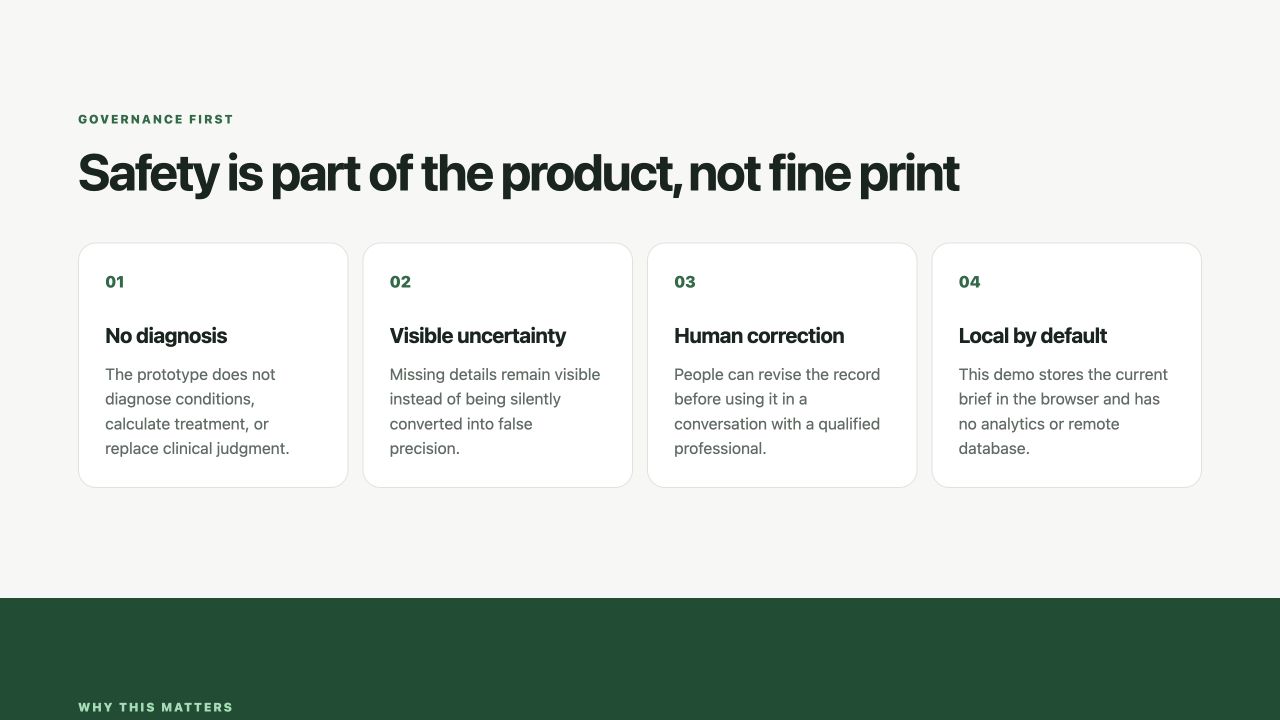
The prototype does not diagnose, prescribe, calculate treatment, or claim medical accuracy. It keeps credentialed nutrition professionals in the role of interpretation. The current brief stays in the browser: there is no remote database, analytics tracker, API key, account, or paid service.
How we built it
I built the prototype during the Hack for Humanity Summer 2026 build period as a standalone, dependency-free web application using semantic HTML, responsive CSS, and vanilla JavaScript. Browser local storage preserves the current brief on the device. User-entered text is escaped before it is rendered. The source is public on GitHub and the live demo is deployed with GitHub Pages.
The interface treats evidence boundaries as a product feature. Each step pairs the input workflow with a short safety explanation, and the final brief labels what was observed, what the individual supplied, what remains uncertain, and what needs qualified review.
Challenges we ran into
The central challenge was avoiding false precision. Nutrition interfaces often reward the appearance of certainty even when preparation, portion, ingredients, health history, and personal goals are unknown. The workflow keeps missing details visible and useful rather than silently filling them in.
I also had to make the safety model understandable without turning the interface into a wall of disclaimers. The final design uses compact evidence-boundary guidance and plain-language labels.
Accomplishments that we're proud of
- A complete responsive workflow that works without an account or installation.
- A useful output even when important meal details remain unknown.
- A local-first privacy model with no analytics or remote database.
- Clear separation of observation, estimation, correction, and professional review.
- Honest scope: no clinical-validation, accuracy, partner, or outcome claims.
- A public functioning repository and live deployment created during the hackathon period.
What we learned
Responsible health technology is not only about adding a disclaimer. The interaction itself must preserve uncertainty, invite correction, limit claims, and make escalation to qualified people easy to understand. A modest transparent workflow can be more useful than an impressive-looking answer that hides assumptions.
What's next
The next step is to recruit an RDN advisor to review the evidence boundaries and co-design a bounded pilot. Future work could add optional meal-image input only after confirming lawful data sources, defining a transparent evaluation protocol, and keeping every inferred component editable. I also want to test accessibility and whether the brief improves conversations for individuals, clinics, health centers, and community programs.
Build statement
This standalone prototype and repository were created on August 25, 2026 during the Hack for Humanity Summer 2026 build period. It draws on my broader NutriSight concept but implements a new review-brief workflow, local-first privacy model, and responsible-health interface for this event.

Log in or sign up for Devpost to join the conversation.