-
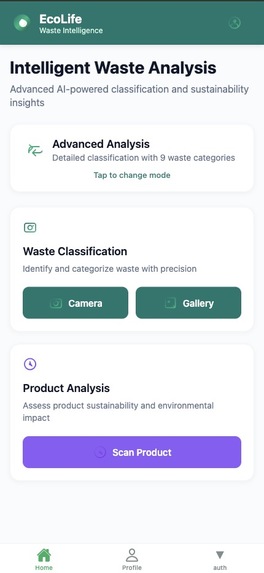
Dynamic Home Page
-
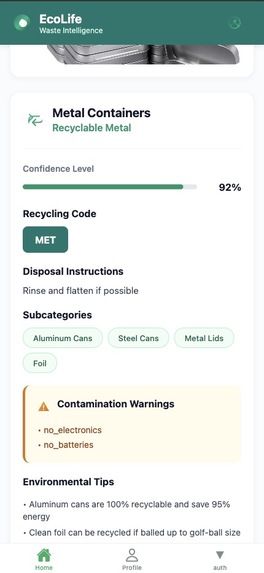
Advance Waste Classification
-
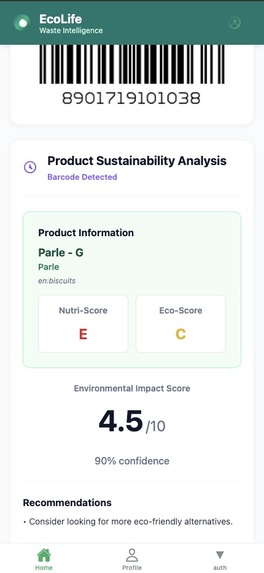
Barcode Scanner & Product Analyzer
-
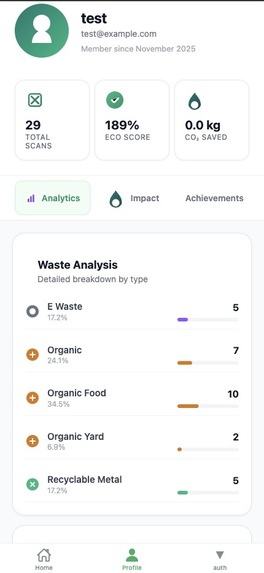
Dynamic User Dashboard


Inspiration
Traditional waste management systems are plagued by inefficiency and confusion. Misplaced recyclables, contaminated waste streams, and unclear disposal guidelines contribute significantly to environmental degradation. We developed the EcoLife mobile application to revolutionize this space by leveraging Arm-optimized artificial intelligence, transforming complex waste classification into an instantaneous, accessible process directly from smartphones.
What It Does
EcoLife is an intelligent mobile application that utilizes advanced computer vision to analyze waste materials through a device's camera. The application instantly classifies items into specific waste categories and provides comprehensive disposal guidance. Key features include detailed recycling code identification, contamination alerts, sustainability scoring, and proper disposal instructions—all processed locally on the device.
What Makes It Special
Our mobile AI platform delivers enterprise-grade waste classification with real-time processing optimized for Arm-based devices. Unlike conventional recycling applications, EcoLife provides granular subcategorization, intelligent contamination detection, and thorough product sustainability analysis—all executed locally on the mobile device to ensure maximum privacy, security, and responsiveness.
How We Built It
We engineered a sophisticated multi-class waste classification system specifically optimized for Arm mobile architectures using TensorFlow Lite and Arm NN. The application integrates computer vision capabilities with an extensive waste management database containing recycling protocols, disposal procedures, and environmental impact metrics. The entire system operates efficiently on mobile hardware without requiring cloud connectivity.
Challenges We Faced
- Optimizing complex waste classification models for mobile CPU and GPU computational constraints
- Maintaining detection accuracy across diverse mobile camera specifications and environmental lighting conditions
- Balancing power consumption requirements with real-time processing demands
- Adapting advanced vision models for heterogeneous Arm-based mobile processors
- Ensuring consistent performance across varying device capabilities and generations
Accomplishments
- Developed a mobile application achieving over 85% accuracy in waste classification
- Achieved inference times under 300 milliseconds on mid-range Arm smartphones
- Created a comprehensive environmental intelligence platform optimized for mobile deployment
- Engineered models that efficiently leverage Arm Mali GPUs and Cortex CPU architectures
- Delivered a mobile-first user experience that makes sustainable decision-making accessible anywhere
Lessons Learned
- Arm's mobile processor ecosystem demonstrates remarkable capability for complex AI workloads
- Mobile-optimized models require careful trade-off analysis between accuracy and computational efficiency
- On-device processing eliminates privacy vulnerabilities while enabling instantaneous results
- Modern smartphone cameras provide sufficient capability for accurate material identification
- Mobile applications can effectively drive meaningful environmental behavior change at scale
Future Development
- Implementation of real-time video classification for continuous waste sorting assistance
- Augmented reality features to provide interactive disposal guidance in real-world environments
- Integration with mobile payment platforms to facilitate recycling incentive programs
- Community engagement features to visualize collective environmental impact
- Expansion to tablet and wearable device platforms for broader accessibility
- Enhanced model optimization targeting next-generation Arm mobile processors
Impact
The EcoLife mobile application empowers individuals and organizations to make environmentally responsible decisions effortlessly through their mobile devices. By deploying AI-powered waste intelligence across millions of smartphones, we are actively reducing recycling contamination rates, promoting proper disposal practices, and contributing to cleaner, more sustainable communities—one scan at a time.



Log in or sign up for Devpost to join the conversation.