Inspiration
The United Nations’ Sustainable Development goal we are primarily aiming to tackle with our solution is SDG #2 which aims to end hunger, achieve food security and improve nutrition and promote sustainable agriculture. Our solution NutrIoTion is able to provide an IoT-based solution that aims to improve nutrition by ensuring the best quality produce always reaches the end consumer and at the same time minimise excess food wastage. Our solution aims to reduce food from getting wasted that could actually be consumed or utilised by someone in need.
The inspiration behind going for this was an innate desire within us to tackle the problem of food wastage. Having seen food being wasted in canteens, we tried researching how we could try to reduce food wastage, which is when we came across the problem of Ugly Food. We noted that 1.3 billion tonnes of food – about a third of food produced – is wasted per year, with fruits and vegetables having the highest wastage rates of up to 40 to 50%.
We come with the sole purpose of reducing hunger by controlling big supermarkets and food giants from throwing away food before its true expiry. The smart IoT approach reduces fresh food waste by 50 percent or more.. Reducing food waste by just 15 percent could provide enough sustenance to feed more than 25 million people annually.
What it does
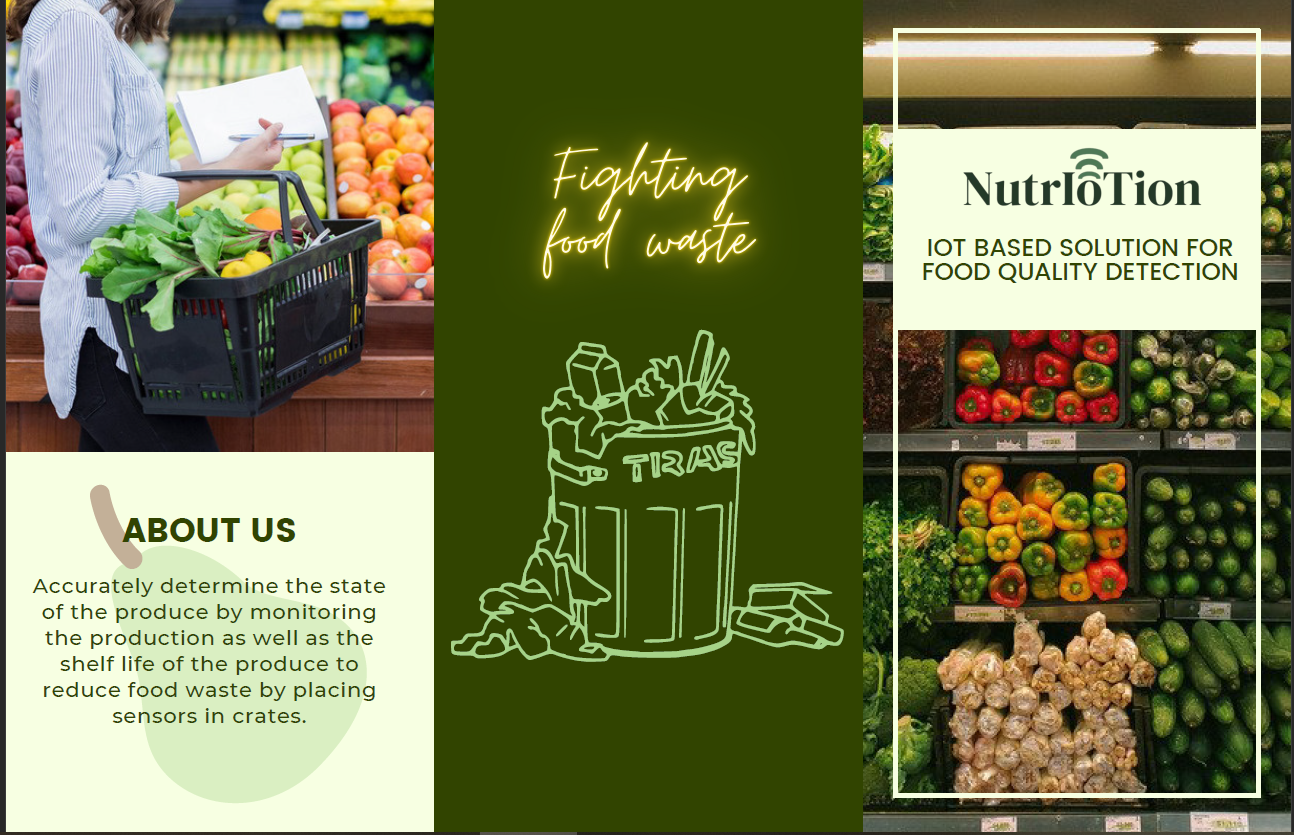
We are proposing an IoT solution which will be an addition to existing crates with sensors that update dashboard with real-time status of the food quality. Due to microbial action on fresh produce (fruits, vegetables, and seafood) they release gases like Ammonia, Hydrogen Sulphide, Methane and other VOCs. The following sensors: MQ3 - Detects Methane, alcohol, and VOCs (limit of detection 300 ppm) MQ135- Detects Air Quality - Ammonia, Alcohol (limit of detection 10ppm) MQ136- Detects Hydrogen Sulphide (limit of detection 1ppm) Can use sampled air using small exhaust fans under the crate to detect the presence of different gas concentrations. The levels of gas concentrations can help us predict and use the food until the very last stage. This is crucial as it reduces the food being thrown away before it is actually spoiled. It is scientifically validated using the gas sensors. Reducing food waste by just 15 percent could provide enough sustenance to feed more than 25 million people annually which makes our solution a crucial need in order to attain ZERO HUNGER.
How we built it
Since our solution involves a combination of hardware and software components to better tackle our problem statement of unnecessary food wastage, the architecture pattern we followed was the Observe-and-React pattern which is commonly used in a sensor-based real time system like ours. Here, the input values from the set of sensors (MQ3,MQ135 and MQ136) are parsed using Arduino code in C++ and are stored in Firestore by Google's Firebase, which serves as the application backend in this context. These values are then curated and displayed on a data dashboard implemented on Streamlit, which is a Python library that offers easy integration with Firestore and is our frontend. Based on our results, the stakeholder (inventory manager) at a supermarket can then make the right decision on the produce as opposed to a manual inspection that leads to the wanton food wastage in the first place.
Challenges we ran into
Since our solution involved a hardware-software integration to work, the coming together of me and Ashutosh, a software and electronics engineer seemed like a perfect fit. However, the process of integration was not all easy and required us to put our heads together on several matters. For example, reading the value from the sensors was straightforward. However, the sensors display a continuous stream of values that is not of much importance as opposed to the fluctuations. As such, setting conditions on the input to determine what part of the input is sent over to the Firestore was challenging. This required reading up in fair detail on the gas sensors and the critical values that need noting from the sensors. With the required background knowledge, we were able to map the right values so that we could use the same for better analysis and alerting the inventory manager.
Accomplishments that we're proud of
We implemented a proof of concept using a tray and three gas sensors (MQ3, MQ135, MQ136). We tested it using multiple oranges, two were new and two were rotten. We wanted no delay, our first goal was to have a real time update. So the ESP board sent in sensor values to Firebase and this updated the dashboard on time. We further divided the sensor values to divide the quality in order to indicate the quality of the food for that specific crate. The dashboard organises the approach and reduces manual work. This could be provided as an client IoT extension that could be implemented in their warehouses to see it real time like FairPrice and Giant. In the end, considering the financial aspect - food giants can price model their food products and reduce it as the quality detected from the sensors in order to maximise profits from the products instead of simply throwing it away too.
What we learned
In order to learn more about the usability of our product we approached two salespeople at Giant and FairPrice respectively. We asked them how fruits and vegetables, and open items were treated. One salespersion had told us that there have been multiple scenarios: i) threw the fruits and vegetables without seeing if spoilt or not to make space ii) threw fruits away because looked bad in shape iii) threw crate of fruits because of smell iv) no tool to track food quality vi) no option to throw as no sale/no profit v) no automated tool to throw rotten food or keeping fresh food - simply relied on human sense
We realised there was no organised approach in terms of food quality tracking. Considering the growth in the IoT sector, we wanted to integrate cloud and sensors to automate the process and make it convenient for supermarket stores. The experience of making an initial prototype served as our way to validate our thinking process and implement on a small-scale, what we achieve to do with our solution.
What's next for NutrIoTion
In the future, we hope to add image recognition capabilities that track the state of the produce visually using Raspberry Pi camera nodes. This camera would run an image recognition model, written in Google’s TensorFlow, that further classifies food as fresh or rotten and would help the team generate a better and more accurate output for the inventory manager to base a decision on. We wish to implement a smart crate based solution that encompasses all segments of the supply chain that helps determine food quality for market players like cold storage facilities, restaurants and food chains. We hope to get more funding and recognition for the project too.

Log in or sign up for Devpost to join the conversation.