-
-
NutriLens
Inspiration
We built NutriLens because many everyday food decisions directly affect long-term health, but most people do not get useful guidance at the moment they need it.
People often know that nutrition matters, but in real life the challenge is practical: choosing between two meals, understanding whether a lunch is too high in sodium, or noticing that an entire day of eating is low in protein or fiber. We wanted to build something that makes preventive health support feel immediate, actionable, and easy to use.
This project was especially inspired by the idea that AI should not just answer questions, but help people make better day-to-day decisions before small nutrition issues become larger health risks.
What it does
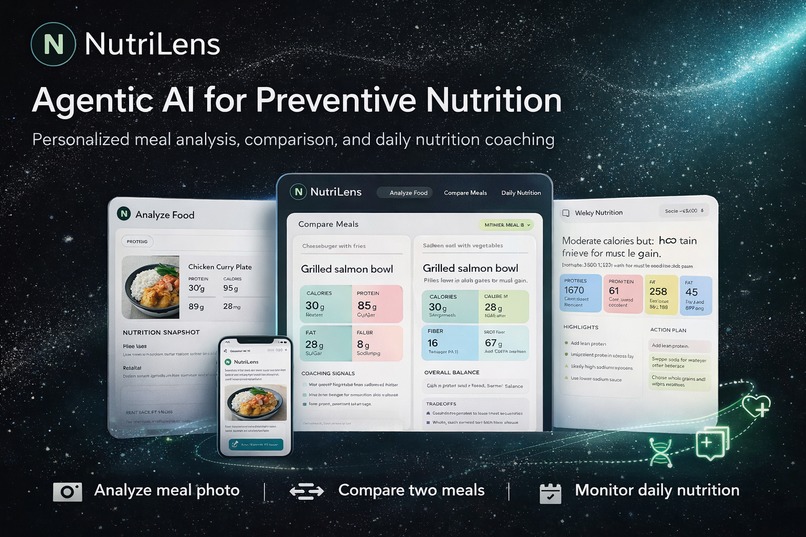
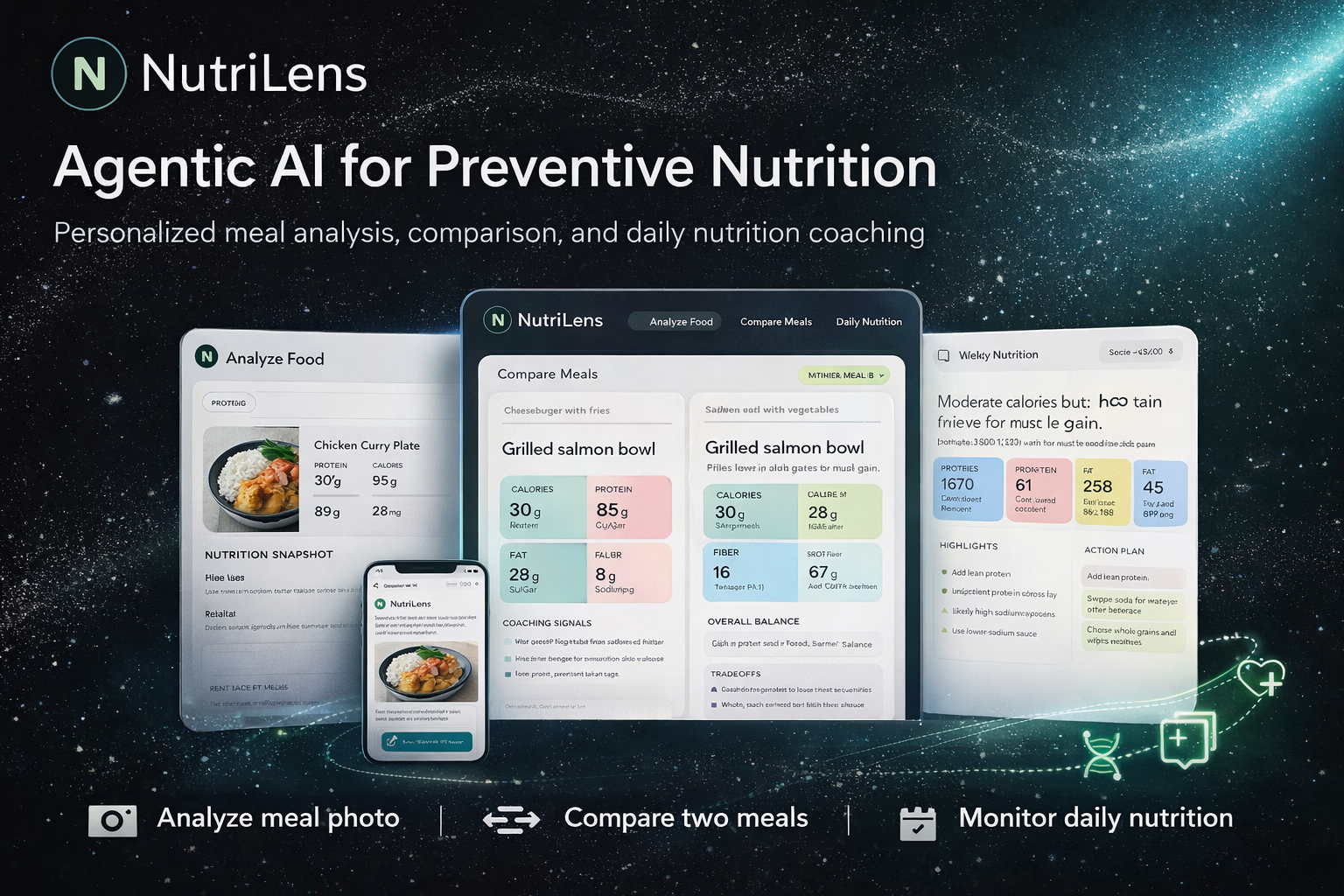
NutriLens is an agentic AI nutrition copilot that helps users make healthier daily food decisions through three core workflows:
- Analyze Food – upload a meal image and receive estimated calories, macros, ingredients, health signals, and practical next steps.
- Compare Meals – compare two meal options side by side based on a user goal such as muscle gain, lower sodium, or better balance.
- Daily Nutrition – summarize a full day of eating, identify nutrition gaps or risks, and generate an action plan.
The goal is to move beyond passive food logging and instead provide personalized, preventive guidance that helps users act right away.
How we built it
We built NutriLens as a full-stack AI application with a clean frontend experience and a structured backend pipeline.
On the frontend, we designed a simple multi-workflow interface so users can move naturally between meal analysis, meal comparison, and day-level nutrition tracking. We also added a health profile step so the system can personalize recommendations using context like user goals and activity level.
On the backend, we used FastAPI and Pydantic to create a reliable structured-output pipeline. User inputs are routed into task-specific prompts, sent to the OpenAI API for analysis, and then validated into predictable JSON schemas before being returned to the frontend. This was important for making the product feel like a real system rather than a one-off demo.
Why it is agentic AI
We consider NutriLens an agentic AI system because it follows a loop of:
- Monitoring user meal inputs and nutrition context
- Detecting health signals, trade-offs, and day-level patterns
- Intervening with practical recommendations and next best actions
Instead of only describing food, NutriLens helps users decide what to do next. That makes it more than a chatbot — it acts like a preventive nutrition decision-support agent.
Challenges we ran into
One of our biggest challenges was making the model output consistently useful and structured across very different tasks. Image-based meal analysis, meal comparison, and full-day nutrition summaries all require different reasoning patterns, but we still wanted a unified user experience.
Another challenge was balancing detail with clarity. Nutrition feedback can easily become too long or too generic, so we had to iterate on prompts and output design to make the results concise, actionable, and product-ready.
We also had to think carefully about reliability. Raw LLM output can be inconsistent, so schema validation and structured JSON responses became a core part of the system design.
What we learned
Through building NutriLens, we learned a lot about designing AI products that feel trustworthy and actionable, not just intelligent.
We learned that:
- structured outputs make AI applications much more reliable,
- personalization dramatically improves recommendation quality,
- and preventive health tools become more useful when they focus on decisions and actions, not just information.
We also learned how important product framing is: users do not just want nutrition data — they want help deciding what to eat, what to change, and what to do next.
What's next for NutriLens
Our next step is to make NutriLens more persistent and personalized over time.
We would like to expand it with:
- longer-term meal history and nutrition trend tracking,
- stronger personalization using health goals and routines,
- wearable or health-data integrations,
- and more advanced support for preventive care scenarios such as sodium reduction, protein intake, or chronic condition management.
Our vision is for NutriLens to become an everyday preventive health companion that helps people turn small food decisions into better long-term outcomes.


Log in or sign up for Devpost to join the conversation.