-
-
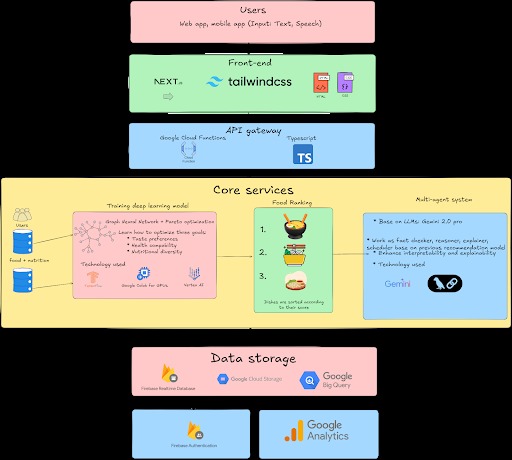
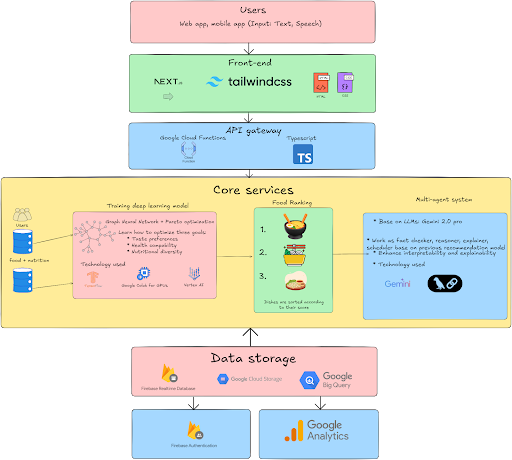
System Arthitecture
Inspiration
The idea for NutriCare Agents was born from a simple yet powerful realization: nutrition is deeply personal, yet most nutrition advice is painfully generic. In Vietnam, rising rates of non-communicable diseases like obesity, diabetes, and cardiovascular issues are tightly linked to dietary habits, but personalized dietary guidance is often inaccessible or culturally irrelevant.
We wanted to change that. We envisioned a system where anyone—regardless of income, ability, or location—could receive personalized, evidence-based nutritional advice tailored to their health needs, local food culture, and even voice preferences. We were particularly inspired to support visually impaired individuals and those in rural communities, using technology to break down barriers in access to health.
What it does
NutriCare Agents is a multi-agent AI-powered nutrition assistant that:
- Recommends personalized Vietnamese meals based on health conditions, preferences, and budget.
- Uses Graph Neural Networks to match users with suitable dishes.
- Provides cultural, nutritional, and historical context of dishes using Gemini APIs.
- Enables voice-based interaction for accessibility (via STT & TTS).
- Identifies dishes from uploaded photos using vision AI.
- Suggests nearby healthy food vendors using Google Maps & Places API.
- Supports both textual and spoken interfaces, making it inclusive for a wide range of users.
How we built it
- Frontend: React + Next.js, Tailwind CSS for responsive, clean UI/UX.
- Backend: Flask for API handling and Firebase Functions for scalable processing.
- Database: Firebase Realtime Database for user data, MySQL for structured food data.
AI/ML:
- LangChain + Gemini API: For reasoning, explanation, and cultural context.
- GNNs: For personalized meal matching based on user graphs.
- OpenAI Whisper + Coqui TTS: For voice interaction.
- Google Maps APIs: For geolocation-based food vendor suggestions.
Deployment: Hosted on Azure, integrated with Firebase Authentication for secure login.
Challenges we ran into
- Data Scarcity: Vietnamese food datasets with nutritional data were limited, requiring scraping and manual cleaning from multiple sources.
- Voice UX: Building a seamless experience for voice input/output involved synchronizing multiple APIs and tuning latency.
- Multi-Agent Coordination: Ensuring agents could communicate and delegate responsibilities effectively without redundancy was technically complex.
- Cultural Sensitivity: Avoiding generic advice meant deeply understanding regional food practices and ensuring recommendations felt natural and authentic.
- Time Constraints: Implementing and integrating multiple technologies in a short period required rapid prototyping and constant iteration.
Accomplishments that we're proud of
- Successfully orchestrated five specialized agents in a unified system.
- Built a voice-first interface that is inclusive for blind and visually impaired users.
- Designed a culturally aware recommendation engine using GNNs tailored to Vietnamese cuisine.
- Created an intuitive UI/UX with smooth multi-modal interactions (text, voice, image).
- Ran a user research survey with 400+ participants, validating core needs and features.
What we learned
- AI Orchestration is not just about combining tools—it's about defining clear agent roles and ensuring cooperative, non-overlapping functionality.
- Graph Neural Networks can significantly enhance personalization by capturing complex, non-linear relationships between user attributes and food metadata.
- Designing for accessibility requires empathy, user testing, and understanding how people interact with voice-first systems.
- Localizing AI involves more than translation—it requires adapting to cultural context, dietary practices, and lived experiences.
What's next for NutriCare Agents
- Expand dish dataset to cover Southeast Asian cuisines, enabling cross-cultural personalization.
- Launch a mobile app with real-time health tracking, meal logging, and push notifications.
- Integrate wearable data (e.g., smartwatches) to provide dynamic, condition-aware meal recommendations.
- Develop a public API for third-party integration (e.g., with fitness apps, hospitals, or e-commerce).
- Release open-source agent modules to encourage community collaboration and ensure transparency.
NutriCare Agents is just the beginning. We're not just building a nutrition app—we're building a platform for personalized, culturally-respectful, and inclusive digital healthcare.
Built With
- azure
- coqui-tts
- firebase
- firebase-realtime-database
- flask
- gemini-api
- google-cloud
- google-maps
- google-places
- graph-neural-networks-(gnn)
- langchain
- mysql
- next.js
- openai-whisper
- react
- tailwind-css

Log in or sign up for Devpost to join the conversation.