-
-
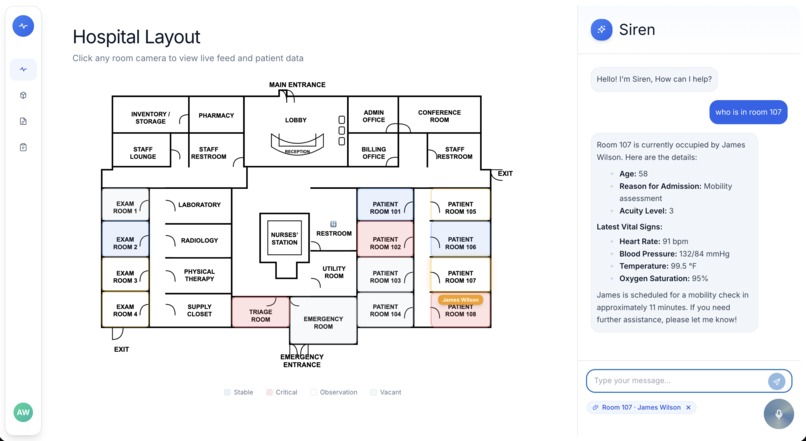
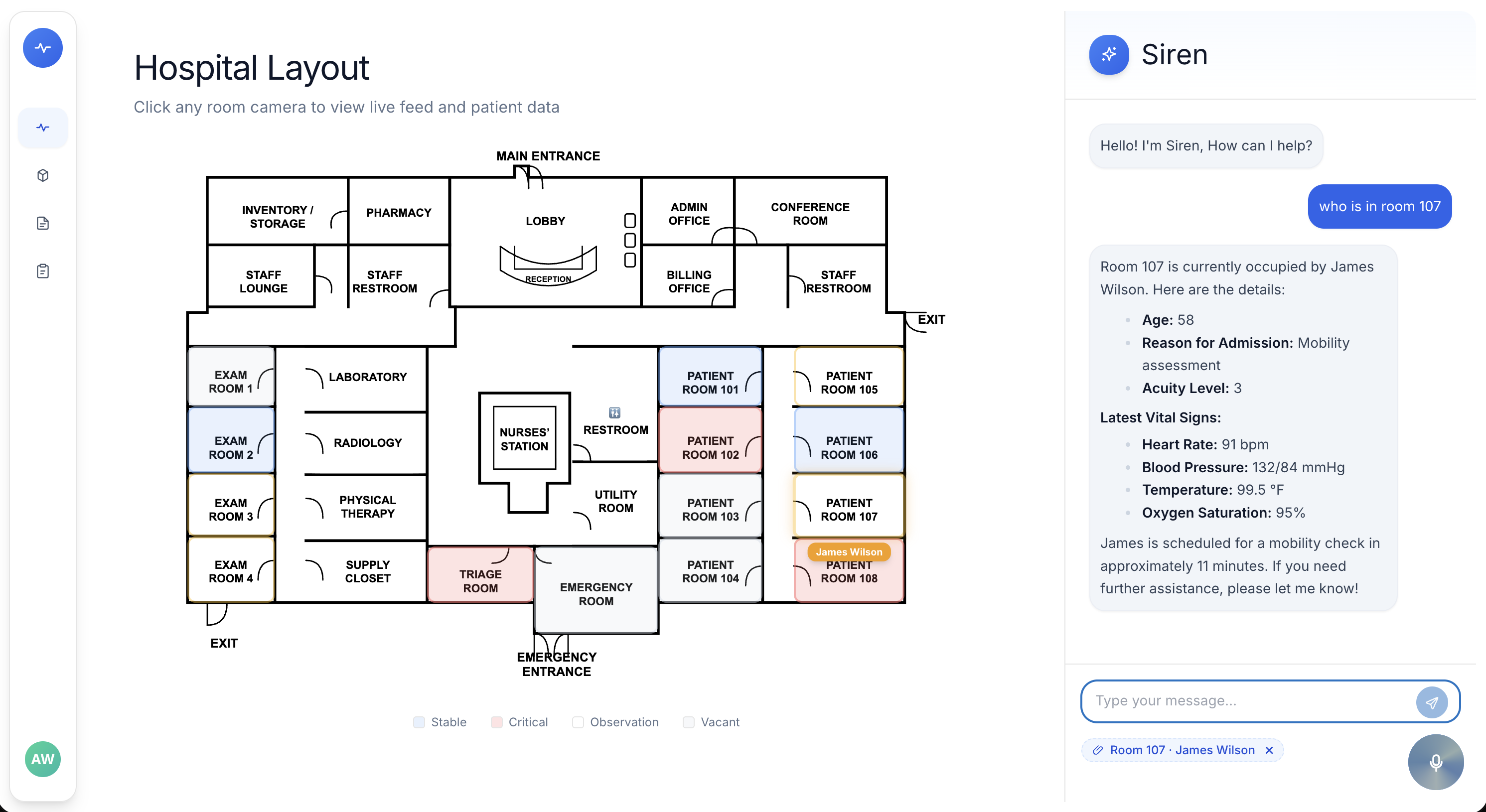
Interactive dashboard with Hospital Layout & NurseFlow
-
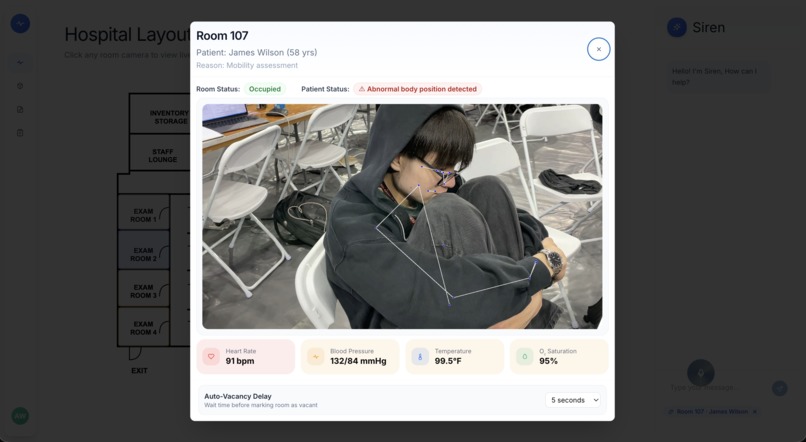
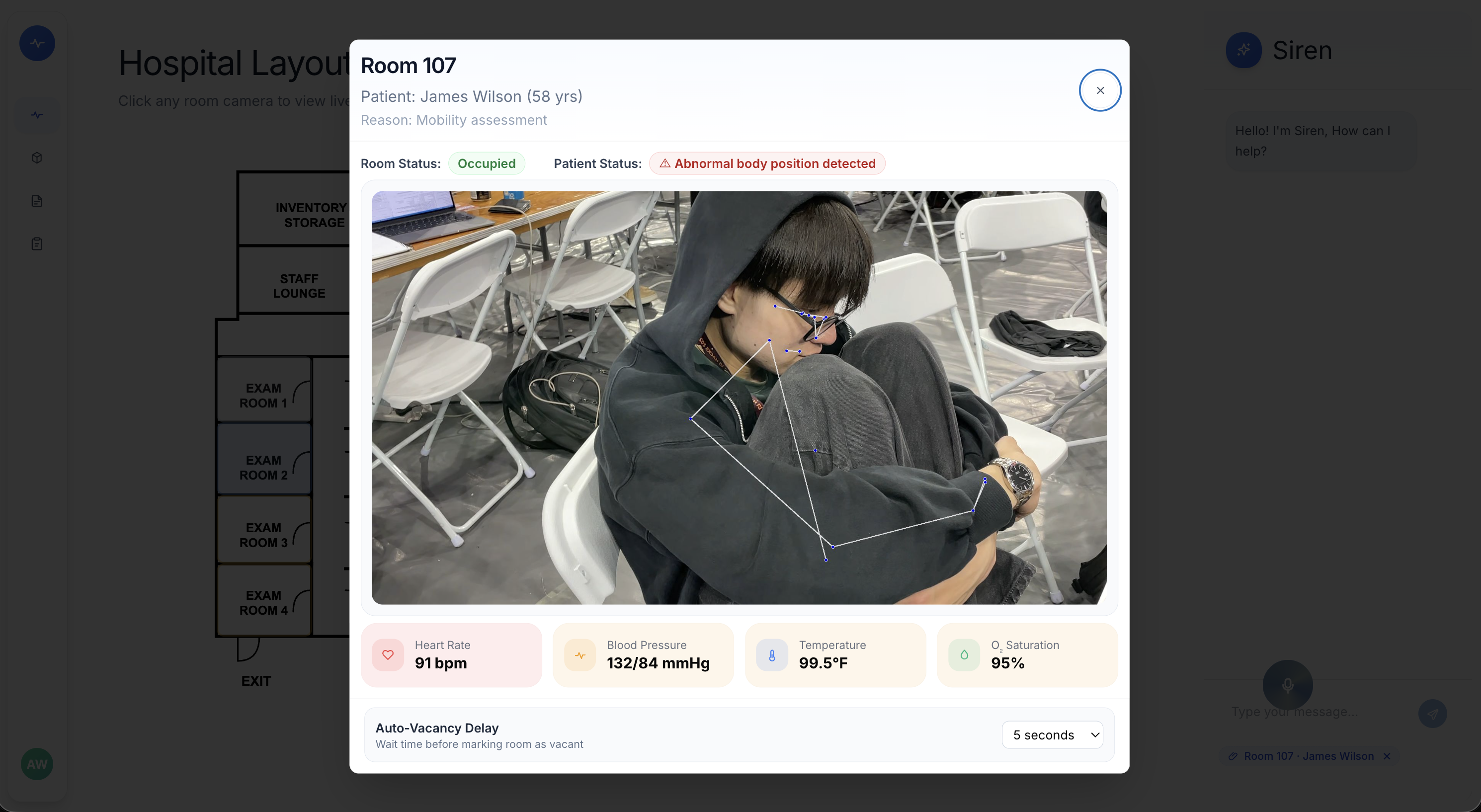
CV powered patient anomaly detection
-
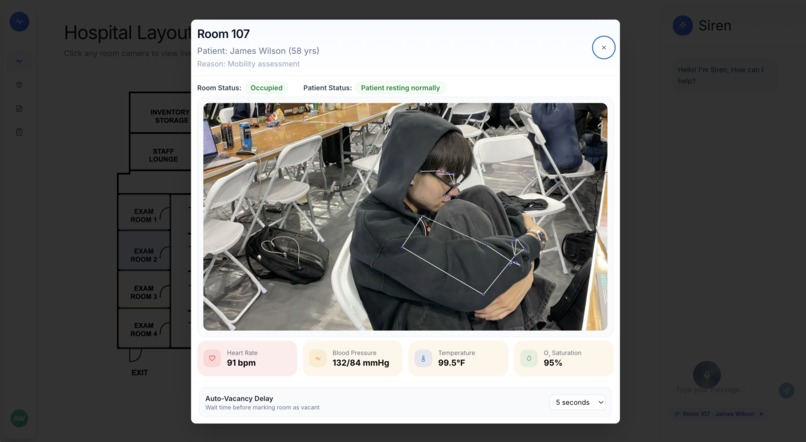
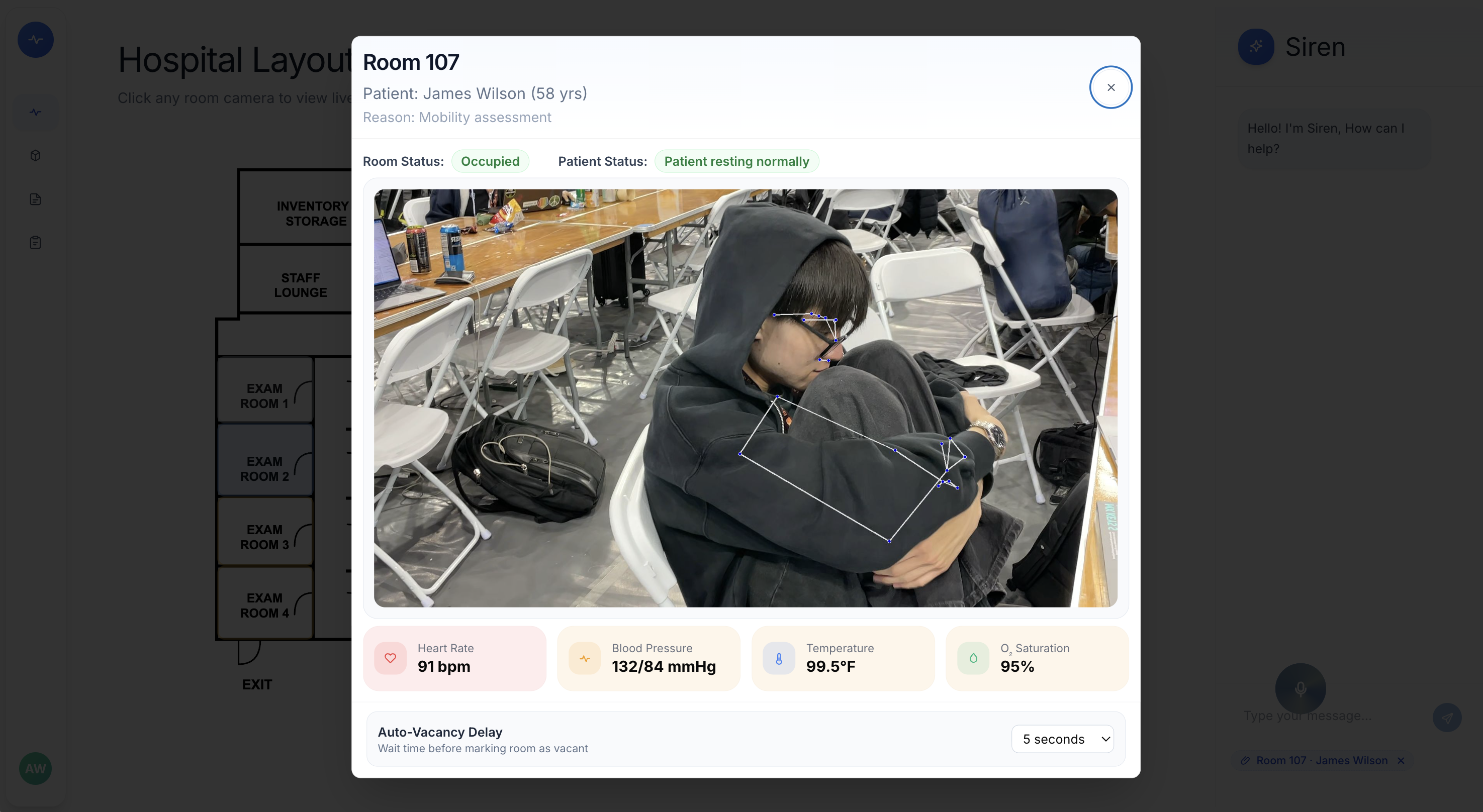
CV powered patient anomaly detection
-
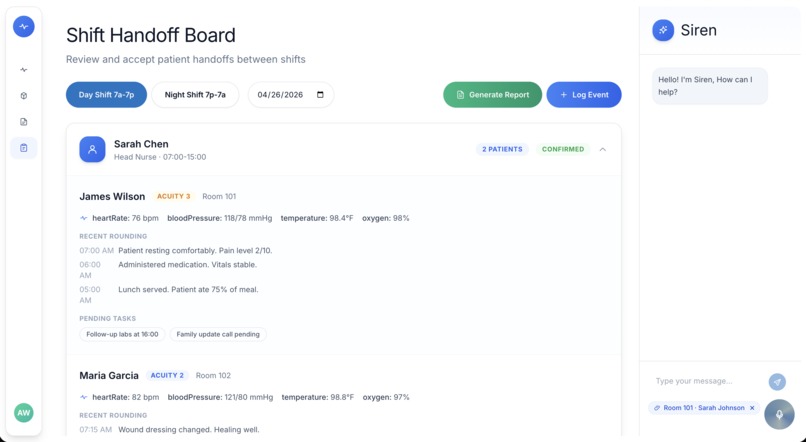
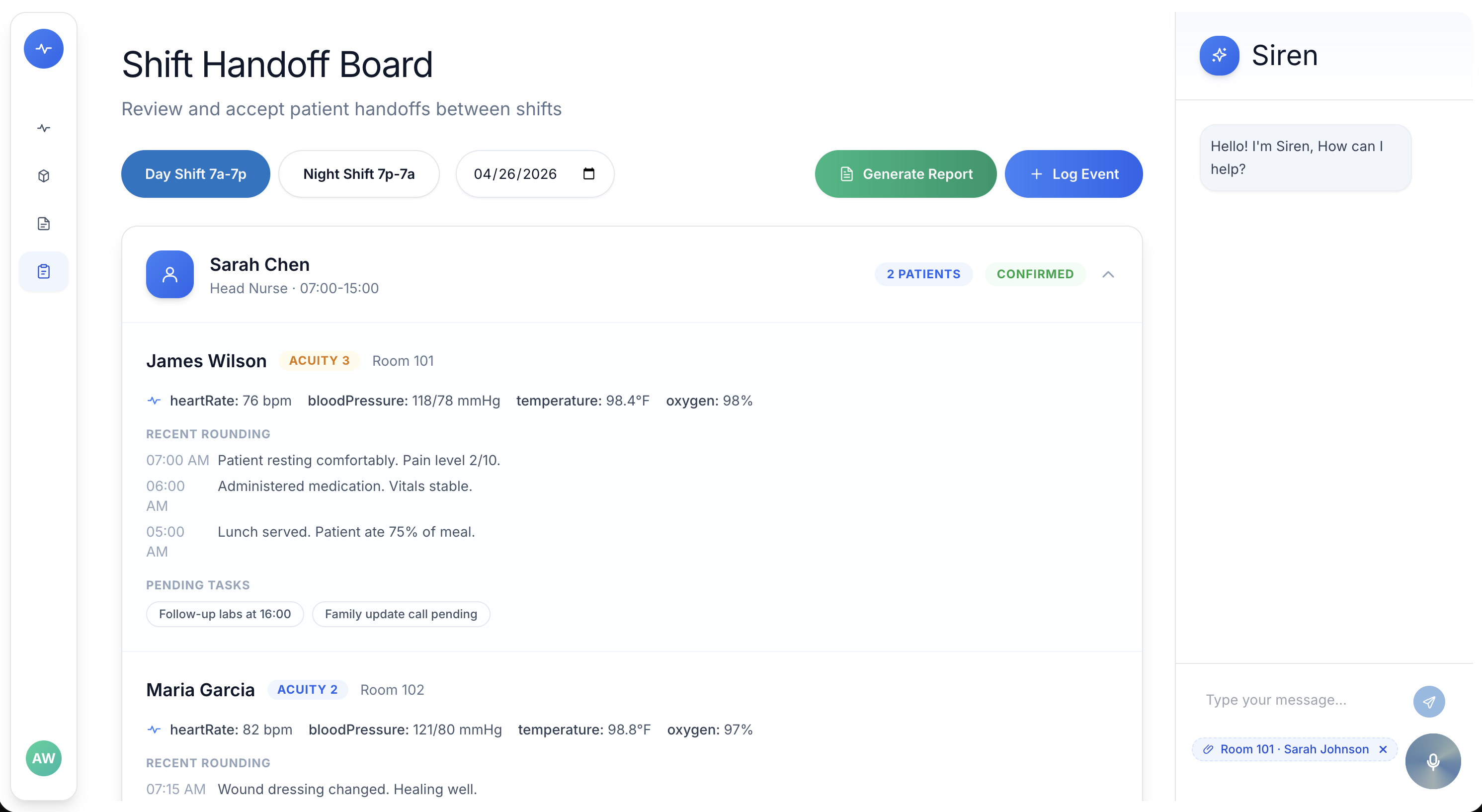
Shift handoffs and logistics
NurseFlow — AI Co-Pilot for Hospital Nursing Operations
Inspiration
Hospital nurses spend up to 35% of their shift on paperwork — answering family phone calls, managing shift call-outs, logging rounding visits, tracking down supplies — instead of being at the bedside. On understaffed floors, missed rounds and delayed alerts put patients at real risk. We saw an opportunity to build a single AI-powered system that offloads the administrative burden and gives charge nurses real-time visibility across every room, every patient, and every shift.
What It Does
Siren is an AI-driven hospital operations hub with six core capabilities:
Conversational AI Assistant — A resizable chat sidebar powered by GPT-4o with 20+ tool definitions. Nurses can query patient vitals, room status, nurse availability, and shift schedules in natural language. The assistant can also execute actions — admit a patient, record vitals, create alerts, send SMS — with confirmation required before any destructive action. Responses stream in real-time via Server-Sent Events.
Interactive Hospital Floor Map — An SVG floor plan with 14 color-coded rooms (stable = blue, critical = red, observation = amber, vacant = gray). Click any room to see live patient details, vital signs, camera feeds, and quick actions like admitting a patient or marking a room vacant. Supabase Realtime subscriptions keep the entire dashboard live — room status, vitals, and alert changes update instantly.
SMS Triage Agent — Nurses text a dedicated number via Twilio. An LLM classifies the intent (call-out, patient request, shift blast, family update, or general), extracts entities, and routes accordingly. A nurse can text "calling out tomorrow, family emergency" and the agent finds available replacements, blast-messages them, and auto-confirms the first response.
Computer Vision Room Monitoring — A Python WebSocket server streams live camera feeds through MediaPipe Pose estimation. It detects whether a room is occupied (NORMAL), has someone in an abnormal position like a fall or fetal position (ALERT), or is empty (VACANT). The frontend displays the annotated video feed and status in real time.
Voice Interface — A floating microphone bubble powered by the ElevenLabs Conversational AI SDK lets nurses interact hands-free from any page. A dedicated voice page shows connection status and audio frequency visualization.
Shift Handoff Board — A structured handoff view with day/night shift tabs, patient cards showing acuity, vitals, rounding logs, pending alerts, and logged events. Nurses can log clinical events with type classification and generate AI handoff summaries.
How We Built It
Frontend
- React 19 + TypeScript with Vite for fast development
- Tailwind CSS + shadcn/ui for a polished, consistent design system
- Zustand for state management (chat messages, selected room, sidebar width)
- Supabase JS SDK with Realtime subscriptions for live updates across rooms, patients, vitals, alerts, and events
- react-markdown + remark-gfm for rich AI response rendering
- ElevenLabs React SDK for voice conversation sessions
Backend
- Flask API server with six Blueprint route groups (agent, SMS, rooms, shifts, events, handoff)
- OpenAI GPT-4o with function/tool calling — 20+ tools mapped to Supabase CRUD operations, Twilio SMS, and alert creation
- uAgents (Fetch.ai) for specialized SMS and chat agents, with Flask proxying requests and handling the SSE streaming endpoint directly for lower latency
- Supabase (PostgreSQL) for all persistent data — rooms, patients, nurses, shifts, vitals, rounds, alerts, events
- MediaPipe + OpenCV for on-device computer vision — no cloud GPU required
- websockets (Python) for streaming annotated camera frames and status JSON
Key Technical Decisions
- SSE streaming for chat: The
/agent/streamendpoint bypasses the uAgent intermediary and calls OpenAI directly withstream=True, yieldingtoken,tool_call,done, anderrorevents. This gives token-by-token streaming to the browser with full multi-turn tool call support — when GPT-4o decides to call a tool, we buffer the streamed deltas, execute the tool, and re-call OpenAI for the follow-up response, all while maintaining the SSE stream. - Realtime everywhere: The frontend subscribes to 4+ Supabase Realtime tables. Any database change (new vital reading, room status update, alert created) is reflected within milliseconds on every connected dashboard.
- Graceful fallback: Every data-fetching hook and route falls back to mock data when Supabase is unavailable, so the demo always works.
Challenges We Ran Into
- SSE through Vite proxy: Development CORS and response buffering made streaming unreliable. We solved this by configuring the Vite proxy with
changeOrigin: trueand addingX-Accel-Buffering: noandCache-Control: no-cacheheaders on the Flask response. - Streaming tool calls: OpenAI's streaming API sends tool call arguments in chunks across multiple
deltaobjects. We had to carefully accumulate these by index, reconstruct complete tool call objects, execute them, and then re-stream the follow-up response — all within a single SSE connection. - MediaPipe posture classification: Distinguishing between a person sitting normally vs. lying down or curled up required custom heuristics on landmark positions that worked across different camera angles and body types.
- Realtime race conditions: Multiple Supabase Realtime subscriptions triggering re-renders simultaneously caused stale closure bugs in Zustand. We solved this by ensuring all state reads go through
get()rather than captured closures.
Accomplishments We're Proud Of
- A fully functional streaming AI assistant that can look up patients, record vitals, admit and discharge patients, create alerts, send SMS, and manage nurse availability — all through natural language
- Real-time hospital dashboard where every data change is reflected instantly via Supabase Realtime
- Working computer vision pipeline that classifies room occupancy and detects abnormal postures in real time
- Sprint-to-production pipeline where the SMS agent can receive a call-out text, find replacement nurses, blast-message them, and auto-confirm — end-to-end in under 3 minutes
- Unified design language across 6 pages (Dashboard, Inventory, Logs, Handoff, Voice, and a secret Tetris game)
What We Learned
- Streaming is harder than it looks: Building a robust SSE pipeline that handles multi-turn tool calls with proper error recovery, backpressure, and client-side reconnection taught us a lot about the nuances of real-time web protocols.
- Supabase Realtime is powerful but quirky: The Postgres changes channel is incredibly useful, but subscription management and reconnect logic require careful handling to avoid memory leaks and stale listeners.
- Computer vision on a hackathon timeline: MediaPipe is free and runs on-device, but tuning detection thresholds and handling edge cases (occlusion, multiple people, unusual camera positions) takes longer than expected.
- Agent design patterns: GPT-4o's function calling is remarkably good at choosing the right tool, but requires careful prompt engineering to ensure it asks for confirmation before destructive actions (admit, discharge, record vitals).
What's Next
- HIPAA compliance layer: Add row-level security policies, audit logging, and data de-identification for production hospital use
- Role-based access control: Nurse vs. head nurse vs. admin permissions in the dashboard
- Google Calendar integration: MCP-based shift management with real calendar sync
- Sanitization gesture detection: Track hand-hygiene compliance at dispenser zones using MediaPipe Holistic
- Multi-language voice: ElevenLabs multilingual voices for family updates in Spanish, Mandarin, and more
- Mobile-responsive UI: Adapt the dashboard for tablet and phone form factors for bedside use
Built With
- chatgpt
- elevenlabs
- fetch.ai
- mediapipe
- react
- supabase
- typescript

Log in or sign up for Devpost to join the conversation.