-
-
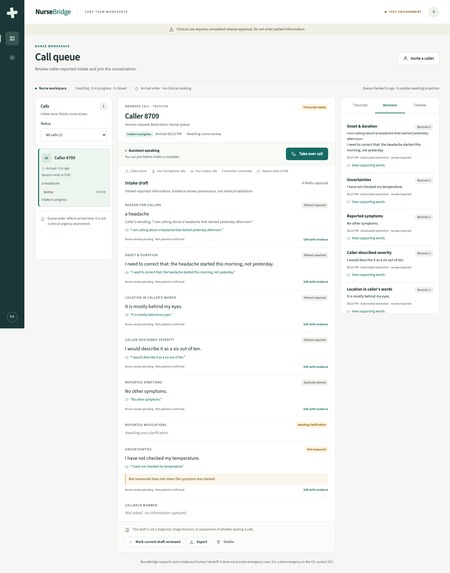
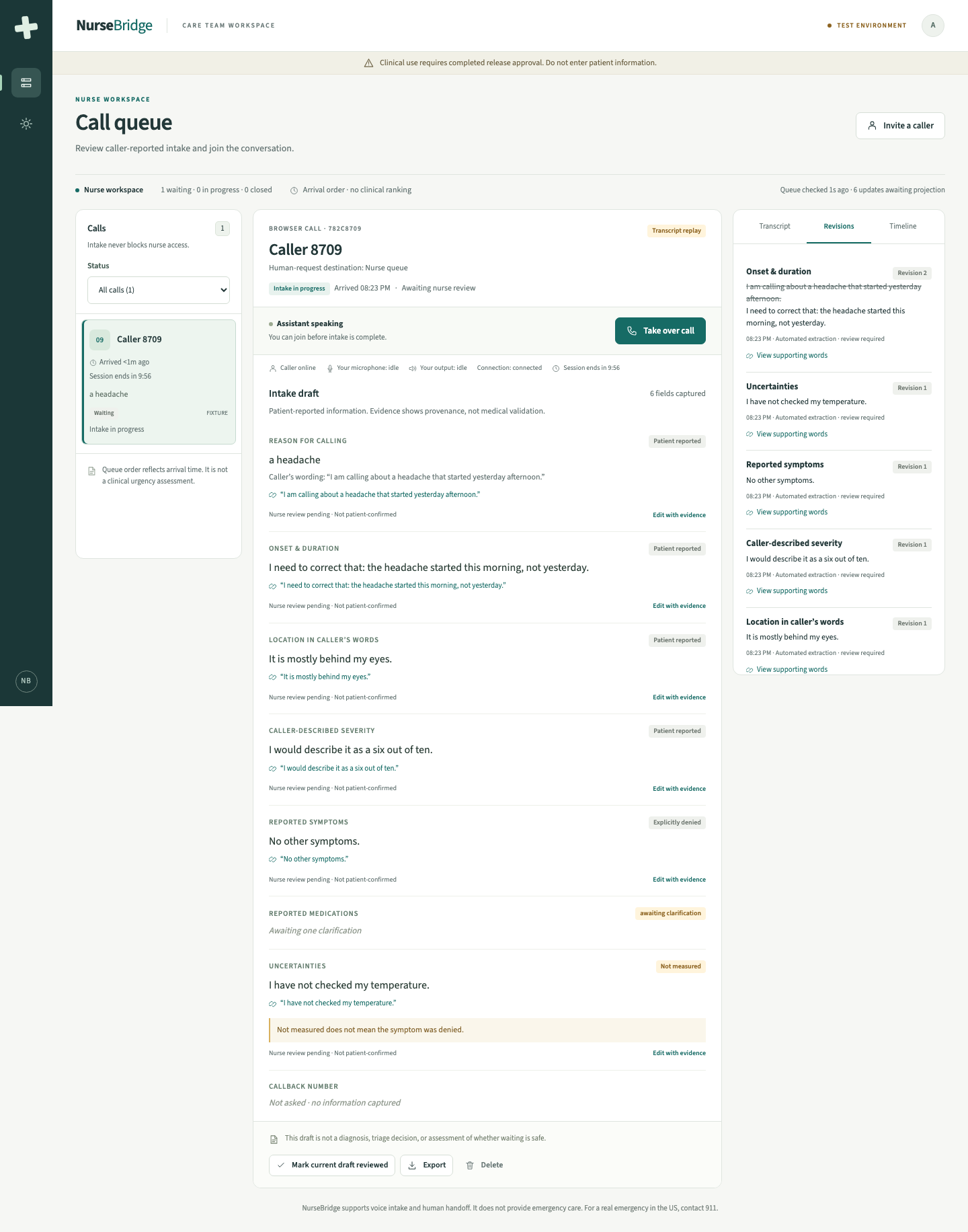
Fictional prototype: review intake facts with their supporting caller statements.
-
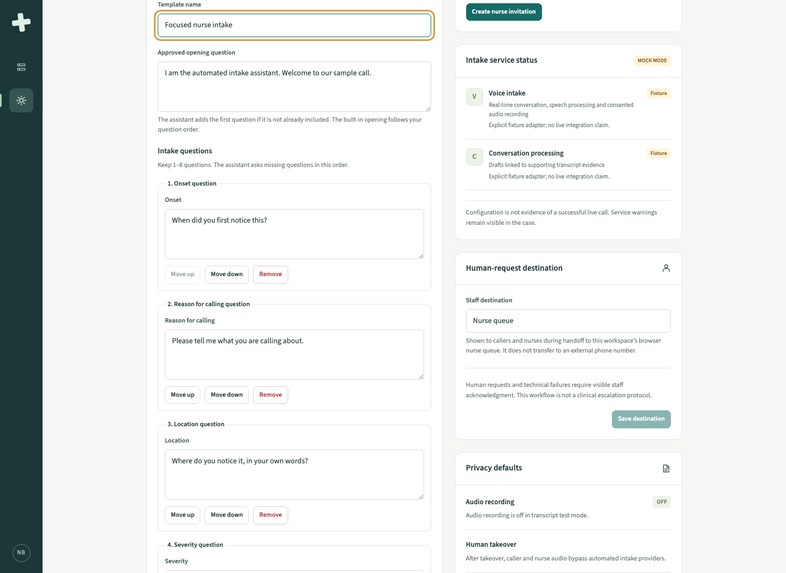
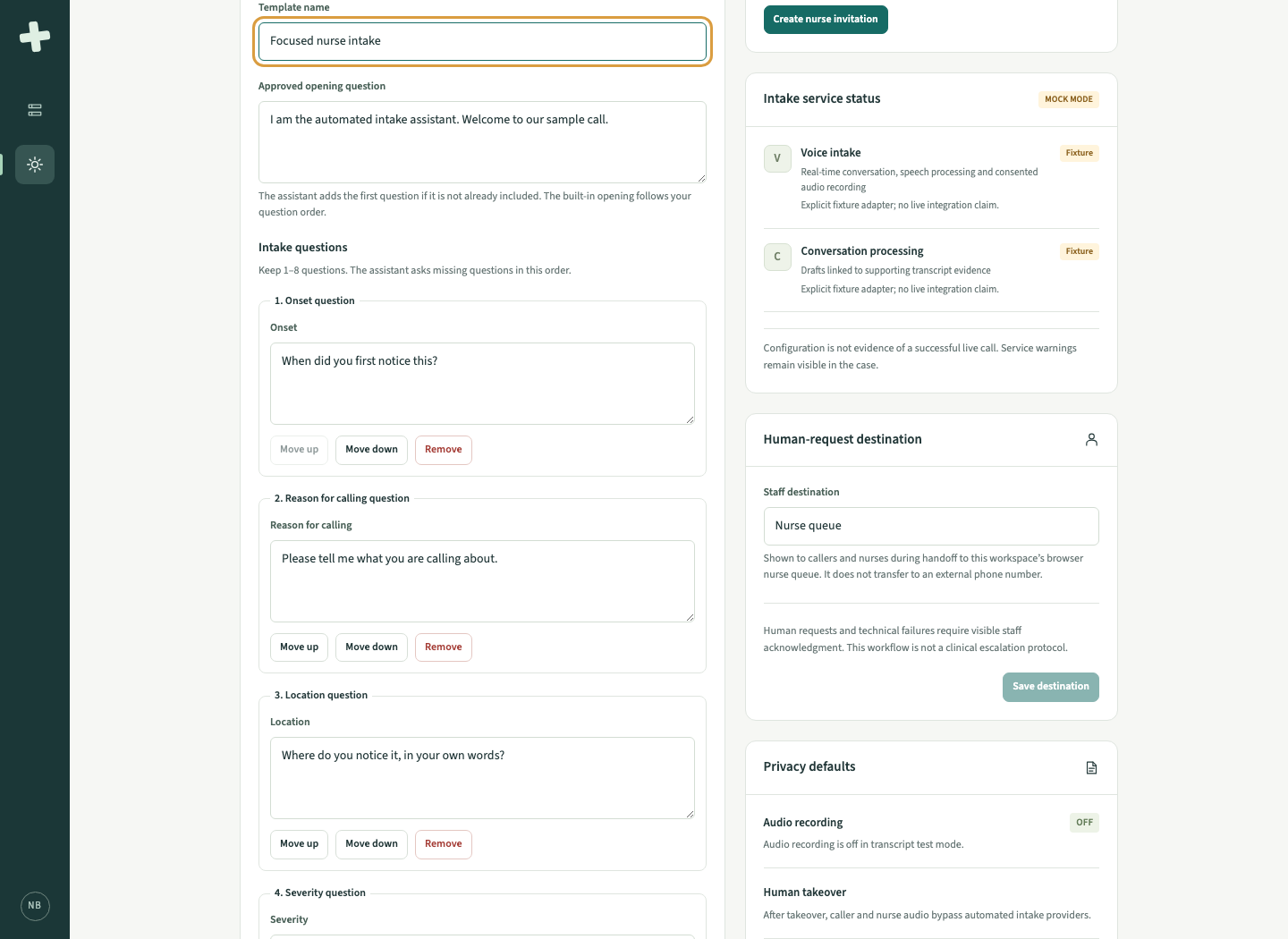
Editable intake templates with questions and acknowledgments.
Inspiration
Nursing teams face limited capacity, but routine intake still takes time: asking why someone is calling, recording what they report, and collecting details before a nurse can review them. NurseBridge explores a practical way to collect those first answers while a nurse is occupied, then make the information easy to verify when the nurse is ready.
What it does
NurseBridge is a voice intake workspace that turns a caller's answers into an evidence-linked draft for nurse review.
A caller joins a browser call and consents to automated intake. The agent asks the configured questions and the nurse workspace shows the collected information with supporting quotes. Corrections retain their history, and unknown or uncertain answers remain explicit. A nurse can claim the call and take over the same conversation, including before automated intake finishes. Teams can edit intake questions and acknowledgments; each call retains the template version it started with.
The intended benefit is less repetitive collection work and more nursing time for assessment and care. We have not yet measured time savings or clinical benefit.
How we built it
NVIDIA nvidia/Nemotron-3_5-Lightning, served through Nebius Token Factory, supplies the language model for the intake conversation. AssemblyAI Voice Agent handles transcription, turn detection, and speech generation and calls the Nebius model during the conversation.
NurseBridge also calls Nebius separately for structured extraction from finalized caller statements. It validates the returned schema and supporting evidence before using the result in the draft. Keeping conversational generation and fact extraction separate lets the interface retain the caller's source statements for review.
The application uses TypeScript and Next.js on Cloudflare Workers through OpenNext. A Durable Object coordinates each call and its audio state. D1 stores workspace and case records, and R2 supports private case exports. Browser audio uses Web Audio and WebSockets. After nurse takeover, the human audio path bypasses the AI providers. An optional Twilio adapter supports telephone ingress, but live telephone-network acceptance remains unverified.
Nebius Token Factory let us use hosted model inference through an API instead of operating GPU servers. We used prompt engineering, structured output validation, and transcript evidence checks; we did not fine-tune the model. Codex assisted implementation, debugging, tests, and presentation preparation.
Challenges we ran into
A conversational answer and a reliable intake record are different things. We needed to preserve corrections, avoid treating uncertainty as a confirmed fact, and show where each collected detail came from. We also needed call recovery and nurse takeover to behave consistently across asynchronous audio and provider events. The result is a server-controlled call state machine with explicit consent, review, and handoff behavior.
Accomplishments
The prototype demonstrates browser intake, an evidence-linked draft, correction history, explicit uncertainty, same-call nurse takeover, and editable templates.
The 2:53 demo includes a 28-second actual AssemblyAI/Nebius conversation with a fictional prerecorded caller, followed by a labeled transcript-replay workflow tour. In the real-provider clip, the caller reports a headache, the agent asks when it started, and the nurse view shows the reason with the supporting quote. The live segment was captured in a local browser runtime. It is separate from the replayed workflow demonstration.
What we learned
The usefulness of intake automation depends on how quickly a nurse can verify and act on the collected information. Model output alone is insufficient: visible evidence, uncertainty, correction history, and a dependable handoff are central to the experience. Live provider checks and repeatable fictional replay tests serve different purposes, and we keep their evidence separate.
What's next
We plan to evaluate fictional cases with nurses, comparing total nursing time for manual intake against agent intake plus review, correction, and handoff. We will also measure information quality, clarify which cases need a human sooner, and complete physical-device and telephone-network testing.
NurseBridge is currently a fictional-data prototype. It does not diagnose, recommend treatment, or assess urgency. Clinical use, provider retention controls, and production readiness have not been validated.
Try it and review the source
- Hosted prototype: https://nursebridge-web-staging.pullthread-commerce-worker.workers.dev/nurse
- Public source and setup instructions: https://github.com/Xuefeng-Zhu/NurseBridge
- Repeatable local workflow demo: run
pnpm install --frozen-lockfile, thenpnpm demo, using Node 24.14.1 and pnpm 11.19.0. This mode disables external providers and uses fictional transcript replay. - Live-provider configuration and its current verification boundaries are documented in
docs/voice-agent.md.
Built With
- assemblyai
- cloudflare-d1
- cloudflare-r2
- cloudflare-workers
- durable-objects
- nebius-token-factory
- nextjs
- nvidia-nemotron
- typescript
- web-audio
- websockets

Log in or sign up for Devpost to join the conversation.