-
-
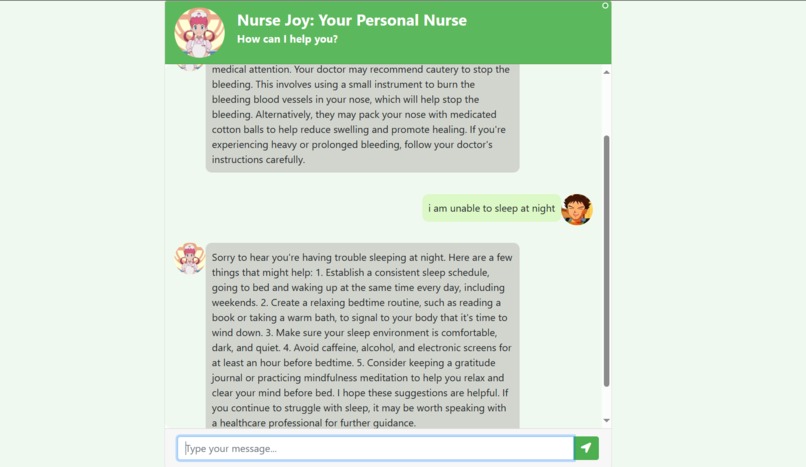
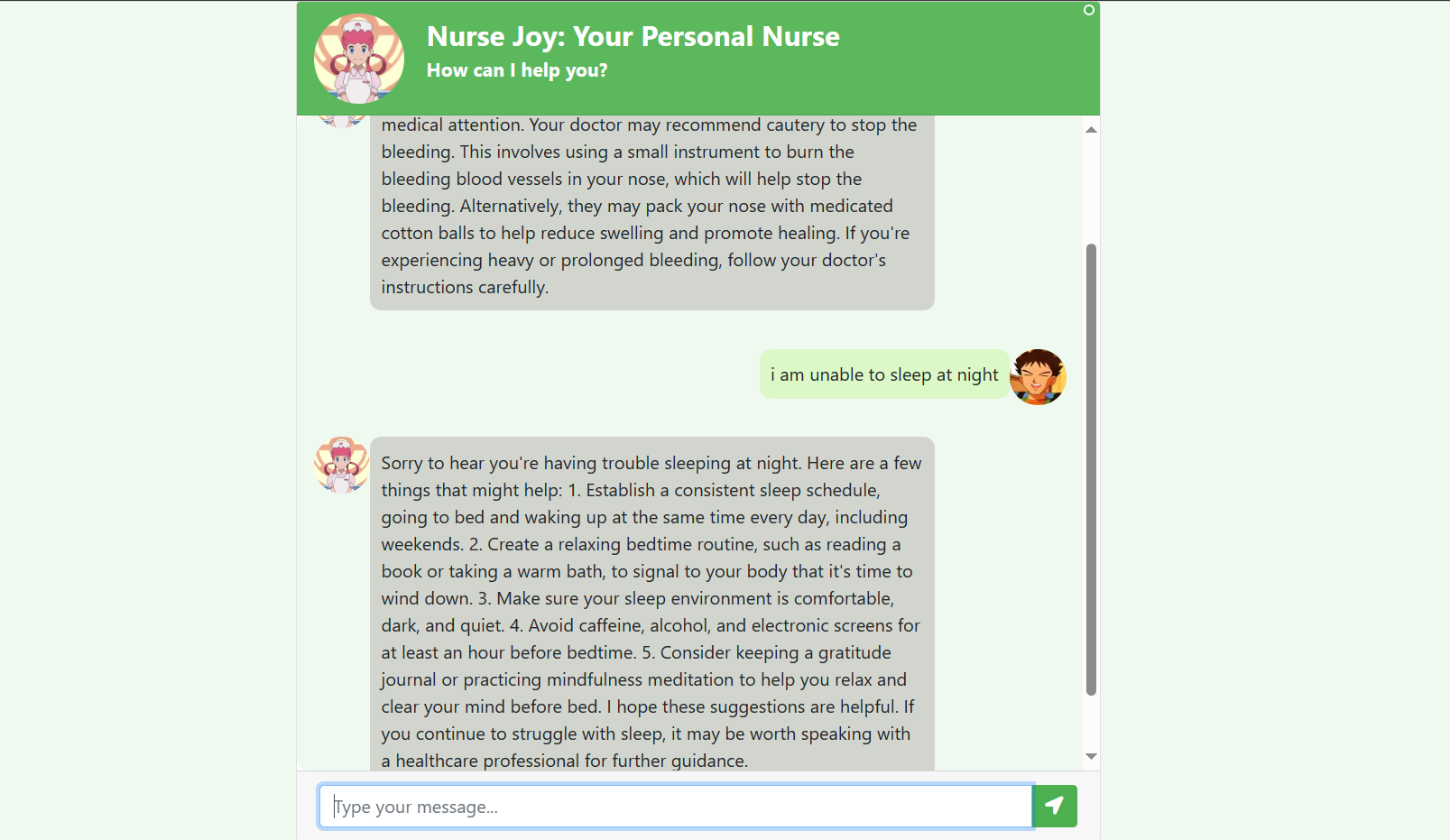
Preview of Nurse Joy.
Inspiration
A large number of people seek medical advice online. Unfortunately, the information they find is often unreliable, leading to potential health risks. Additionally, consulting a professional doctor for advice can be expensive, making it inaccessible for many. So, we decided to build Nurse Joy that can overcome these challenges. Nurse Joy provides reliable and accurate medical advice free of cost, ensuring that quality medical advice is accessible to everyone, regardless of their financial situation.
What it does
Nurse Joy is a medical chatbot that answers health-related questions using a vast collection of medical books. It retrieves relevant information through a Chroma vector database and generates precise and reliable responses using a quantized Llama 2 model.
How we built it
We built Nurse Joy by leveraging a combination of advanced machine learning techniques and robust software engineering practices. Here's a detailed breakdown of the process:
Model Selection and Training: We selected the Llama 2 model for its robust language understanding capabilities. We downloaded the quantized version,
llama-2-7b-chat.ggmlv3.q4_0.bin, to optimize performance and reduce resource consumption.Data Preparation: We curated a comprehensive dataset comprising various medical books and reliable sources. This dataset was preprocessed to extract relevant text.
Vectorization: Using the Chroma vector database, we transformed the preprocessed text into vectors. This step involved encoding the text into a numerical format that the RAG system could use to find semantically similar content efficiently.
RAG System Integration: We integrated the Retrieval-Augmented Generation (RAG) system with the Llama 2 model. This setup allows the model to retrieve relevant information from the vector database before generating responses.
Backend Development: We built the backend using Flask, a lightweight web framework for Python. This backend handles user queries, interacts with the RAG system, and sends back the generated responses.
Frontend Development: For the user interface, we used HTML, CSS, and JavaScript, leveraging Bootstrap for responsive design. We created a user-friendly chat interface where users can input their medical questions and receive answers from Nurse Joy.
Testing and Optimization: We conducted extensive testing to ensure the accuracy and reliability of the responses.
Throughout the development process, we focused on optimizing the system for performance and accuracy while maintaining a user-friendly interface to provide a seamless experience for users seeking medical advice.
Challenges we ran into
During the development of Nurse Joy, we encountered several challenges.
Integrating the Retrieval-Augmented Generation (RAG) system with the Llama 2 model was complex and required extensive fine-tuning to ensure accurate and relevant answers. Managing the large dataset of medical books was also a significant task, as we needed to preprocess and vectorize the text efficiently for the Chroma vector database.
Integrating multiple libraries and systems like Langchain, Flask, Chroma, and the Llama2 model posed significant integration challenges due to compatibility and version issues.
Optimizing the performance of the system, especially during real-time querying and response generation, was a constant challenge to ensure fast and efficient user interaction.
Designing an intuitive and responsive user interface that seamlessly integrates with the backend AI system while maintaining a user-friendly experience was a difficult task.
Overall, balancing the technical complexities with user needs and ensuring the system's reliability and efficiency were key challenges we faced and overcame during the project.
Accomplishments that we're proud of
Effective Knowledge Retrieval: Implemented a RAG system that retrieves relevant information from a comprehensive medical literature database.
User-Friendly Interface: Developed an intuitive and appealing interface for seamless interaction. Scalability: Designed a scalable system with a Chroma vector database and quantized Llama 2 model.
Real-Time Processing: Achieved instant response capabilities.
Innovation in Healthcare: Contributed to digital health with an intelligent medical assistant.
Community Impact: Created a tool beneficial for individuals and healthcare professionals alike.
What we learned
We learned how to develop a retrieval-augmented generation (RAG) system and the importance of fine-tuning language models for specific domains. This project enhanced our understanding of integrating machine learning models with web applications and reinforced the significance of user-friendly design in creating impactful tools. Additionally, we gained valuable experience in handling large datasets, optimizing information retrieval processes, and ensuring efficient performance of the system.
What's next for Nurse Joy
Looking ahead, we have exciting plans for Nurse Joy-
Multilingual and Voice Support: Introduce multilingual capabilities so that people who do not speak English can also chat with it. Additionally, integrate voice recognition technology to allow users to interact with Nurse Joy through spoken commands and questions, enhancing accessibility and user experience.
Appointment Scheduling: Add a feature for scheduling virtual consultations with human doctors for cases where professional medical intervention is necessary.
Expanded Knowledge Base: Continuously update and expand the dataset with the latest medical research and guidelines to ensure Nurse Joy provides up-to-date and accurate medical advice.
Community Support Forum: Create a community platform where users can share their experiences, ask questions, and receive support from both peers and medical professionals.


Log in or sign up for Devpost to join the conversation.