-
-
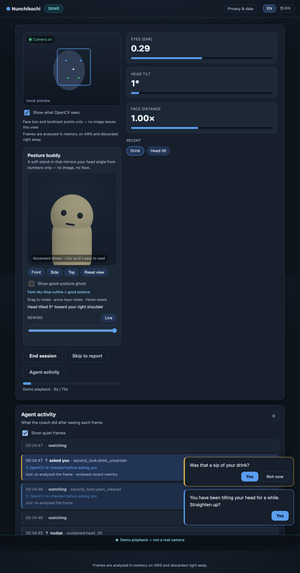
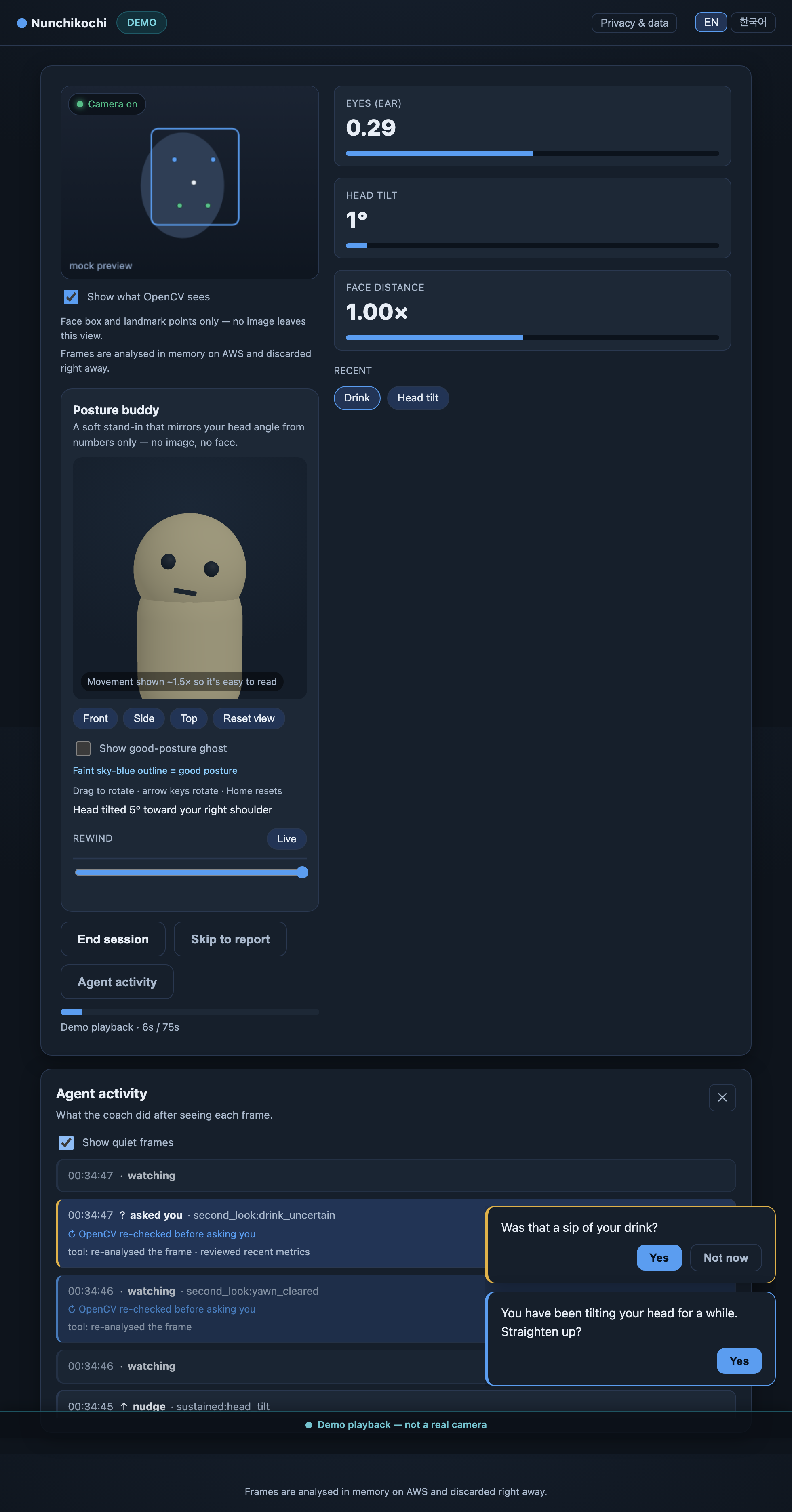
The agent activity panel: each frame ends in nudge / confirm / look-again / silent, and OpenCV re-checks the frame before asking the person.
-
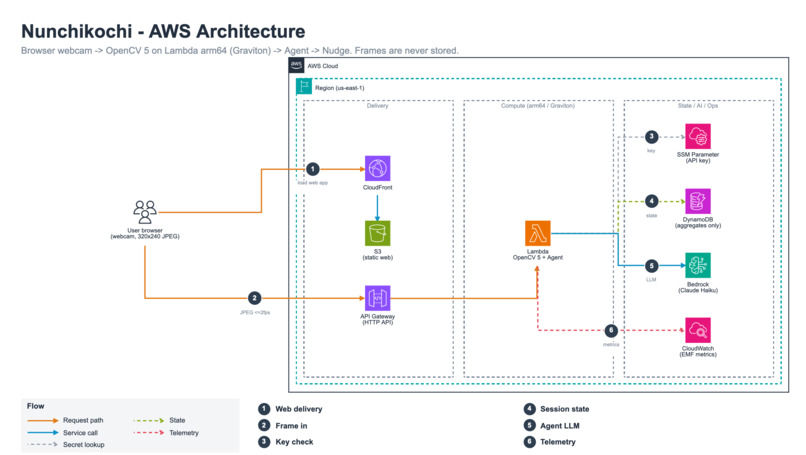
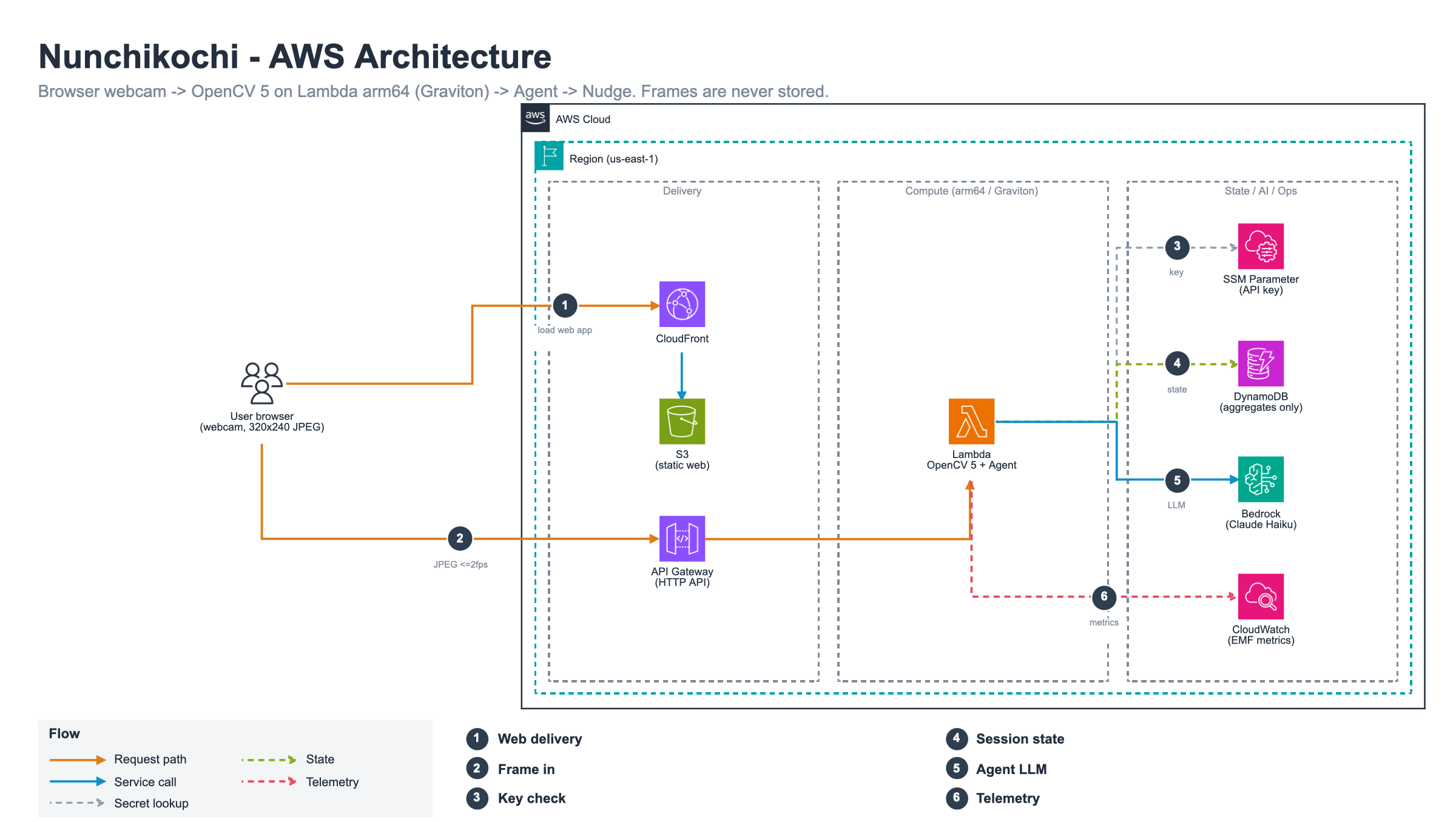
AWS architecture: one arm64 Lambda behind API Gateway, S3 + CloudFront for the web, DynamoDB (TTL) for aggregate numbers only.
-
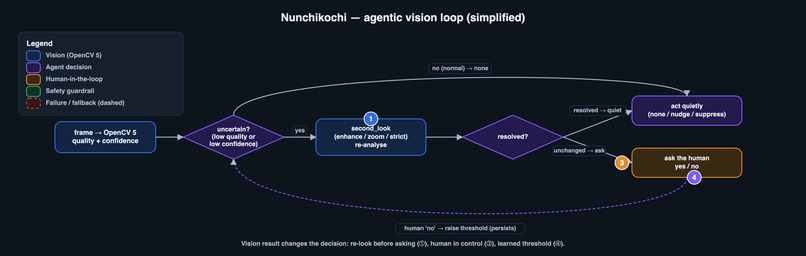
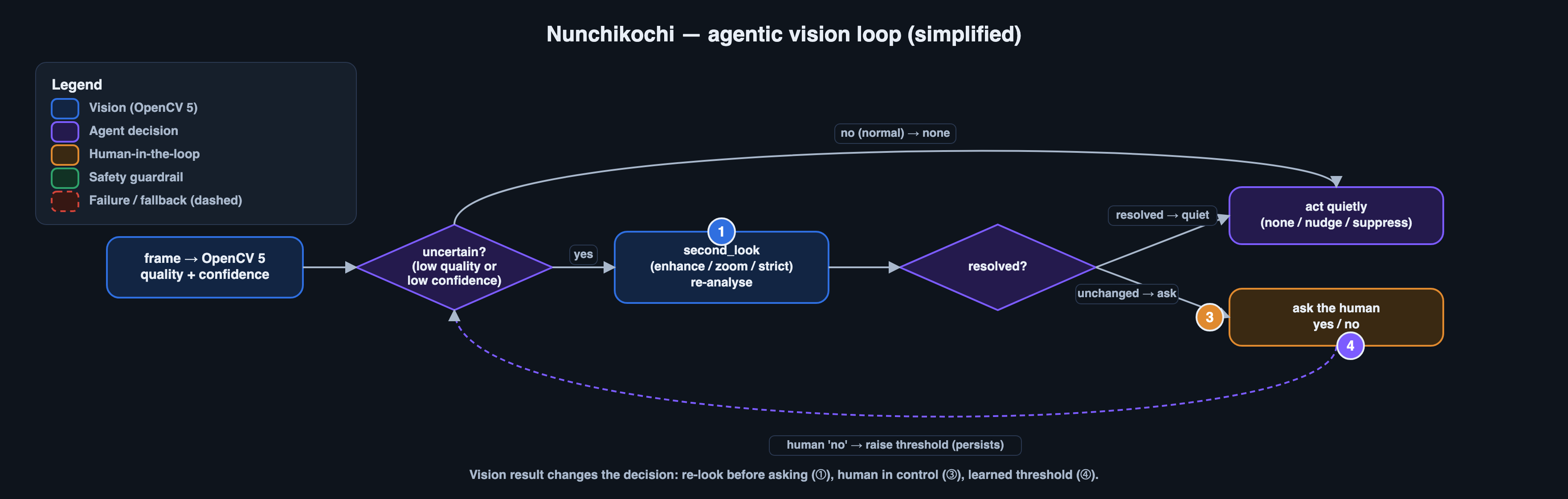
Agent workflow: the vision result changes which tool the agent calls (second_look) and when it asks a human.
-
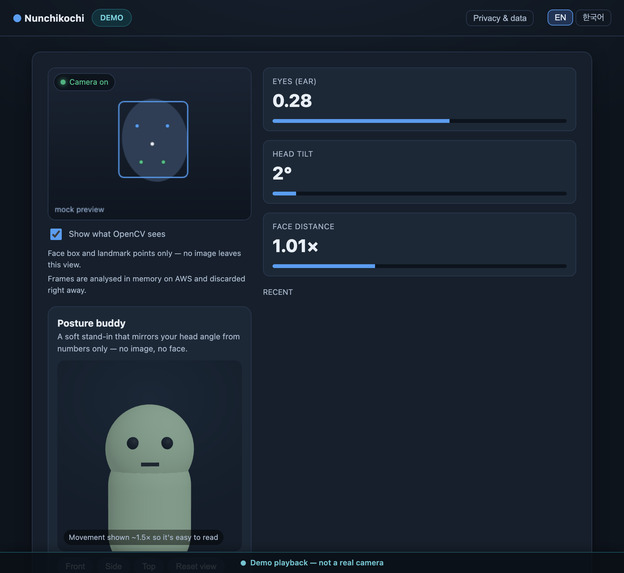
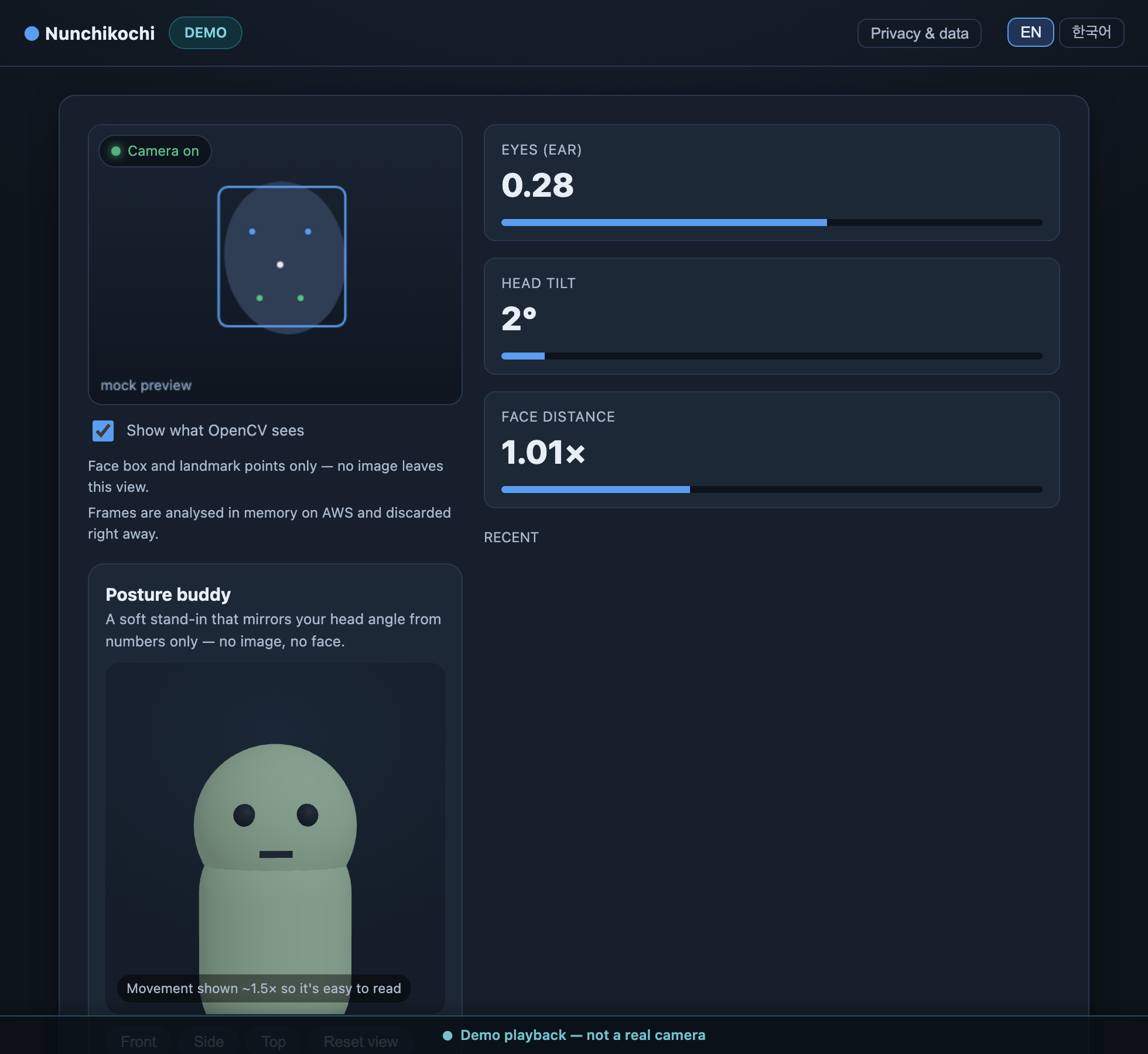
Demo mode: the overlay shows what OpenCV sees — face box and landmark points only, no image leaves this view.
-
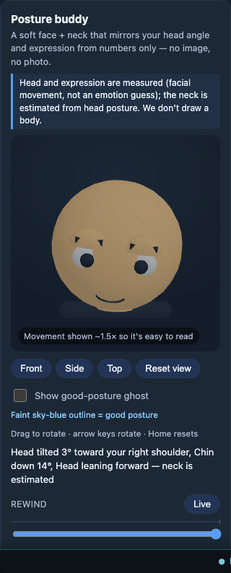
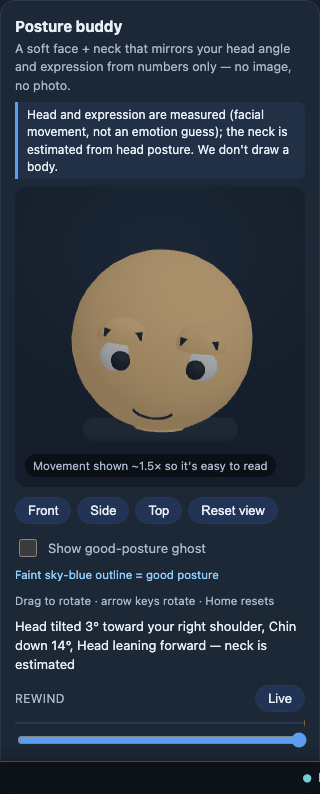
Posture buddy: a face + neck avatar driven by measured head angles and expression; the neck is a labelled estimate.
-
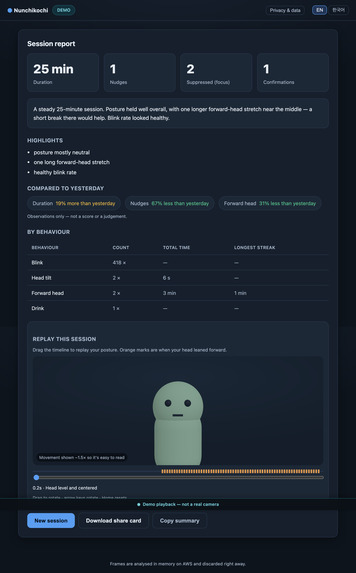
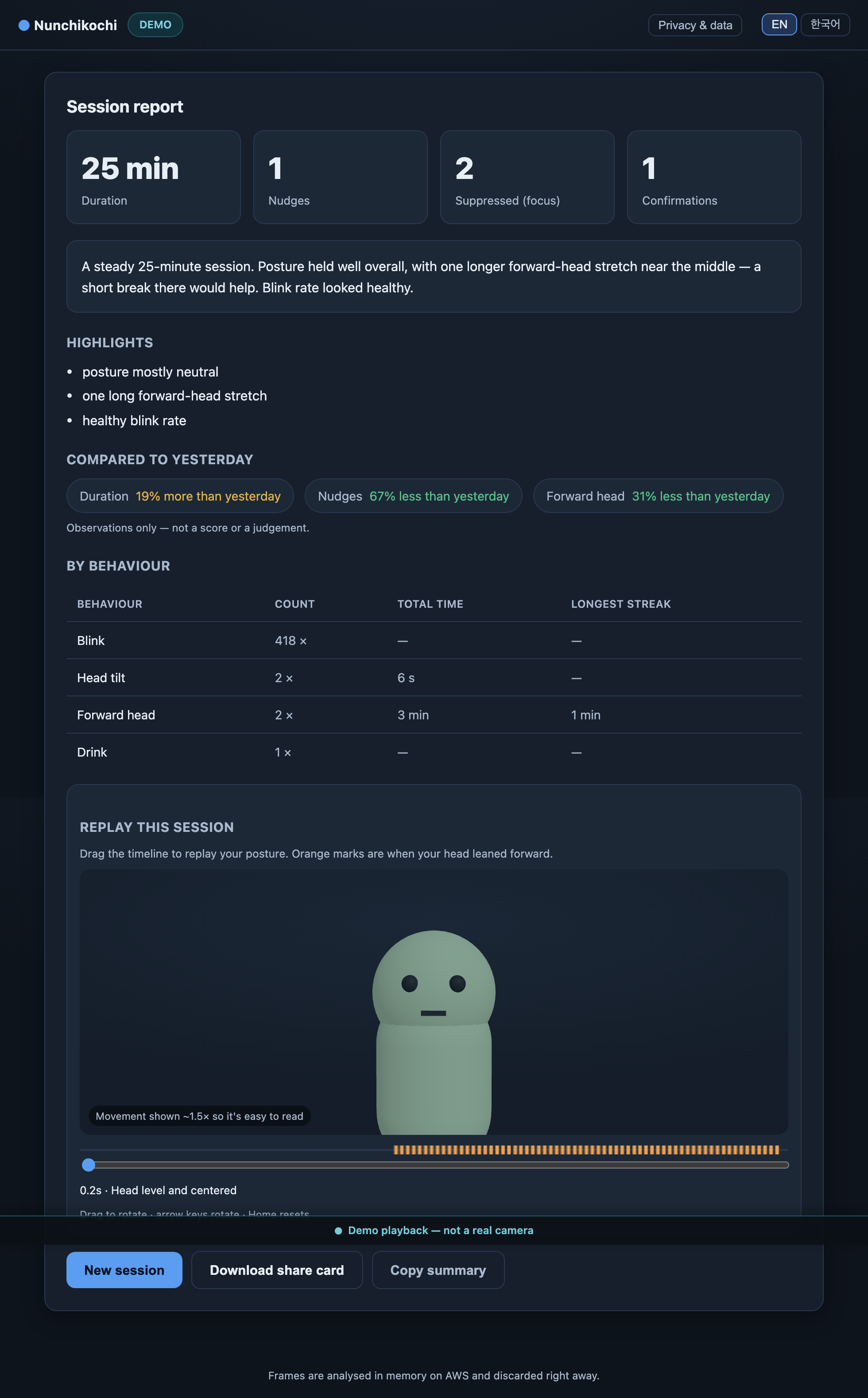
End-of-session report: aggregate habits only, compared to yesterday, with a replay of the session.
-
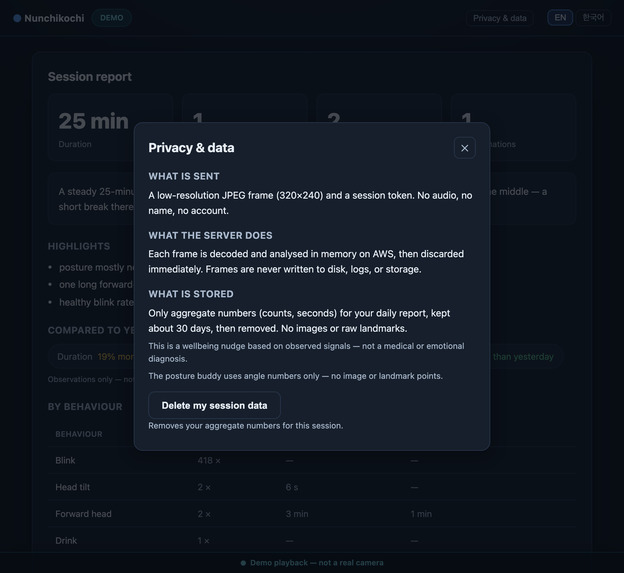
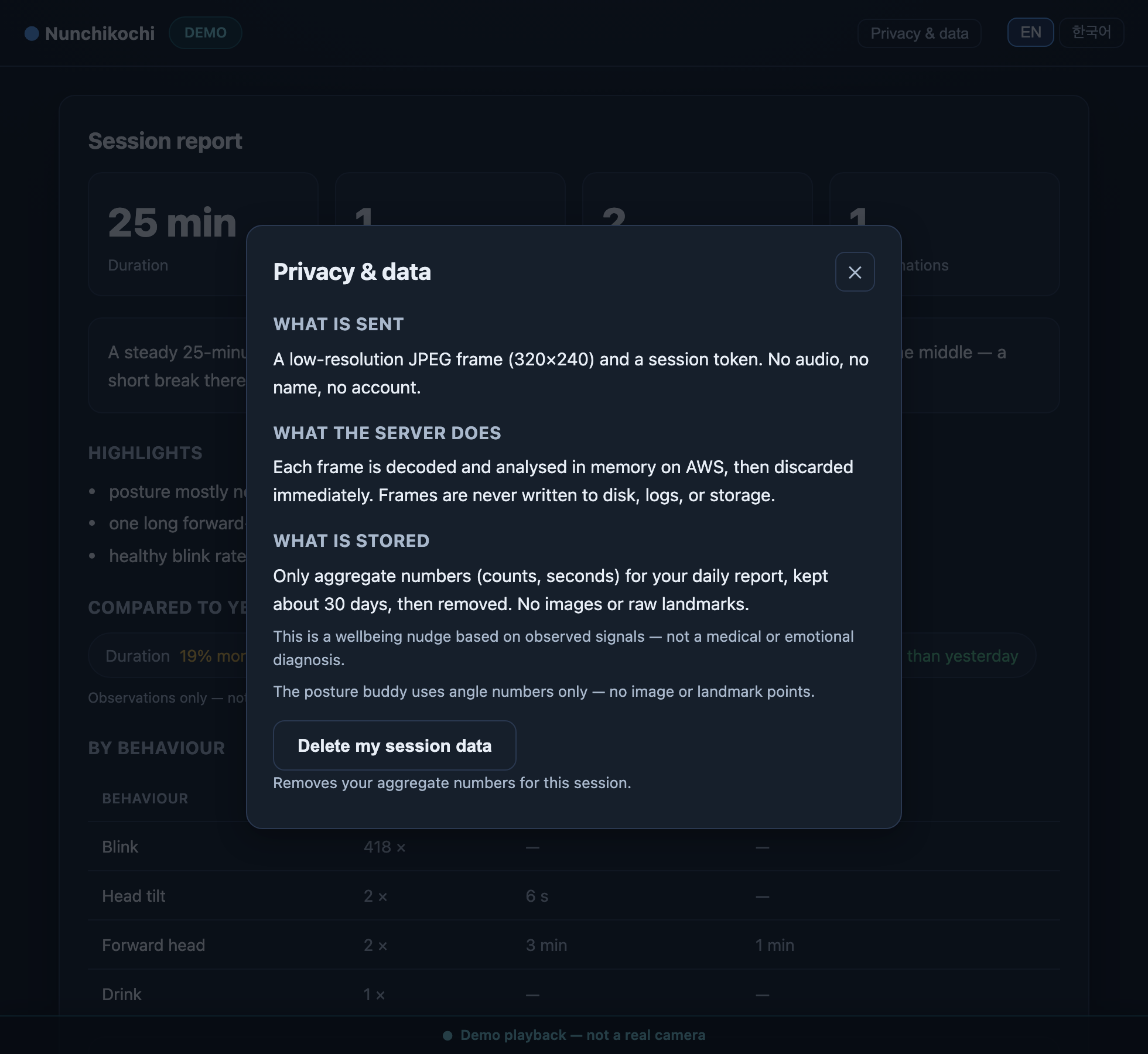
Privacy & data screen: frames are analysed in memory and discarded right away.
- Theme: self-awareness coaching with OpenCV 5 on AWS
- Special prize: Agentic Vision
- Live (no key needed): https://dhys8dgxlvbgx.cloudfront.net/?demo=1
- Code: https://github.com/jogilsang/opencv-nunchikochi
- Built with: OpenCV 5 · AWS Lambda (Graviton/arm64) · API Gateway · CloudFront+S3 · DynamoDB · Bedrock · FastAPI · ONNX · NumPy · JavaScript
Try it in one minute (judges, start here)
Open https://dhys8dgxlvbgx.cloudfront.net/?demo=1 — no camera or key needed. A short recorded session plays (a 60–90 s window; "Skip to report" ends it).
Three things to watch:
- the overlay drawing the detected landmarks and behaviours,
- the posture buddy — a clay face + neck mirroring your head angle and facial movement (head pose + expression measured; neck a labelled estimate, no body; a measured sip shows a small cup at the mouth),
- the agent activity panel — each frame's nudge / confirm / look-again / silent decision, quiet mode on by default (posture still recorded, alerts held and counted).
Live mode (your own webcam) needs no shared key: pick Live and press "Get a trial key (30 min)" on the page — one click issues a 30-minute key (same IP 3×/day, 6/day across the service; if used up, key-free demo mode still shows everything that matters).
One desk, 2:40 PM (an illustrative day — not a real user)
It's 2:40 PM and Mina has been heads-down for two hours — head drifting toward the screen, chin dropping, blinks slowing — and she notices none of it, because that's what a habit is. A blunt tool would have buzzed her a dozen times and been muted before lunch.
Nunchikochi reads your own desk habits through the laptop webcam with OpenCV 5 — forward lean, head tilt, deep blinks, yawns, stepping away, forgetting to drink — and an agent decides each frame whether to nudge, look again, or stay quiet. The video is never stored. "Nunchi" (눈치) is the Korean sense of reading a room; this reads you.
The number that is the product
You can send a frame, and it leaves no trace — proven by a counterexample, not a promise. A test uploads a JPEG with a unique marker, runs the live perceive→decide path, then searches every surface it could leak into — files, logs, the DynamoDB state, the CloudWatch EMF stream, and the /v1/trace response — in raw, hex, and base64. The marker is found 0 times across all five surfaces; 5 counterexample tests pass (test_no_persist.py + test_privacy_no_frame_leak.py).
Restraint is measured too: in the agent harness, second_look (OpenCV re-reading the same frame) changed the decision in 3 of 7 ambiguous moments — a dark frame cleared to silent, a low-confidence signal zoomed in and dismissed itself. (Stub-driven; see Limitations.)
Who decides what
The vision pipeline measures, the code decides, the model only proposes.
| Layer | What it owns |
|---|---|
| OpenCV pipeline (measures) | Face detect, 478-point mesh, eye/mouth ratios, face scale, head yaw/pitch/roll + depth. Numbers only, never a decision. |
| Rule policy / agent (decides) | Each frame: nudge / confirm / look-again / silent; suppresses on do-not-disturb, away, focus. Normal frames take the zero-cost rules path. |
| LLM — Bedrock, optional (proposes) | May suggest a report sentence or an action; a whitelist + no-diagnosis guardrail and a latency budget fall back to rules. Never the last word. |
| The person (final authority) | Explicit consent, camera-on visible; on low confidence it asks yes/no, and a "no" raises that threshold and stops asking. |
What it does
- Six self-awareness signals from OpenCV: forward lean, head tilt, blink / sustained "deep" blink, yawn, stepping away, and a drink cue.
- An agent decides, not a threshold — nudge, confirm, "look again", or stay silent.
- Quiet by default, and quieter on purpose. Nudges for the same posture are capped (≈20-min cooldown, ≤3/hour), confirm toasts are rare (≤2/hour, no same kind in a row), and a brief quality blip waits out a 30-s debounce. Held alerts are counted, not dropped.
- A posture record you can track. The end-of-session report (aggregate habits only, no video; optional Bedrock with a template fallback) buckets bad posture into 5 / 10 / 30 / 60-minute windows and, at 10+ minutes, an hour-rate plus an improving / same / worsening trend vs recent sessions — anonymous per-browser id, numbers only.
- A posture buddy avatar — a face + neck mirroring your head angle, distance, and facial movement from numbers only (never an image); the neck is a labelled estimate, no body drawn.
- Keyboard-first, accessible web UI with an explicit consent modal.
How we built it (short)
OpenCV 5 does all vision, pinned to opencv-python-headless==5.0.0.93, no external inference framework: YuNet face detection, a 478-point FaceMesh ONNX via cv2.dnn, an optional palm ONNX for the "drink" cue, and head yaw/pitch/roll from six mesh points via cv2.solvePnP.
On AWS it is one Lambda on arm64 (Graviton) behind API Gateway; S3 + CloudFront (OAC) serve the web, DynamoDB (TTL) holds aggregate numbers only, the API key is an SSM SecureString (fail-closed), CloudWatch EMF emits numbers only, and the optional report planner uses Bedrock.
Build note (coding-agent hackathon): perception and judgement are separate components joined only by a typed, image-free contract — so each half is testable on its own.
Why this is Agentic Vision
The visual result changes the next decision, tool call, and approval request — shown as runnable traces, not slides: second_look flips a dark frame to silent; a low-confidence signal zooms in and, if still unsure, asks the human; a forbidden LLM action is rejected and rules decide; an over-budget Bedrock call falls back to rules; a human "no" raises the threshold. Evidence: five demo traces, a workflow spec, and 22 deterministic + 9 adversarial scenarios — every branch mapped to a trace or test.
Built / Measured / Not measured (honest)
| Status | What |
|---|---|
| Built & measured | 366 Python tests pass (uv run pytest -q); web e2e 97/97 + buddy unit 7/7, axe WCAG 2 A/AA 0 hard violations; per-frame OpenCV ~178–282 ms on real Graviton (~178 ms per warm host), ~2.5 s cold Init; frame non-storage proven by the 5 tests above; a synthetic 1-hour session cut interruptions 9 → 5. |
| Synthetic baseline | Vision robustness = public samples + synthetic transforms (not tuned, not accuracy); head-pose error ~3–5° yaw/pitch, ~2–3° roll; typing/chin-rest drink false-positive paths rejected by a synthetic vertical+rise gate. |
| Not measured | Real-clip accuracy; drink is a hand-position estimate (palm near mouth), so real-clip false/missed detections are unmeasured; the buddy's neck is estimated from the measured head angles, not measured body pose, and no body is drawn. |
| On hold | Best Use of COOL (an AWS Marketplace AMI; this service is a Lambda zip). |
Blink is undercounted at ~2 fps, so we report an eyes-closed fraction and only claim sustained closure. The multi-session comparison is keyed to an anonymous per-browser id — it does not follow you across browsers or devices, and a live non-"na" trend is proven only by a unit test. The alert-reduction figure is synthetic; agent evaluation is stub-based. Cost ~$1–2/month at demo scale, idle ≈ $0, is a public-pricing estimate — not a bill.
Challenges we ran into
- An org SCP blocked our public endpoint. The Lambda Function URL (AuthType NONE) was denied (403) by an org SCP; we swapped to API Gateway HTTP API and health returned 200.
- A state-restore defect, caught by e2e before deploy — session state restored wrong across Lambda instances; fixed before deploy.
- A single latency number was a lie. Warm per-frame time swung ~178↔282 ms; A/B tests cleared head pose (+1.6 ms), so we report a host-variance range.
What's next
- Record real clips, publish per-behaviour precision/recall/F1 by lighting, and validate the
drinkcue on real footage. - Replace the buddy's estimated neck with a real int8 body-pose model within the model-size budget.
- Tune thresholds on real sessions and confirm the multi-session trend on real data.
Responsible use & privacy
No video stored (proven above); not a diagnosis (a deterministic guardrail blocks health claims in English and Korean); no face recognition, single-user only. Traces carry no image data or coordinates; only aggregate numbers go to DynamoDB under a TTL. The Live-mode trial key is issued per request from the page (no shared key); its per-IP 3/day limit uses only a keyed hash of the IP kept 48 hours — the raw IP is never stored and is removed from access logs. Keys are capped at 6/day total, so they can run out; demo mode needs none.
Built With
- amazon-api-gateway
- amazon-bedrock
- amazon-cloudfront
- amazon-cloudwatch
- amazon-dynamodb
- amazon-web-services
- aws-graviton
- aws-lambda
- aws-systems-manager
- fastapi
- javascript
- mangum
- numpy
- onnx
- opencv
- python

Log in or sign up for Devpost to join the conversation.