-
-
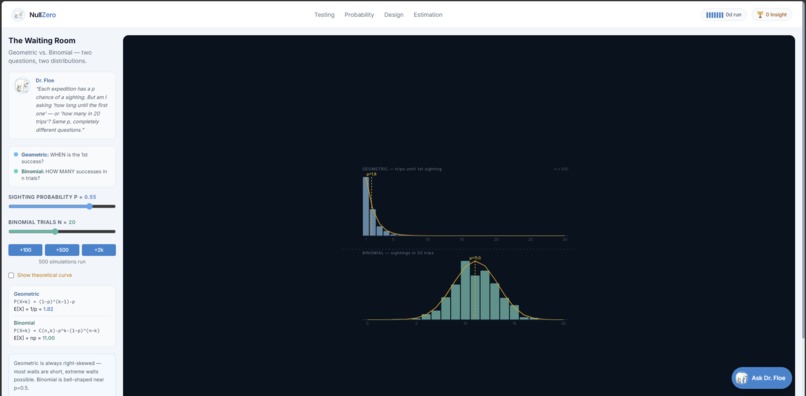
Binom v. Geometric
-
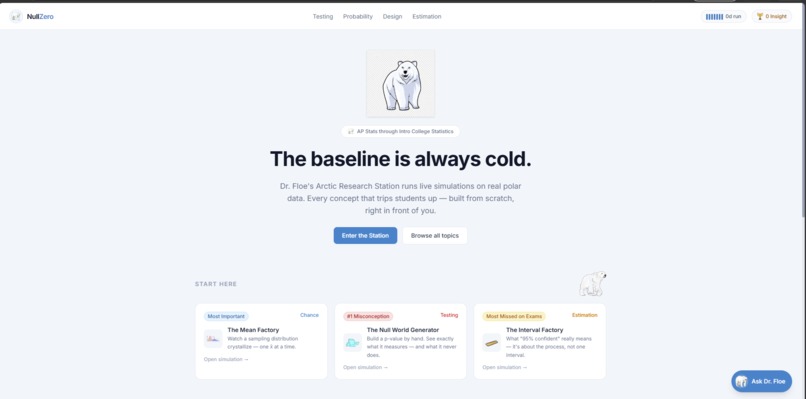
Home Page
NullZero
Inspiration
Statistics is one of the most failed AP exams not because students don't study, but because they often study it in a way that stays too abstract. Definitions get memorized, but the meaning behind them is harder to see.
I struggled with p-values for a long time. I could reproduce the definition and still miss interpretation questions. The issue was not understanding the words, but not seeing how the idea is built from the ground up.
NullZero came from that gap between definition and understanding, turning common AP Stats confusions into simulations you can actually run.
What It Does
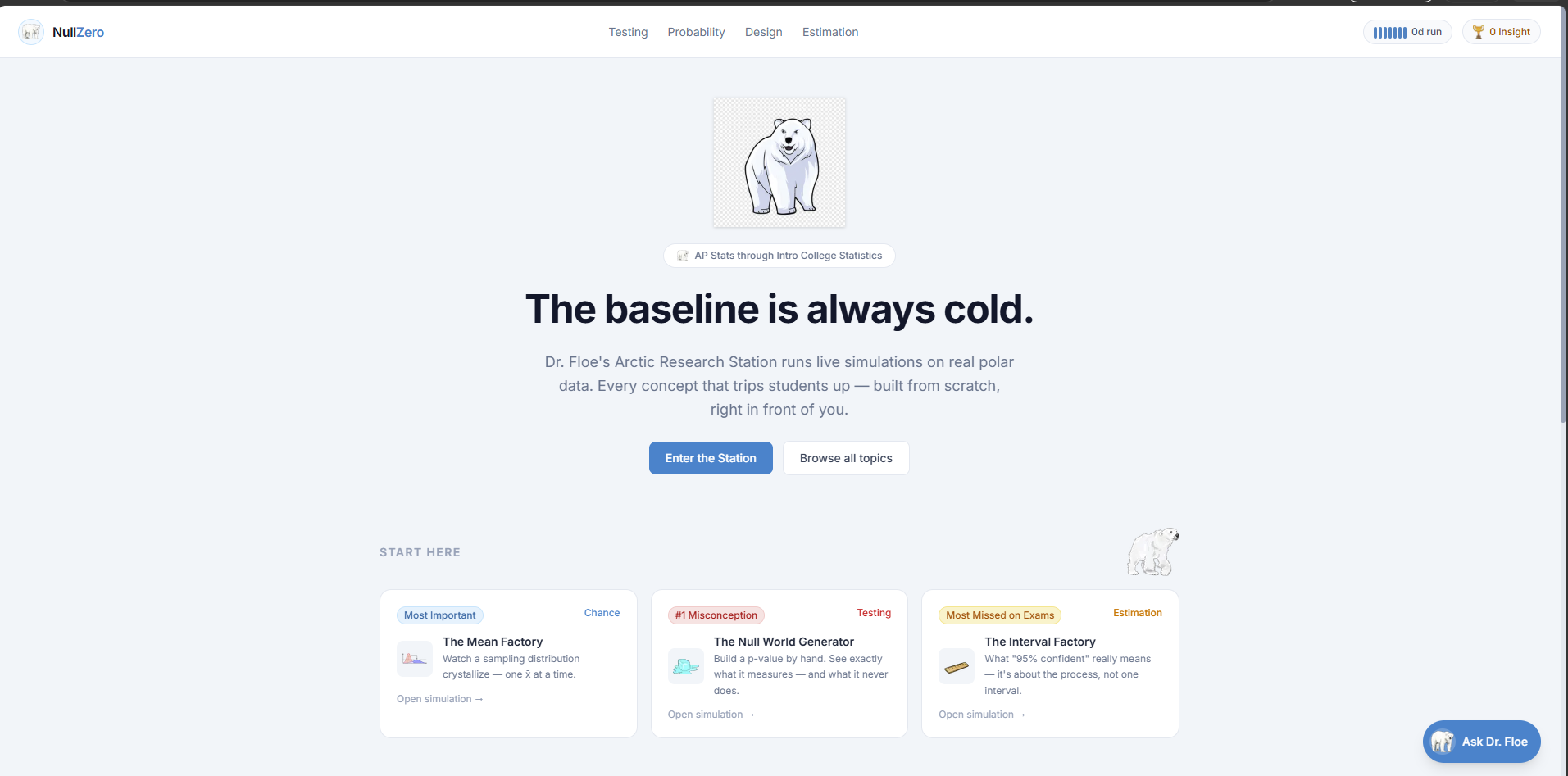
NullZero is an arctic-themed statistics learning platform guided by Dr. Floe, a polar bear researcher at a fictional Arctic Research Station. Concepts are tied to simple arctic scenarios like polar bear sightings, sea ice thickness, aurora frequency, and snowfall.
Six simulations are included:
The Null World Generator — Build a p-value by simulating many null worlds and seeing how often results match or exceed your observation.
The Mean Factory — Draw repeated samples from arctic data and watch the Central Limit Theorem appear through the sampling distribution.
The Interval Factory — Generate confidence intervals from samples and see which ones miss the true mean (μ = 45 cm snowfall).
Courtroom of Evidence — Set up hypotheses and visually compare evidence against H₀ using arctic case scenarios.
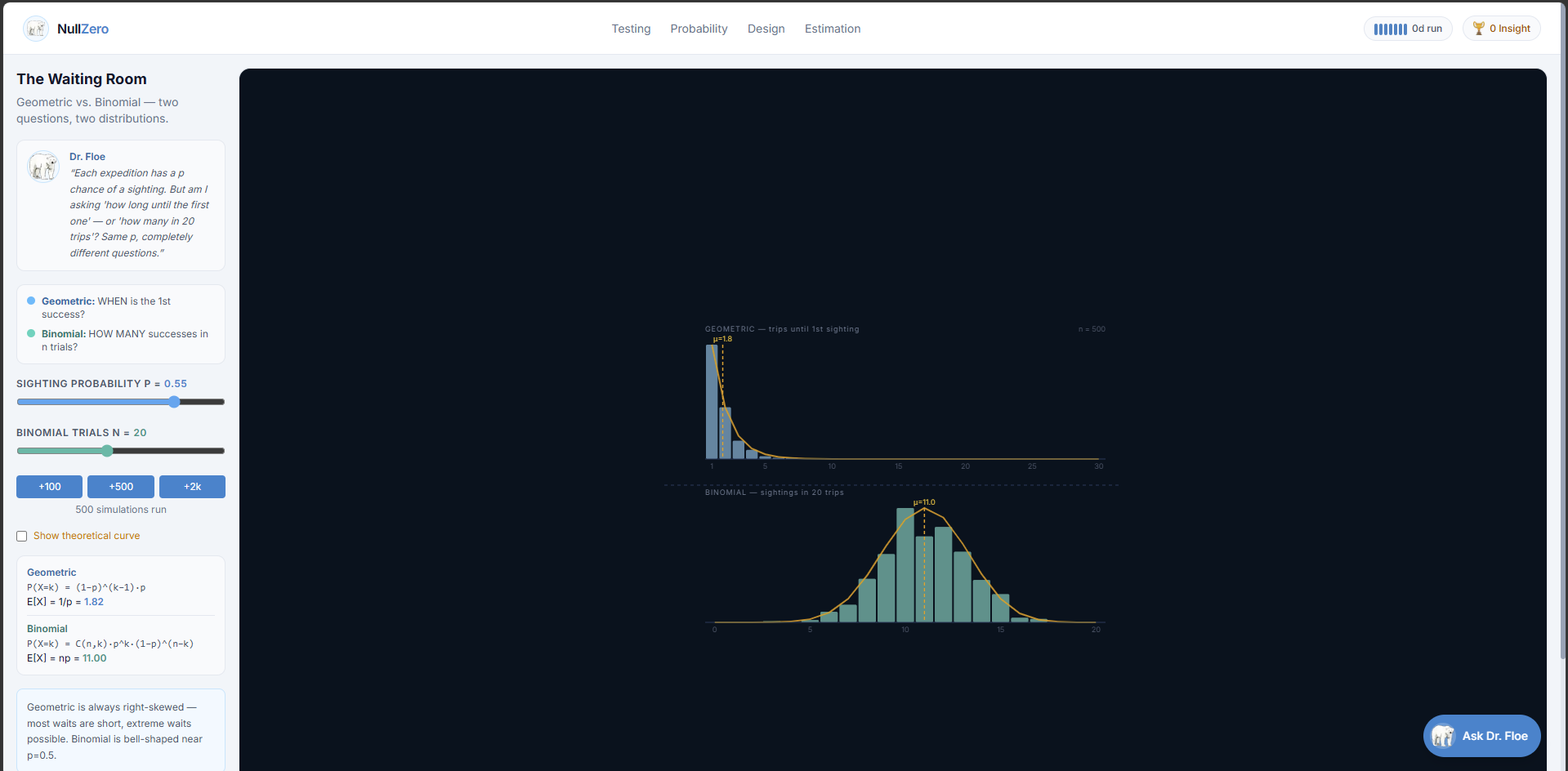
The Waiting Room — Compare geometric and binomial distributions through repeated simulation to see how their shapes differ.
The Sampling Autopsy — Review small case files of flawed sampling methods and identify what went wrong.
An Ask Dr. Floe chat (powered by OpenAI GPT-4o-mini) is available throughout to answer questions in context.
How I Built It
Built in a single sprint using:
- Next.js 14 App Router for routing and API handling
- Canvas API for all visualizations, drawn manually without chart libraries
- Zustand for global state and progress tracking
- Tailwind v4 for styling and layout
- OpenAI API (GPT-4o-mini) for the Dr. Floe chat system
- Vercel for deployment with environment-based secrets
Each simulation is designed so the user runs the experiment themselves. The system generates real random samples, computes results, and visualizes them immediately so the idea comes from observation rather than explanation.
Challenges
The hardest part was building reliable canvas visualizations from scratch, especially for histograms, scaling, and responsive rendering across different screen densities.
Another challenge was design clarity. Each simulation went through several revisions to make sure it focused on one specific misunderstanding instead of trying to cover too much at once.
What I Learned
Working on this project made it clear that understanding in statistics comes more from interaction than explanation. Turning abstract ideas into something visual and repeatable helped clarify concepts that are usually easy to memorize but hard to truly grasp.
Built With
- canvas-api
- claude
- next.js
- node.js
- openai-api-(gpt-4o-mini)
- react
- tailwind-css-v4
- typescript
- vercel
- zustand

Log in or sign up for Devpost to join the conversation.