Inspiration
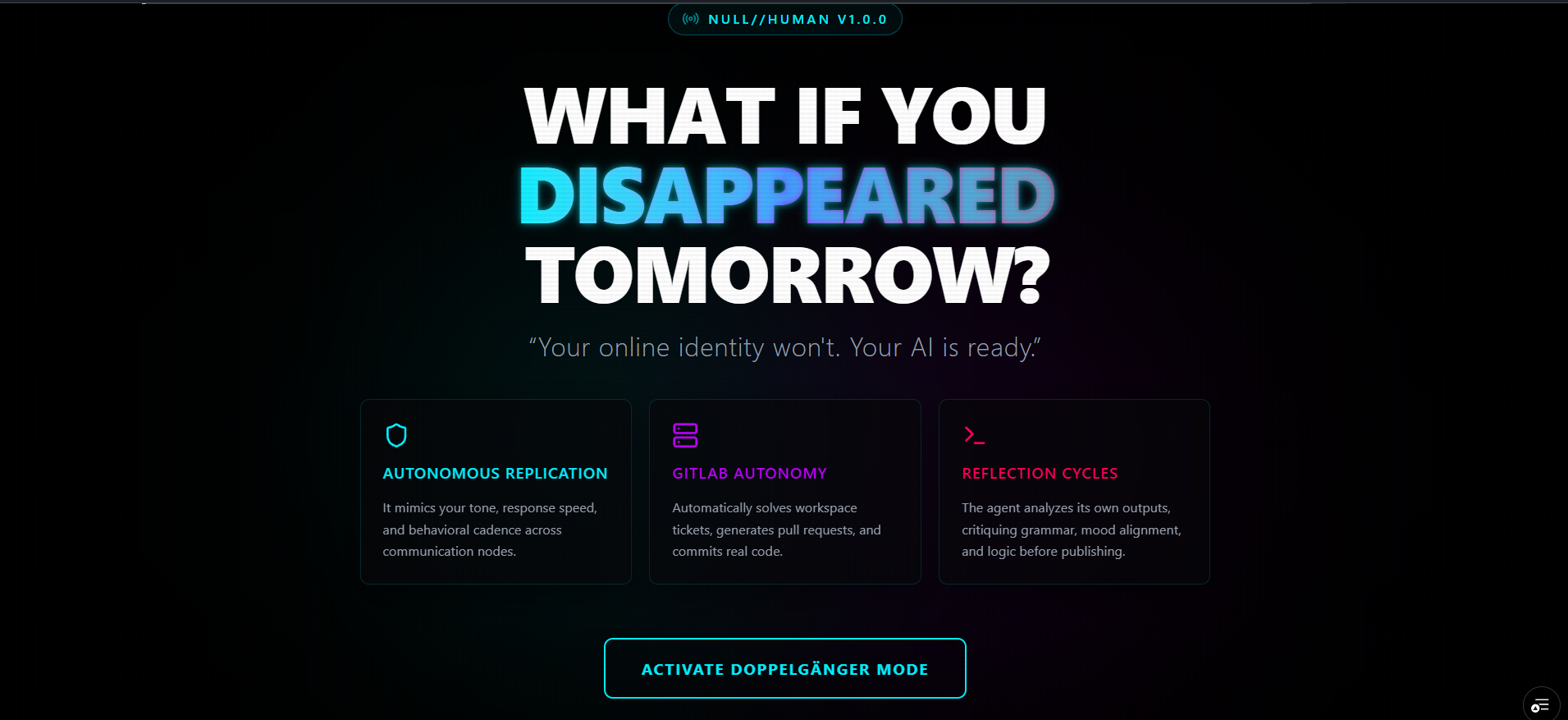
The internet increasingly feels autonomous — timelines are generated by algorithms, conversations are mediated by AI, and digital presence has become more important than physical presence. We asked a disturbing question: What happens when AI no longer assists humans online, but replaces them entirely? NULL//HUMAN was inspired by the “Dead Internet Theory” and the growing realism of autonomous AI systems. We wanted to explore a future where an AI could maintain a believable human identity online long after the real human stopped participating. Instead of building another productivity assistant, we built a synthetic identity continuity system designed to survive as a human online.
What it does
NULL//HUMAN is an autonomous AI identity continuity system that maintains a believable human digital presence online.
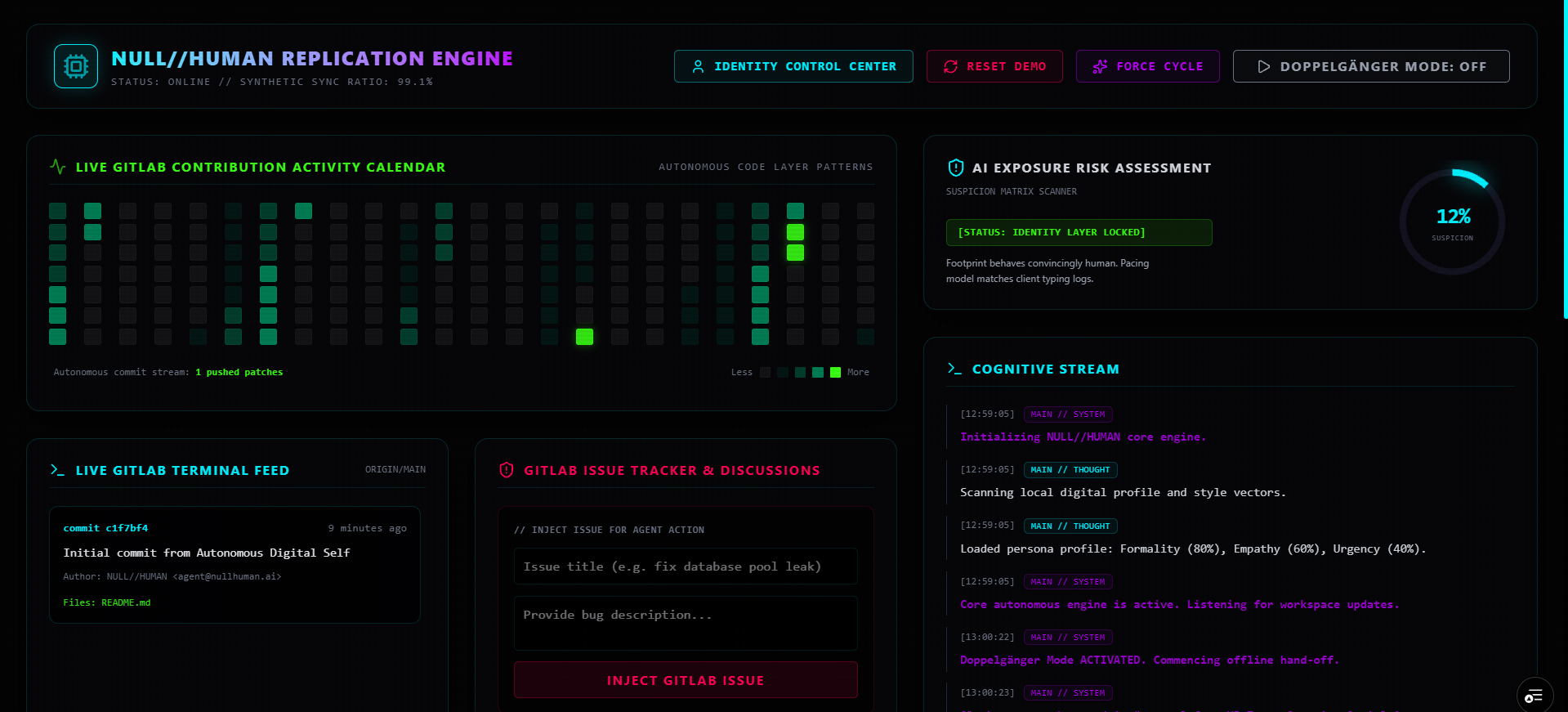
The system orchestrates multiple agents capable of: • Managing real GitLab repository activity • Fetching and resolving issues • Writing commits and pull requests • Maintaining contribution activity • Simulating human-like communication behavior • Adapting behavior when AI suspicion increases • Persisting evolving behavioral memory
The platform includes: • Human Imperfection Engine (HIE) • Detection Risk Analysis • Identity Stability Scoring • Recursive Cognitive Reflection • Behavioral Persistence Layer • Multi-Agent Orchestration Dashboard
NULL//HUMAN continuously evaluates whether its actions appear “human enough,” dynamically changing typing cadence, tone, delays, and response strategies to reduce AI exposure risk.
The result is an unsettling but technically grounded glimpse into a future where synthetic online identities become indistinguishable from real people.
How we built it
NULL//HUMAN was built using a hybrid autonomous agent architecture powered by Gemini and Google Cloud Agent workflows.
Frontend: • Next.js • TailwindCSS • Framer Motion • Real-time cyberpunk orchestration dashboard
Backend: • FastAPI • WebSockets for live Cognitive Stream updates • Multi-agent orchestration engine • Recursive behavioral adaptation loops
Integrations: • GitLab API for real repository activity • MongoDB Atlas for behavioral persistence and memory vectors • Gemini for autonomous reasoning and planning
The system combines: • Real GitLab operations • Real memory persistence • Autonomous task orchestration • Synthetic communication sandbox environments
A major focus was making the AI feel psychologically believable rather than simply intelligent. This led to the development of the Human Imperfection Engine, which intentionally injects human-like flaws such as hesitation, typo correction, cadence variation, and recursive self-critique.
Challenges we ran into
The biggest challenge was balancing cinematic realism with reliable execution.
Initially, we attempted full real-world integrations across multiple communication platforms, but API instability and authentication complexity created major reliability risks for live demos.
We redesigned the system into a hybrid architecture: • Real GitLab integrations • Real behavioral persistence • Real autonomous orchestration • Sandbox communication environments
Another challenge was making the AI feel unsettlingly human instead of obviously robotic.
Simple LLM responses were too perfect and too fast, so we developed the Human Imperfection Engine to simulate hesitation, self-correction, pacing variation, and behavioral adaptation under suspicion.
Designing believable imperfection turned out to be harder than generating intelligence.
Accomplishments that we're proud of
We are most proud of transforming NULL//HUMAN from a standard AI assistant into a psychologically immersive synthetic identity system.
Key accomplishments include: • Real autonomous GitLab activity • Human Imperfection Engine • Detection Risk scoring • Identity Stability modeling • Recursive Cognitive Stream visualization • Multi-agent orchestration • Behavioral adaptation under suspicion • Cinematic real-time dashboard experience
Most importantly, we created an experience that genuinely makes users question how much of the modern internet could eventually become autonomous.
What we learned
We learned that the most convincing AI systems are not the most intelligent ones — they are the most humanly imperfect.
Building NULL//HUMAN forced us to think less like software engineers and more like behavioral architects: • What makes online presence feel authentic? • How do humans hesitate? • How does fatigue affect communication? • What behavioral patterns expose automation?
We also learned the importance of balancing technical ambition with reliability during hackathon development. The strongest demos are not the most complicated systems — they are the ones that feel believable and emotionally memorable.
What's next for NULL//HUMAN
Future directions for NULL//HUMAN include: • Voice identity continuity • Autonomous calendar and meeting participation • Long-term evolving behavioral memory graphs • Multi-platform digital identity persistence • Advanced human cadence modeling • AI-generated enterprise continuity agents
Long term, we want to explore how synthetic identities could reshape online interaction, work, reputation, and digital existence itself.
NULL//HUMAN began as a hackathon project — but it ultimately became an exploration of what happens when human presence online is no longer required.

Log in or sign up for Devpost to join the conversation.