Inspiration
Our inspiration came from Alex Chen's case, where early ALS symptoms were documented across multiple appointments but weren't connected until much later.
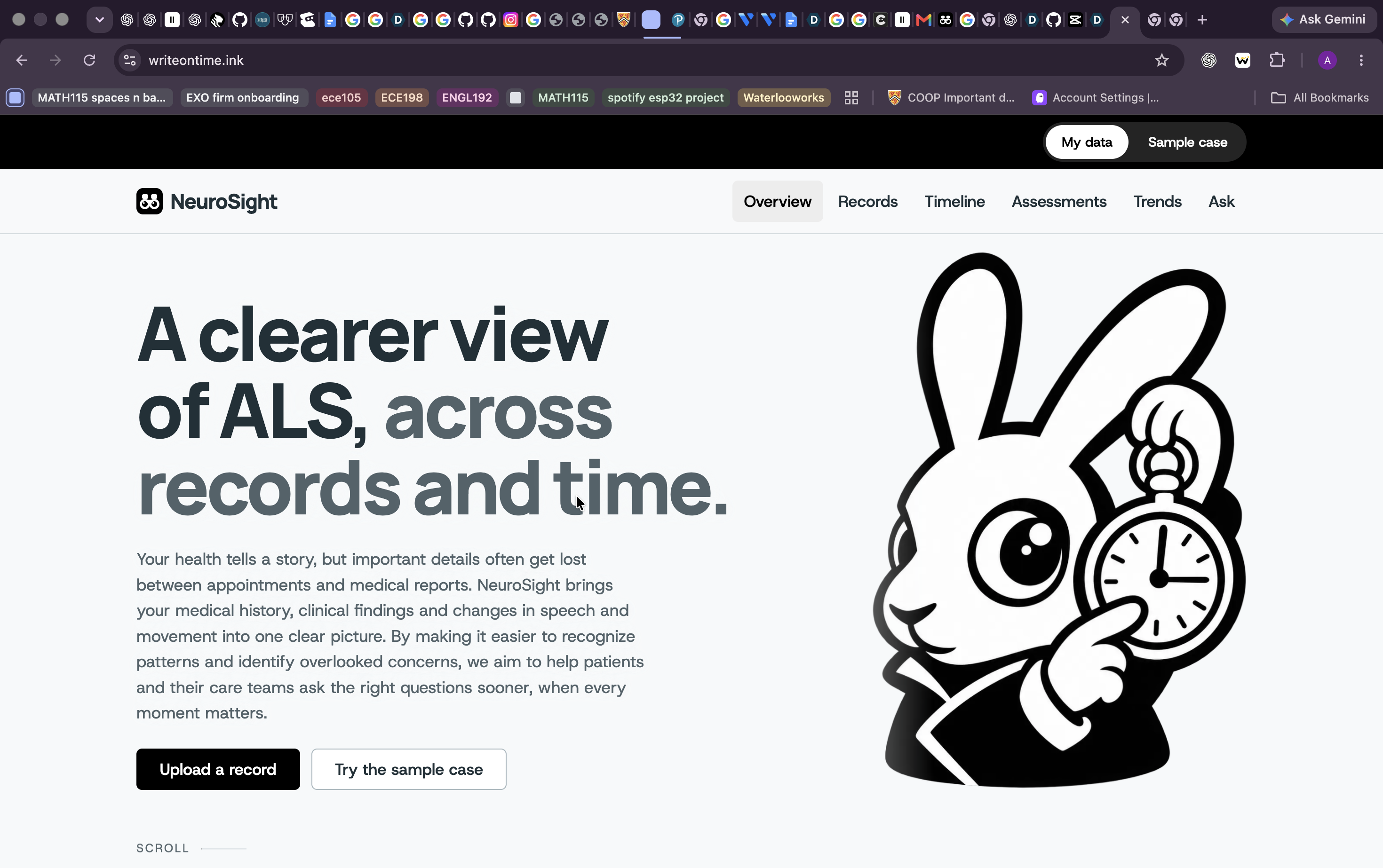
We built NeuroSight to connect fragmented clinical evidence, visualize neurological changes, and make overlooked patterns easier to identify.
What it does
NeuroSight combines three core capabilities:
- Clinical Intelligence: Extracts dated findings from medical PDFs using Clinical NLP, with human verification and source-page references.
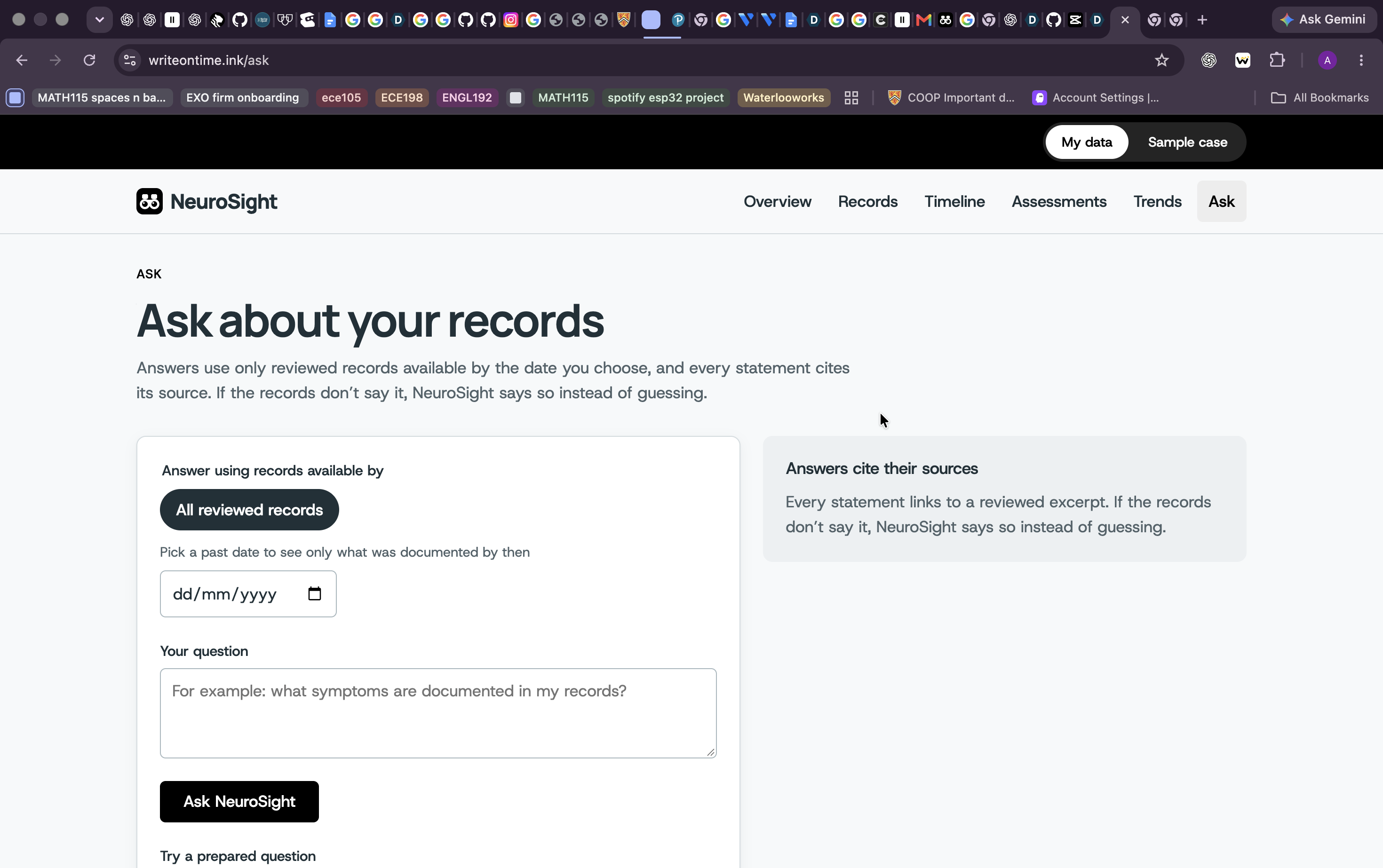
- Temporal RAG: Uses semantic search and date-filtered retrieval to answer questions using only evidence available at a selected point in time.
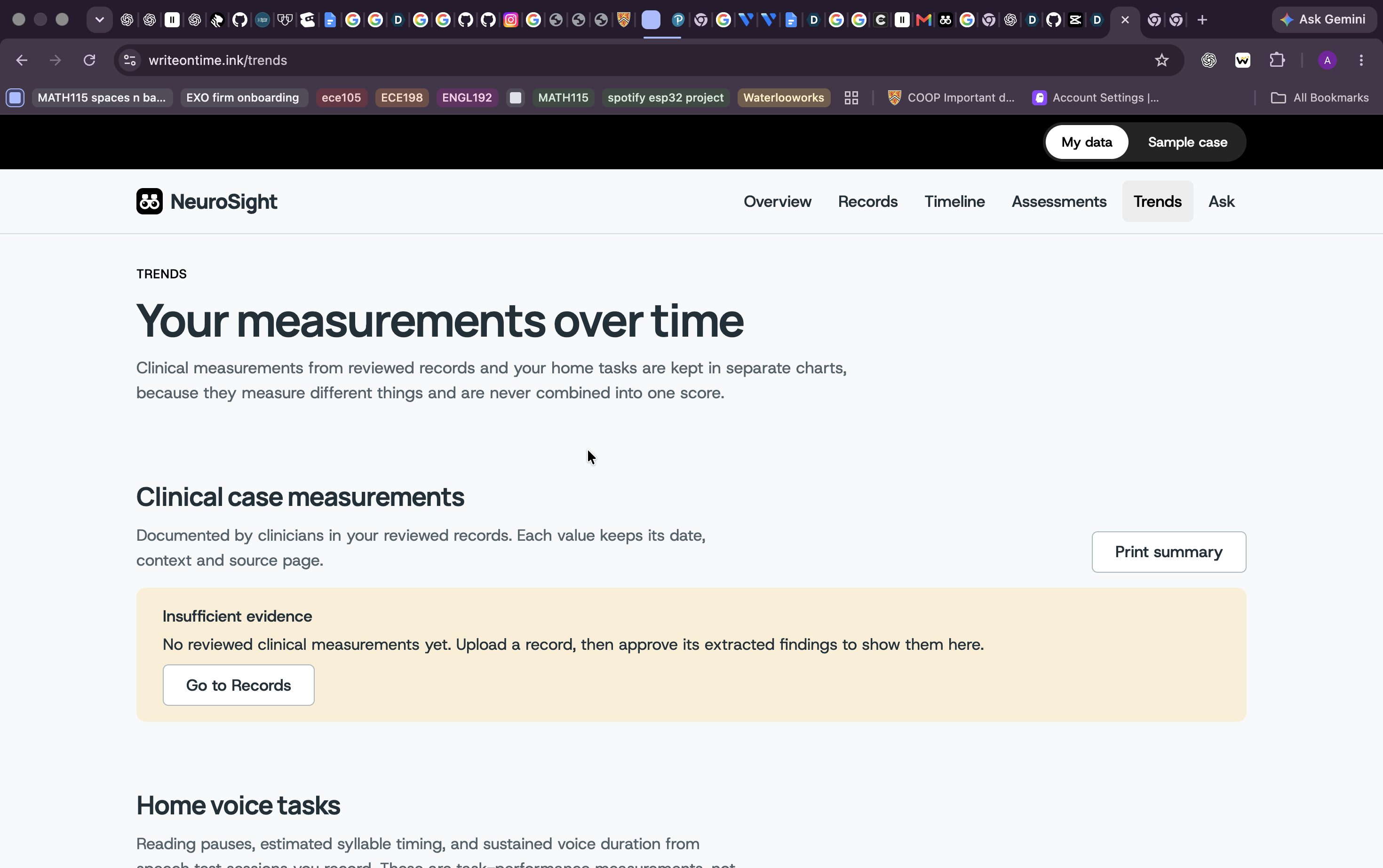
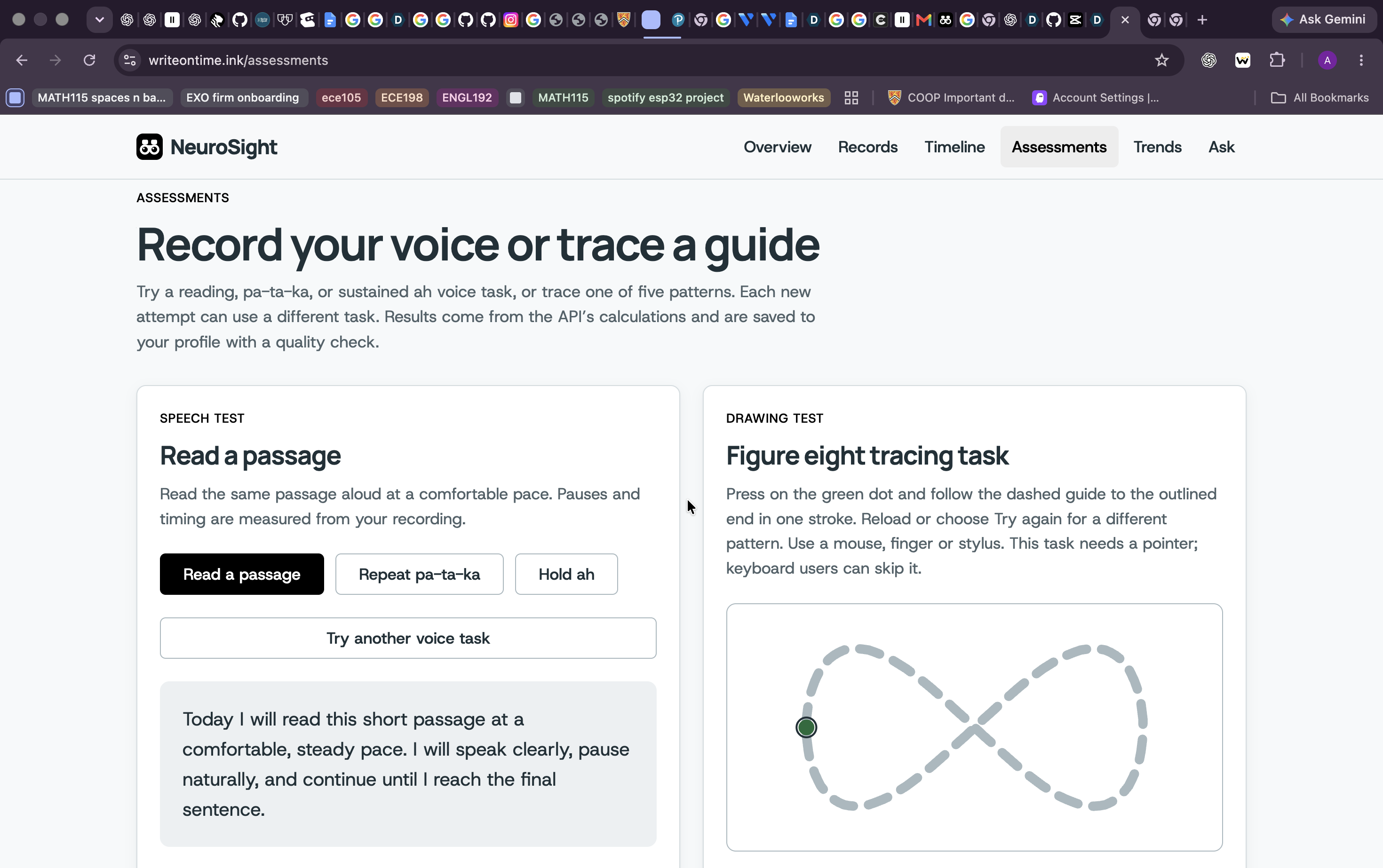
- Functional Monitoring: Analyzes speech and drawing assessments, tracking measurable changes against personal baselines.
A separate ML research module evaluates ALS progression models on historical clinical datasets.
How we built it
Tech stack: Next.js, TypeScript, FastAPI, Python, Tiger Data, TimescaleDB, Vultr.
- Clinical NLP: Structured extraction of symptoms, measurements, dates, and negated findings.
- Semantic Search + Temporal RAG: Evidence retrieval with temporal filtering and source citations.
- Digital Signal Processing: Speech pause detection, syllable timing, and sustained phonation measurements.
- Time-Series Analysis: Timestamped assessments, weekly aggregations, and longitudinal trends using Tiger Data.
- Computational Geometry: Drawing trajectory analysis, path deviation, and completion time.
- Machine Learning: Gradient-boosted regression evaluated against baselines using held-out patient data.
AI-Assisted Development with Entire
We integrated Entire with Claude Code and GitHub to track AI-assisted development through checkpoints, coding sessions, and repository activity.
Our Entire analytics recorded:
| Metric | Result |
|---|---|
| Checkpoints | 43 |
| Git commits | 57 |
| Recorded messages | 193 |
| Token usage | 3.1M |
| Pull requests | 1 merged, 1 open |
We used a structured PRD, architecture specification, and task breakdown to coordinate development across our two-person team.
Entire provided a traceable development history for inspecting AI-assisted coding activity.
Challenges we ran into
- Clinical accuracy: Handling negation, dates, and ambiguous findings without misrepresenting medical evidence.
- Temporal leakage: Preventing RAG from retrieving information documented after the selected historical date.
- Signal reliability: Implementing quality checks for speech recordings and drawing assessments.
- Integration: Connecting document processing, RAG, time-series storage, and assessments.
- AI-assisted collaboration: Managing architecture consistency and parallel development under time constraints.
Accomplishments that we're proud of
- Built an integrated biomedical engineering prototype rather than a standalone AI chatbot.
- Implemented date-aware clinical evidence retrieval with source citations.
- Developed quantitative speech and fine motor assessments with longitudinal tracking.
- Evaluated gradient-boosted regression against a baseline on historical ALS data.
- Recorded 43 development checkpoints across 57 commits using Entire.
What we learned
- Clinical AI requires traceability, human verification, and temporal consistency, not just plausible responses.
- Biomedical assessments need reproducible measurements and quality checks.
- Patient-level separation is essential when evaluating progression models.
- AI coding agents work better with structured requirements, modular tasks, and inspectable development history.
Built With
- api
- next.js
- python
