-
-

Nudge
-
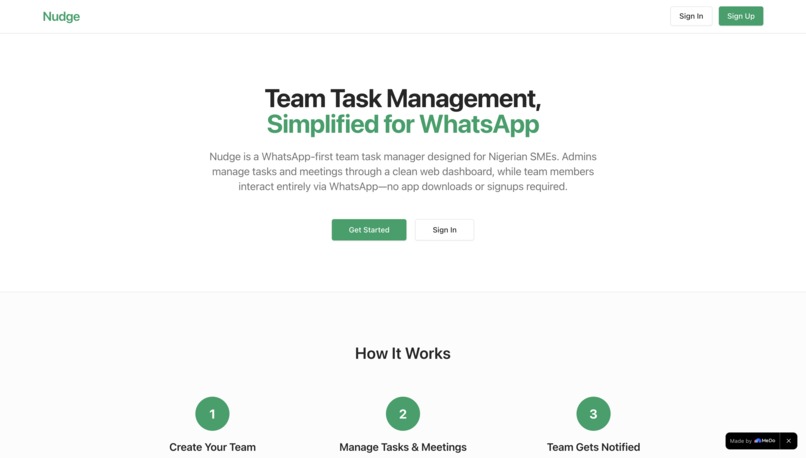
Home page

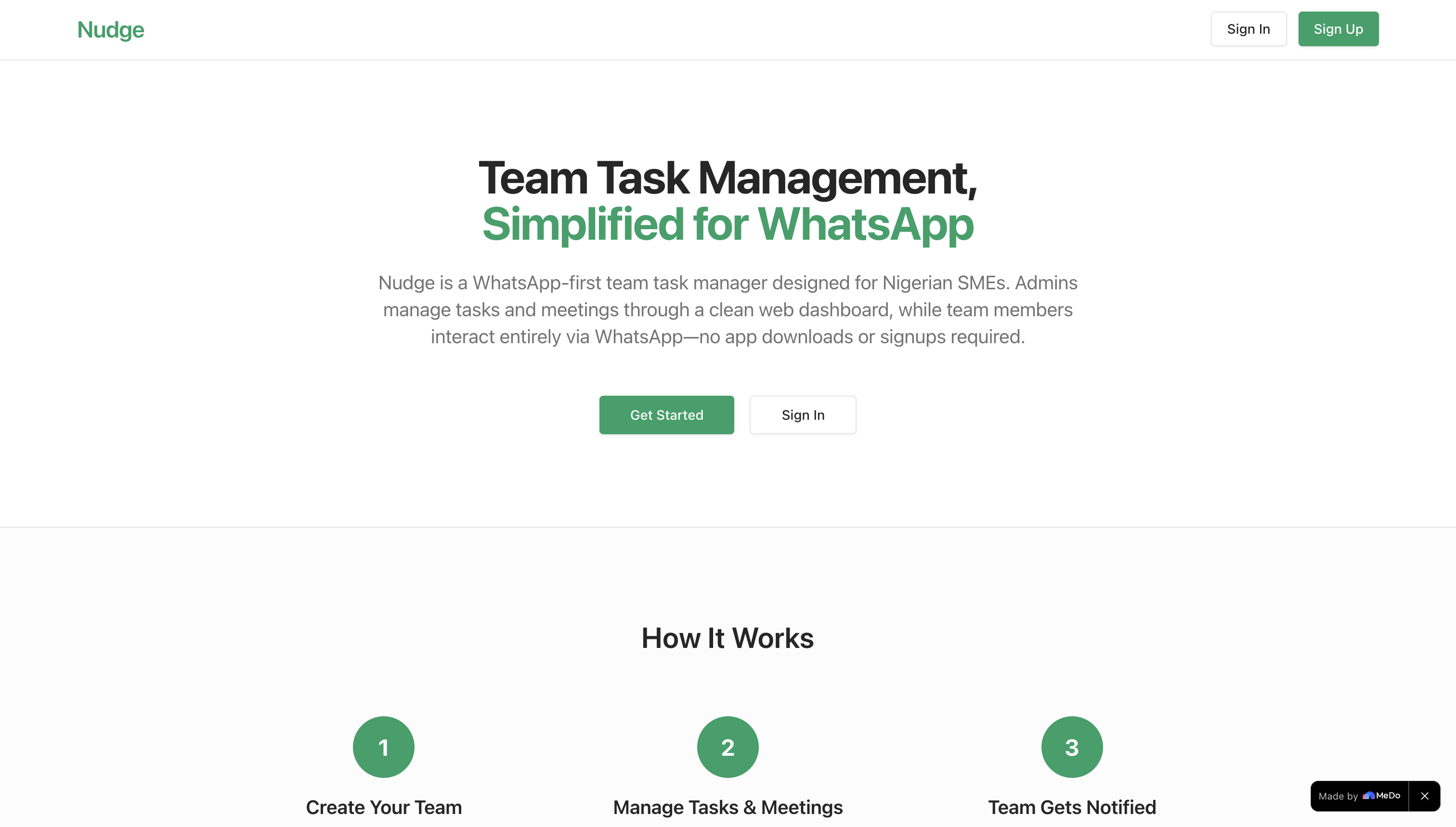
Inspiration
Small teams across Nigeria run on WhatsApp. It's where decisions are made, updates are shared, and work gets discussed. Yet when it comes to actually tracking tasks and accountability, most tools assume your team is sitting at a desk with a Slack subscription. They're not. I built Nudge for the business owner in Lagos whose five-person team lives on their phones, who needs to know if Tunde finished the client proposal without sending a follow-up message for the third time this week.
What it does
Nudge is a WhatsApp-first task and meeting manager for small teams. Admins create and assign tasks from a clean web dashboard. Team members receive assignments, reminders, and meeting invites directly on WhatsApp, no app to download, no account to create. They respond with a single tap. When a task is done, the admin knows instantly. When a meeting is coming up, the whole team gets reminded automatically. A weekly digest lands every Monday morning so the admin always knows what got done, what's overdue, and what's coming up.
How I built it
I used MeDo as the core dashboard and app shell, describing requirements as structured briefs for each feature, outlining the data, the actions, and the user flows upfront. The WhatsApp Cloud API handles all messaging directly through Meta with no third-party BSP. Inbound messages run through a webhook server with a state machine handling button replies, free-text updates, and the JOIN opt-in flow. The database is managed with PostgreSQL, and a scheduler handles automated reminders, overdue detection, and digest delivery.
Challenges I ran into
Getting the messaging architecture right took careful thought around cost, compliance, and user experience. Meta's policies mean businesses risk being flagged as spam if they initiate conversations without prior consent, so I built the entire opt-in flow around Utility templates, with members starting the conversation themselves through a pre-filled WhatsApp link from their invite email. During template creation I also had to restructure several templates since Meta doesn't allow messages to start or end with a variable.
MeDo had its own friction. Not being able to edit code directly was frustrating at times, since there were things I could spot and fix myself but instead had to describe and let MeDo attempt, sometimes burning through tokens without resolving the issue. Changing environment variable values also didn't update the running app consistently, though I eventually found a workaround. I also tried building custom plugins to extend functionality, but MeDo currently doesn't support integrating custom plugins into pre-existing projects, which was a limitation I ran into. Navigating the WhatsApp ecosystem across the Meta Developer Console, Business Suite, and WhatsApp Manager also took significant time, since they overlap in ways the documentation doesn't always make clear.
Accomplishments that I'm proud of
The opt-in architecture is something I'm genuinely proud of. It's compliant, frictionless for the end user, and sets Nudge up properly for scale. The member dashboard is the feature I'm most proud of visually, giving each team member a personal view of their tasks broken down by status, with due dates, descriptions, and a recent updates trail, all tied to their WhatsApp identity without requiring a separate login. The state machine in the webhook server is also clean and extensible, and the overall product scope is substantial for the timeframe without feeling bloated. And MeDo made this possible under a short amount of time.
What I learned
WhatsApp's Cloud API is far more accessible than its reputation suggests. You don't need a BSP, the setup is free, and the platform has more depth than most people realise. I also learned that product decisions and compliance decisions are deeply intertwined when building on messaging platforms. Every UX choice has a policy implication behind it, and you have to think about those factors early.
What's next for Nudge
The first priority is a dedicated phone number so Nudge is properly production-ready. After that, version 2 brings AI-powered team insights, WhatsApp Group support for shared digests and meeting invites, multi-team member support, Google Calendar integration, and a subscription-based business model. Further down the line, the goal is to go through Meta's Tech Provider process so businesses can send messages from their own branded WhatsApp number.
Built With
- medo
- openai
- potgresql
- typescript

Log in or sign up for Devpost to join the conversation.