Inspiration
Small businesses across India, Malaysia and Singapore run their whole sales counter on WhatsApp. They also lose most of their money in the gaps: the lead that goes quiet, the booking nobody confirms, the patient who never shows.
Then on 3 June 2026, Meta shipped a free AI inside WhatsApp Business that answers questions and books basic appointments. Overnight, "AI that replies on WhatsApp" stopped being a product.
Which was clarifying, honestly. Replying was never the hard part. The hard part is an agent that actually does things in your calendar and your payment rail. Nobody trusts an agent with money because there's no way to bound what it does. So we built the bounding.
What it does
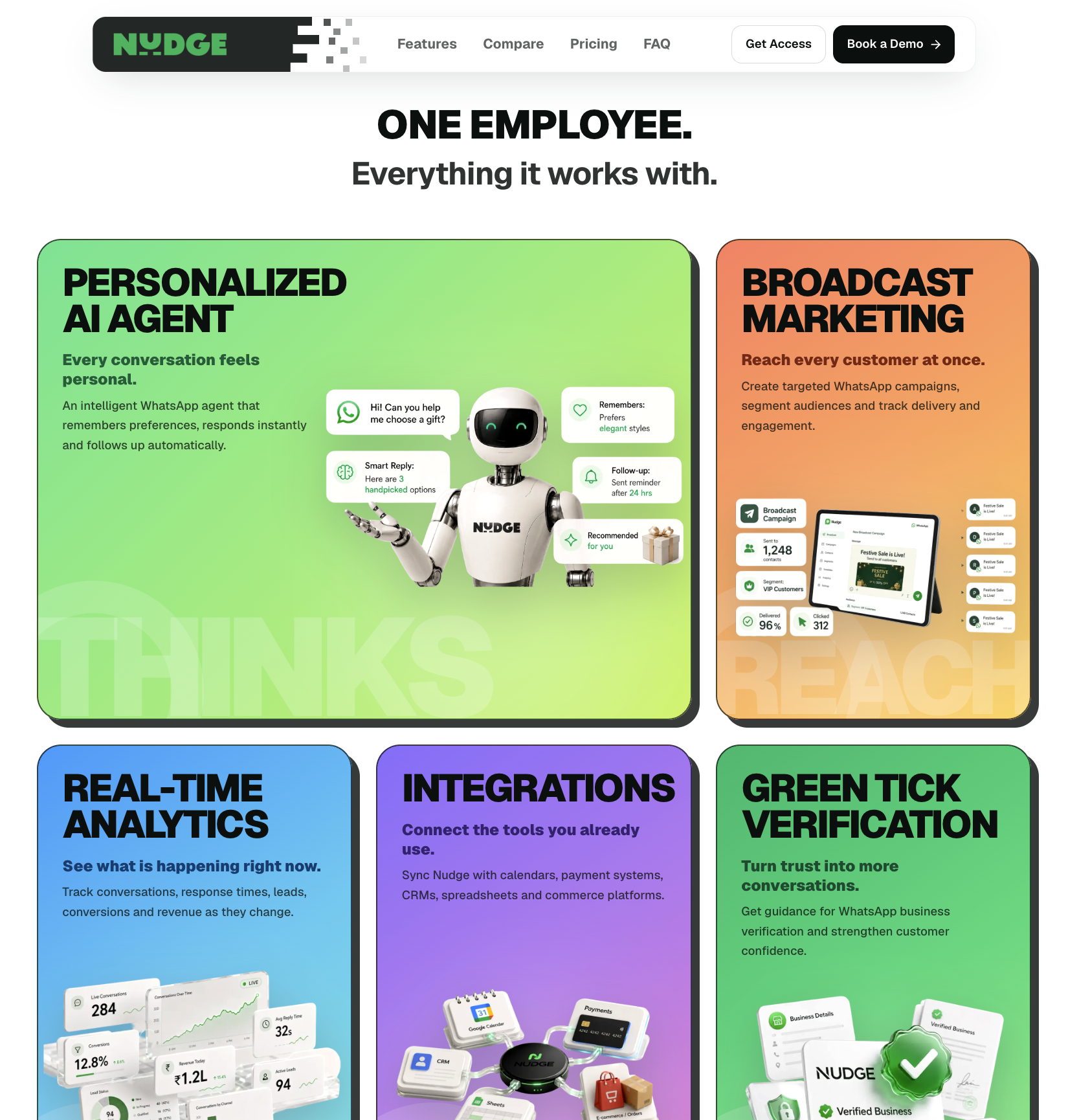
NUDGE is a done-for-you AI employee that runs a small business's WhatsApp end to end.
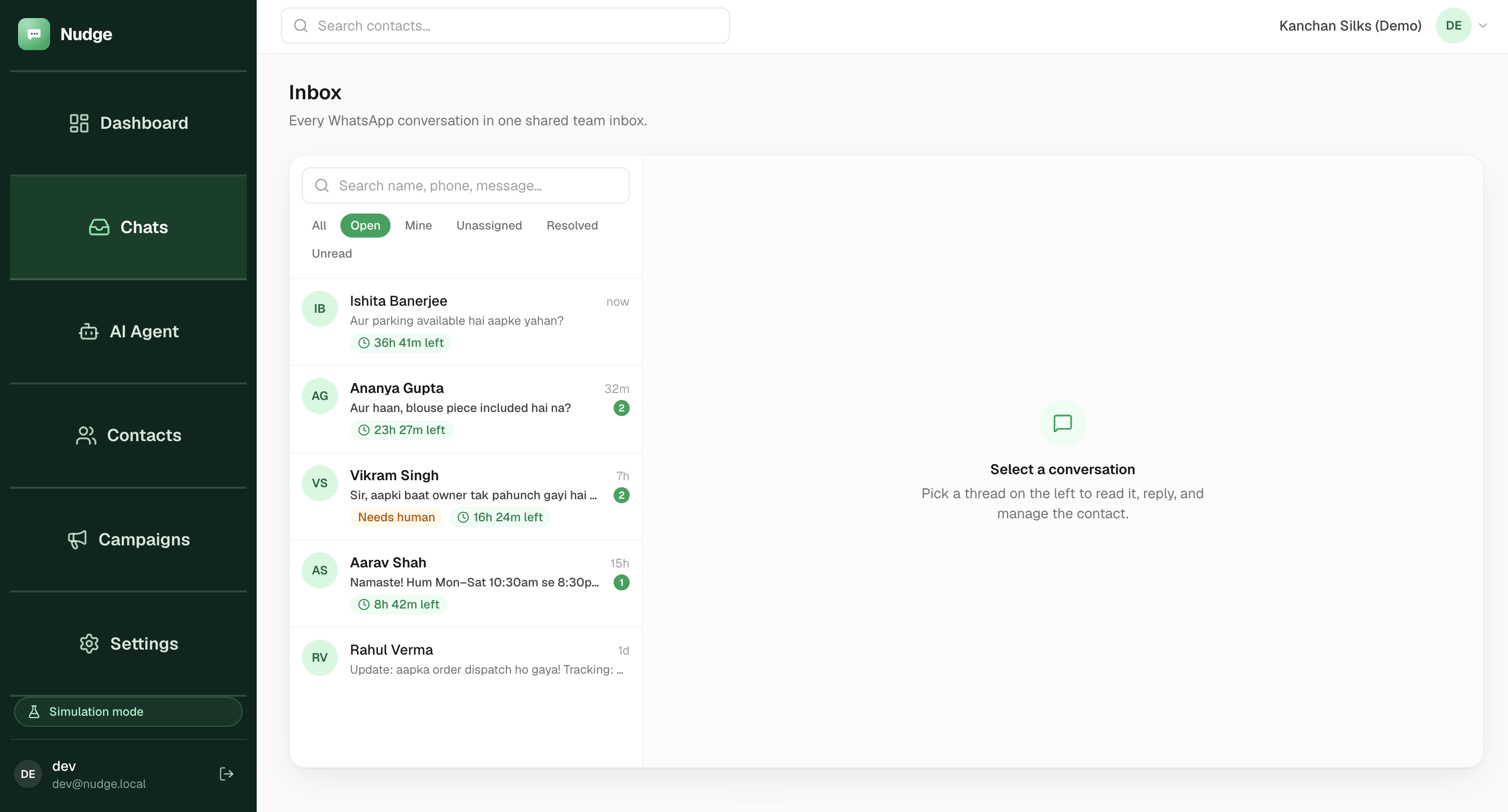
It answers, grounded only in what the owner told it. When it hits something it doesn't know, it asks the owner in-app, then automatically follows up with every customer who was waiting.
It books real Google Calendar slots with live availability checks.
It chases. Ghosted leads, booking reminders, no-shows.
It collects, which is the part we built here. Deposits settle in stablecoins into an escrow contract, released when the customer shows up, refunded if they cancel in time. The agent runs on a smart account under an on-chain spending policy with allowlisted recipients, per-transaction caps and rate limits. What it can't do is a contract constraint, not a line in a prompt.
So a Malaysian patient can pay an Indian clinic a deposit, no chargebacks, no card rails, and both sides can check the release conditions themselves without trusting us.
How we built it
Next.js 16, TypeScript, Tailwind v4, Supabase for Postgres, Auth and Storage, Prisma 6 with row-level security on every table, Anthropic Haiku behind a model router, and a Postgres-backed queue on Vercel Cron. About 20 bounded modules and 35 Prisma models. Official Meta Cloud API only.
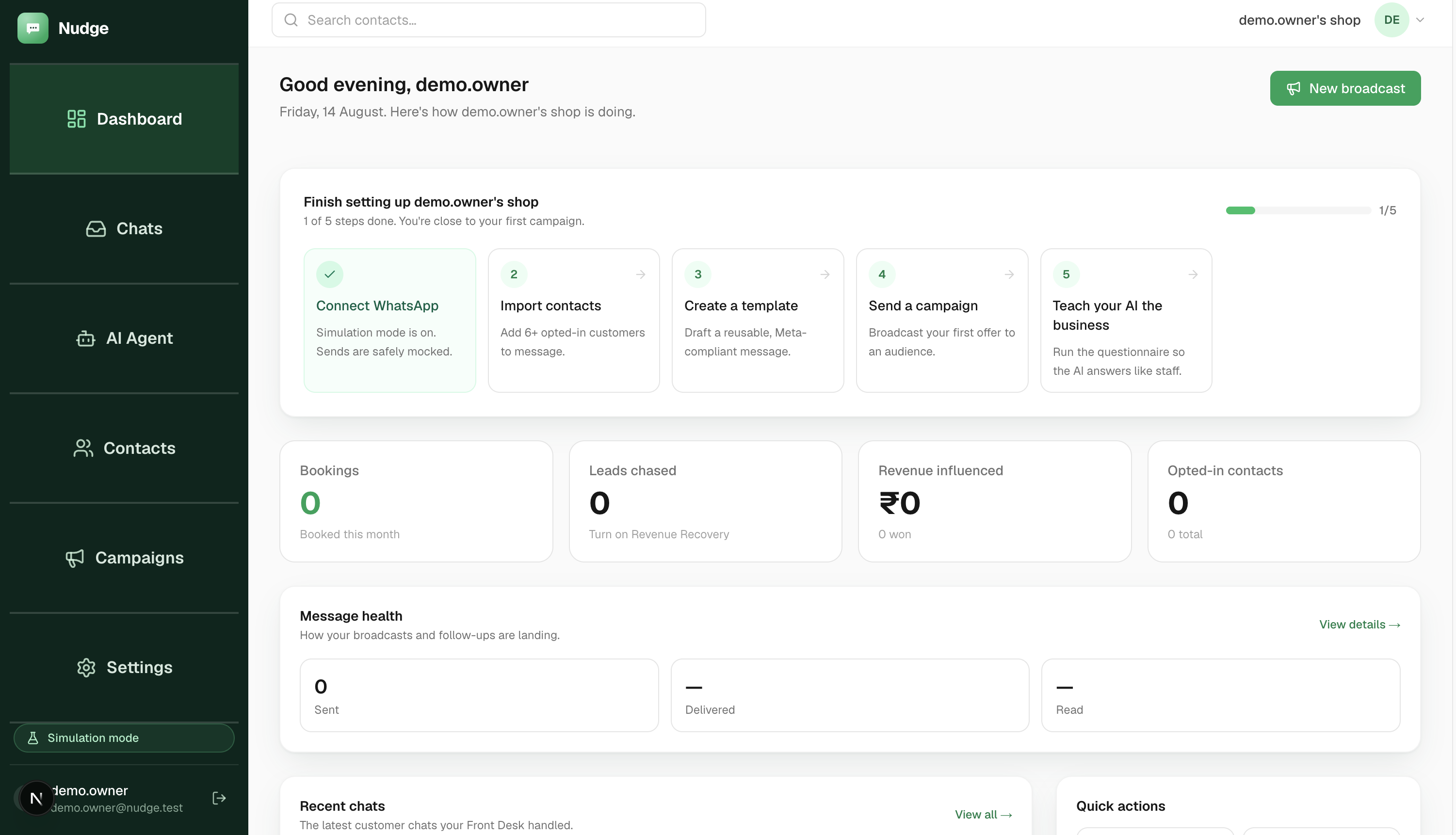
Seven invariants are enforced in code and guarded by tests. Consent lives in the data, not the UI, so STOP is permanent and a CSV re-import can't undo it. The 24-hour window is enforced at the send layer. Every query is tenant-scoped. The agent drafts, a human sends. And the whole product runs in simulation mode with zero external keys, so anyone can verify the full flow.
The settlement layer targets Base with ERC-4337 smart accounts, embedded wallets so the owner never touches a seed phrase, and an escrow contract holding deposits against attendance.
The WhatsApp platform is pre-existing work we built in June and July 2026, disclosed as such. What we built during the hackathon is the on-chain settlement layer: the escrow contracts, the policy engine, and the stablecoin deposit flow. Commit history available on request.
Challenges we ran into
Competing with free. Meta's agent is native and costs nothing, so any feature that just talks is worth zero. That pushed every decision toward what an inbound bot structurally can't do: act in outside systems, reach out first, and move money.
Compliance had to be architecture. One non-compliant broadcast can cost a business its number for good, so consent and window state had to sit in the send path where nothing can route around them.
Giving an agent a wallet without giving it authority. A hot key is out, and trusting the model to behave is worse. Scoping it to a session key under an on-chain policy meant assuming the model will eventually be wrong or get prompt-injected, and bounding the damage anyway.
Accomplishments that we're proud of
418 tests across 53 files green, with typecheck, lint and build clean. This is a real system, not a demo.
A 23-agent adversarial security audit that caught and fixed billing-integrity, SSRF, open-redirect and tenant-isolation bugs.
Simulation mode that runs everything, generation through dashboard, with no external credentials. It's why anyone can verify the product end to end, judges included.
Ten currencies across two payment gateways, so we price in the local currency of the salary we're replacing.
An agent that closes its own knowledge gaps by asking the owner. No fine-tuning, no RAG, just deterministic grounding.
What we learned
When a platform gives something away free, the defensible layer drops one step down the stack, from conversation to execution. Every moat we have is something Meta's agent structurally can't do, not something we just do better.
Trust is the real ceiling on agentic commerce, not capability. An agent that moves money is only deployable if the limits on it are checkable by the other side, without trusting us. That's the case for putting settlement on-chain, and it's a case we'd have waved off a month ago.
Also: distribution is the bottleneck, not features. The moat is built. Getting it in front of the first ten clinics is the hard part.
What's next for NUDGE
Connect the live Meta Cloud API path, which is code-complete and just waiting on credentials, so the demo runs on a real phone instead of a simulator. Get the escrow contracts onto a public testnet with an explorer link inside the demo.
Then the beachhead: high-ticket clinics like hair transplant, derma, cosmetic dental and IVF, where recovering one no-show pays for a month of the product. India, then Malaysia, then Singapore, then the UAE, which is also the corridor where cross-border deposits actually matter.
After that, becoming a Meta Tech Provider for embedded signup at scale, plus a reseller channel. Somewhere around 250 to 450 flagship clients is $1M ARR.

Log in or sign up for Devpost to join the conversation.