-
-
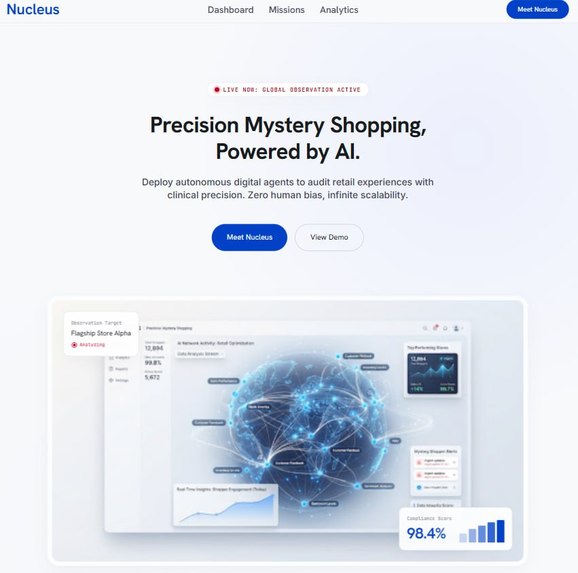
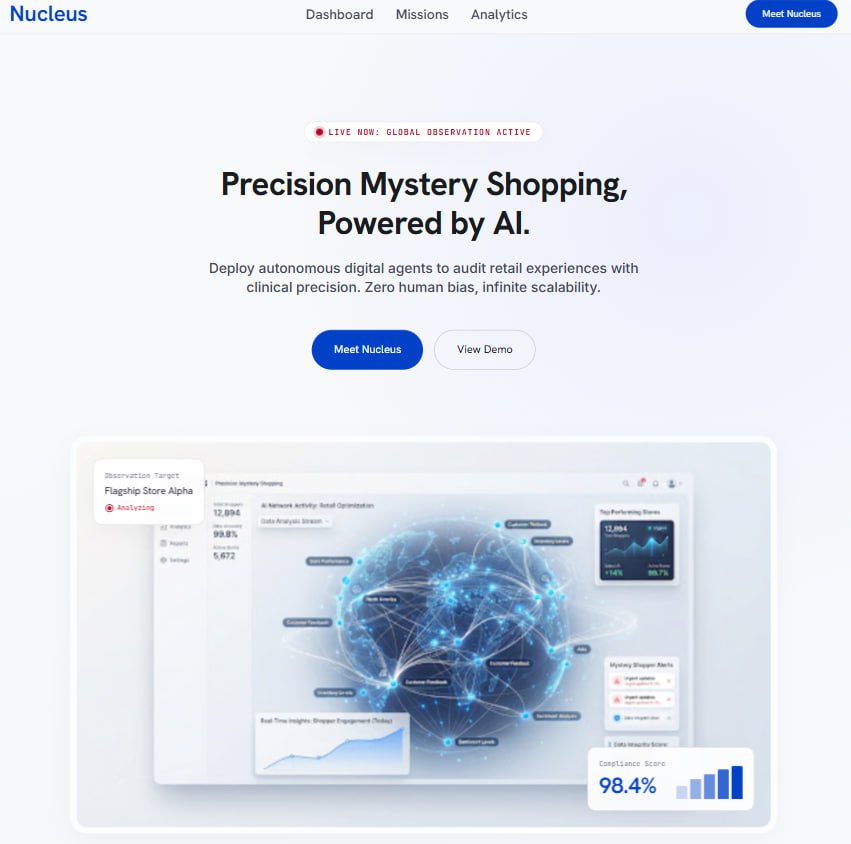
Home / Landing Page Wireframe
-
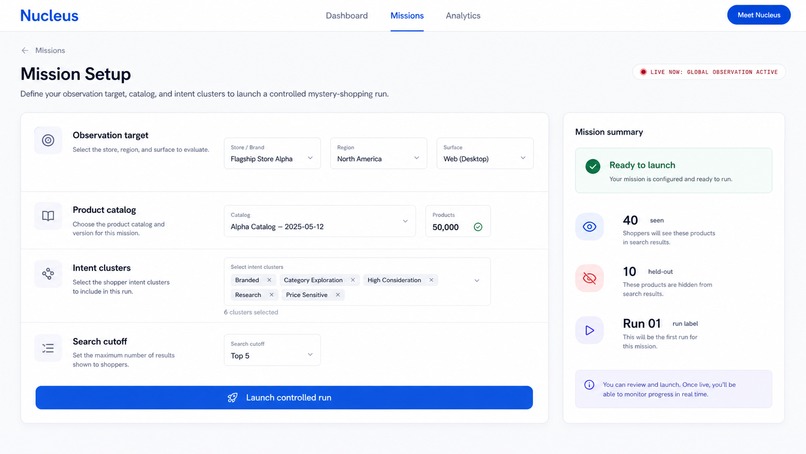
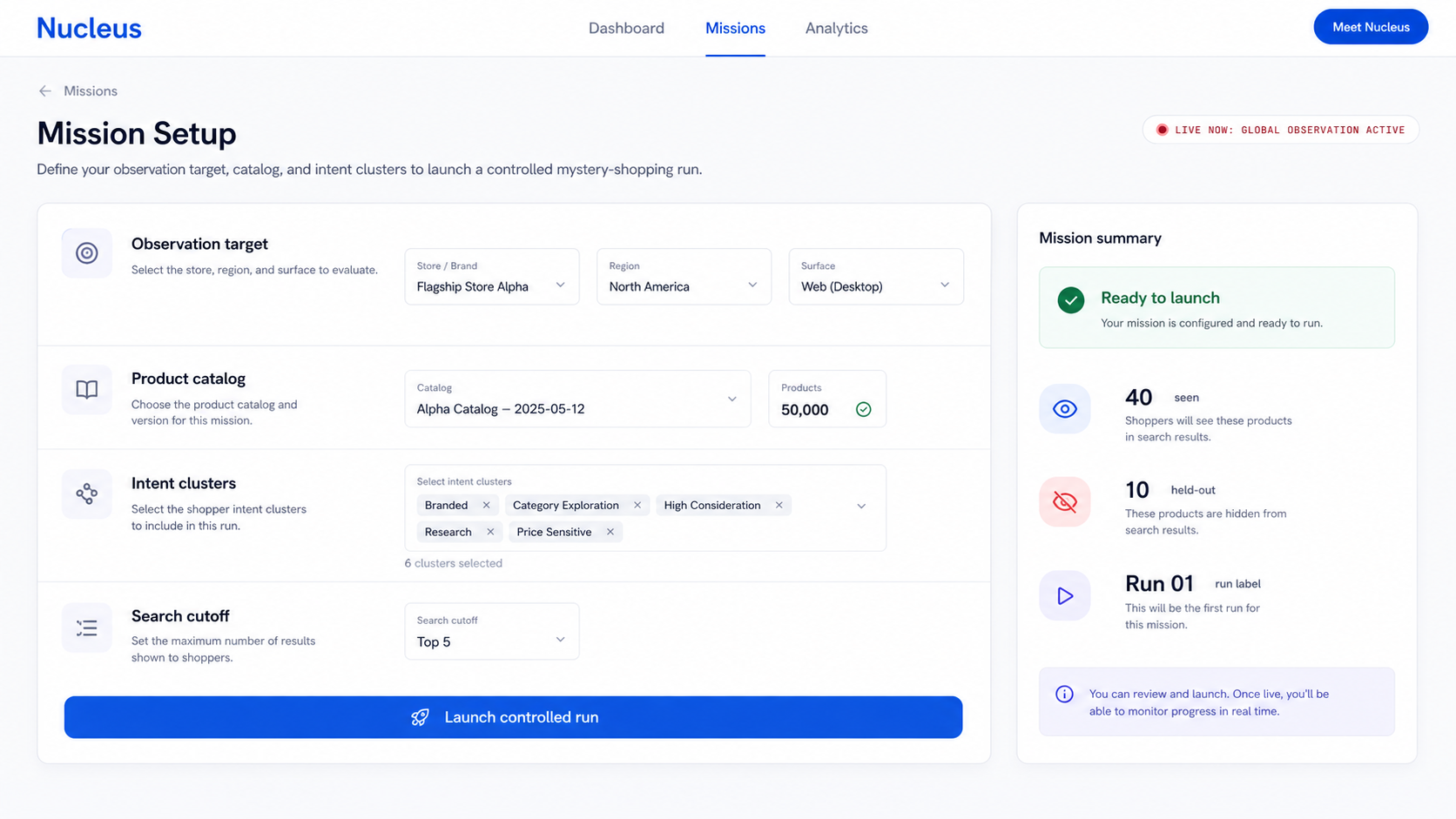
Mission Setup Wireframe
-
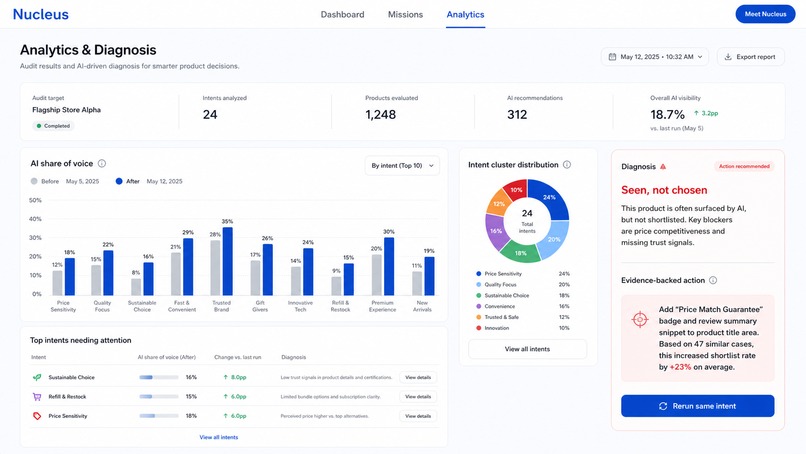
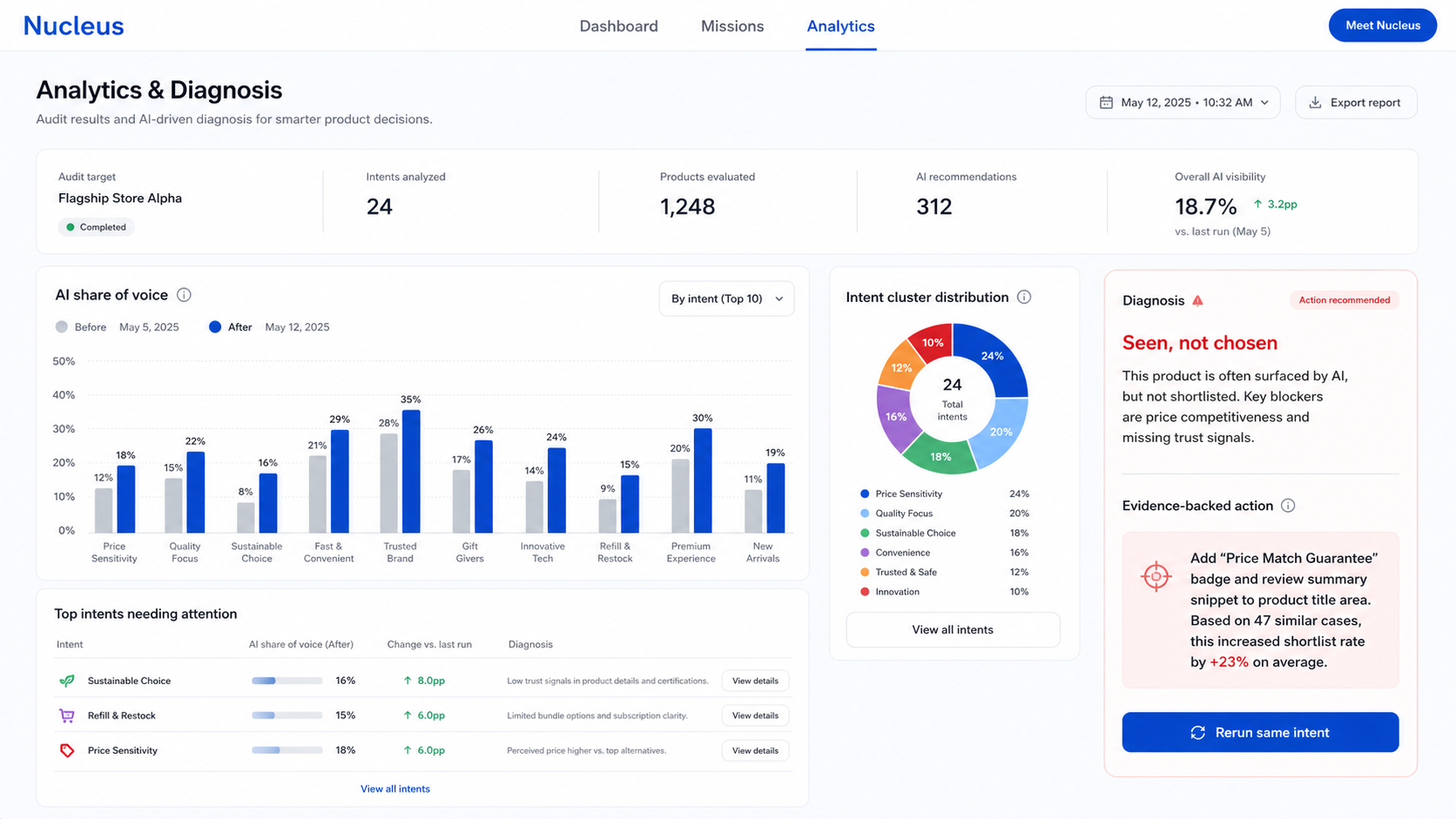
Analytics & Diagnosis Wireframe
-
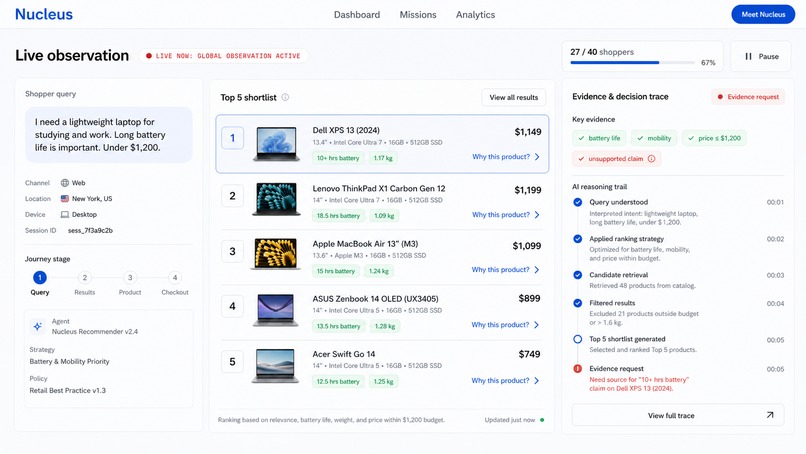
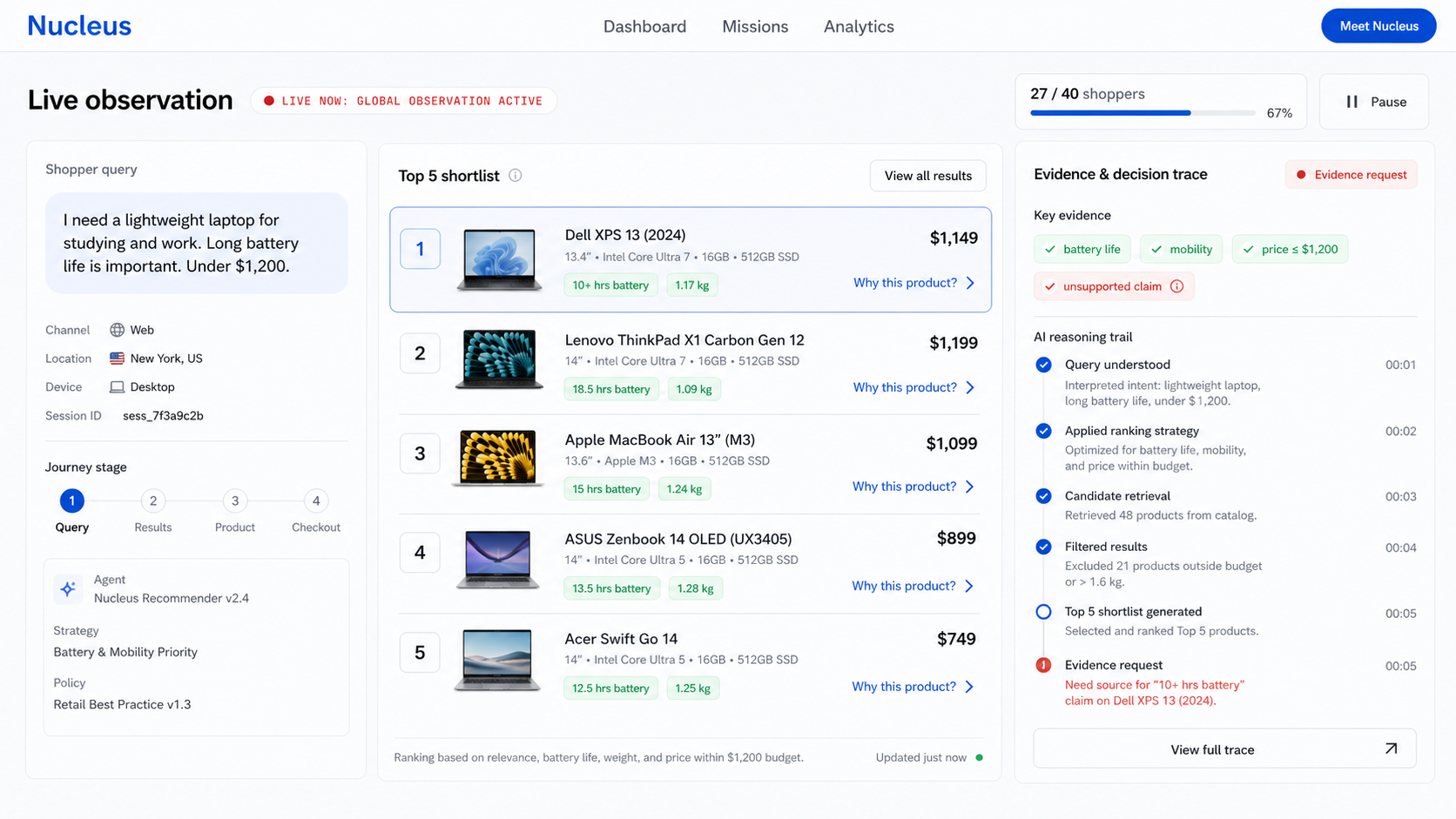
Live observation Wireframe
About Nucleus
Inspiration
Shopping is shifting from keyword searches to conversations with AI assistants. Instead of searching for “laptop 16GB RAM,” a consumer may ask:
“I need a lightweight laptop for university, coding, and occasional gaming that lasts all day and costs under S$1,500.” Consumers expect AI to understand their complete situation. However, most product content is still designed for websites and search engines. Brands also cannot easily see why an AI assistant recommends one product while silently ignoring another. This inspired Nucleus, an AI-commerce platform that helps consumers find suitable products and helps brands understand, measure, and improve how AI agents evaluate them.
What Nucleus Does
Nucleus supports two connected groups: consumers and brands. For consumers, we created two shopping experiences:
- QuickPick provides a fast, simple recommendation for users who do not want to study technical specifications.
- DeepCompare provides detailed comparisons, evidence, specifications, and trade-offs for users who want greater control. Nucleus evaluates the shopper’s full intent—including budget, lifestyle, priorities, environment, and constraints—rather than matching products using keywords alone. For brands, Nucleus acts like an independent AI shopper. It tests products against realistic shopping requests and measures how often each product appears in the Top 5 recommendations. Example: [ \text{Win Rate} = \frac{\text{Relevant intents where the product enters the Top 5}} {\text{Total relevant intents tested}} \times 100\% ]
When a product loses, Nucleus identifies two main failure modes:
- Not Seen — the AI could not discover or understand enough relevant information.
- Seen but Not Chosen — the product was considered, but another product matched the shopper’s needs better. Nucleus then recommends the smallest evidence-backed change that could improve the outcome.
How We Built It
We used laptops as our first product category because laptop purchases involve both technical specifications and personal considerations such as portability, battery life, workload, durability, and price. Our system begins with natural shopping requests and expands them into different personas and intent variations. These variations test the catalogue across different budgets, priorities, and use cases. For each intent, Nucleus:
- Understands the consumer’s needs.
- evaluates the available product information.
- Produces a ranked shortlist.
- Records which products were seen and selected.
- Explains why a product won or lost.
- Suggests an evidence-backed improvement.
- Re-runs the same scenario to measure the result. This final step is what makes Nucleus different. We do not rely only on AI-generated explanations. We change one supported variable and test whether the recommendation outcome changes. For example, if a laptop loses because its battery performance is unclear, Nucleus may suggest adding verified battery evidence. It then re-runs the same shopping intent to see whether the laptop enters the Top 5.
Challenges We Faced
One major challenge was translating human situations into product requirements. Consumers describe their lifestyles, not catalogue attributes. Nucleus must understand what “working during long flights” or “carrying it around campus” means when comparing products. Another challenge was supporting both casual and technical shoppers. QuickPick and DeepCompare allow users to choose the level of detail they want. We also needed to prevent AI from inventing persuasive but unsupported marketing claims. Nucleus classifies every proposed improvement as:
- Supported
- Evidence Required
- Product Gap When evidence is missing, Nucleus requests proof instead of generating a claim. If the product genuinely does not qualify, it reports the limitation honestly.
What We Learned
We learned that AI-commerce optimization is more than adding keywords. AI agents need context, clear attributes, comparisons, constraints, and trustworthy evidence before they can confidently recommend a product. We also learned that visibility alone is not enough. Brands need to understand why they lost and whether a proposed improvement actually changes the outcome. Although our prototype focuses on laptops, the same process can support skincare, electronics, fitness products, home appliances, travel equipment, and other categories. As AI assistants become the new storefront, Nucleus makes their product decisions visible, explainable, measurable, and improvable.
Nucleus helps consumers choose confidently—and helps brands improve how AI agents choose them.
Built With
- agenticai
- analytics
- automation
- commerce
- ecommerce
- genai
- llm
- natural-language-processing
- optimization
- personalization
- recommendations
- responsibleai
- retailtech
- shopping

Log in or sign up for Devpost to join the conversation.