-
dashboard
Inspiration
Hospital systems are fragmented. Nurses and doctors spend hours on administrative overhead, chasing alerts across disconnected monitors and manually coordinating calls. This problem is compounded by chronic understaffing. When information is hard to access, patient deterioration can go unnoticed. We built Nucleus to attack the root cause. Information fragmentation at the point of care.
What it does
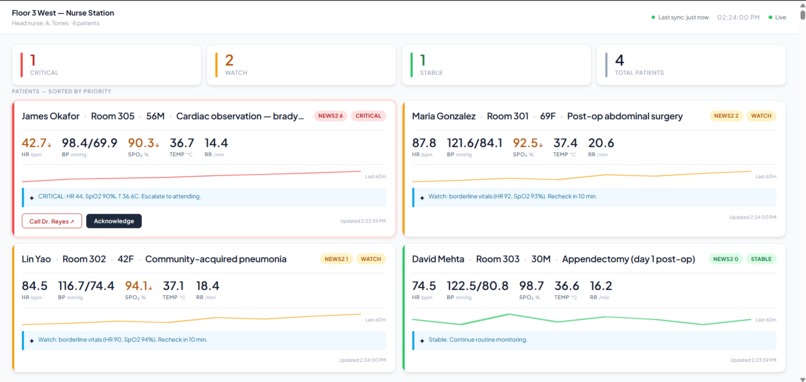
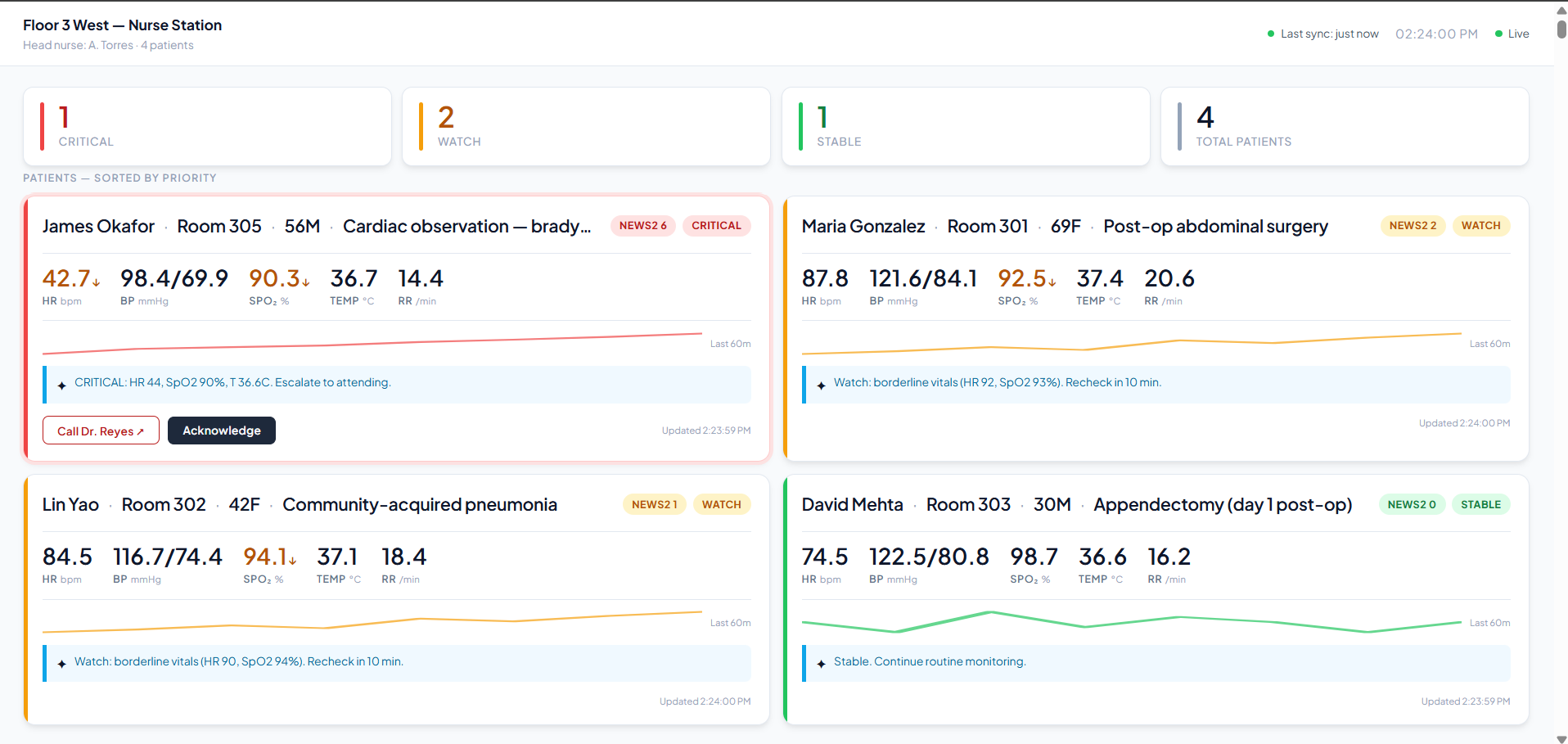
Nucleus is a centralized, real-time dashboard that gives a nurse everything they need to manage an entire floor from one screen:
- Live Patient Grid: Tracks patients dynamically by clinical severity.
- NEWS2 Integration: Automatically calculates the National Early Warning Score 2, assigning risk bands (None/Low/Medium/High) based on real-time vitals.
- AI Clinical Notes: An LLM-powered agent (Claude) generates 1-2 sentence context-aware notes for every state change.
- Smart Triage: Patients are automatically ranked: Critical → Watch → Stable.
- Intervention Tools: A doctor call queue auto-populates when a patient enters a critical state, allowing for one-tap acknowledgments and doctor paging.
Working Features
- Real-time Vitals Monitoring: Tracks HR, BP, SpO₂, Temp, and RR with trend indicators (↑↓) when values drift out of range.
- Clinical Indicators: Support for O₂ supplementation and ACVPU (Alert, Confusion, Voice, Pain, Unresponsive) status via blue/purple badges.
- Dynamic Sorting: Cards re-rank instantly every 10 seconds via Supabase Realtime as conditions change.
- Acknowledge & Call System: Interactive "Acknowledge" and "Call Doctor" buttons to manage flags and trigger intervention entries in the queue.
- Agent Console: A live terminal view showing the multi-agent NEWS2 breakdowns and flag transitions, perfect for stage demos.
- Audit Trail: Every vital reading is logged row-by-row in the
vitals_readingstable in the Supabase Table Editor for full clinical accountability.
How we built it
Nucleus utilizes a multi-agent architecture built on Fetch.AI’s uAgents:
- Patient Agents: Lightweight Python agents (one per room) poll vitals every 10 seconds and calculate NEWS2 scores.
- Floor Aggregator: Collects signals from all rooms and writes structured state to a Supabase (PostgreSQL) database.
- Real-time UI: A React frontend consumes updates via Supabase Realtime WebSockets, ensuring the dashboard reflects the floor state with zero latency.
- Clinical Intelligence: Claude analyzes the vitals delta to provide actionable context.
Challenges we ran into
Acquiring real-time hospital datasets is difficult due to HIPAA regulations. To solve this, we built a mock data generator in Python, seeding it with realistic clinical ranges and variance patterns based on adult reference intervals. This forced us to deeply research clinical thresholds, which ultimately made our NEWS2 scoring logic more robust.
Accomplishments that we're proud of
We built a system that can page doctors remotely to their phones.
Built With
- claude
- fetch.ai
- react
- supabase


Log in or sign up for Devpost to join the conversation.