-
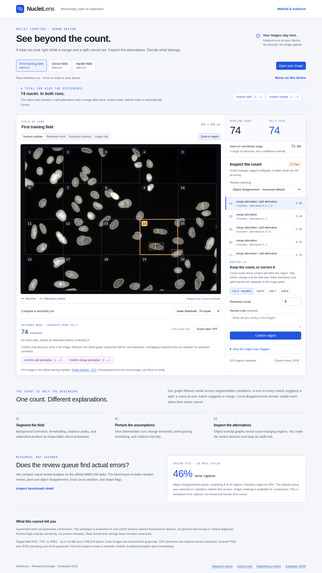
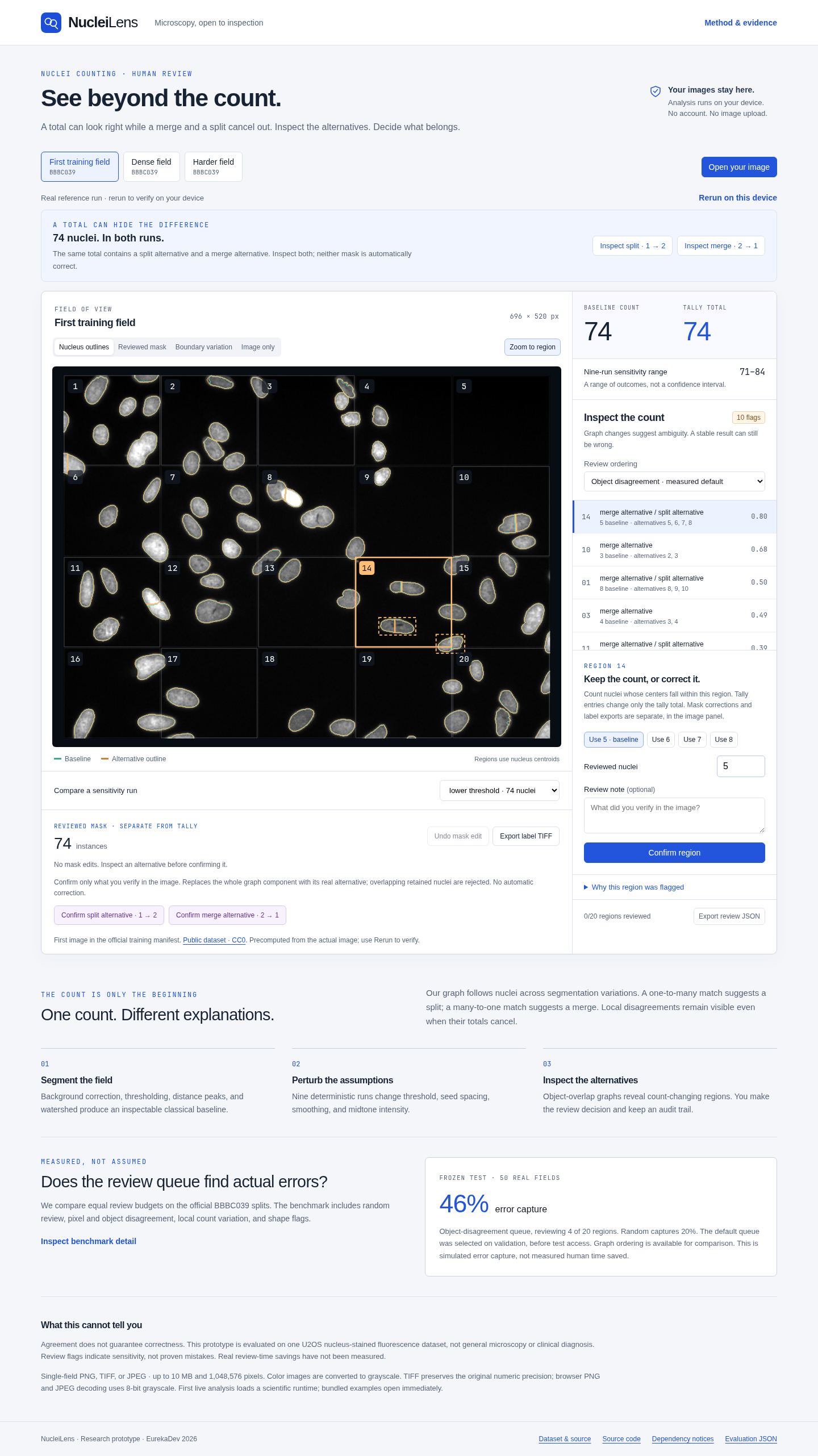
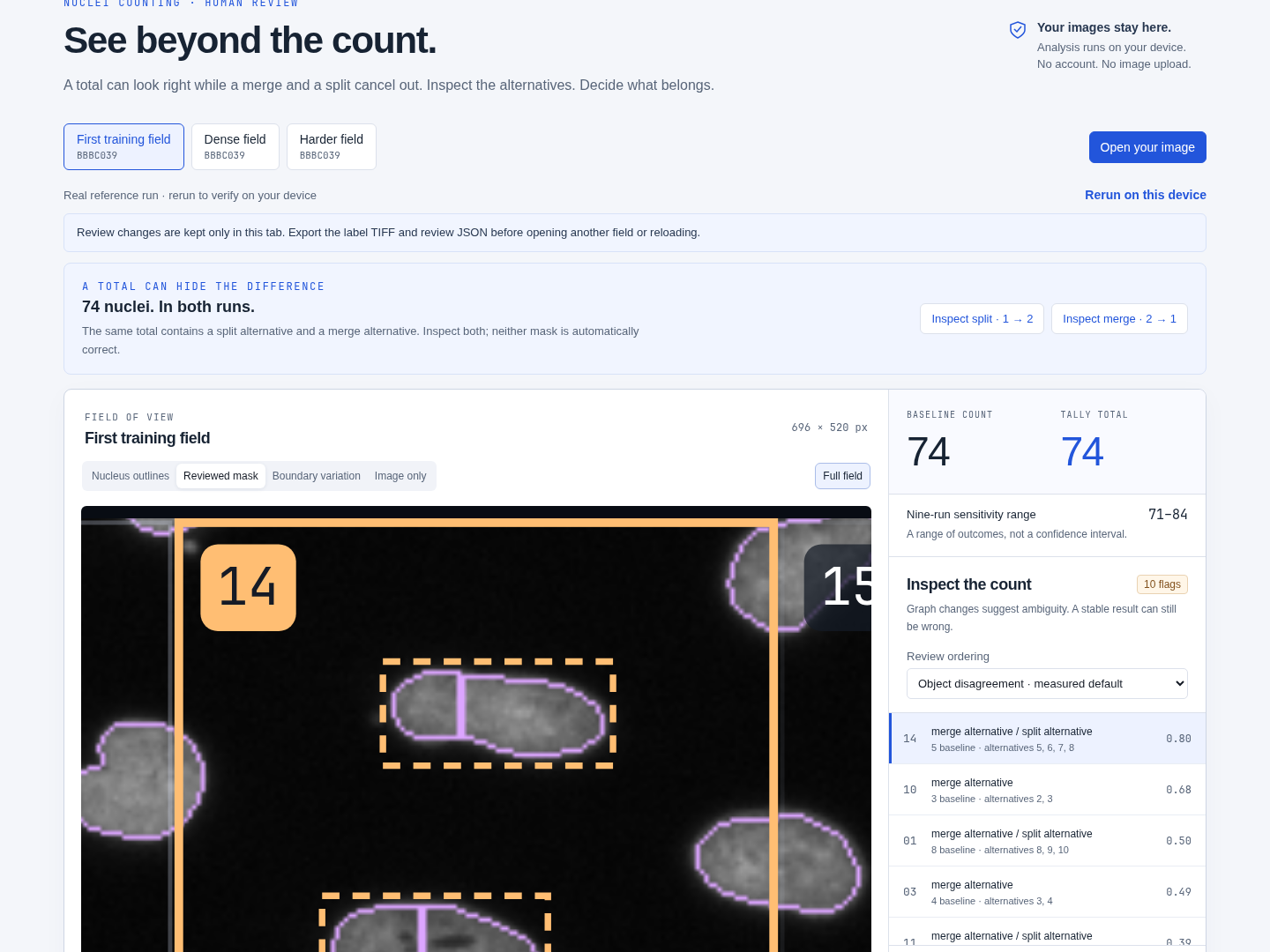
Actual interface and real BBBC039 training field. Reference results are labeled and can be rerun locally.
-
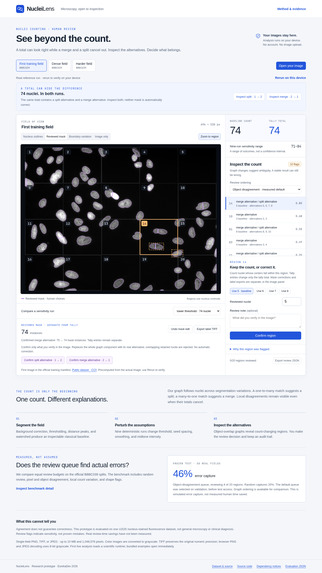
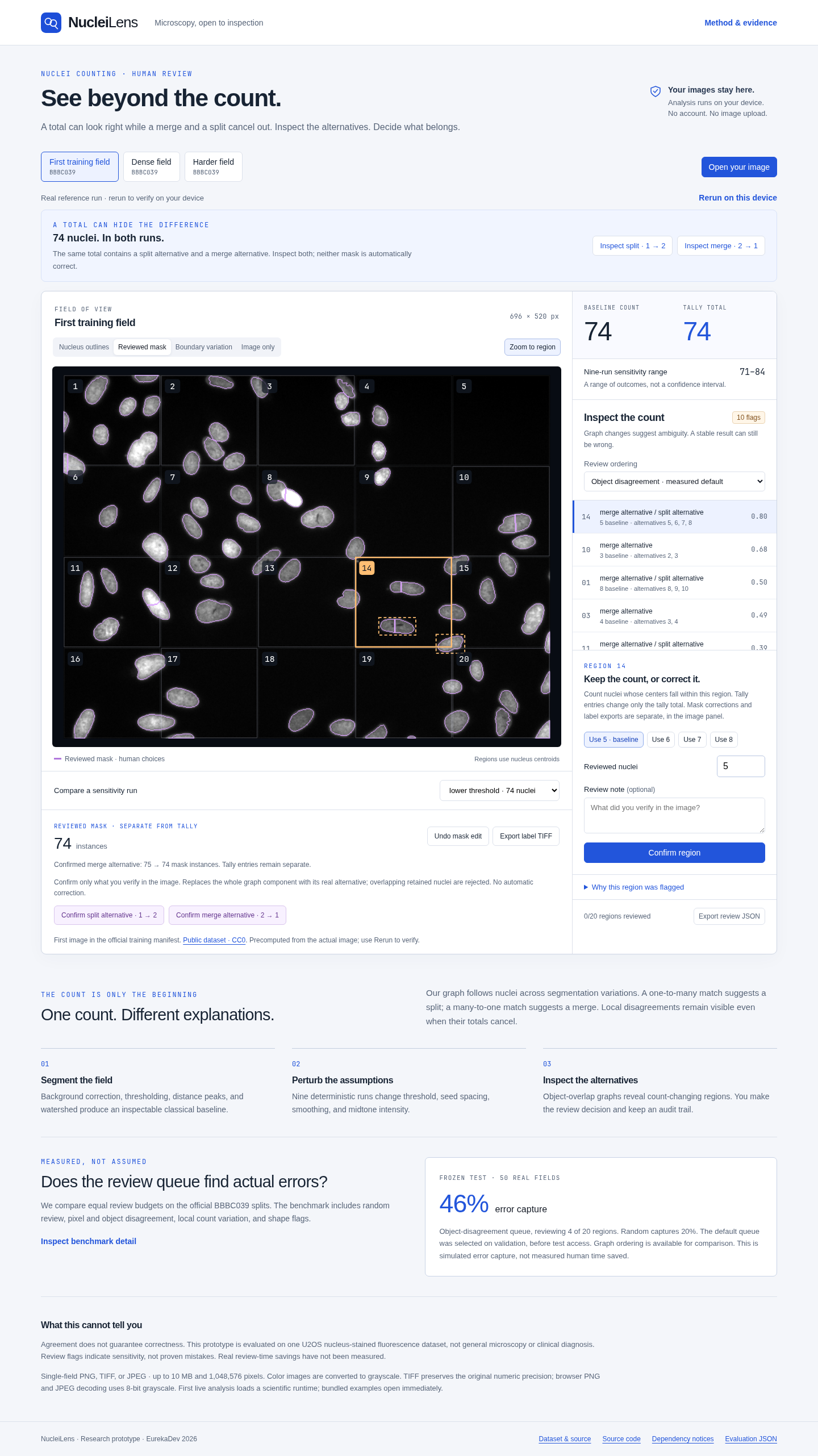
Automated workflow example: opposing split/merge mask choices preserve total74. Not a human-validated correction.
-
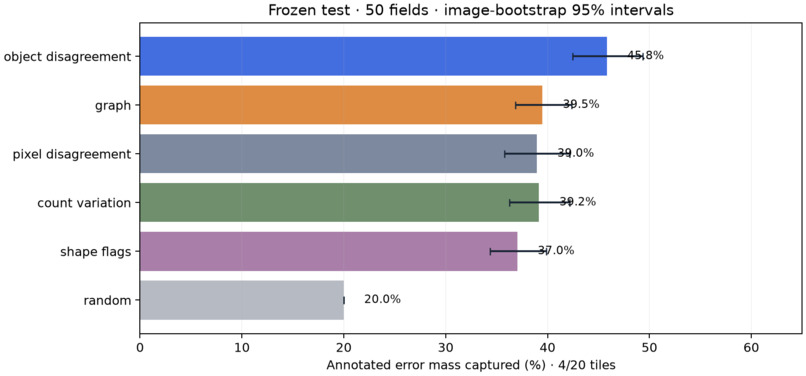
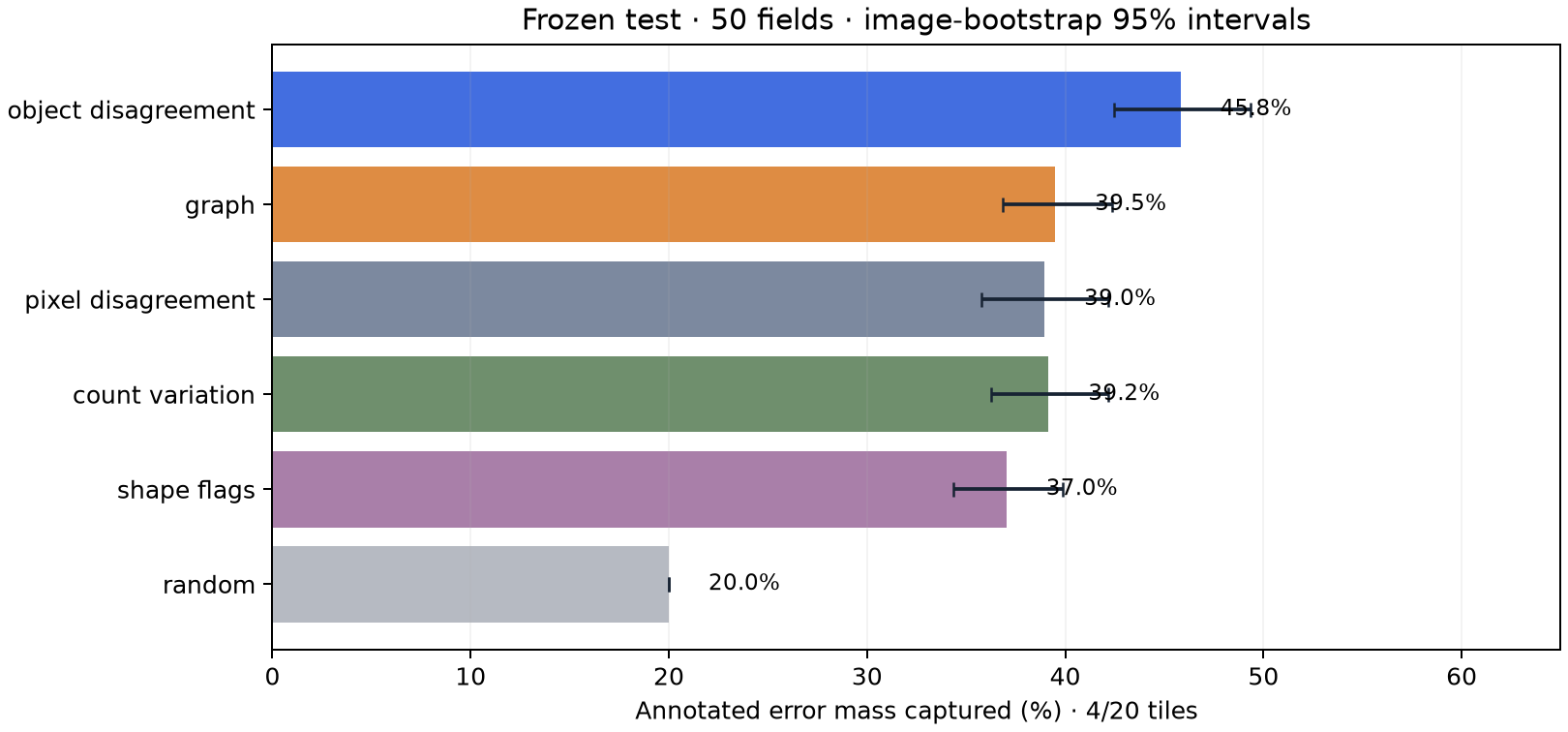
Frozen50-field assessment: actual equal-budget FP+FN error capture; not measured human time savings.
-
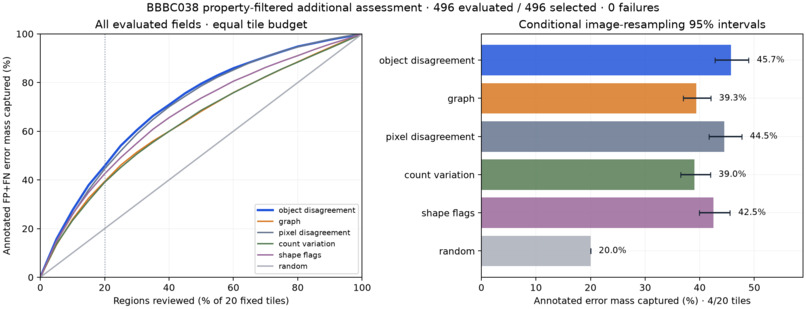
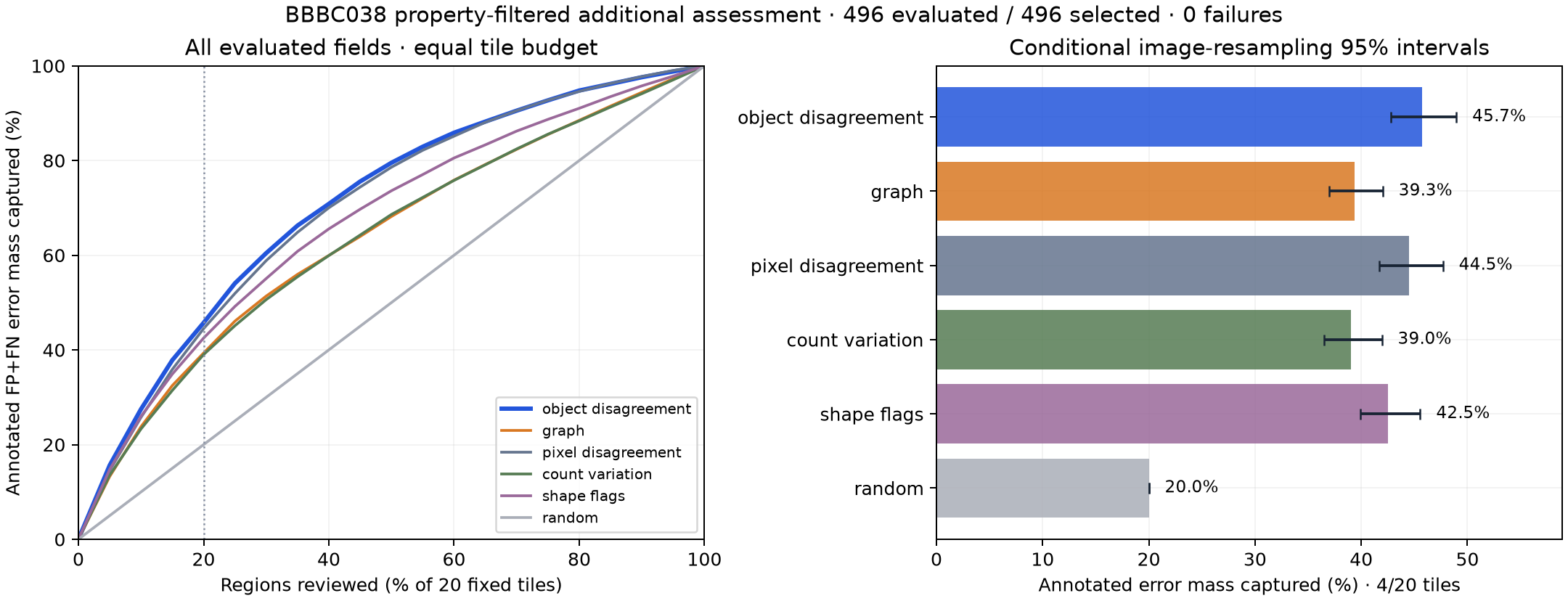
Frozen additional assessment:496 property-filtered images; six queues and conditional intervals. Not independent biological validation.
-
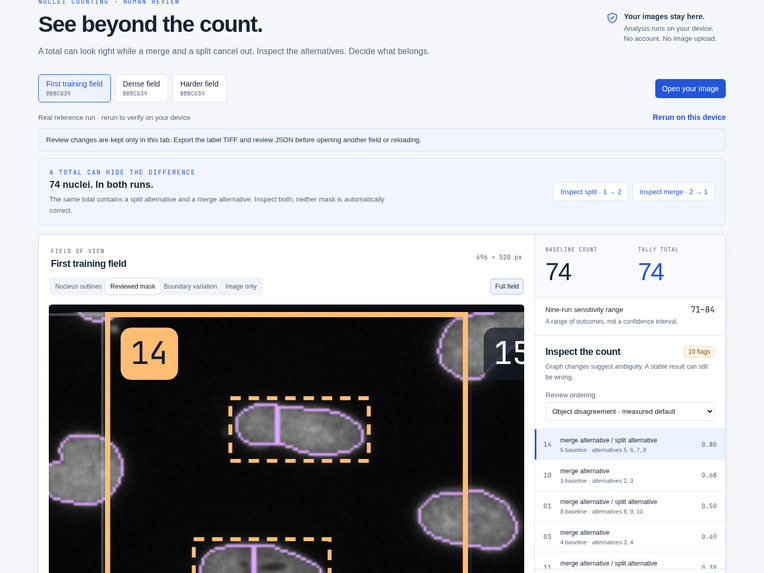
Actual alternative outlines and local graph-component review. Human choices are auditable, not automatically correct.
-
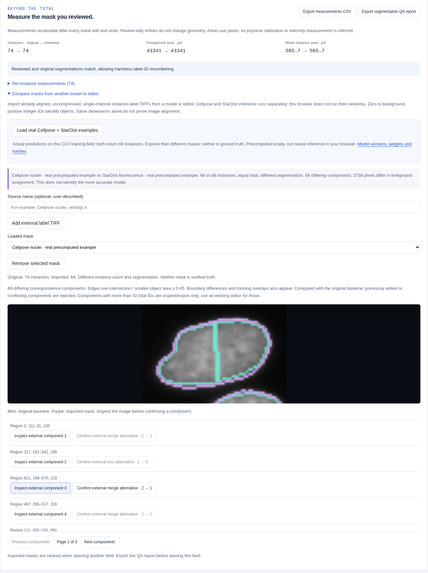
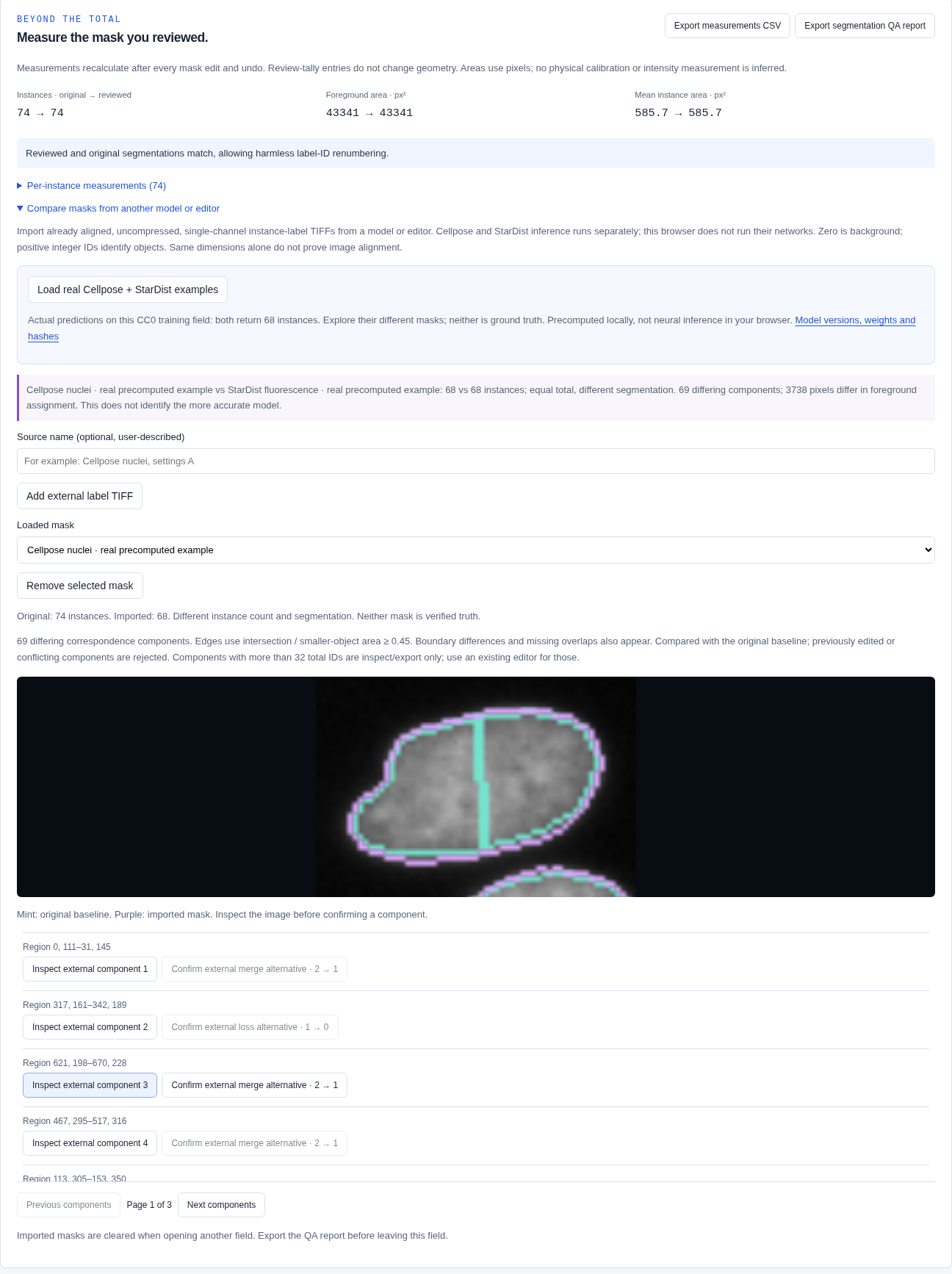
Real Cellpose/StarDist predictions:68each, different masks. Inspect an original/imported merge hypothesis; export auditable measurements.
Inspiration
A segmentation merges two nuclei. Elsewhere, it splits one nucleus into two masks. The total stays unchanged, while the objects differ.
In our fixed assessment of 50 public microscopy fields, four fields had exactly correct total counts while retaining 100 unmatched instances under object-level evaluation. A plausible total can hide disagreement about which nuclei exist.
We built NucleiLens for biology students and researchers who want to inspect the assumptions behind a count. The public BBBC039 benchmark and its associated study provide a concrete way to evaluate instance-level errors rather than rely on a convincing screenshot. [1,2]
What it does
Open a real bundled field or your own single-field image. NucleiLens runs nine deterministic segmentation sensitivity probes on your device, compares their object correspondences, and shows the actual competing outlines.
The signature example is real: two runs both count 74 nuclei, yet the graph contains a 1 → 2 split alternative and a 2 → 1 merge alternative. Click each explanation to inspect it. Neither alternative is automatically declared correct.
A reviewer can select a region, compare candidate counts, confirm a tally, undo it, and export a record with the input hash and analysis configuration. Tally entries stay separate from mask geometry. After each mask confirmation or undo, the interface reports the new mask-instance count beside the unchanged review-tally total. A reviewer can also explicitly confirm a whole graph-component alternative, producing a real edited label map. Overlap with retained nuclei is rejected; fresh IDs and exact undo preserve integrity. Export a lossless unsigned 32-bit TIFF and a SHA256-linked audit. These human choices are not automatically correct.
Model comparison and measurements
On the first training field, load two actual pretrained Cellpose and StarDist predictions. Both count 68 instances, but their foreground assignments differ at 3,738pixels and their partitions differ in 69 correspondence components. These components include boundary hypotheses; they are not 69 verified errors or a model accuracy comparison. View the actual source/model/weight/output hashes. These are precomputed CPU predictions; the browser does not run their networks.
Import up to three aligned, uncompressed unsigned label TIFFs from a model or editor. Inspect an original/imported component before explicitly confirming it. Existing conflict checks, fresh IDs and exact undo protect mask integrity. Area, pixel-center centroid, exposed grid-edge perimeter and border measurements recalculate from the actual reviewed mask after edits and undo. Export the CSV, label TIFF and QA JSON linking original/reviewed/source hashes and pairwise comparisons. Geometry alone does not establish alignment or correctness.
Cellpose, StarDist and napari already provide segmentation and editing, while CellSampler combines segmentation methods. Model aggregation and shape measurement are established prior art, not a scientific-first claim. Our addition makes these comparisons and audit semantics concrete in the same review workflow; measured reader benefit remains future work. [6]
How we built it
The shared Python core uses intensity normalization, background correction, Otsu thresholding, distance peaks, and marker-controlled watershed. Eight alternatives vary threshold, seed spacing, smoothing, and midtone intensity around the baseline.
Sparse bipartite overlap graphs connect baseline and alternate instances when their intersection covers at least 45% of the smaller object. Components with different object cardinalities expose local split, merge, missing, and additional-detection hypotheses; count-neutral boundary changes remain separate.
A React/TypeScript interface runs the numerical Python code inside a dedicated Pyodide/WebAssembly worker. Scientific libraries and real samples are self-hosted. Images are not sent to a project inference service. TIFF preserves numeric precision; browser PNG/JPEG decoding uses 8-bit grayscale. A bounded local Python companion provides a separate recovery path.
The core innovation
The contribution is an original, inspectable count-audit workflow: identical aggregate counts can be unpacked into opposing local object explanations, linked to real alternate masks and explicit human decisions.
Watershed, uncertainty review, graph matching, and sensitivity analysis are established methods. We do not claim a scientific first or state-of-the-art segmentation. The graph is an explanation layer; the review order is selected by measured comparison.
Challenges we ran into
Our initial full-validation run had count MAE 25.06. Saturated bright plateaus and weak-signal fields caused serious failures. Validation-guided safeguards reduced MAE to 5.10, with failure cases retained.
Our original graph-ranking hypothesis also failed: simple object disagreement found more annotated error mass at the same budget. A bounded nonnegative ranker failed its adoption gate too. We kept the stronger simple queue, preserved the negative results, froze the protocol, and assessed all 50 test fields without test-driven tuning.
Browser deployment required preserving 16-bit TIFF precision while running the same scientific code locally. We replaced the browser Pillow dependency with bounded TIFF/browser decoding and a small numerical PNG encoder, reducing runtime assets to about 39 MB.
Additional assessment
We publicly froze the unchanged source, image-property filter and 496-field BBBC038 manifest before inference. 43 potential same-size content overlaps with BBBC039 were removed first. All 496 selected fields were retained: zero structural reference/inference failures, count MAE 6.54, mean instance F1 0.772. The preselected object queue captured 45.7% of annotated error mass at the same 20% tile budget, versus 39.3% graph and 20% expected random.37 fields had F1 below 0.5 and remain in the aggregates. A visually sparse original reference is documented, not repaired or excluded after scoring. [4]
This property-filtered labeled training archive is not an independent biological group test. Other shared sources, mixed modalities and reference imperfections remain; no universal accuracy or human benefit follows from these numbers.
Accomplishments
- Actual device-local scientific analysis and a public, login-free review workflow.
- A verified same-total opposing split/merge example from a real public image.
- Complete frozen 50-field test: count MAE 5.12, mean instance F1 0.827.
- The preselected object-disagreement queue captures 45.8% of annotated FP+FN error mass at a 20% tile-review budget, versus 20.0% expected random review. Graph ranking captures 39.5%; its inferiority is disclosed.
- Full per-image results, fixed comparator budgets, tie averaging, image-bootstrap intervals, source/archive hashes, and reproducible commands.
- Actual split/merge mask correction, exact undo, compatible reruns, lossless TIFF plus audit-hash readback on the deployment.
- Actual Chromium and Firefox analysis, mask export/hash verification and compatible reruns.
- Automated WCAG A/AA checks across desktop, expanded benchmark/additional assessment, and mobile layouts; manual accessibility checks remain.
These are algorithm and workflow measurements, not evidence of human time savings, adoption, clinical benefit, or generalization to all microscopy.
Where it fits
CellProfiler, ImageJ and QuPath already provide established segmentation/counting workflows. NucleiLens focuses on a small inspectable job: show the opposing object alternatives behind a plausible count, then record the reviewer's chosen label map without a project inference upload. It does not replace multichannel, stack or batch analysis. No head-to-head usability or accuracy advantage has been measured. The repository contains a sourced capability comparison. [5]
What we learned
A better explanation is not automatically a better ranking policy. Our object graphs make opposing hypotheses visible, while a simpler overlap-based queue concentrates more benchmark errors. Treating those as separate responsibilities produced a more honest product.
We also learned that a correct count can coexist with poor instance correspondence, and that uncertainty under chosen perturbations cannot detect every stable-but-wrong result.
What's next
A controlled reader study and source-group-controlled external validation. We will measure those outcomes before claiming user-effort or scientific improvements.
Built with
Python, NumPy, SciPy, scikit-image, React, TypeScript, Vite, Pyodide, WebAssembly, GeoTIFF.js, FastAPI, pytest, Vitest, Playwright. Optional local adapters: Cellpose, StarDist, PyTorch CPU and TensorFlow CPU.
Links
- Live application: https://nuclei-lens.dumbthing999.chatgpt.site
- Public source: https://github.com/dumbthing999-ui/nuclei-lens
- Complete test evidence: https://github.com/dumbthing999-ui/nuclei-lens/tree/main/evaluation/test
Sources and scope
- Broad Bioimage Benchmark Collection, BBBC039: https://bbbc.broadinstitute.org/BBBC039 — public CC0 U2 OS fluorescence images, instance annotations, official partitions.
- Caicedo et al., Evaluation of Deep Learning Strategies for Nucleus Segmentation: https://doi.org/10.1002/cyto.a.23863 — dataset-associated analysis of instance segmentation and error modes.
- Our fixed protocol and measured outputs: repository
evaluation/frozen/andevaluation/test/. - BBBC038v1 official record: https://bbbc.broadinstitute.org/BBBC038 — CC0 original labeled stage1 archive; full additional protocol/records: https://github.com/dumbthing999-ui/nuclei-lens/tree/main/evaluation/additional.
Established-tool comparison with primary documentation: https://github.com/dumbthing999-ui/nuclei-lens/blob/main/docs/PRODUCT_COMPARISON.md.
Robust consensus nuclear and cell segmentation, 2025: https://doi.org/10.3389/fgene.2025.1547788. Implementation/provenance and established-tool sources: https://github.com/dumbthing999-ui/nuclei-lens/blob/main/docs/MASK_QA.md and https://github.com/dumbthing999-ui/nuclei-lens/blob/main/docs/OPTIONAL_MODELS.md.
This is a research/education prototype, not a clinical diagnostic tool. AI assistance was used for development, research, review, and draft writing. Reported measurements come from reproducible program execution; human-reader benefits remain unmeasured.

Log in or sign up for Devpost to join the conversation.