-
-
(Nuclear) Spaghetti, Lasagna, Parking Garages
Inspiration
Our project was inspired by a sequence of papers by Dr. Caplan (Indiana University) and collaborators on the interesting phases that are hypothesized to occur in the extreme conditions in neutron stars. Being condensed matter physicists (some current, some future), we decided to bring a new perspective to this line of work. Plus, who doesn`t love pasta?
What it does
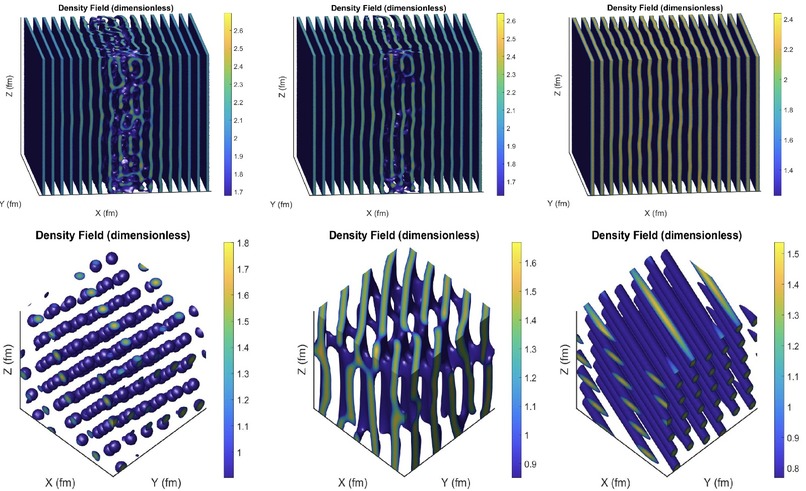
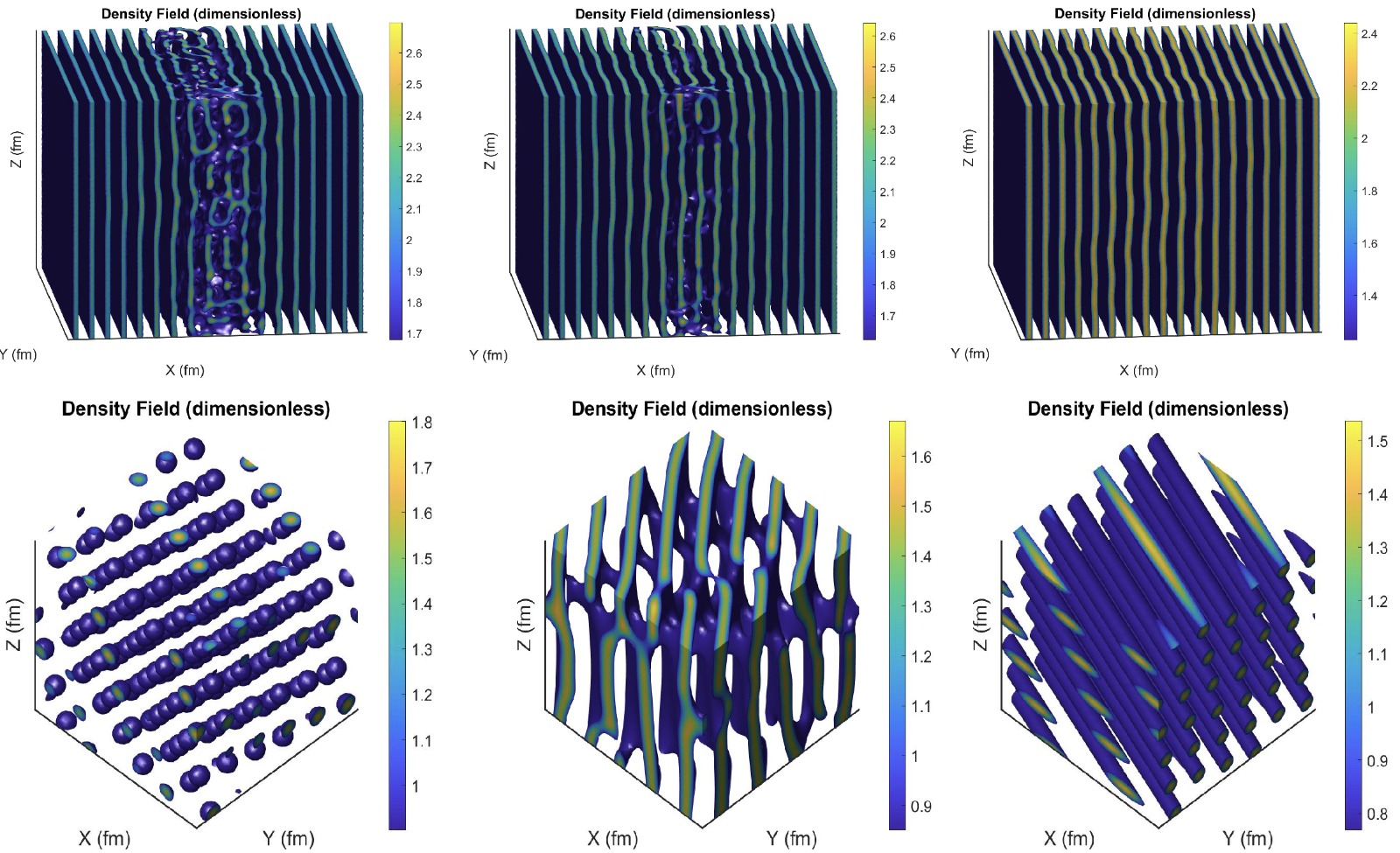
We have devised an efficient method to cook (simulate) nuclear pastas on GPUs. We use the statistical physics of phase transitions (Phase Field Crystals), port the discretized equations to GPU, and simulate the formation of nuclear pasta at different initial conditions, temperature, density, noise, etc. We actually use the known nuclear interactions, so we are really talking nuclear physics (even though you may be misled to think we are only speaking of Pasta). Finally, we induced strain to the lasagna phase to create cool parking garage defects.
How we built it
The code was created on Matlab with the capacity to run on GPU. Some of the bigger simulation had to be run on a supercomputer (Beluga).
Challenges we ran into
Creating some of the exotic phases associated with the pasta using conventional method without having access to a phase diagram (or really not having much intuition at all) made it challenging to find appropriate simulation conditions. Also, as it turns out, simulating three dimensional systems on GPU is quite hard to do.
Accomplishments that we're proud of
Our model successfully simulated parking garage defects, which we didn't think was possible. We also discovered a new transient phase that has been reported in the literature! We are able to reproduce all the physics currently known, but we are capable of simulating much bigger systems and for much longer than anything that has been attempted thus far :)
What we learned
That it is extremely hard to scale a GPU-accelerated code and that having a phase diagram would be extremely useful to avoid rerunning the code in series with small change in initial condition in the hope to have different final system.
What's next for Nuclear Spaghetti Code
We believe we have the basic set-up to now start building a phase diagram, and also to couple to temperature so we can look at the effects of defects on thermal conductivity. This could make for a very interesting peer-reviewed paper.
Built With
- gpu
- matlab


Log in or sign up for Devpost to join the conversation.