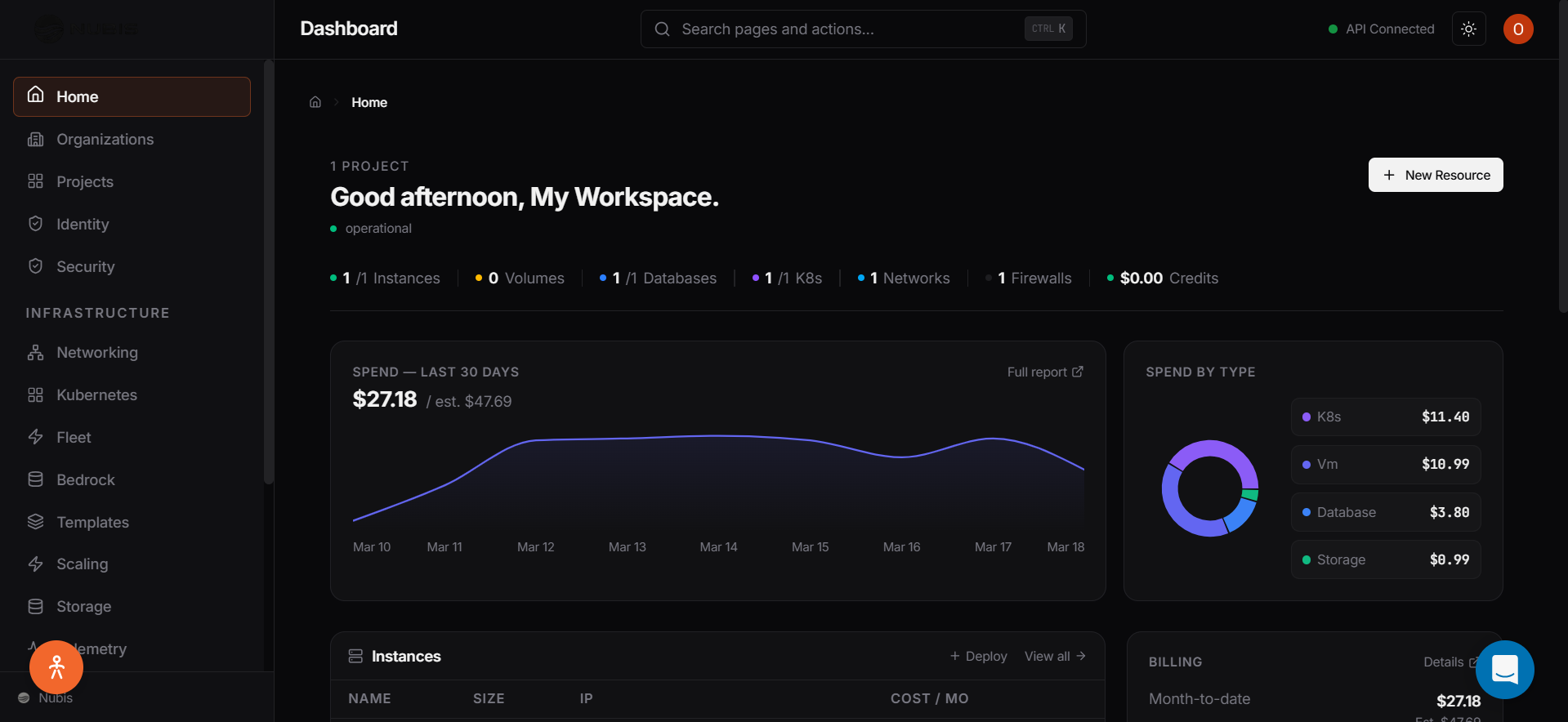
Nubis was born from a simple but persistent observation: building scalable products in emerging markets is unnecessarily difficult. Developers often face unreliable infrastructure, high latency, foreign currency barriers, and tools that are not designed with their realities in mind. While global cloud providers offer powerful systems, they rarely optimize for local constraints. Nubis set out to close that gap by rethinking cloud infrastructure from the ground up for builders operating in these environments.
Inspiration
The inspiration came from firsthand experience. Repeated friction while deploying and scaling applications revealed a structural problem, not just a tooling issue. Access to compute should not be a privilege tied to geography. Nubis is driven by the idea that infrastructure should be as accessible and predictable as electricity. If developers can rely on the underlying system, they can focus entirely on innovation.
At a conceptual level, Nubis treats infrastructure as a function of availability, cost, and performance:
$$ \text{Infrastructure Value} = \frac{\text{Performance} \times \text{Reliability}}{\text{Cost}} $$
The goal is to maximize this value for developers who have historically been underserved.
How It Was Built
Nubis was built with a modular, cloud-native architecture. The system is designed to be lightweight, scalable, and region-aware.
Core components include:
Compute Layer: Containerized workloads orchestrated for efficient resource usage Networking Layer: Optimized routing to reduce latency within local regions Storage Layer: Distributed and fault-tolerant data systems Control Plane: A unified interface for provisioning and monitoring resources
The architecture emphasizes simplicity at the user level while maintaining complexity under the hood. Developers interact with clean abstractions, while Nubis manages orchestration, scaling, and failover automatically.
Challenges
Several non-trivial challenges emerged during development:
Infrastructure Fragmentation: Local environments vary widely in reliability and performance Latency Optimization: Achieving low latency required careful regional design and routing strategies Cost Constraints: Keeping pricing accessible while maintaining performance demanded efficient resource allocation Trust and Reliability: Building a system that developers can depend on required rigorous testing and redundancy planning
One recurring challenge was balancing abstraction with control. Too much abstraction limits flexibility, while too little increases complexity. Nubis continuously iterates to find the right equilibrium.
What Was Learned
Building Nubis reinforced a few key principles:
Infrastructure must be designed for context, not just scale Simplicity is a feature, not a limitation Reliability is earned through consistency, not claims Developer experience is as critical as raw performance
It also became clear that emerging markets are not “edge cases.” They represent the next wave of global builders, and their needs should shape the future of cloud infrastructure.
Looking Forward
Nubis is not just a product, but a long-term vision. The aim is to evolve into a foundational layer for digital innovation, eventually operating at hyperscale with regionally distributed data centers.
The direction is straightforward: reduce friction, increase access, and enable builders to create without constraints.
Built With
- alertmanager
- axum
- better-stack
- clerk
- cloudflare-dns
- cloudflare-r2
- cloudflare-workers
- croct
- digitalocean
- digitalocean-gradient-ai
- digitalocean-kubernetes
- digitalocean-spaces
- docker
- docker-compose
- dodo-payments
- framer-motion
- grafana
- intercom
- javascript
- jwt
- kubernetes
- loki
- mdx
- namesilo
- neon
- next.js
- notion-api
- paystack
- playwright
- polar.sh
- postgresql
- prometheus
- radix-ui
- react
- react-hook-form
- react-router
- react-three-fiber
- recharts
- redis
- remotion
- render
- reqwest
- rust
- sentry
- serde
- sql
- sqlx
- tailwind-css
- tanstack-query
- three.js
- tokio
- tower
- typescript
- upstash-redis
- vercel-analytics
- vite
- wrangler
- xterm.js
- zod


Log in or sign up for Devpost to join the conversation.