Inspiration
NTC — NAH to Cancer — was inspired by an often-overlooked health risk: ultraviolet (UV) exposure in the United Kingdom.
Although the UK is not typically associated with intense sunshine, its UV index can reach levels of 5–8 during periods of elevated exposure. Many people underestimate the risks associated with UV radiation, despite melanoma affecting approximately 20,000 people in the UK each year.
We were particularly interested in the challenges surrounding timely diagnosis. Patients can face lengthy waits for appointments, investigations, and definitive results, potentially adding anxiety during an already stressful period.
This inspired us to explore a question: could artificial intelligence help healthcare professionals assess suspicious skin lesions more efficiently?
Our vision was to develop a system that could assist medical professionals with preliminary image assessment, supporting faster decision-making without replacing clinical expertise.
What it does
NTC is an AI-powered skin lesion classification prototype designed to distinguish between benign and malignant lesion images.
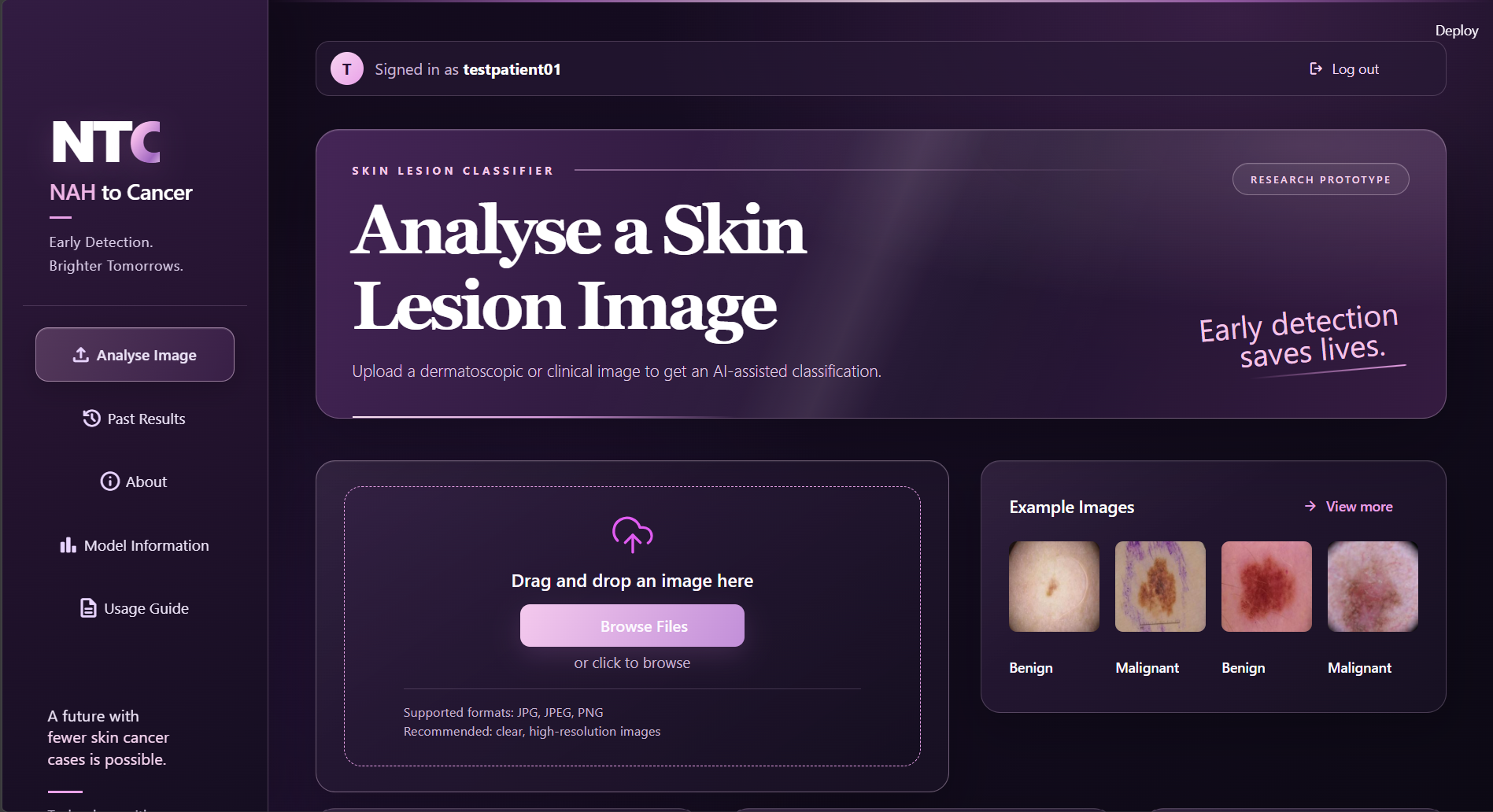
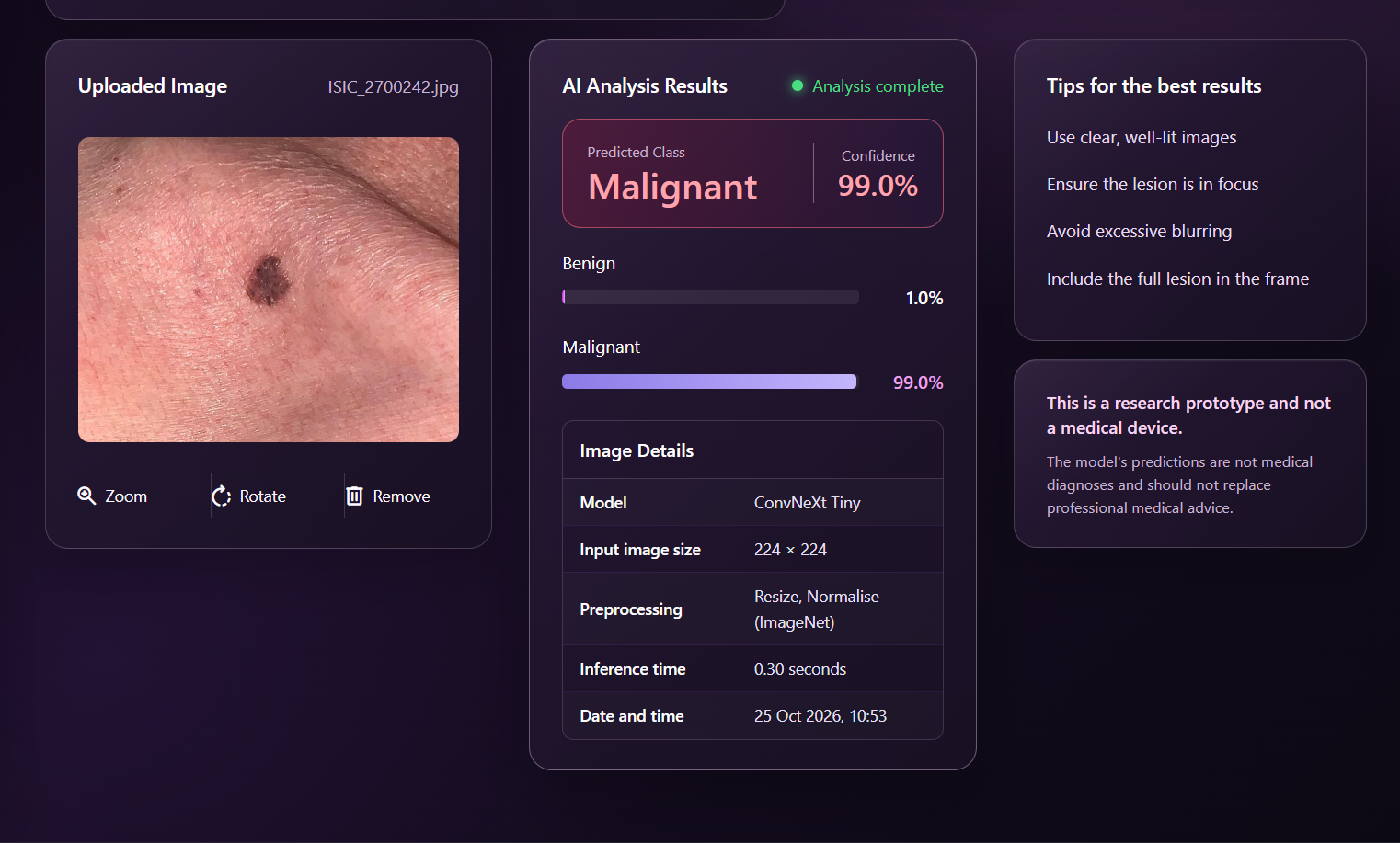
Users can upload an image through an interactive graphical interface, after which the trained model produces a classification alongside a probability breakdown for both categories.
The application combines several components:
- AI-powered image classification: predicts whether a lesion image is benign or malignant.
- Probability-based results: displays model confidence across both classes.
- Interactive user interface: provides an accessible way to interact with the machine learning model.
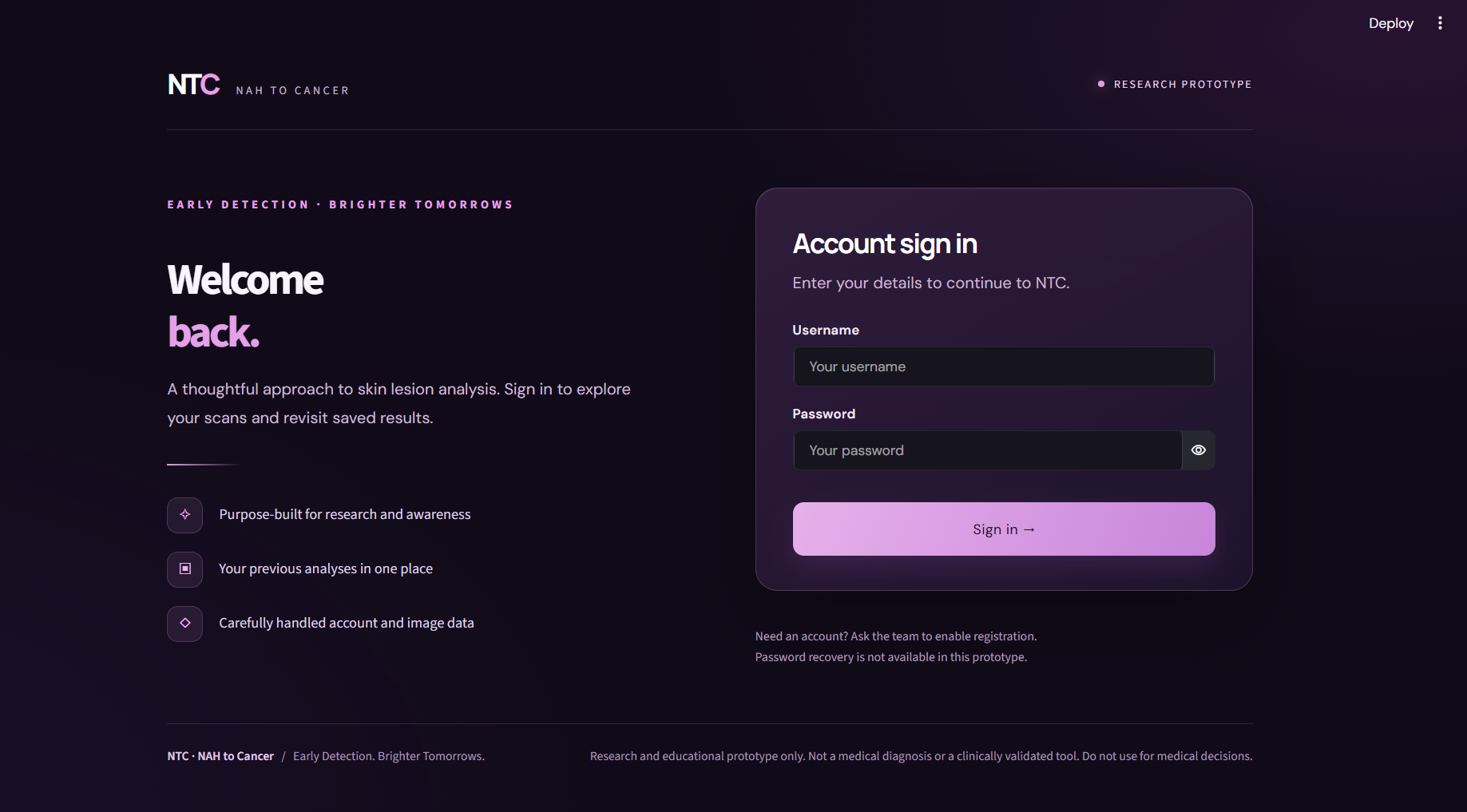
- User authentication: includes a login system to support controlled access.
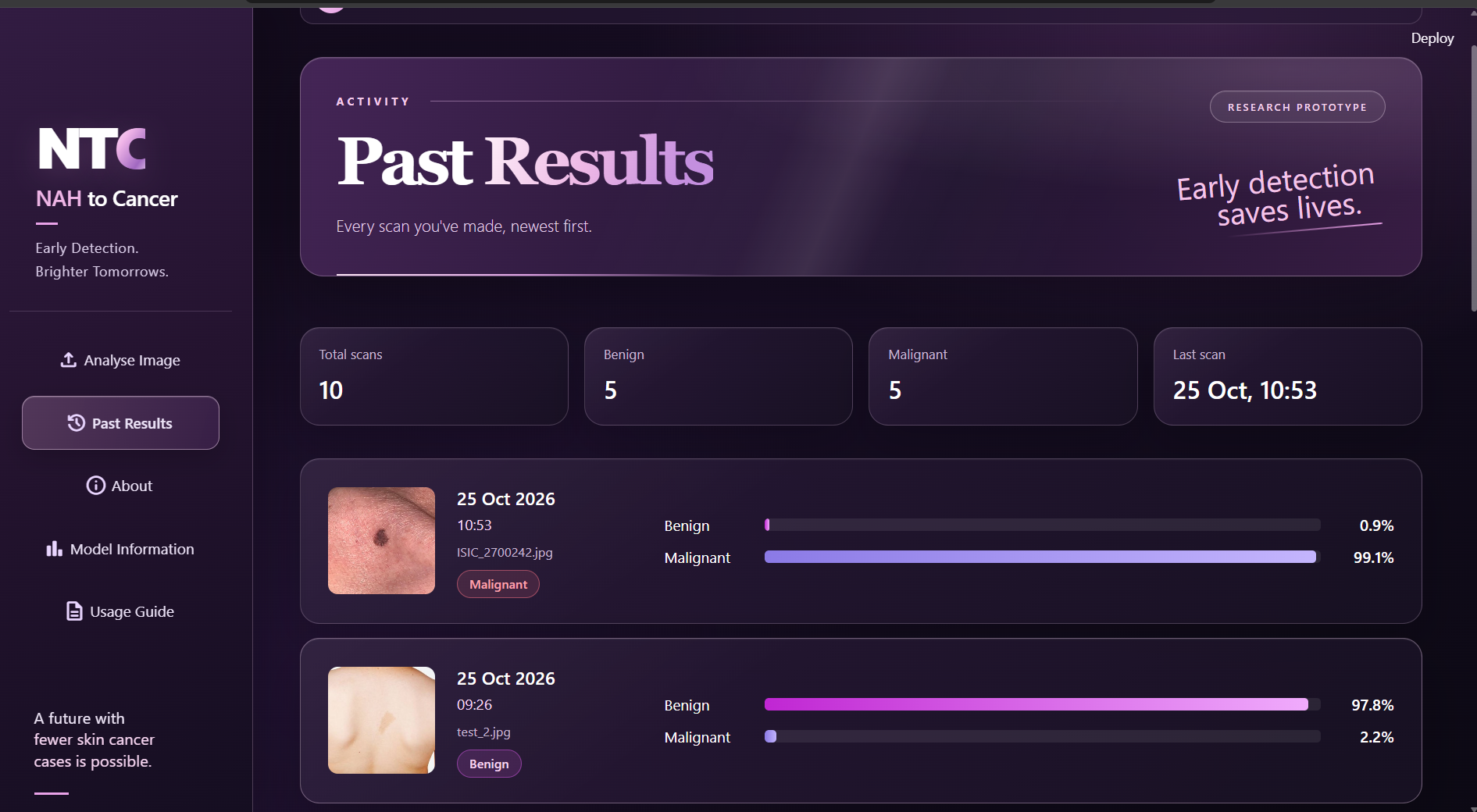
- Database integration: supports the application's data-management functionality.
NTC is currently a research prototype, not a clinically validated medical device. Its predictions are intended to demonstrate the potential of AI-assisted screening and should not be used as a substitute for professional diagnosis.
How we built it
We developed NTC using Python, PyTorch, and ConvNeXt-Tiny, a convolutional neural network architecture suited to image classification.
Our project used a dataset of approximately 13,900 benign and malignant skin lesion images. We trained the model over 10 epochs, allowing it to learn visual patterns associated with the two categories.
We evaluated the model using a validation set containing 2,000 images, evenly divided between 1,000 benign and 1,000 malignant samples.
Model performance
Our final-epoch evaluation produced the following results:
| Metric | Result |
|---|---|
| Validation accuracy | 94.25% |
| Sensitivity (malignant recall) | 92.2% |
| Specificity (benign recall) | 96.3% |
| ROC-AUC | Approximately 0.988 |
| Correct classifications | 1,885 / 2,000 |
| Training epochs | 10 |
The confusion matrix from the final epoch was:
                  Predicted
                 Benign  Malignant
Actual Benign      963       37
Actual Malignant    78      922
This means the model correctly identified 963 benign lesions and 922 malignant lesions, while producing 37 false positives and 78 false negatives.
The results are encouraging for an early-stage prototype, particularly the ROC-AUC score of approximately 0.988, which suggests strong discrimination between the two classes on the evaluation data.
However, the 78 false negatives also demonstrate why further validation and sensitivity improvements are essential before any clinical application.
We received valuable guidance from Ameen Izhac, who is pursuing a PhD in Artificial Intelligence at Oxford, in structuring, developing, and refining our machine learning approach.
To make the model accessible, we built an interactive application using Streamlit, integrating image uploads, classification results, probability displays, authentication, and database functionality.
We also used AI-assisted development tools, including ChatGPT, Gemini, and Claude, to support interface design, debugging, and code refinement.
Throughout the project, we collaborated using Git and GitHub, integrating independently developed components into a single application.
Challenges we ran into
One of our greatest challenges was training the machine learning model.
Working with a dataset of approximately 13,900 images required careful data preparation, repeated experimentation, and significant computational time. Training was particularly demanding within the time constraints of a hackathon.
We also had to consider how to evaluate the model beyond accuracy alone. In melanoma classification, false negatives are especially important because a malignant lesion incorrectly classified as benign could create false reassurance.
Another major challenge was collaborative development through GitHub.
Different parts of NTC were developed across separate branches, including the interface and database components. Bringing these together involved resolving merge conflicts, debugging imports, and ensuring that the machine learning model remained compatible with the graphical interface.
Overcoming these challenges strengthened our understanding of both machine learning development and collaborative software engineering.
Accomplishments that we're proud of
We are proud to have transformed an idea motivated by a real healthcare challenge into a fully functioning AI-powered prototype.
Our main accomplishments include:
- Building a ConvNeXt-Tiny skin lesion classifier using a dataset of approximately 13,900 images.
- Achieving 94.25% validation accuracy after 10 training epochs.
- Reaching 92.2% sensitivity and 96.3% specificity on a balanced validation set.
- Obtaining an ROC-AUC of approximately 0.988.
- Correctly classifying 1,885 out of 2,000 validation images.
- Developing a polished graphical interface with image uploads and probability-based predictions.
- Integrating user authentication and database functionality.
- Successfully combining independently developed components into one working application.
What makes this achievement particularly meaningful is that NTC is not simply a trained model in a notebook. It is an interactive prototype that demonstrates how machine learning could be incorporated into a practical healthcare-oriented application.
What we learned
This project gave us a much deeper understanding of machine learning, neural network architectures, image classification, model evaluation, and overfitting.
We learned that high accuracy alone is not enough to determine whether a model is suitable for healthcare applications. Metrics such as sensitivity, specificity, ROC-AUC, and false-negative rates are equally important when evaluating performance.
We also gained experience handling image datasets, training models with PyTorch, debugging software, and integrating AI models into interactive applications.
Beyond the technical skills, we learned the importance of communication, organisation, and version control.
Working collaboratively showed us that successful development requires careful coordination between team members, especially when different components are being built simultaneously.
Above all, we learned that creating responsible healthcare AI requires balancing technical performance with patient safety and real-world limitations.
What's next for NTC - Melanoma Detection
Our next objective is to improve model reliability, sensitivity, and generalisation through further experimentation.
We aim to expand and diversify our dataset, refine our training process, and investigate methods of reducing overfitting.
A particular priority is reducing false negatives. Although our current model correctly identified 922 of the 1,000 malignant samples in its validation set, the remaining 78 missed cases highlight the importance of further improvement.
We also hope to explore more advanced model evaluation, explainable AI techniques, stronger privacy safeguards, and collaboration with clinical professionals.
Before considering real-world healthcare use, NTC would require rigorous testing on independent datasets, clinical validation, and appropriate regulatory and safety assessment.
Ultimately, our ambition is to explore how artificial intelligence could help healthcare professionals assess suspicious skin lesions more efficiently and support patients in receiving timely medical attention.
NTC began with a simple question: what if AI could help shorten the journey from concern to diagnosis?
This prototype is our first step toward exploring that possibility.
Built With
- cryptography
- huggingface
- kaggle
- numpy
- python
- pytorch
- scikit-learn
- sqlite
- streamlit
- timm


Log in or sign up for Devpost to join the conversation.