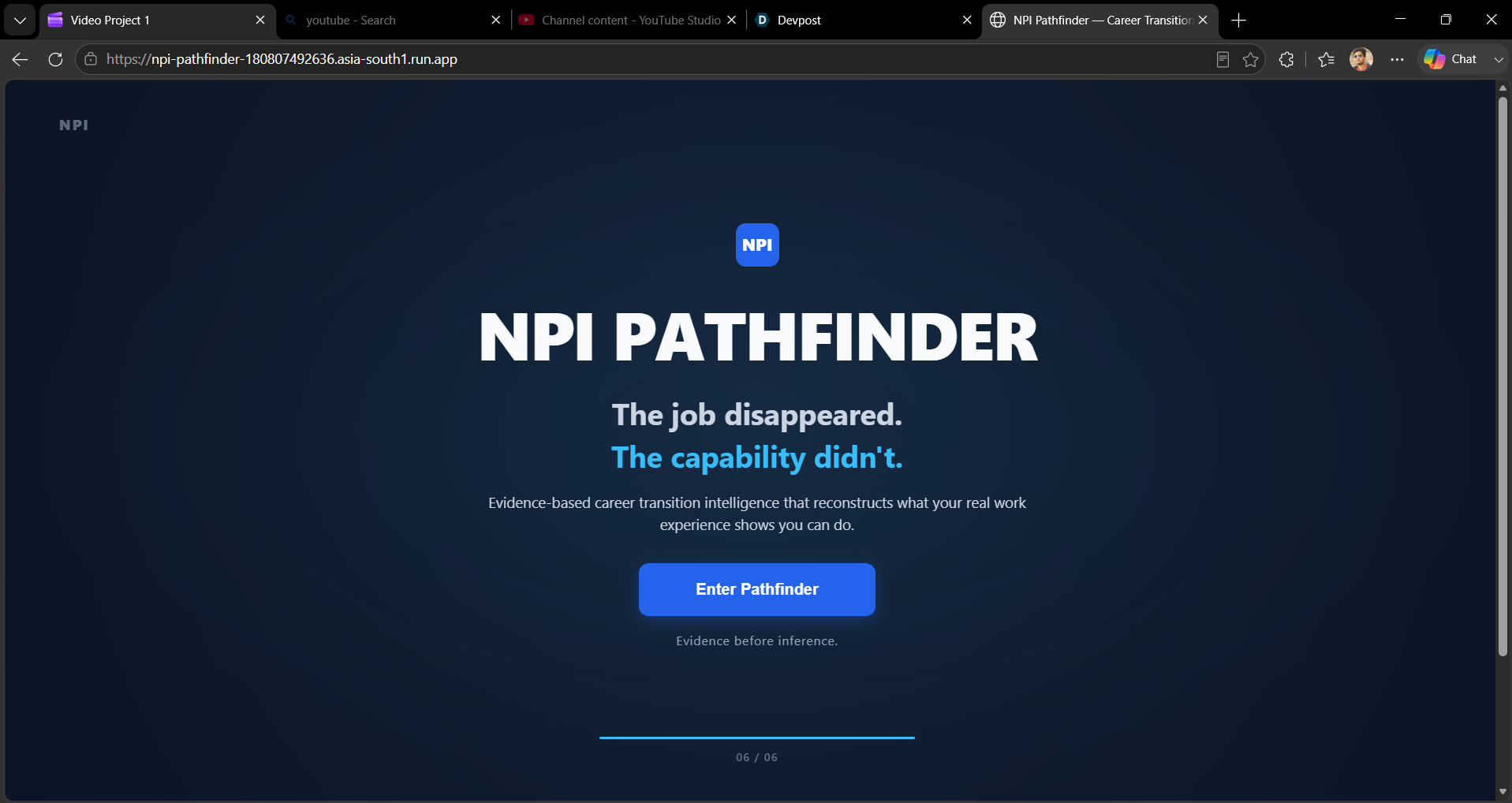
# NPI Pathfinder
The job disappeared. The capability didn’t.
Inspiration
NPI Pathfinder grew from a simple question: when a person loses a job, do the capabilities built over years of real work disappear too?
I experienced career disruption myself. That made me think about workers who may spend 10, 20, or 30 years developing real abilities, yet when their job disappears they are often reduced to a previous job title or résumé keywords.
NPI Pathfinder is part of the broader vision of Noble Path India (NPI): helping people understand their real capabilities, navigate career change with dignity, and move toward meaningful work instead of starting from zero.
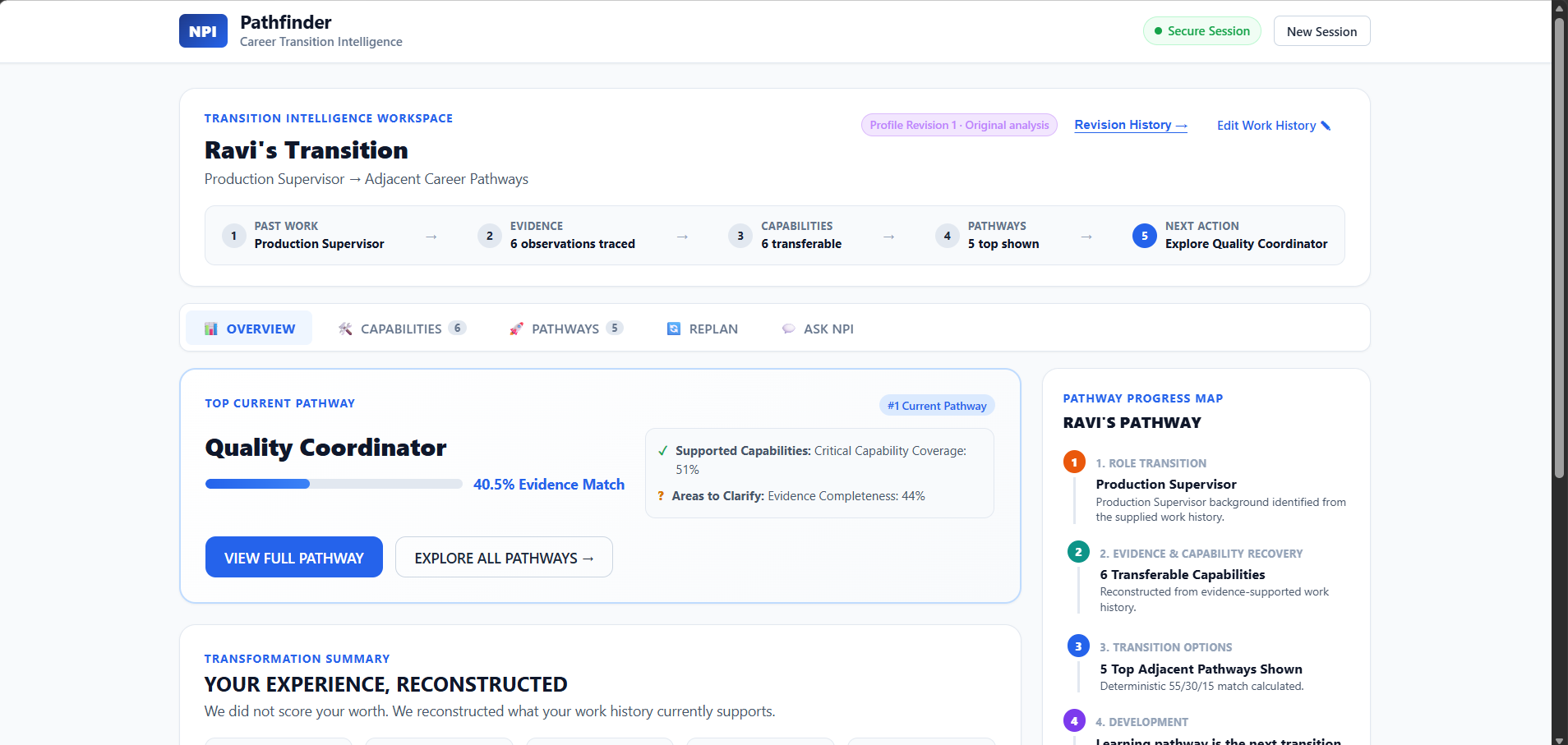
The prototype focuses on a mid-career worker named Ravi, an experienced Production Supervisor.
What it does
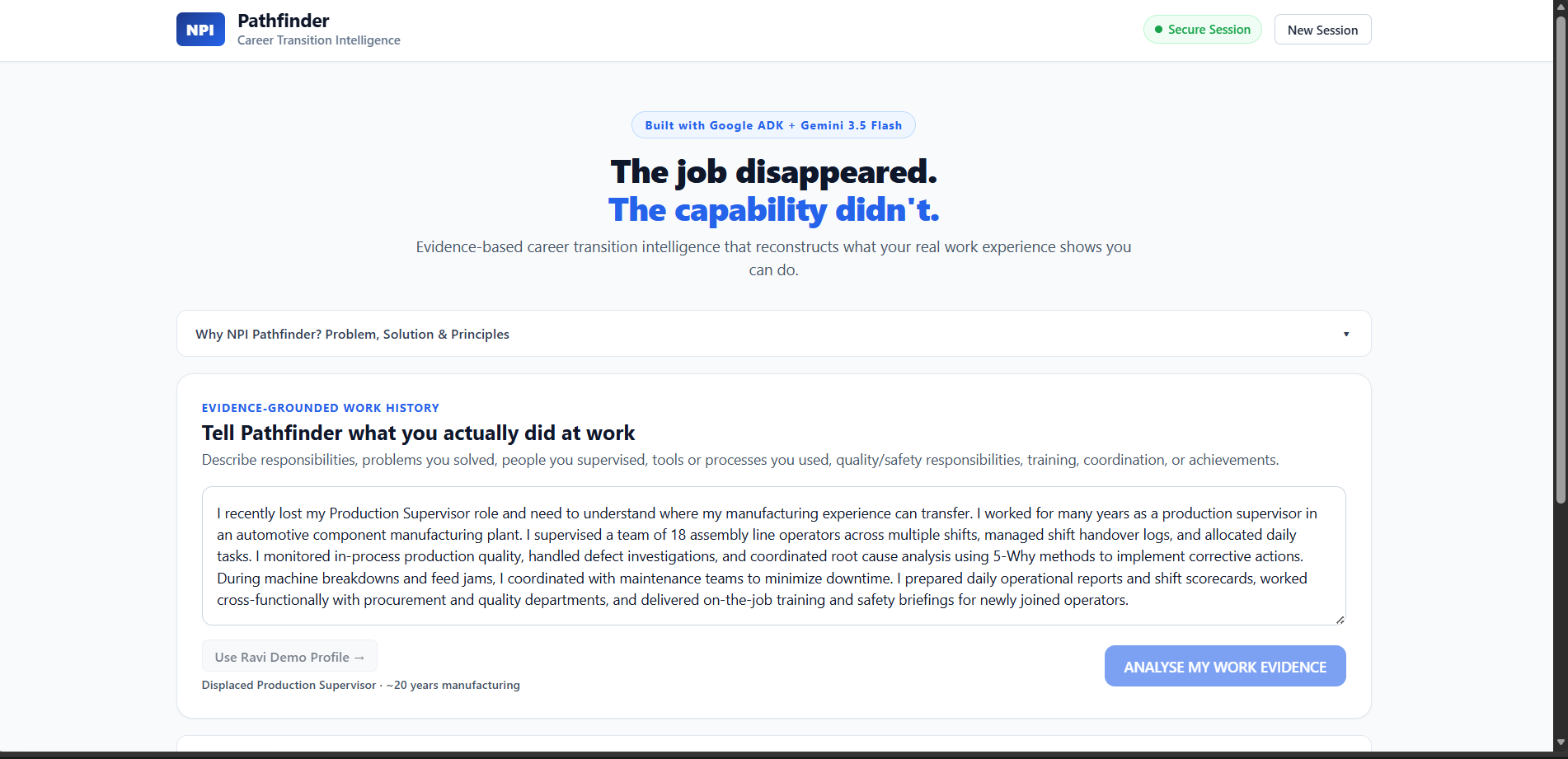
Pathfinder converts a person’s unstructured work history into an evidence-backed capability profile.
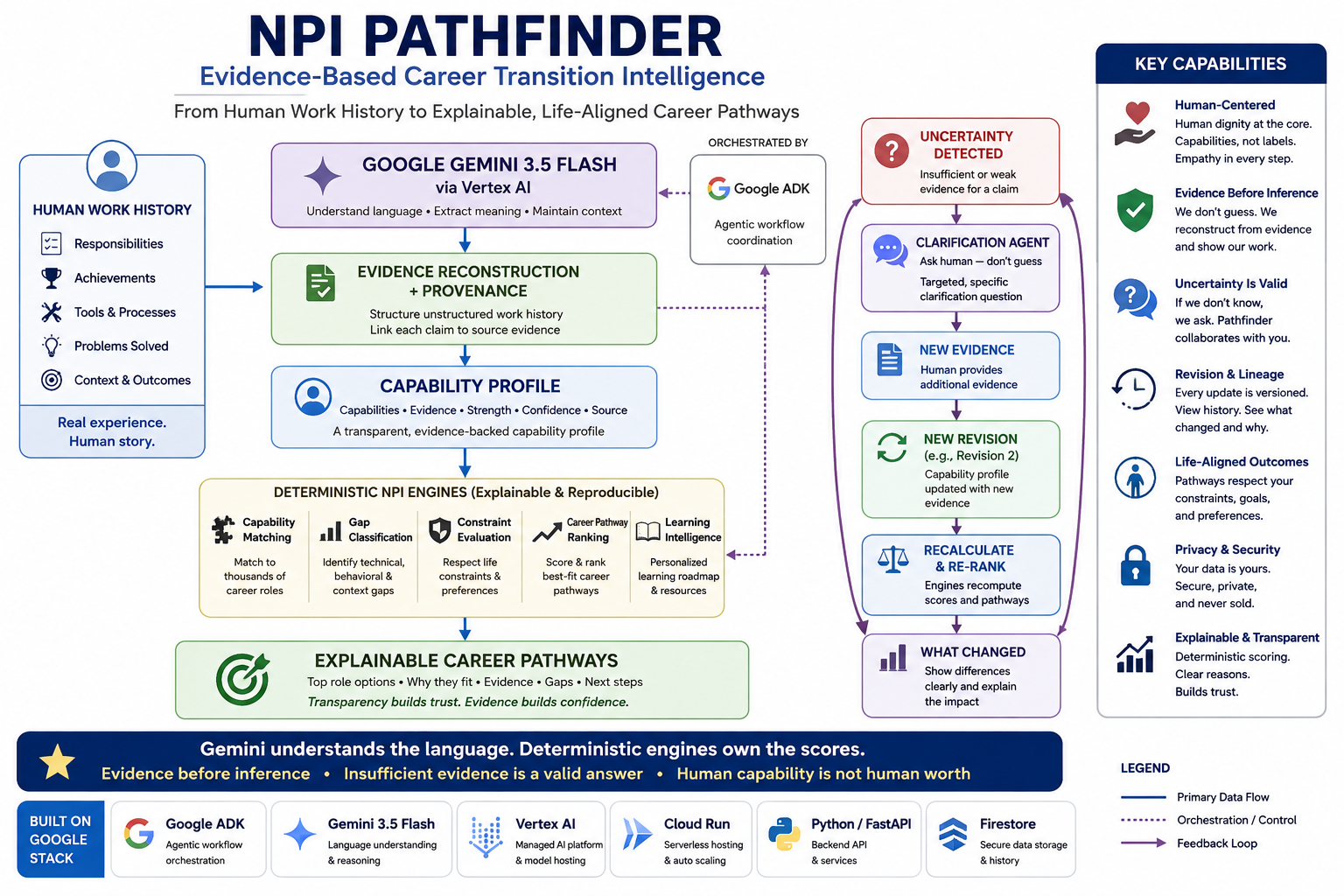
Instead of simply asking an AI model, “What job should this person do?”, Pathfinder follows an evidence-first process:
- Understand real work history such as responsibilities, achievements, tools, processes, problems solved, and outcomes.
- Reconstruct structured evidence while preserving source, strength, confidence, extraction method, and provenance.
- Build a capability profile from that evidence.
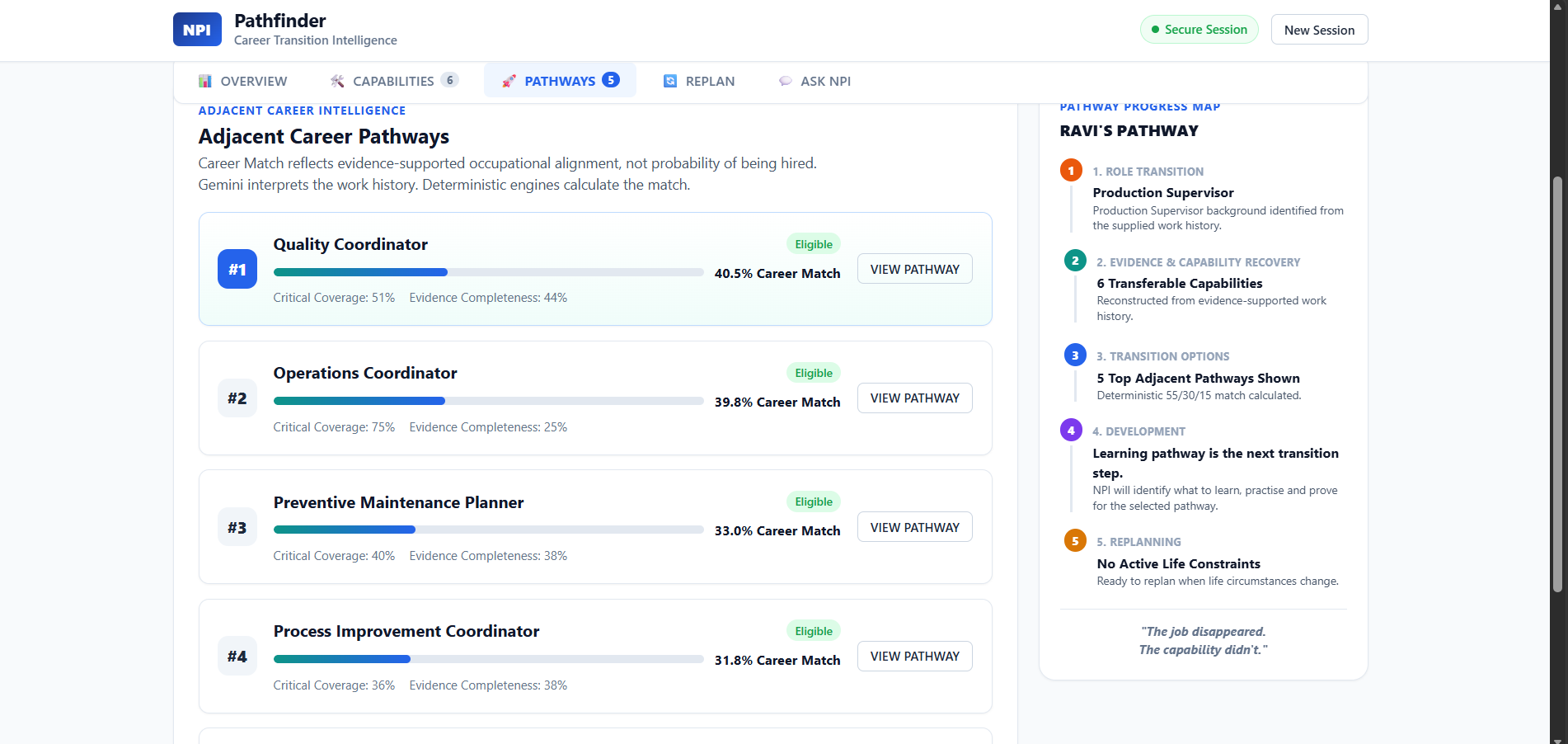
- Compare demonstrated capabilities with adjacent occupations.
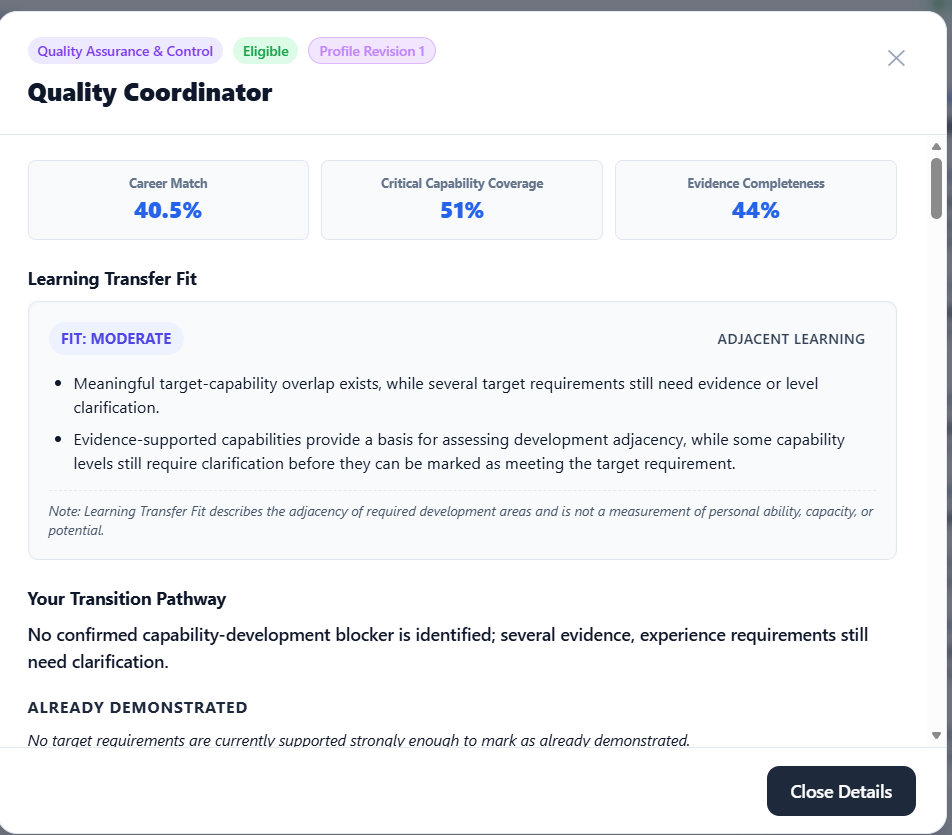
- Identify capability, evidence, qualification, and experience gaps.
- Rank possible career pathways using deterministic engines.
- Explain why a pathway fits and what evidence supports it.
A key principle is:
Insufficient evidence is a valid answer.
When Pathfinder is uncertain, it does not simply guess. A clarification agent asks the human a targeted question.
If the person provides sufficient additional information, Pathfinder can accept it as bounded self-reported evidence, create a new traceable profile revision, recalculate the affected pathway, and show What Changed.
This creates a collaborative loop:
Uncertainty → Clarification → Human Evidence → New Revision → Recalculation → Explanation
Pathfinder also separates a person’s capabilities from changing life or work constraints. A circumstance may change which pathway is suitable without erasing the capabilities the person already demonstrated.
How we built it
The deployed prototype uses:
- Google ADK for agent workflow and tool coordination
- Gemini 3.5 Flash for natural-language understanding and contextual reasoning
- Vertex AI for Gemini inference
- Google Cloud Run for live deployment
- Python
- FastAPI
- Deterministic Python services for matching, gap classification, constraint evaluation, pathway ranking, and learning intelligence
The architectural boundary is intentional:
Gemini understands the language. Deterministic engines own the scores.
The model is used where language understanding is valuable, while calculations and pathway scoring remain deterministic, explainable, and reproducible.
The current hackathon prototype keeps session and analysis state in memory and is deployed as a controlled prototype on Cloud Run.
Challenges
One major challenge was preventing the AI layer from becoming an opaque career recommender.
It would have been much easier to send a résumé to a language model and ask it to recommend jobs, but that would make it difficult to distinguish evidence from inference.
We therefore designed the system around provenance, confidence, explicit uncertainty, and deterministic calculations.
Another challenge was maintaining analysis context across clarification revisions and subsequent agent actions. Pathfinder needed to preserve the relationship between the original analysis, newly accepted evidence, and later calculations without allowing one session or analysis context to overwrite another.
We also had to keep the hackathon scope focused. The broader NPI vision includes workforce intelligence, future job demand, lifelong career mobility, employers, industry, and government, but this prototype deliberately concentrates on one strong problem: helping a displaced worker understand what their experience demonstrates and where those capabilities can move next.
What we learned
The most important lesson was that responsible AI is sometimes about knowing when not to infer.
If evidence is weak, asking the human can be more valuable than generating a confident-looking answer.
We also learned the importance of separating:
- language understanding from deterministic scoring,
- capability from job title,
- missing evidence from missing capability,
- and a person’s capabilities from their changing circumstances.
What’s next
NPI Pathfinder is an early prototype of a much larger workforce-intelligence vision.
Future work could expand the occupation and capability registries, strengthen persistent data infrastructure, add broader labour-market intelligence, support learning and reskilling pathways, and eventually connect people, employers, industry, and public workforce systems.
The long-term goal is simple:
No person should have to start from zero merely because their job, employer, technology, or industry changed.

Log in or sign up for Devpost to join the conversation.