-
-
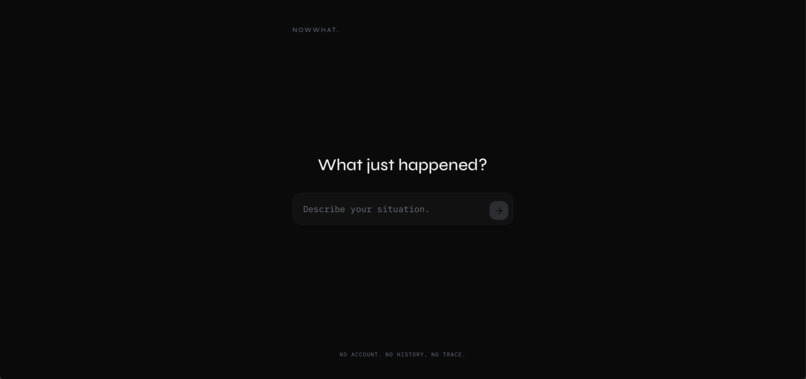
Now What Homepage
-
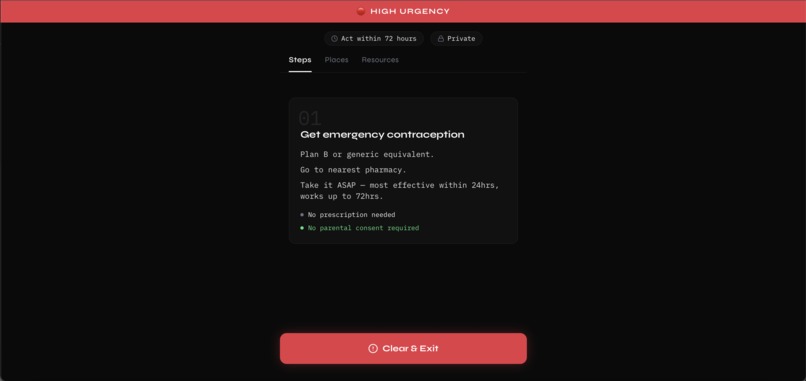
Now What Decision-Support
-
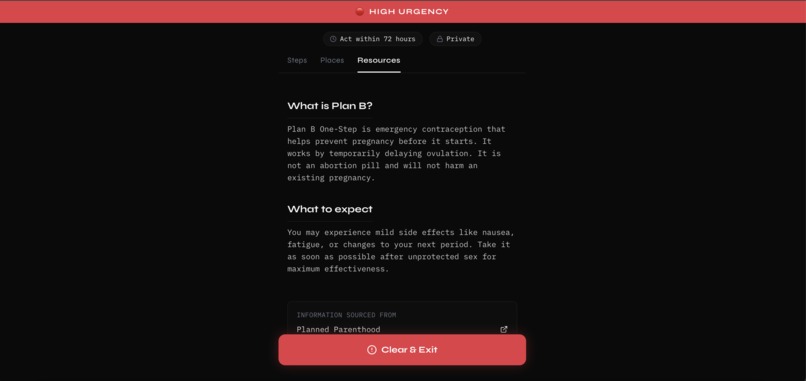
Now What Explainer
-
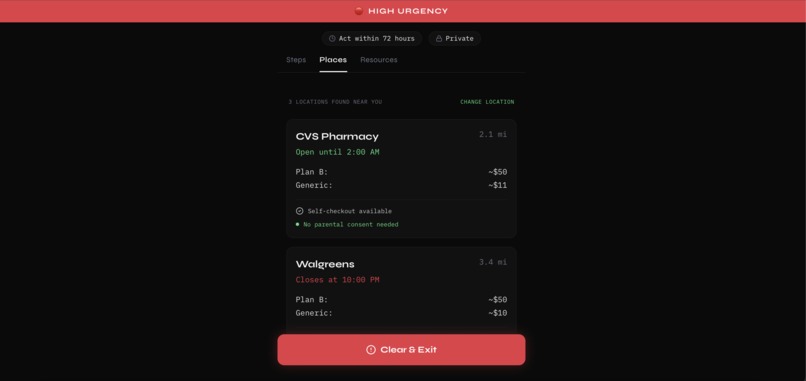
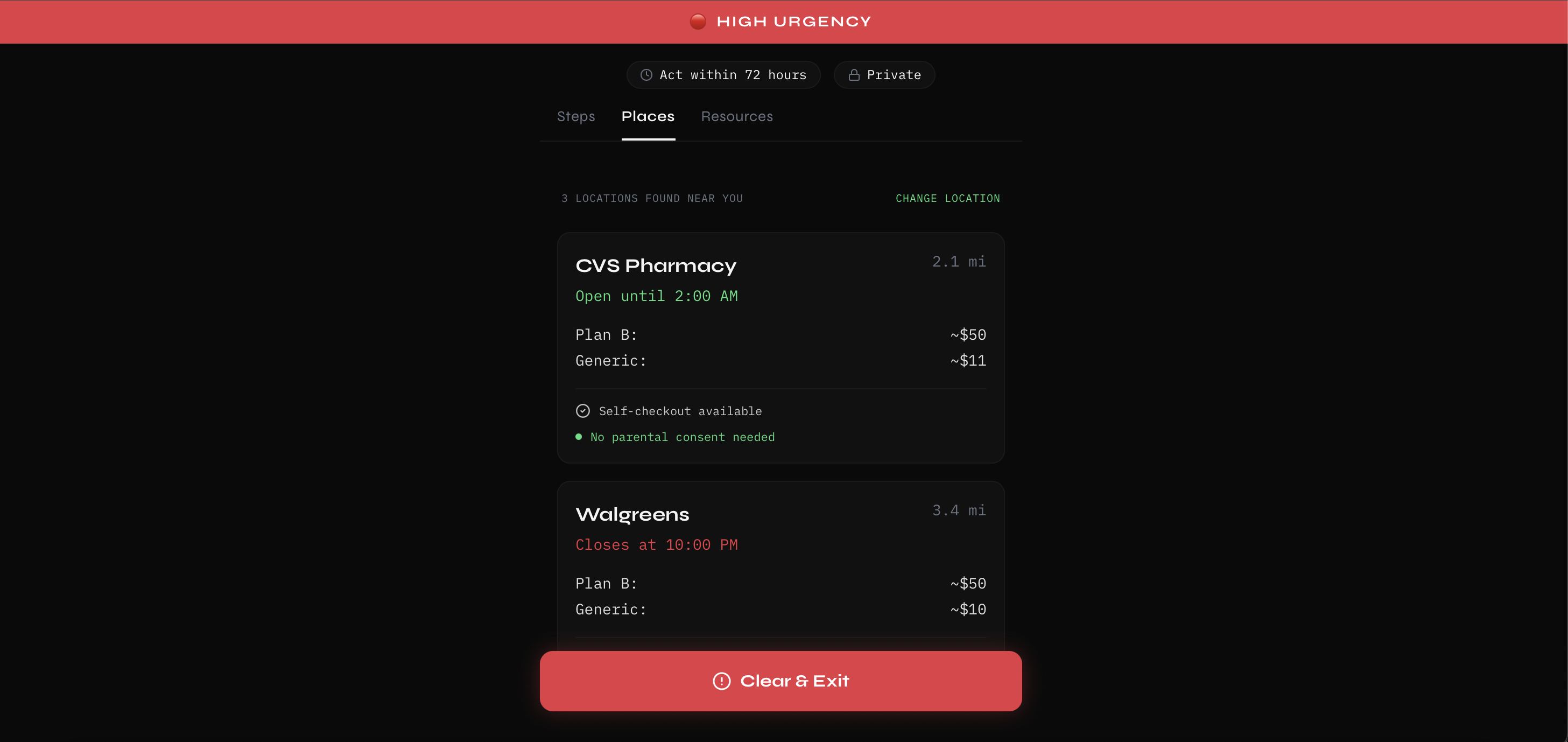
Now What Location Help
-
Safe to ask. Trusted to answer. Built to act.
Inspiration
A close friend of ours was scared. She had an urgent question about her sexual health and had nowhere to turn. She was too ashamed to ask her parents, too embarrassed to walk into a clinic, and too afraid of being judged to tell anyone. So she sat alone with it, and the situation got worse.
That moment stayed with us. Because we knew it was not rare. It was the norm.
- 50% of teens feel uncomfortable talking to their parents about sex
- 1 in 5 teens aged 15–17 would skip sexual health care entirely just to hide it from their parents
- 1/2 of all new STI cases in the US each year fall among people aged 15-24
- 83% worry about how their parents will react, 78% are embarrassed, and 77% do not know how to start the conversation
There were 750,000 teen pregnancies last year alone, in a country with over 42 million adolescents, 95% of whom already carry a smartphone. The gap was not awareness. It was access. Safe, private, judgment-free access. So we built it.
What it does
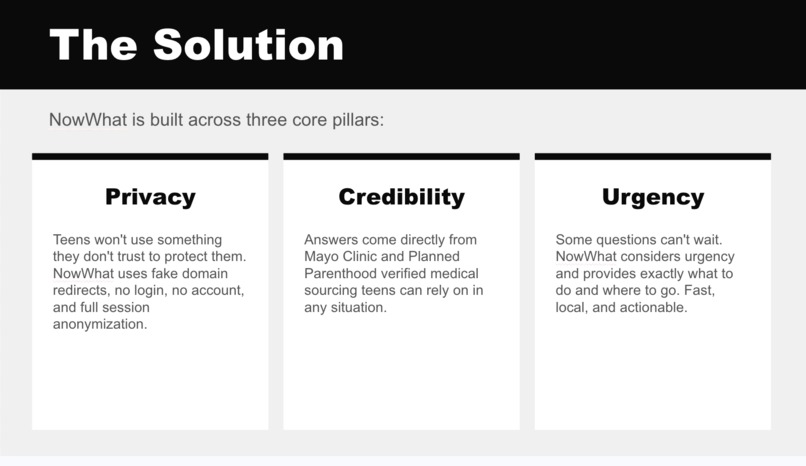
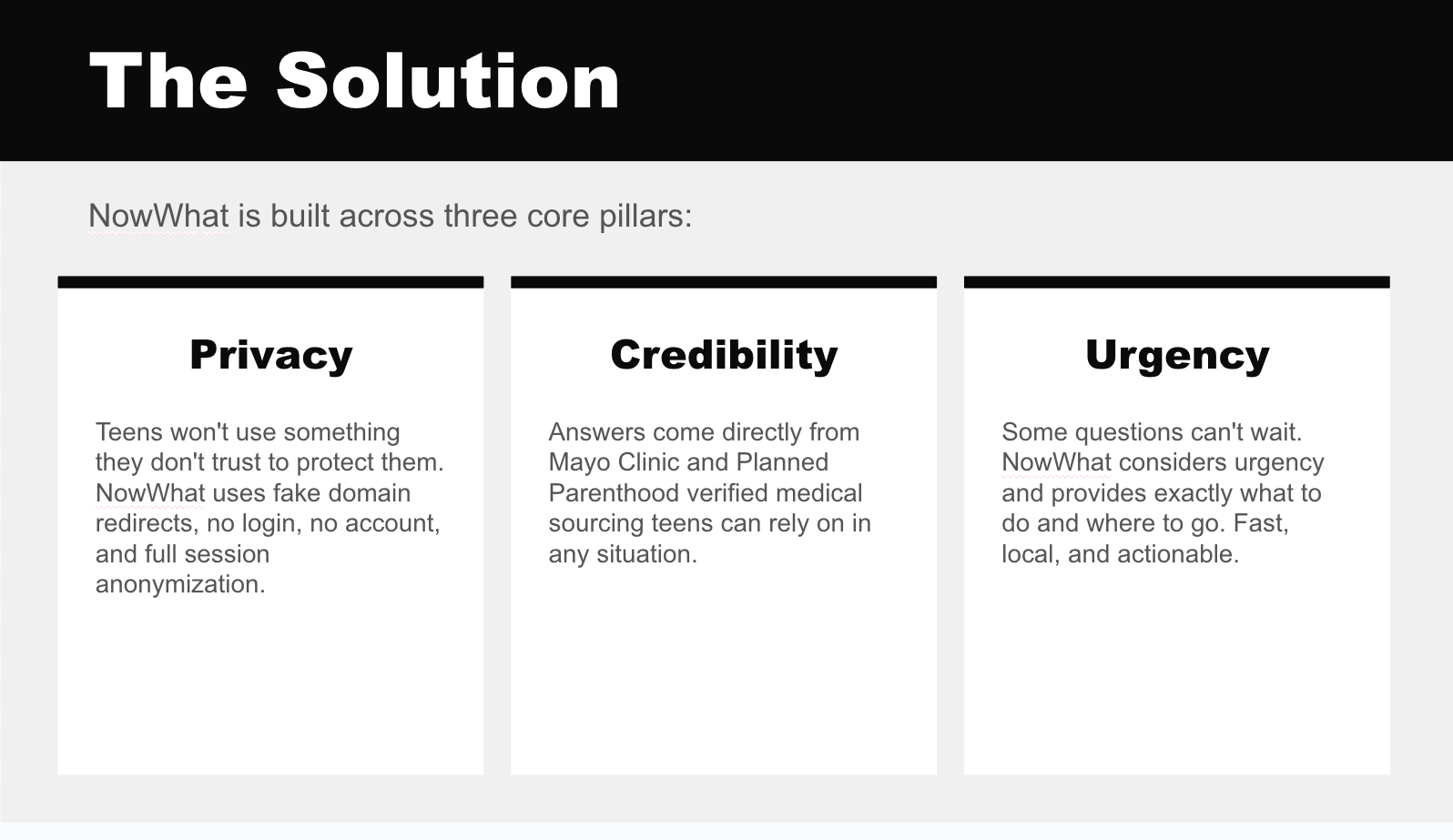
Now What is a teen sexual health safety platform built across three core pillars: Privacy, Credibility, and Urgency.
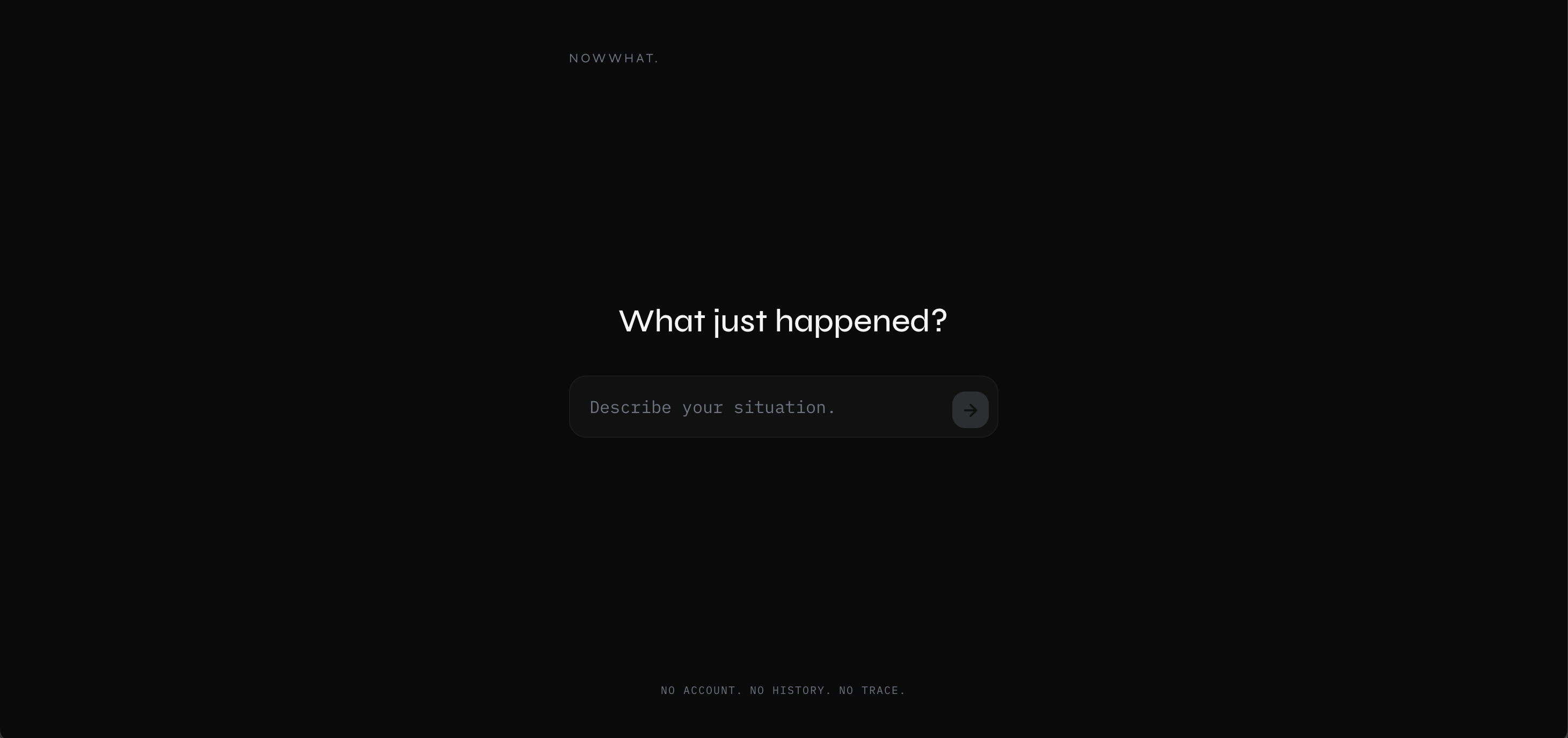
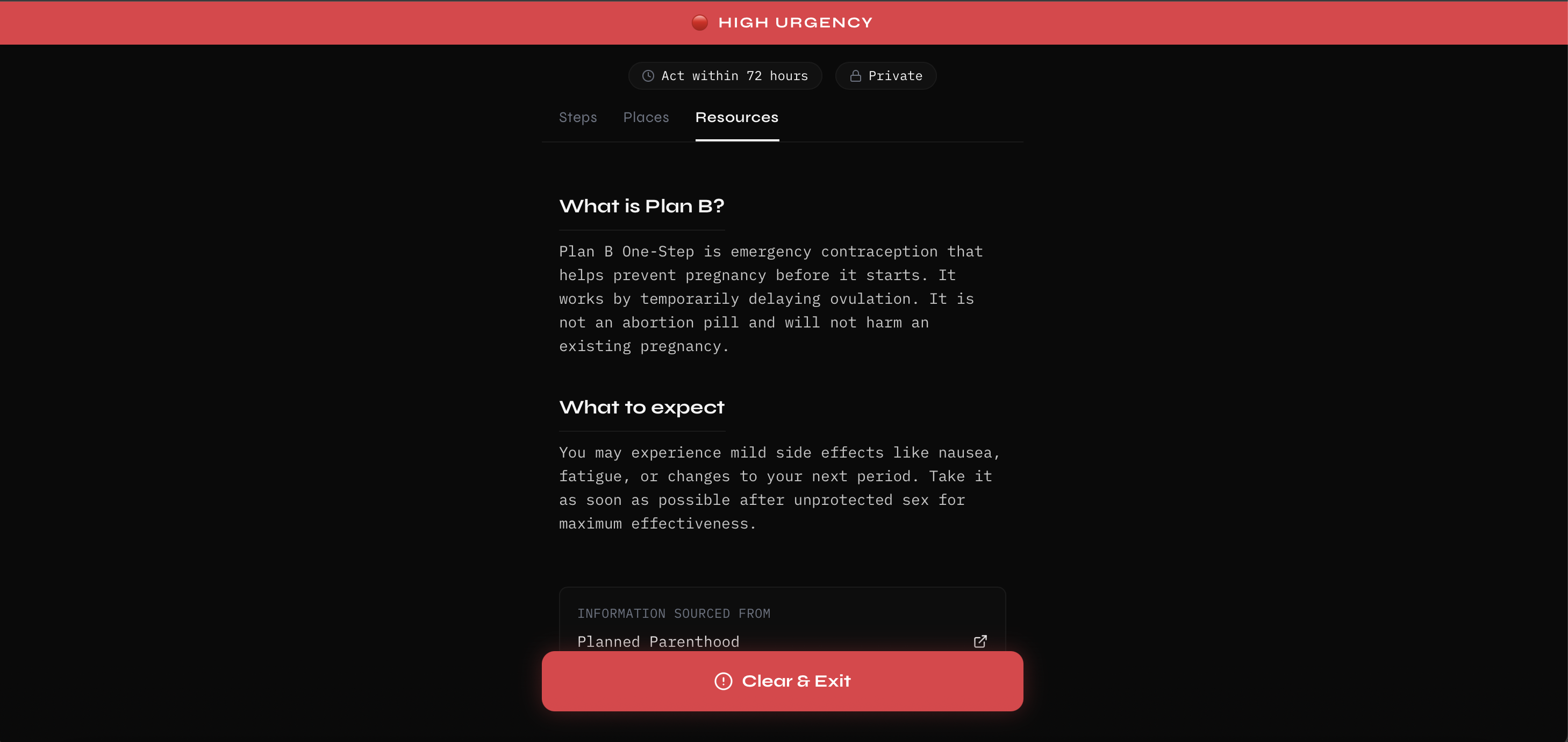
A teen arrives through a fake domain redirect, a neutral-looking URL that raises no flags in a browser history. No login. No account. They type their question and hit send. The question runs through our Retrieval-Augmented Generation (RAG) pipeline, pulling verified answers exclusively from Mayo Clinic and Planned Parenthood. The system identifies urgency factors and generates personalized, accurate guidance.
If the teen chooses, they privately input their location. Our algorithm surfaces the nearest clinics and pharmacies with price points, parental consent requirements, and self-checkout availability. When they are done, one button wipes the entire session. No trace. No history. No account.
How we built it
We started by designing every feature around one constraint: a scared teen on a shared family device should be able to use NowWhat and leave zero trace behind.
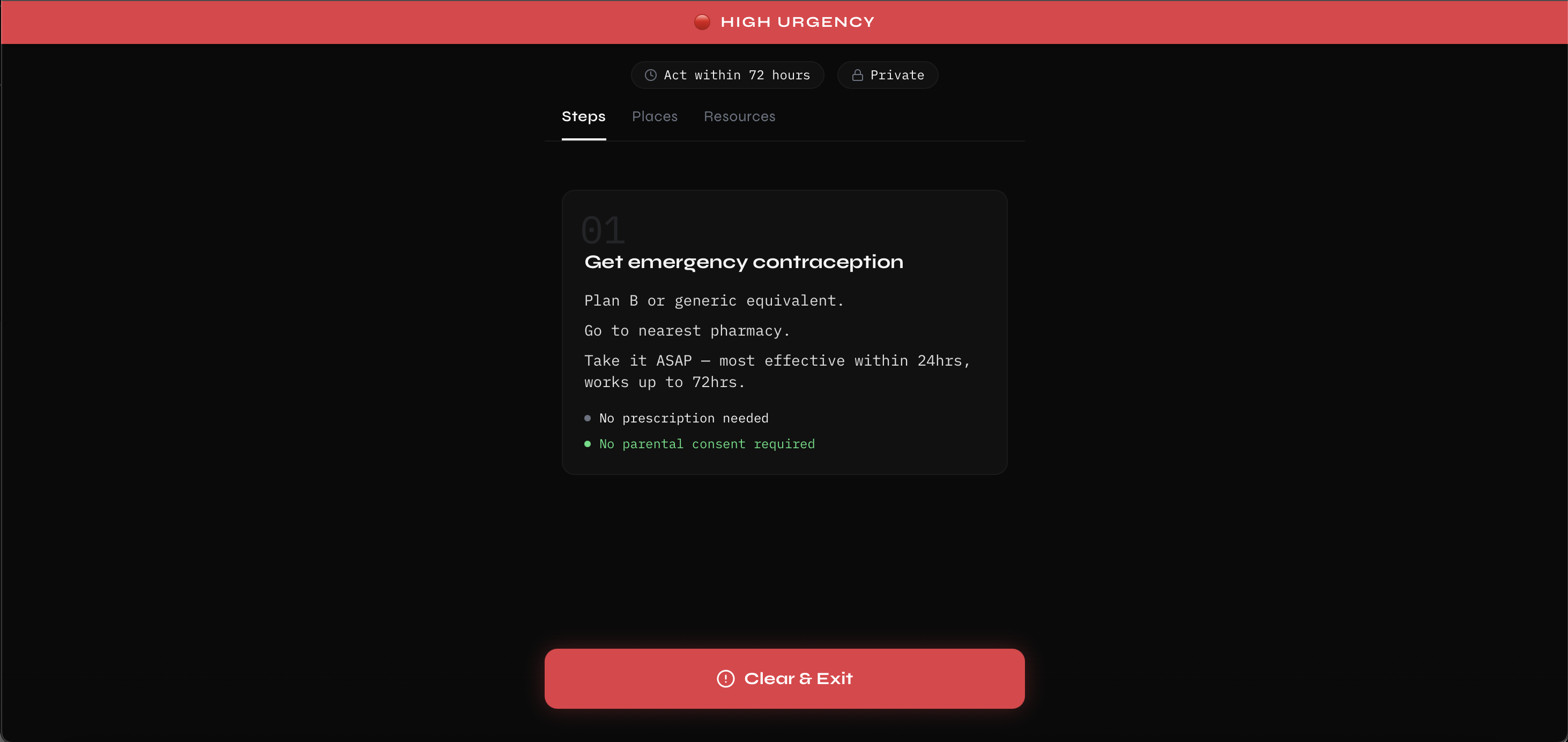
On the backend, we built a RAG pipeline that does not guess. It retrieves verified information from Mayo Clinic and Planned Parenthood before generating any response. We engineered the prompt logic to identify urgency signals in the teen's message and classify the response accordingly. On the frontend, we built a clean, minimal UI with a fake domain redirect and a full session wipe on exit.
Our sustainability model is structured as a nonprofit with four funding pillars:
- Individual Donations to get off the ground
- NGO and Business Partnerships with mission-aligned organizations
- Data Partnerships licensing our fully anonymized, aggregated dataset to public health organizations and school districts
- Public Grants for credibility and long-term funding
Challenges we ran into
Privacy architecture was the first major challenge. Building a system with zero persistent data, no accounts, and a clean session wipe, while still delivering personalized location-specific results, required carefully thinking through how data flows through the system and how it does not.
Source reliability was another. We could not just point to the internet. We had to constrain our RAG pipeline strictly to Mayo Clinic and Planned Parenthood and ensure the model was not drifting beyond those sources in its responses.
Stigma was a challenge we underestimated. Pitching a teen sexual health platform means navigating discomfort in every room. We learned to lead with the data, ground everything in the human story, and let the urgency of the problem speak for itself.
Reaching the right users remains a challenge. Our target users, teens in underserved communities, LGBTQ+ teens, and teens on shared devices, are precisely the ones hardest to reach through traditional channels. Our outreach strategy has to be as privacy-conscious as the product itself.
Accomplishments that we're proud of
We are proud that we built a fully working prototype with the RAG pipeline connected to live medical sources and the privacy layer fully operational. We are proud that every single design decision, from the fake domain to the session wipe, was made with one person in mind: a scared teenager with nowhere else to go. We are proud that we identified a gap that billion-dollar organizations like Planned Parenthood and OpenAI have not closed, and that we closed it. And we are proud that we dared to talk about a stigmatized topic publicly, because the discomfort we feel as presenters is nothing compared to what a teen feels sitting alone at 2 am with a question and no safe place to ask it.
What we learned
Building NowWhat taught us that the hardest part of solving a real problem is not the technology. It is the trust. Teens will not use a tool they do not believe is safe. Every design decision was driven by one question: would a scared 16-year-old trust this?
We learned what RAG means in practice, not just retrieving information, but retrieving the right information from the right sources at the right moment for someone who may be panicking. We learned that existing solutions are not failing because no one cares. They are failing because they were not built with teens in mind. Planned Parenthood has credibility but not privacy. ChatGPT has reach but not accuracy. Now What sits at the intersection of all four values: verified, private, urgent, and local.
What's next for Now What: A teen sexual safety and decision-making app
In the next 90 days, we are focused on three milestones:
- Full RAG Integration
- Fake Domain Deployment
- Teen User Testing
Beyond that, we are building toward school nurse partnerships, health organization collaborations, and multilingual expansion. Because the 1.2 billion teens worldwide facing the same wall deserve the same answer.
Now What is a teen sexual health safety platform. Private, verified, and built for the moments that cannot wait.
Anubhav Dash and Arjun Desikan, INNOSpark 2026

Log in or sign up for Devpost to join the conversation.