-
-
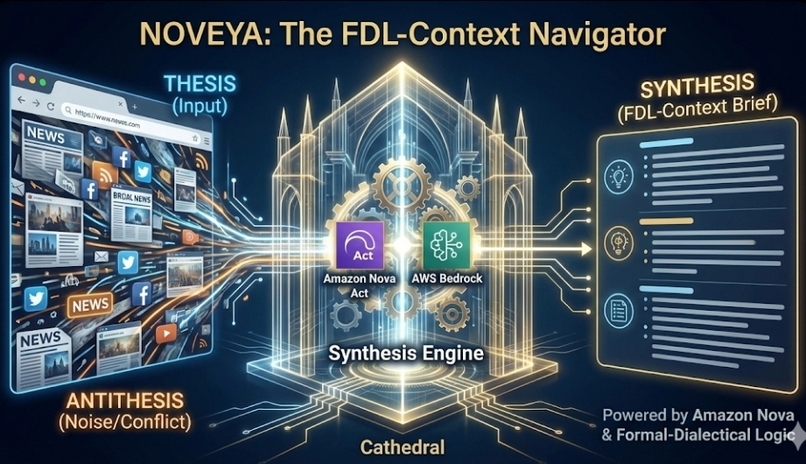
Представление взаимодействия
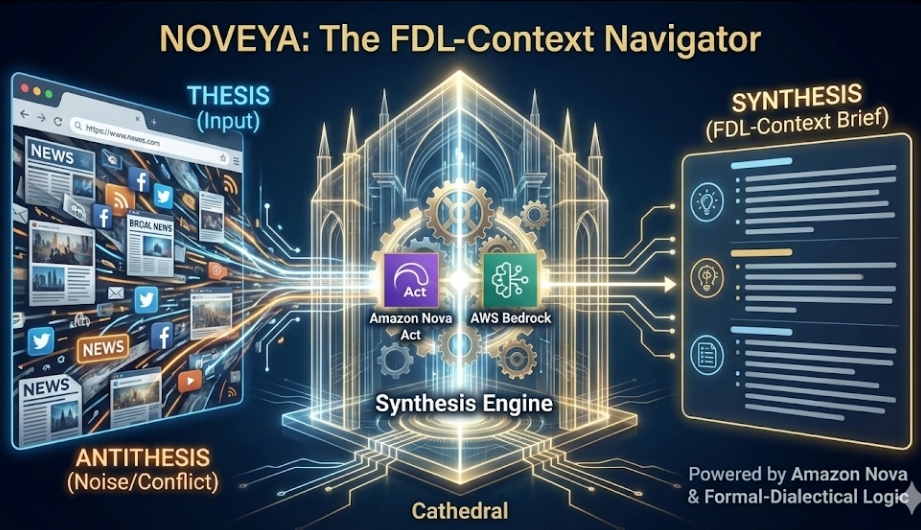
Inspiration
We live in an era of information chaos. Users are bombarded with conflicting narratives, emotional manipulation, and "noise." We asked ourselves: Can we build an AI agent that doesn't just "read" the web, but "heals" the information flow? Inspired by Formal-Dialectical Logic (FDL), we created an agent that acts as a digital immune system. It uses Amazon's cutting-edge Nova Act model to navigate the web, not to consume content, but to harmonize it—transforming "Thesis" and "Antithesis" into a clean "Synthesis."
What it does
NOVEYA is a browser-based automated agent that: Navigates Autonomously: Uses Amazon Nova Act to browse specific topics (news, research, social feeds) requested by the user. Detects Contradictions: Applies the "Cycle of Initiation-Conflict-Synthesis" to identify logical fallacies and emotional bias in the text. Enforces Ethical Canons: Filters content against our "Cathedral of Twelve Theses" (encoded in the system prompt) to ensure the data is structurally sound. Delivers the "Brief": Generates a concise, logic-based summary (The FDL-Context Brief), stripping away the noise and leaving only the systemic essence of the event.
How we built it
We built the core using Python and AWS Bedrock. Agentic Core: We utilized Amazon Nova Act for its superior ability to handle complex UI interactions and multi-step reasoning. Analysis Engine: Incoming data is processed by Amazon Nova Pro, which is prompted with our proprietary FDL algorithms (stored in our open-source ProtoNoveya repository). Infrastructure: The system is deployed using AWS Lambda and integrates with the user's browser via a custom extension interface.
Challenges we ran into
Translating abstract philosophical concepts (like "Dialectical Synthesis") into executable code for an AI agent was difficult. We had to rigorously fine-tune the system prompts for Amazon Nova to ensure it prioritized "logical structure" over "creative writing." The result is a model that "thinks" in strict dialectical terms.
Accomplishments that we're proud of
Successfully implementing the "Thesis-Antithesis-Synthesis" loop using Amazon Nova. Creating a practical tool for "Information Hygiene" that helps users maintain mental clarity. Demonstrating that Amazon Nova can be used for deep structural analysis, not just simple chat or summarization.
What we learned
We learned that implementing Formal-Dialectical Logic (FDL) requires a fundamental shift in prompt engineering. Unlike standard tasks where the AI simply follows instructions, FDL requires the model to actively identify and hold two opposing concepts (Thesis and Antithesis) simultaneously without hallucinating a premature resolution. We discovered that Amazon Nova Act possesses a unique stability in maintaining this "dialectical tension." It excelled at navigating complex UI tasks while adhering to our strict "Cathedral of Twelve Theses" ethical constraints—something that often confuses lesser models. Technically, we gained deep experience in optimizing AWS Bedrock for low-latency "philosophical processing," learning how to chain Nova Act (for browsing) and Nova Pro (for synthesis) into a seamless, real-time agent.
What's next for NOVEYA: The FDL-Context Navigator
We plan to expand the agent's capabilities to handle complex scientific research and legal documents, making NOVEYA a universal tool for professionals who need "clean" data. We will also continue updating our Harmony Development repository to refine the ethical definitions used by the agent.
Built With
- 2
- act
- amazon
- amazon-web-services
- bedrock
- core)
- development
- fdl)
- formal-dialectical
- github
- harmony
- lite/pro)
- logic
- nova
- protonoveya
- python

Log in or sign up for Devpost to join the conversation.