-
-
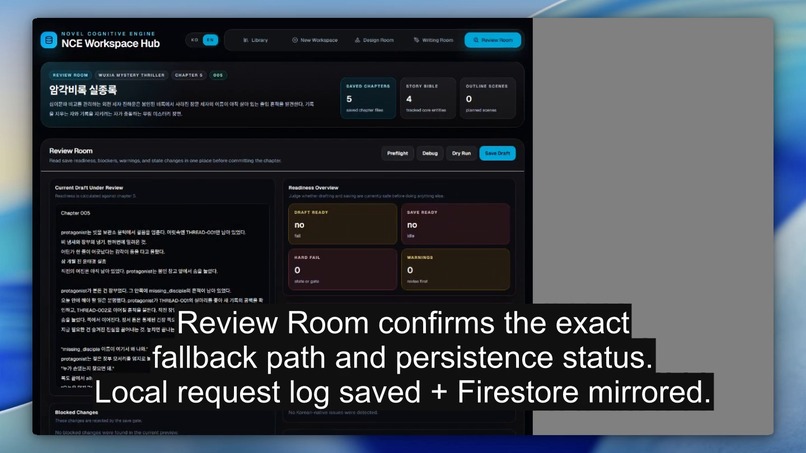
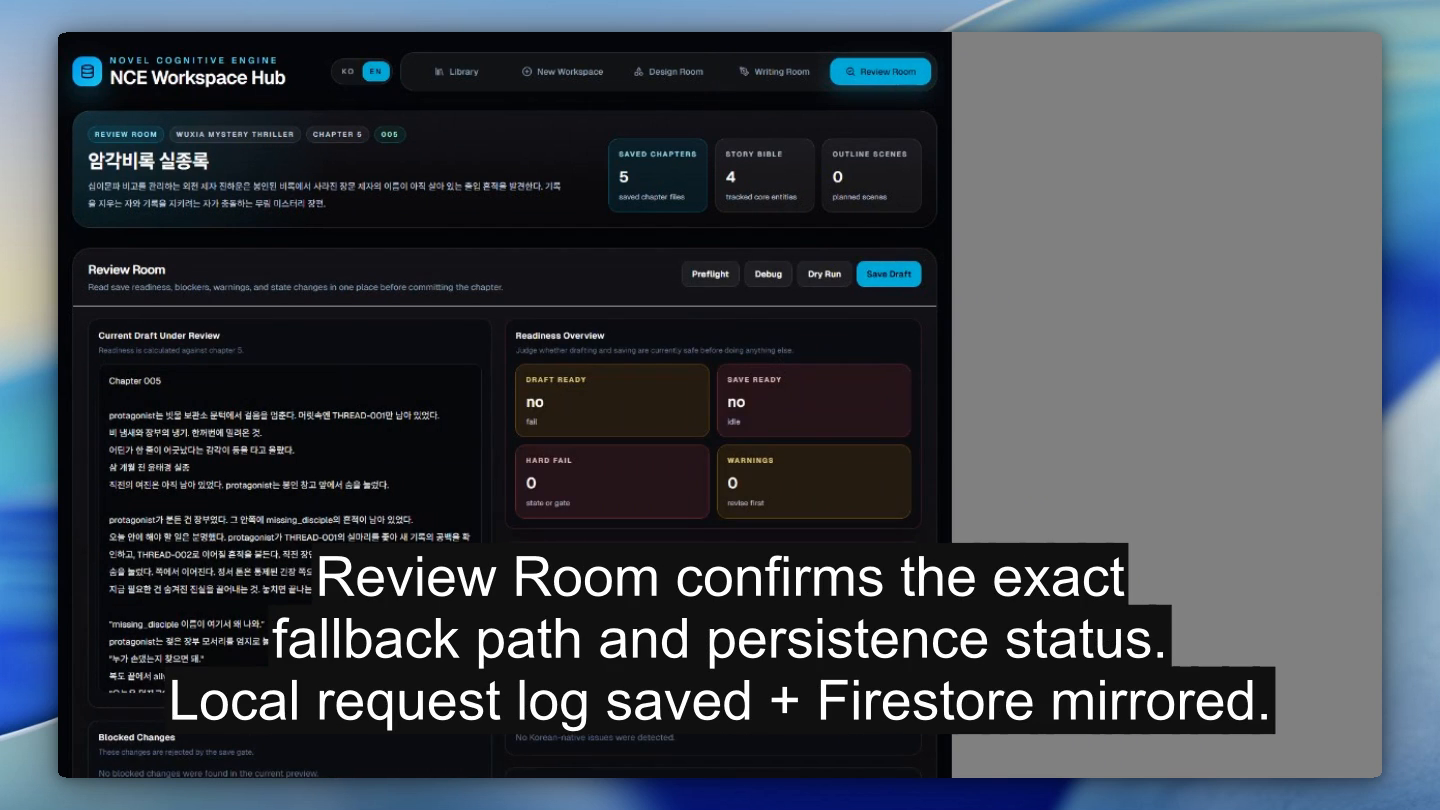
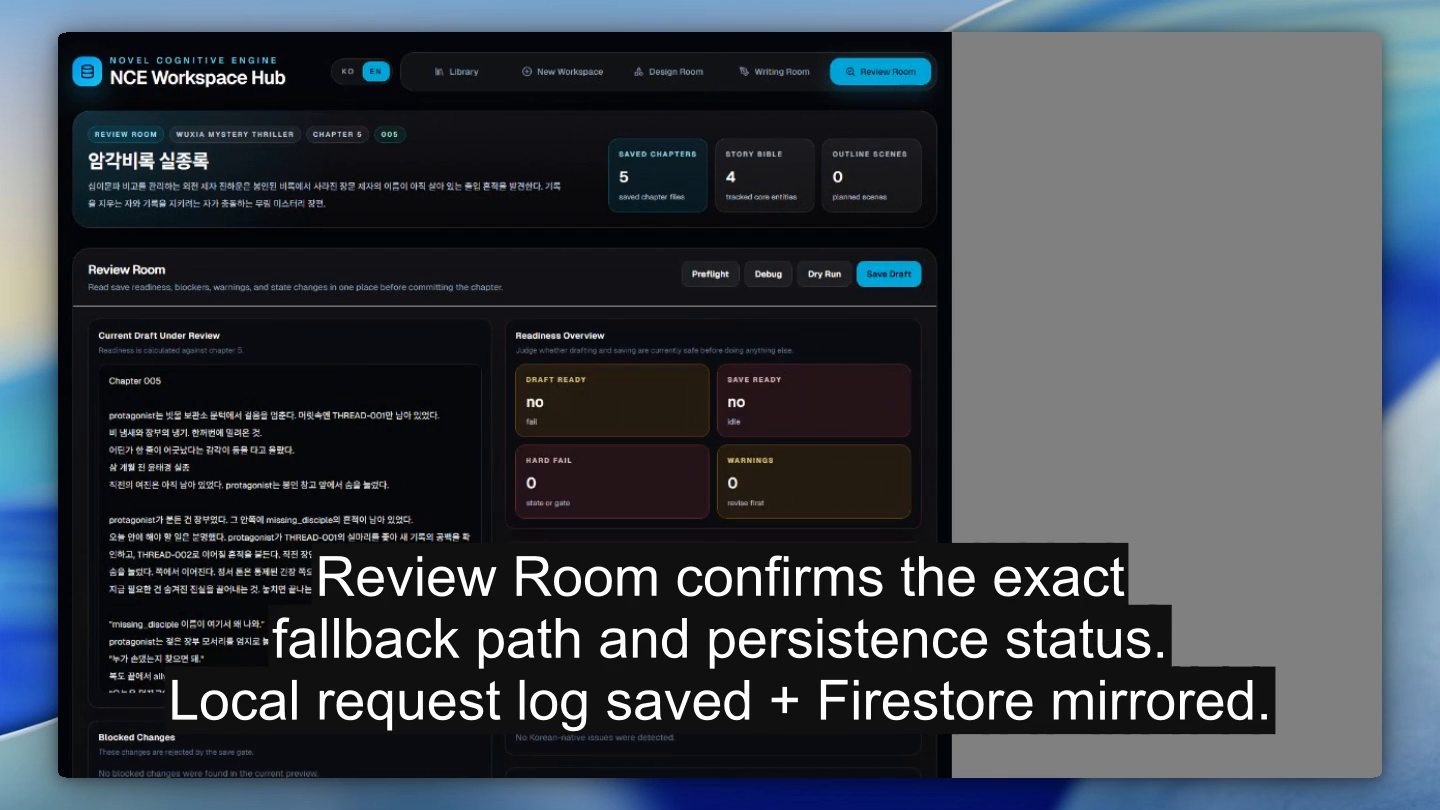
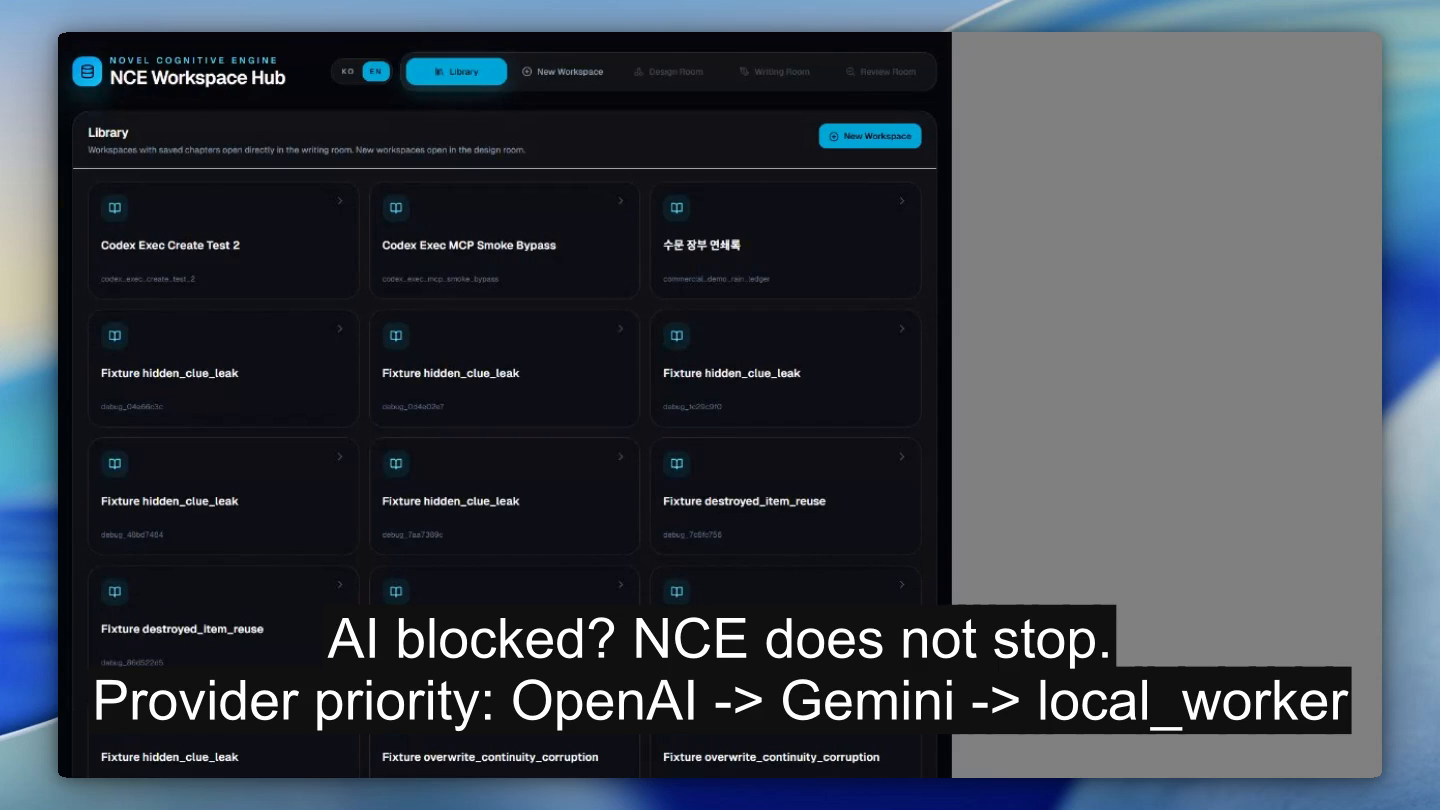
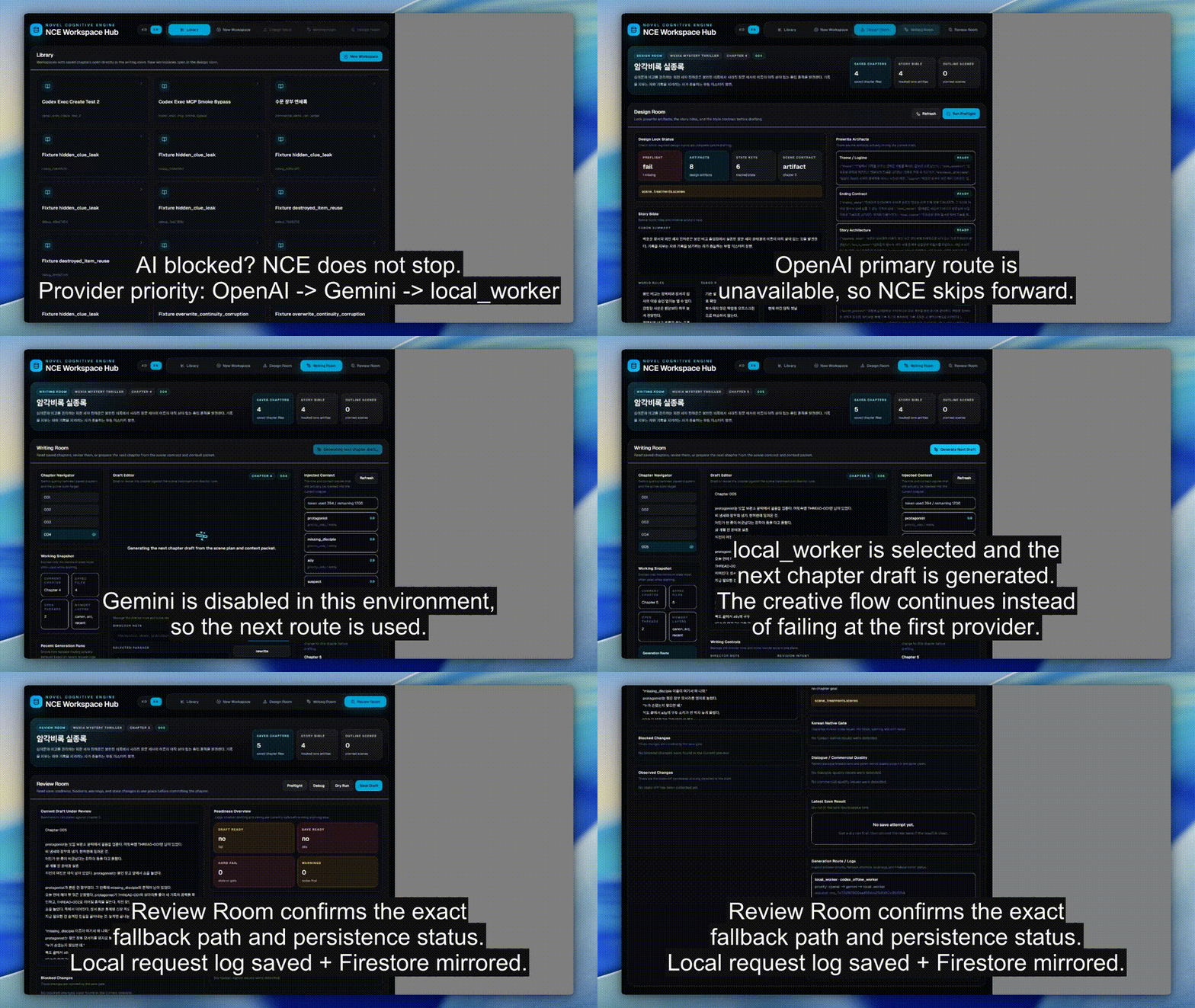
NCE keeps the writing session alive by routing around blocked AI generation paths.
-
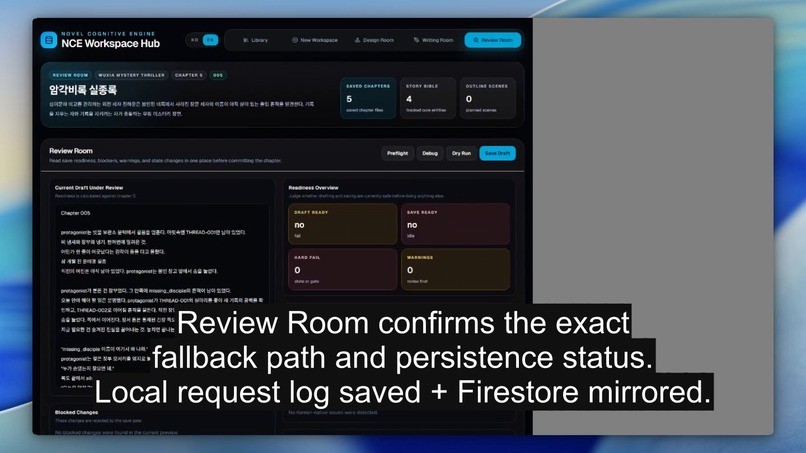
The Review Room shows the exact fallback path, local request log, and Firestore mirror status.
-
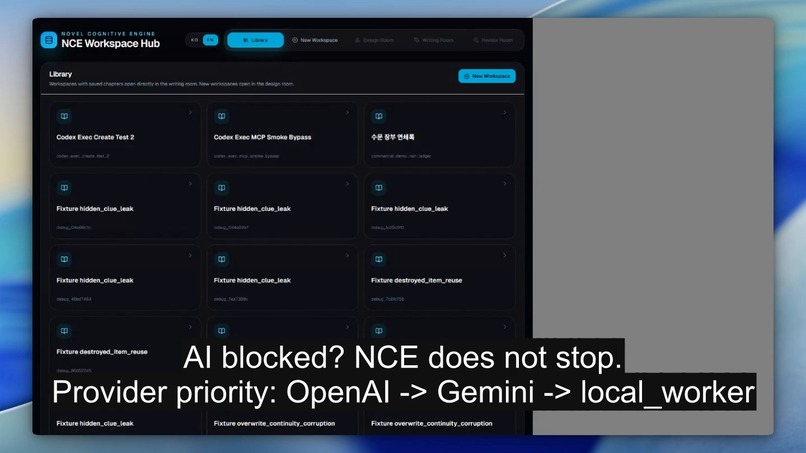
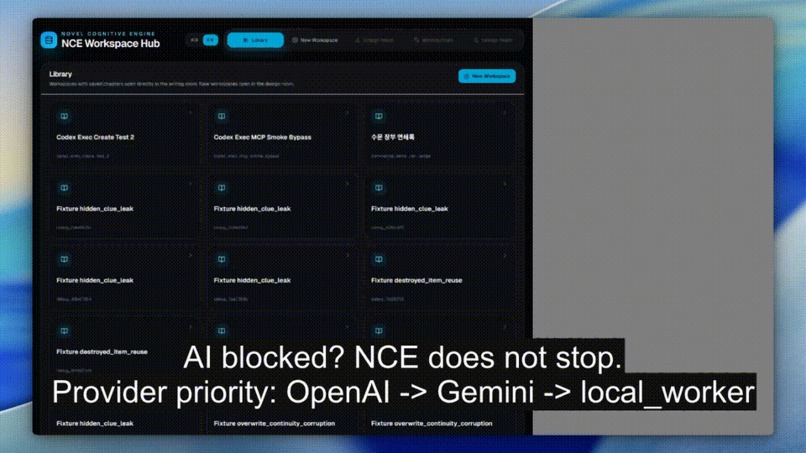
When OpenAI is unavailable and Gemini is disabled, NCE falls through to local_worker.
-
 GIF
GIF
The fallback demo preserves draft progress instead of failing the author session.
Inspiration
Most AI writing tools are good at producing a page of text, but they become unreliable when the project turns into a long-form manuscript. Characters forget what they know, clues leak too early, revisions overwrite canon, and planning gets disconnected from drafting.
We wanted to build a writing system that treats long-form fiction more like a managed production workflow than a one-shot prompt. That became Novel Cognitive Engine, or NCE Workspace.
What it does
NCE Workspace is a continuity-aware writing workspace for long-form fiction.
It gives an author one connected workflow:
- Open or create a novel workspace
- Inspect planning artifacts in Design Room
- Draft and revise chapters in Writing Room
- Run validation in Review Room
- Save only when the chapter passes story-state and quality gates
In the current demo, the product supports:
- prewrite artifacts
- story bible editing
- narrative state inspection
- design preflight
- context preview
- scene contract review
- thread review
- narrative debug reports
- continuity-aware save gating
- valid save / invalid save rejection
- provider-priority routing with fallback
- local and Firestore-mirrored generation logs
How we built it
We built NCE as a writing workspace with explicit workflow boundaries instead of a monolithic text generator.
Next.js + Reactfor the workspace UIPython + FastAPIfor the backendMCP toolsfor orchestration- persisted workspace state for planning artifacts, story bible, and chapter flow
- validation layers for continuity, quality, and save safety
- provider-priority routing for generation fallback
- local request persistence with optional Firestore mirroring
In the current demo, the generation path can skip unavailable or disabled providers, fall through to a lower-priority route, generate the next chapter draft, and preserve the request state.
Challenges we ran into
- long-form fiction quality is not just prose quality; it depends on state consistency across chapters
- save-time validation needed to block bad drafts without breaking normal author flow
- provider fallback had to degrade gracefully while still preserving request logs and user-visible state
- hackathon demo truth had to stay honest: we did not want to present future SaaS plans as already shipped
Accomplishments that we're proud of
- built a real workspace loop instead of a generic “write me a chapter” demo
- connected planning, drafting, validation, and save safety in one product surface
- implemented continuity-aware invalid-save rejection
- added provider-priority routing with local fallback and request logging
- mirrored generation requests to Firestore
- prepared a real fallback demo showing that the writing session continues even when the primary AI route is blocked
What we learned
- long-form fiction fails when planning, state, and revision are separated
- AI writing products need deterministic save-time guardrails, not just better prompts
- resilience is also a UX problem: if generation degrades, the author still needs a coherent workflow
- the strongest demo is a truthful one; clearly separating implemented behavior from future architecture improves trust
What's next
- broader provider adapter coverage beyond the current runtime
- queue persistence beyond request-log storage
- multi-user product layer and cloud storage
- human-assisted recovery workflow for failed generation runs
- deeper internationalization beyond the current bilingual demo UI
Built With
- fastapi
- firebase-firestore
- mcp
- next.js
- playwright
- python
- react
- recordly
- typescript

Log in or sign up for Devpost to join the conversation.