NovaRescue AI Multi-Agent Disaster Response Intelligence Platform Inspiration Every year, natural disasters such as floods, earthquakes, and wildfires cause massive damage and loss of life. One of the biggest challenges during these crises is rapid coordination between emergency services. Critical information often arrives fragmented, response planning takes time, and valuable minutes are lost when lives are at risk. We wanted to explore how AI-powered decision support systems could help emergency teams respond faster and more efficiently. This inspired us to build NovaRescue AI, a multi-agent platform that simulates how different emergency departments collaborate during disasters. Our vision was to create an AI-driven command center capable of analyzing disaster situations, coordinating resources, and generating actionable response strategies in real time.
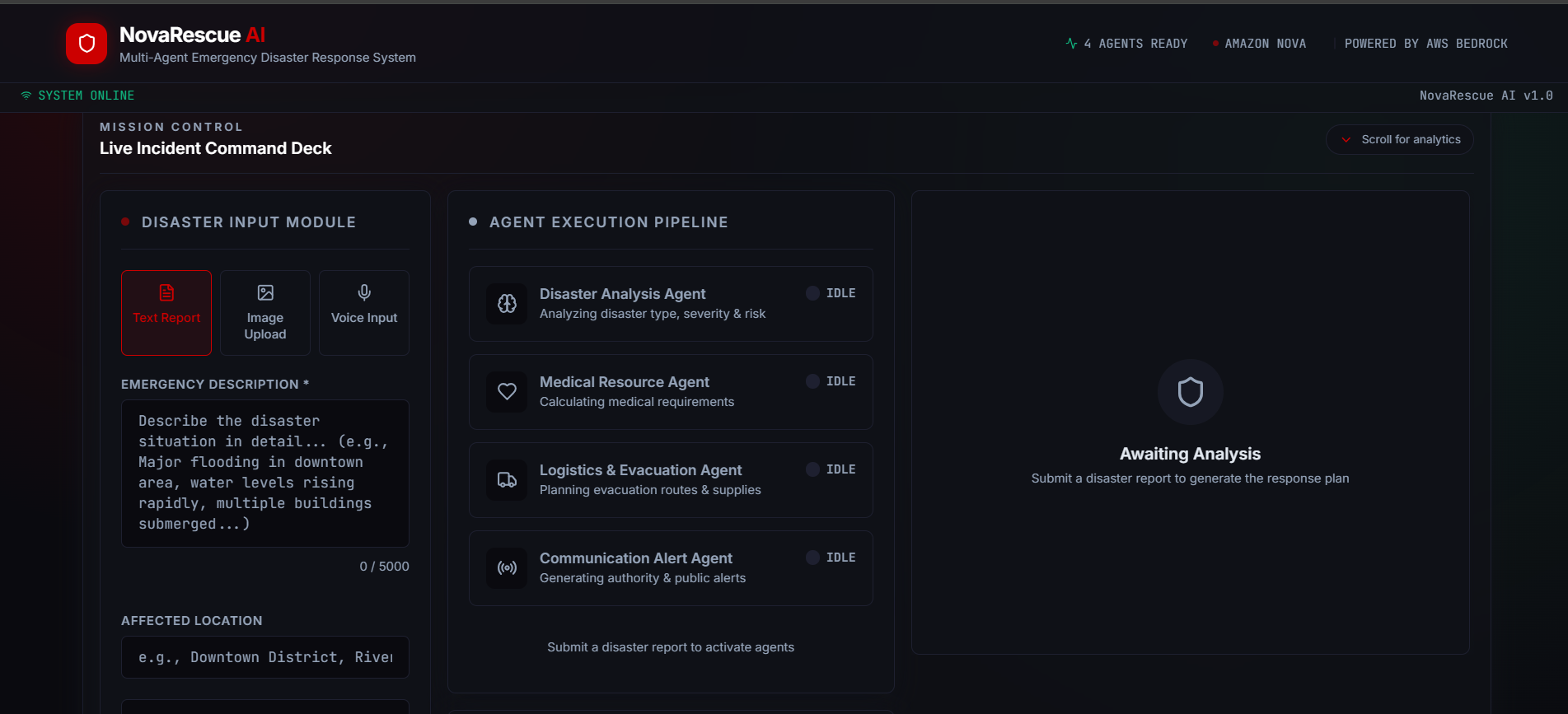
What it does NovaRescue AI functions as an intelligent disaster response coordination system. When a disaster report is submitted, the platform activates a set of specialized AI agents that analyze the situation and generate a structured emergency response plan. The system performs several critical tasks: Detects the type and severity of disasters Estimates risk levels and affected population Plans medical resource allocation Generates evacuation and logistics strategies Produces alerts for authorities and public safety communication Generates incident reports and summaries for response teams The result is presented in an interactive command center dashboard where emergency teams can quickly understand the situation and take action.
How we built it NovaRescue AI is built using a multi-agent AI architecture combined with a modern full-stack application stack. System Architecture Frontend React.js dashboard interface TailwindCSS for UI styling Interactive command center visualization Real-time disaster response panel Backend FastAPI backend for API services Multi-agent orchestration engine Asynchronous request handling for agent coordination AI Agents The system coordinates multiple AI agents that simulate emergency response departments: Disaster Analysis Agent Identifies disaster type Determines severity level Estimates risk score Medical Resource Agent Calculates required ambulances Allocates medical staff Suggests hospital distribution Logistics & Evacuation Agent Plans evacuation zones Coordinates supply distribution Generates rescue logistics strategy Communication Alert Agent Generates alerts for authorities Creates public safety messages Prepares incident communication reports AI Integration Amazon Nova models via AWS Bedrock AI reasoning used for disaster analysis and response planning
Infrastructure Frontend deployed on Vercel Backend deployed on Render Cloud storage using AWS S3 Technology Stack Frontend React TailwindCSS Interactive command center UI Backend FastAPI Multi-agent orchestration system Asynchronous API architecture AI Integration Amazon Nova models via AWS Bedrock Deployment Vercel (Frontend) Render (Backend) Each AI agent is responsible for a specific task and operates sequentially, simulating how different emergency departments collaborate during crisis situations.
Challenges we ran into Designing the Multi-Agent Architecture Coordinating multiple AI agents required careful orchestration. Each agent needed to process outputs from previous agents while maintaining structured and interpretable results. Backend Deployment Issues During deployment we encountered dependency compatibility problems when deploying FastAPI services. We resolved this by stabilizing package versions and configuring the runtime environment properly.
Realistic Disaster Simulation Since real-time disaster datasets were unavailable during development, we designed simulation logic that mimics realistic emergency response scenarios. Accomplishments that we're proud of Built a functional multi-agent disaster response platform Designed a real-time command center dashboard Successfully integrated Amazon Nova AI models Created a scalable architecture that can support real-world deployment Demonstrated how AI can assist emergency decision-making What we learned
While building NovaRescue AI, we learned: How to design multi-agent AI systems Integrating LLMs with backend APIs Building scalable AI-powered web applications Handling real-world deployment challenges Creating technology solutions for social impact This project helped us understand how AI can play a meaningful role in disaster management and emergency planning.
What's next for NovaRescue AI We believe NovaRescue AI can evolve into a powerful disaster response platform. Future improvements include: 🌍 Integration with real-time weather and satellite data 🗺️ Live disaster mapping and geospatial analysis 📊 Predictive risk heatmaps 📱 Mobile application for field rescue teams 🚁 Integration with drones and IoT sensors 🤖 Autonomous AI agents for large-scale disaster coordination
With further development, NovaRescue AI could support government agencies, humanitarian organizations, and emergency response teams in managing disasters more efficiently and saving lives.
Built With
- amazon
- amazon-web-services
- artificial
- cloud
- computing
- disaster
- intelligence
- multi-agent
- nova
- python-fastapi
- react.js
- render
- reportlab
- response
- restapi
- simulation
- systems
- uvicorn
- vercel


Log in or sign up for Devpost to join the conversation.