Inspiration
Low-level and AI-assisted compute workflows can execute complex actions without leaving a clear, reproducible answer to four basic questions: what was requested, what was approved, what actually ran, and what was rejected. Quantum-style demos also frequently blur the boundary between a simulator and physical quantum hardware.
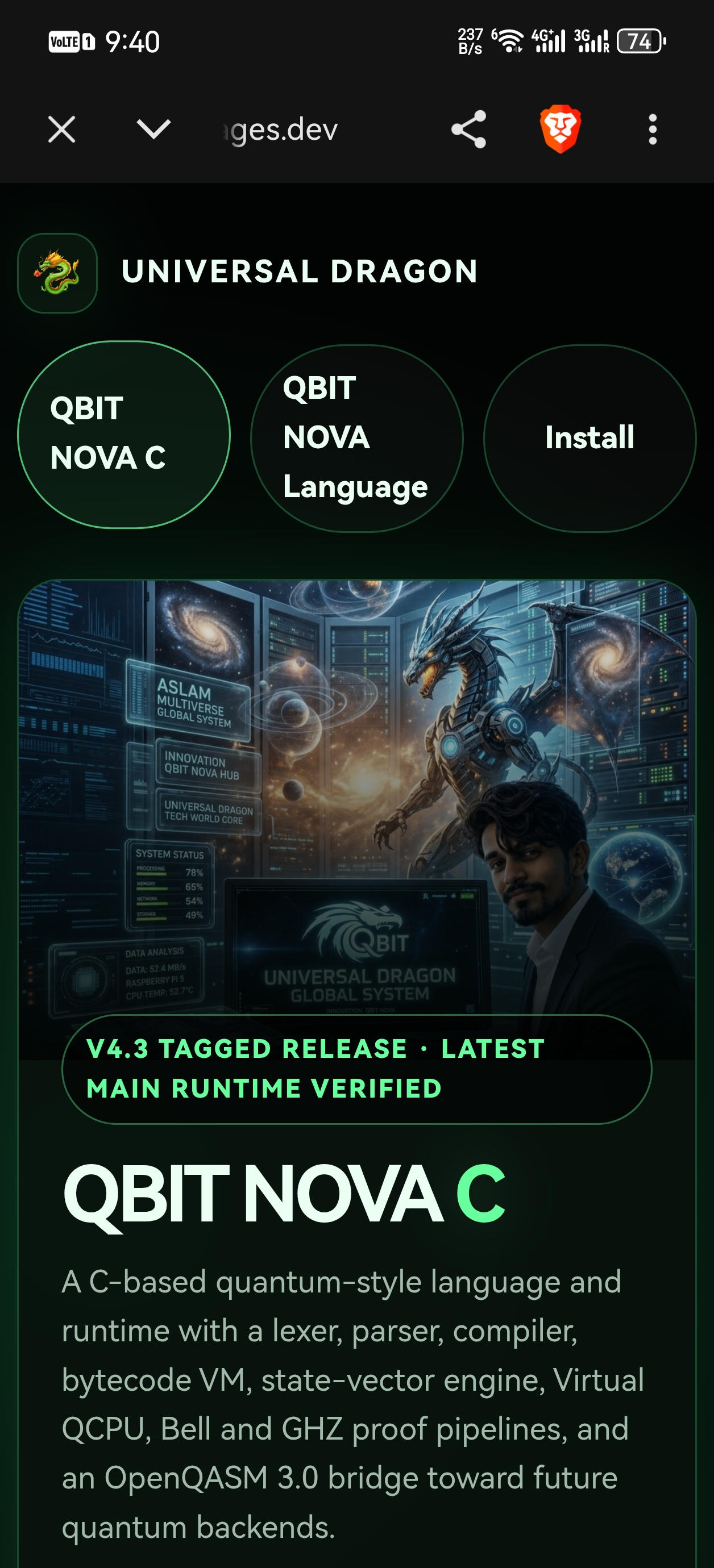
I created Novakutty on my existing QBIT NOVA C ecosystem to make that boundary explicit. Novakutty is conceived, directed, and owned by Universal Dragon Aslam. NOVA / EVE is the user-facing assistant identity.
What it does
Novakutty is an approval-first developer tool for a software Virtual QCPU. It:
admits a bounded standard workload and rejects an unsafe heavy workload; runs a C language, bytecode VM, state-vector engine, and OpenQASM bridge; exposes a stable userspace QCPU contract without creating a kernel module or device node; translates STATUS and GHZ requests through a bounded Unix-socket adapter to the verified qcpud backend; handles missing backends, stalls, cancellation, disconnects, and restarts; and produces deterministic PASS/FAIL markers and a judge-readable evidence receipt.
The truth boundary is intentional: this is a software Virtual QCPU running on a classical host. It does not claim that a Raspberry Pi, phone, or normal CPU becomes physical quantum hardware.
How I built it
The core is written in understandable C11. The Stage 2B path connects the v4.7 pure-userspace frontend to the existing v4.6 qcpud Unix-socket daemon. Requests and responses use fixed-size, explicit little-endian frames. One absolute monotonic deadline is shared across connect, write, and read, so each transport step cannot restart the timeout budget.
The proof suite compiles with warnings as errors and exercises the live STATUS and GHZ bridge, Q32.32 norm conversion, offline mapping, bounded stalls, disconnect wake-up, SIGPIPE suppression, graceful cleanup, and restart recovery.
GitHub Actions runs whitespace checks, Bash syntax, ShellCheck, GCC's static analyzer, the full regression suite, and the exact one-command judge demo.
How Codex and GPT-5.6 helped
I conceived, directed, and own Novakutty and QBIT NOVA C. Codex with GPT-5.6 assisted my Build Week workflow by inspecting the existing UAPI, threat model, transport, and test contracts; implementing and reviewing the bounded Stage 2B adapter; identifying and fixing an early-peer SIGPIPE termination risk; adding focused regression tests and CI gates; and turning the result into a one-command judge demo.
AI output was not accepted as proof by itself. Every claim is tied to compiled code, deterministic tests, live Nova Pi evidence, or GitHub CI. The product identity, architecture direction, ownership, and final engineering decisions remain Universal Dragon Aslam's.
Challenges
The hardest part was connecting two stable contracts without weakening either one. Timeout, cancellation, and file-descriptor reuse races had to remain bounded, while backend failures needed to map cleanly into the public UAPI.
The hosted development sandbox blocked filesystem Unix-socket binding. I therefore transferred the exact Git commit as a verified Git bundle to my AArch64 Nova Pi, ran the live proof there, and then confirmed the same commit through GitHub Actions.
Accomplishments
Preserved the software-only truth boundary. Added a bounded qcpud adapter without kernel, root, device-node, TCP, or UDP actions. Added deterministic success, offline, timeout, disconnect, and restart coverage. Hardened socket writes against process-terminating SIGPIPE. Produced a one-command judge demo and evidence receipt. Verified the implementation on AArch64 Linux and GitHub's Ubuntu runner. GitHub Actions run #79 passed on commit da1dbb9fc9376f66d1861cbe19d21c6299d123bf.
Judge quickstart
Supported platform: Ubuntu or another Linux distribution on x86_64 or AArch64.
Requirements: GCC with C11/pthreads, Bash, Python 3, and standard Linux tools. git clone https://github.com/UniverseDragon14/qbit-nova-c.git cd qbit-nova-c git switch main bash scripts/qnova_build_week_demo.sh
Expected final marker: PASS: NOVAKUTTY_BUILD_WEEK_DEMO_READY
No credentials are required. The demo performs no root, kernel-module, device-node, TCP/UDP, GPIO, or physical-QPU action.
What I learned
Reliable agentic and low-level systems need independent evidence, not confident status text. A single absolute deadline, explicit protocol translation, honest hardware claims, and CI-backed receipts make the system easier to trust and reproduce.
What's next
Next I will add the NOVA presentation layer and EVE explanation interface over the same approval and proof boundary, expand the request vocabulary beyond GHZ, and package the runtime for easier installation while keeping privileged actions and physical-hardware claims explicitly outside the current scope.


Log in or sign up for Devpost to join the conversation.