Inspiration
Modern businesses rely on dozens of SaaS tools such as CRMs, communication platforms, marketing tools, analytics dashboards, and support systems. Setting up these tools and connecting them into meaningful workflows often takes hours or even days of manual configuration. Even simple setups like creating a sales pipeline, sending Slack alerts for new leads, or triggering onboarding emails require navigating multiple dashboards and configuring integrations.
We asked a simple question:
What if AI could configure business software the same way an IT engineer does?
Recent advances in agentic AI systems make it possible for models not only to understand user intent but also to plan tasks, interact with interfaces, and validate outcomes. This inspired us to build NovaFlow, an autonomous AI agent that can turn a simple business request into a fully configured SaaS workflow.
Instead of manually configuring tools, users simply describe what they want, and the AI handles the rest.
What it does
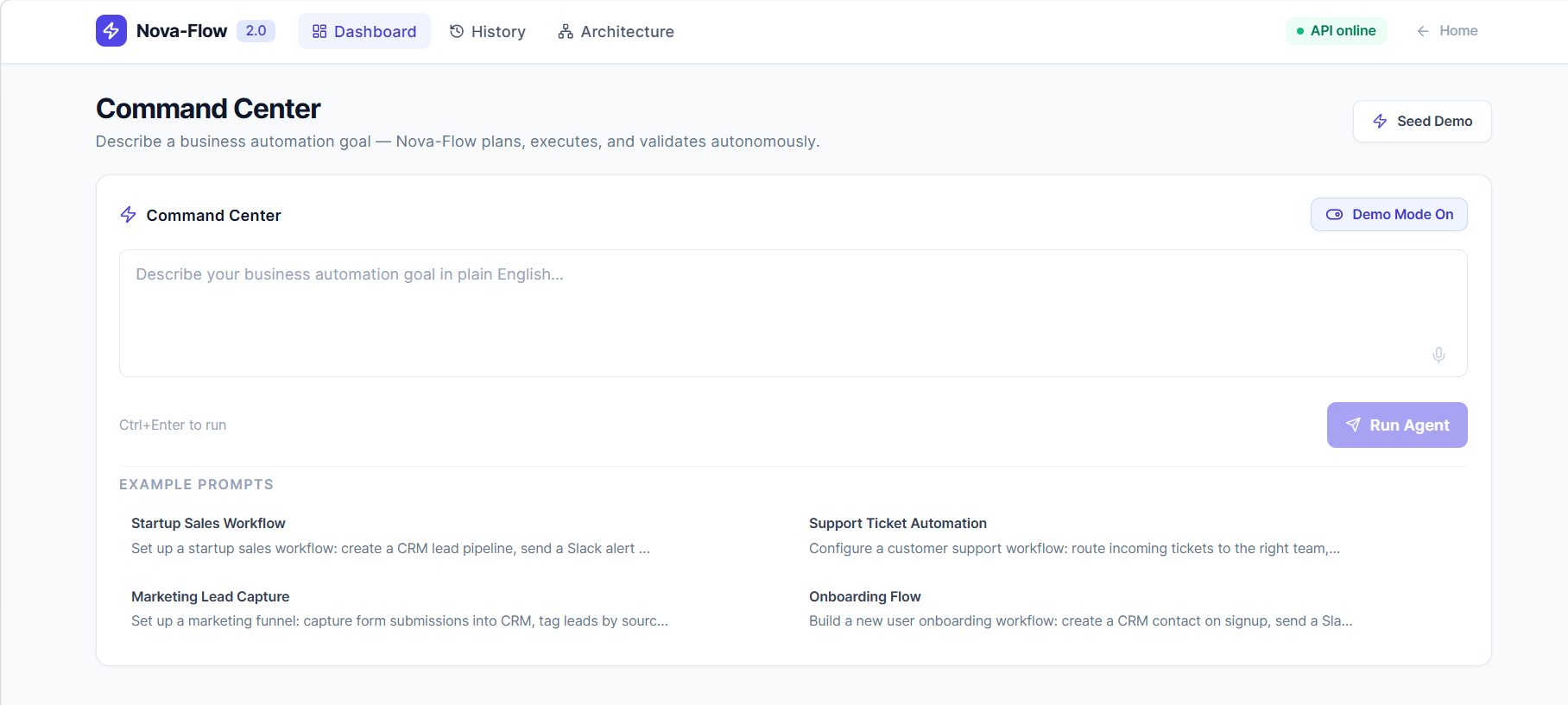
NovaFlow — Autonomous SaaS Setup Agent is an AI system that automatically configures business software workflows from a single prompt.
A user can simply say:
“Set up a sales pipeline that adds new leads to the CRM, sends a Slack notification, and triggers a welcome email.”
NovaFlow will then:
- Understand the user’s request
- Design the workflow architecture
- Navigate SaaS dashboards autonomously
- Configure the required integrations
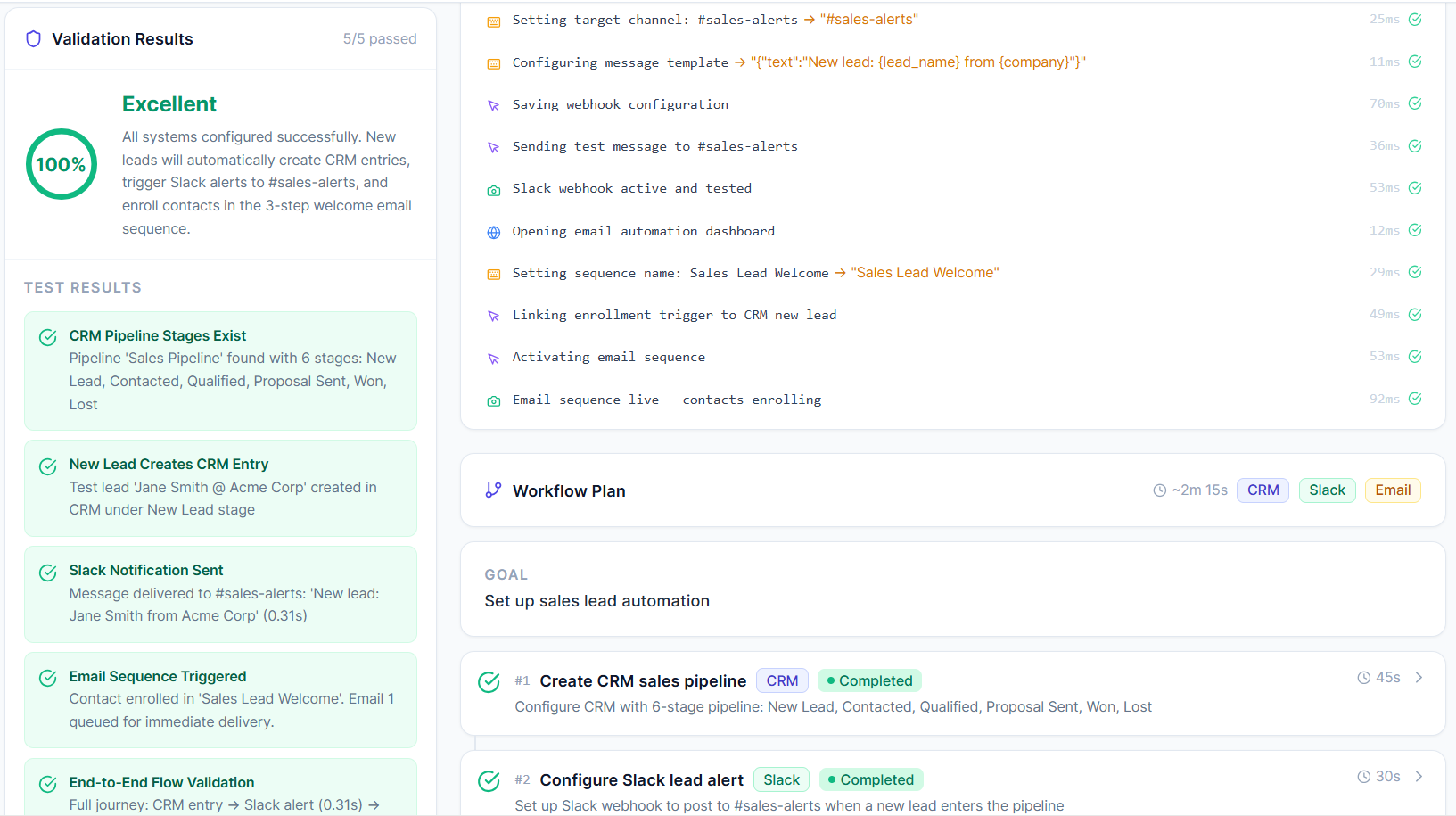
- Validate that the workflow works correctly
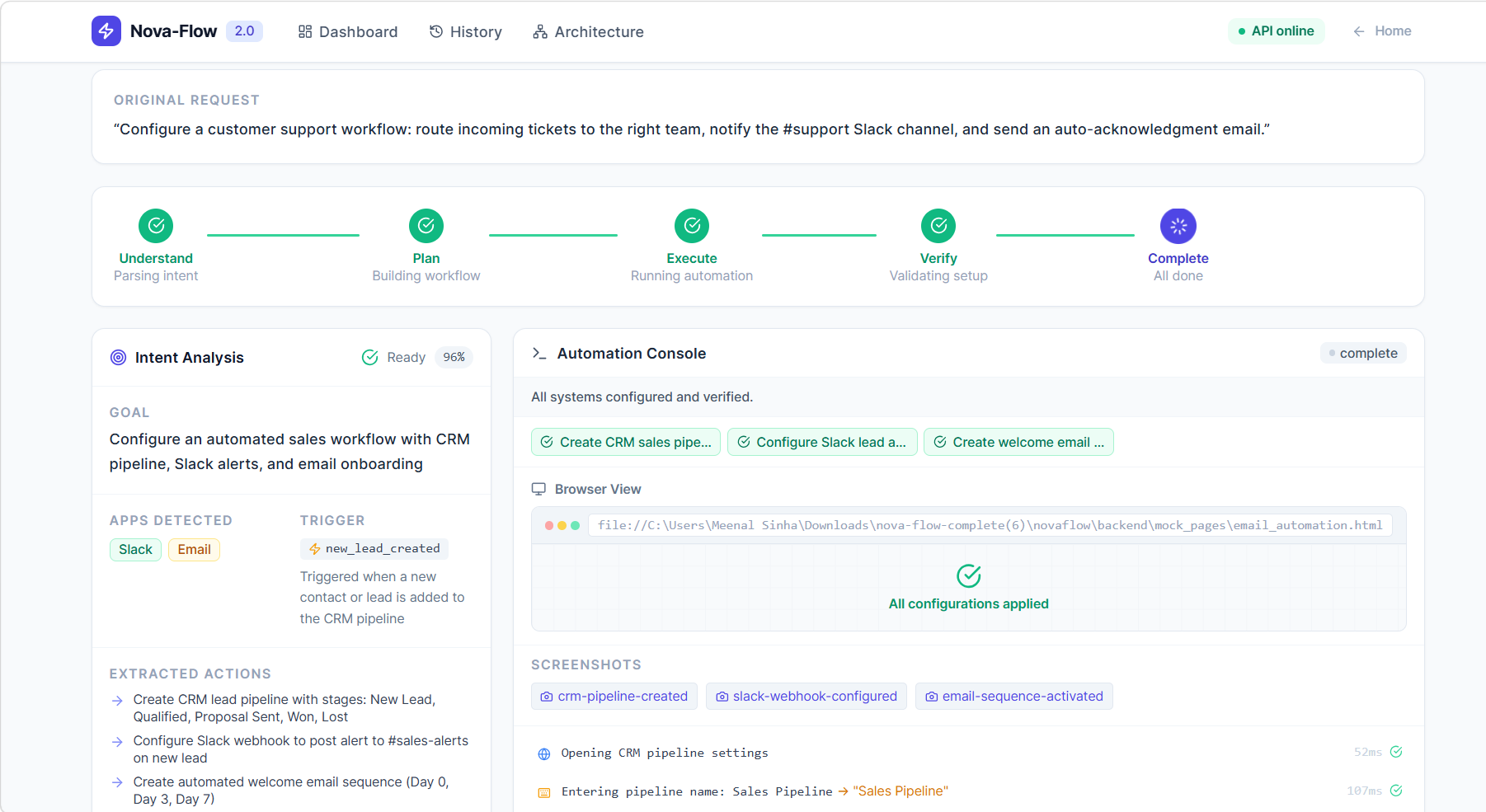
The system follows an agent loop:
Understand → Plan → Execute → Validate
This transforms AI from a passive assistant into an autonomous operations agent capable of setting up real software systems.
How we built it
NovaFlow is built using a multi-agent architecture that mirrors how a human engineer would configure software systems.
The system includes four specialized agents:
Intent Agent
Interprets the user's request and extracts the goal, tools, triggers, and actions.
Workflow Architect Agent
Transforms the intent into a structured workflow plan and determines how different SaaS tools should interact.
Automation Agent
Executes the plan by navigating SaaS dashboards through browser automation and configuring the required settings.
Validation Agent
Tests the configured system and verifies that triggers and automations work correctly.
System Architecture
User Request
↓
Intent Agent
↓
Workflow Architect
↓
Automation Agent
↓
Validation Agent
↓
Configured SaaS Workflow
Technologies Used
Frontend:
- Next.js
- React
- TypeScript
- Tailwind CSS
- Framer Motion
Backend:
- Python
- FastAPI
Automation Layer:
- Playwright browser automation
AI Integration Layer:
- Amazon Nova model adapters for reasoning, automation, and voice interaction
Infrastructure:
- Docker
- Modular service architecture
To ensure a reliable demo environment, we also built mock SaaS dashboards that simulate real CRM, Slack, and email automation interfaces.
Challenges we ran into
One of the biggest challenges was designing a system that could reliably automate interactions with web interfaces. SaaS dashboards are dynamic, and automation systems must handle different layouts, UI states, and asynchronous events.
Another challenge was coordinating multiple AI agents. Each agent has a specific responsibility, and ensuring smooth communication between them required careful orchestration and clear data structures.
We also focused heavily on making the AI reasoning visible. To build trust in the system, we implemented execution timelines, agent state monitoring, and detailed logs that show how the system plans and executes each task.
Finally, demo reliability was a key challenge. Real SaaS APIs can introduce unpredictable failures, so we created simulated SaaS environments to guarantee a stable and repeatable demo.
Accomplishments that we're proud of
We are proud of building a complete agentic AI system that goes beyond a chatbot and performs real operational tasks.
Key accomplishments include:
- Designing a full multi-agent AI architecture
- Implementing autonomous SaaS configuration through browser automation
- Creating a real-time AI reasoning timeline
- Building an agent state monitoring system for observability
- Delivering a full end-to-end workflow from prompt to validated system
NovaFlow demonstrates how AI can move from simply answering questions to actually performing real operational work inside software systems.
What we learned
Building NovaFlow taught us several important lessons about developing agentic AI systems.
First, transparency is critical. Showing how the AI plans and executes tasks greatly improves user trust.
Second, autonomous systems require strong orchestration between specialized agents rather than relying on a single monolithic model.
Third, reliable demos and system observability are essential when building complex AI workflows.
Most importantly, we learned that combining AI reasoning with real-world automation unlocks powerful new possibilities for productivity tools.
What's next for NovaFlow — Autonomous SaaS Setup Agent
NovaFlow is only the first step toward a future where AI can manage complex software ecosystems autonomously.
Future improvements include:
- Direct integrations with real SaaS platforms
- Learning from previous workflows to improve setup speed
- Support for more enterprise tools and integrations
- Voice-first system configuration
- Autonomous troubleshooting and workflow optimization
Our long-term vision is to build an AI operations engineer capable of designing, deploying, and maintaining entire software infrastructures automatically.
Built With
- ai-agents
- amazon-bedrock
- amazon-nova
- docker
- docker-compose
- fastapi
- framer-motion
- next.js
- playwright
- python
- react
- rest
- tailwind-css
- typescript

Log in or sign up for Devpost to join the conversation.