
## Inspiration
Space has way too much data for humans to handle, so we wanted to upgrade old-school astronomy with AI. We’re basically taking 100 years of science and making it instant.
## What it does
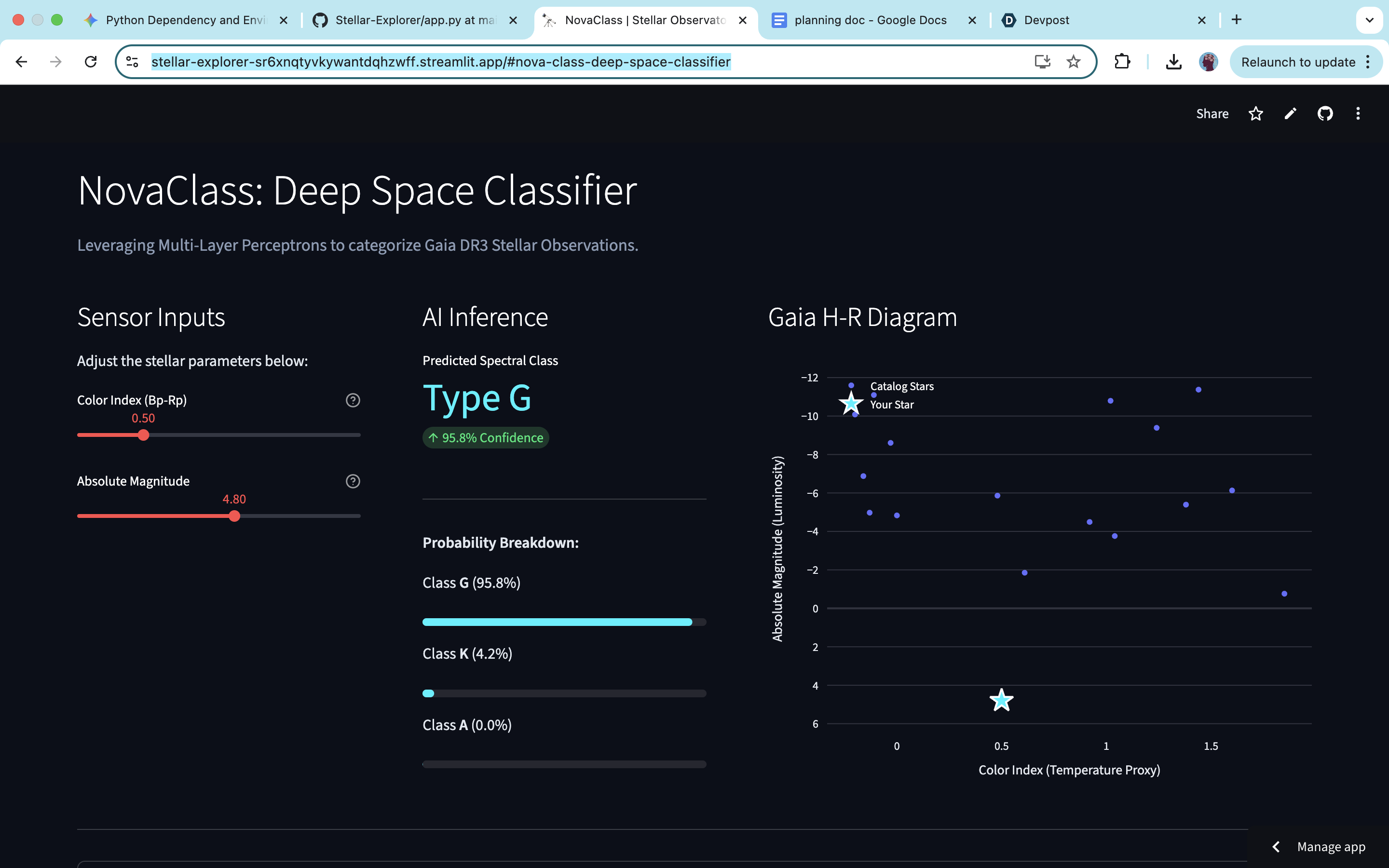
It’s an AI dashboard that uses a neural network to identify stars based on how hot and bright they are. It turns massive spreadsheets into a live, interactive map of the galaxy.
## How we built it
We used Python and Scikit-Learn to train an AI on real NASA/Gaia satellite data. Then we built the site with Streamlit so the graph updates the second you move a slider.
## Challenges we ran into
The math was the hardest part because we had to calculate "true" brightness so the AI didn't get tripped up by distance. We also had to optimize the code so the predictions felt instant and smooth.
## Accomplishments that we're proud of
We’re hyped that we actually got a neural network to understand stellar physics in milliseconds. Making something this complex look clean and easy to use was a huge win.
## What we learned
We learned how to clean messy scientific data and turn "black box" AI into a tool people can actually play with. It taught us how to bridge the gap between crazy math and cool UI.
## What's next for NovaClass: Deep space classifier
We want to let the AI scan millions of stars at once to map entire star clusters. We’re also adding "anomaly detection" to find weird space objects that shouldn't exist!
Built With
- matplotlib
- numpy
- pandas
- plotly
- python
- scikit-learn
- steamlit

Log in or sign up for Devpost to join the conversation.