-
-
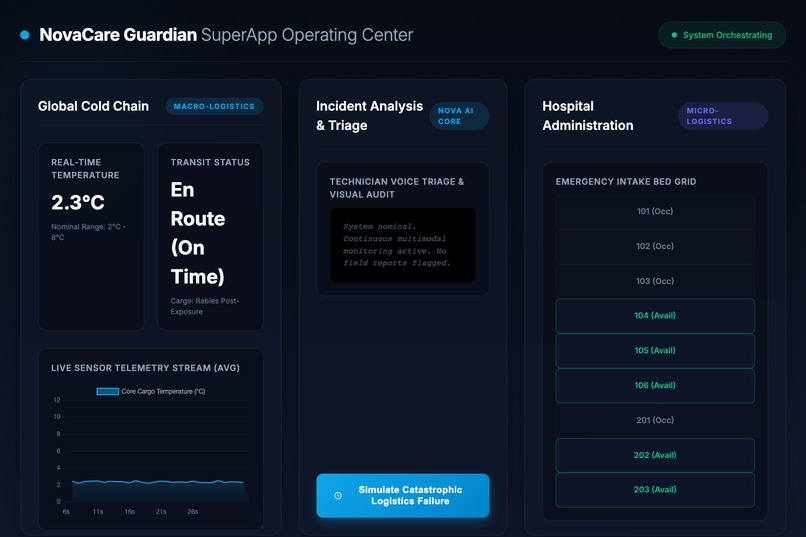
Nominal
-
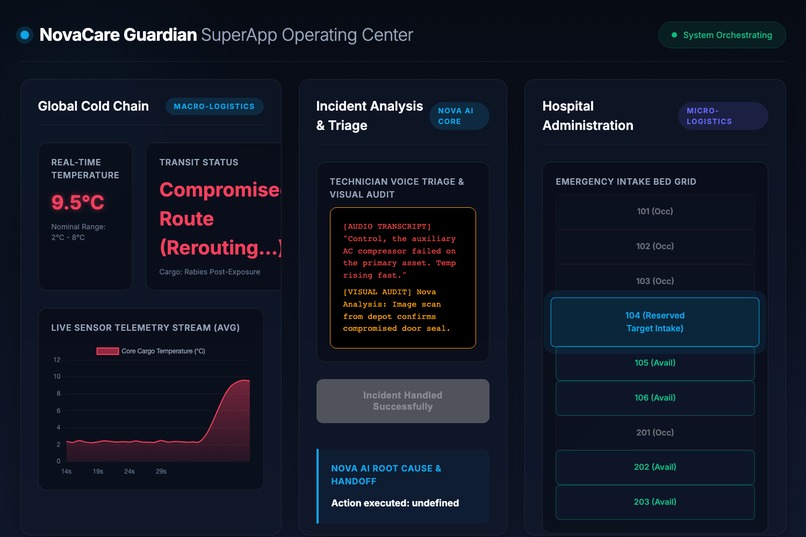
Reasoning
-
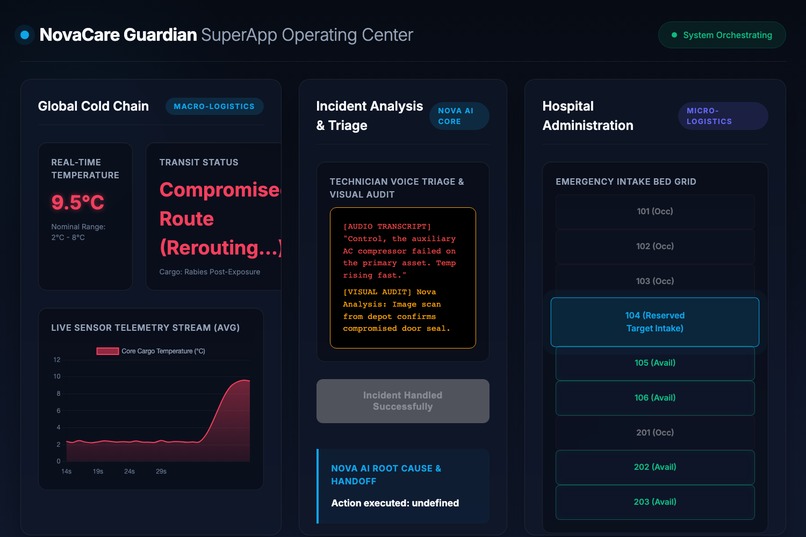
Orchestrated


Inspiration I was inspired by a quiet crisis happening in flood-prone districts across the globe: the silent loss of life-saving biologics. Every year, critical treatments like antivenom and rabies post-exposure vaccines are lost due to refrigeration failures, delayed maintenance, and fragmented communication. The data to prevent these losses exists hidden in sensor logs, field technician voice updates, and visual inspections but manual triage happens too late. I realized that by combining multimodal understanding with agentic orchestration, I could build a system that not only detects these failures before they happen but instantly coordinates the downstream hospital logistics required to save both the cargo and the patients waiting for it.
What it does NovaCare Guardian is an autonomous AI logistics "SuperApp" that secures the full lifecycle of care. It operates across two integrated domains: Macro-Logistics (Cold-Chain Guardian): It continuously analyzes IoT temperature streams, audits visual inspection notes for physical damage, and triages technician voice transcripts for root causes. If a thermal risk is detected, the agent autonomously reroutes the critical medical supply chain before spoilage occurs. Micro-Logistics (Hospital Orchestration): The moment a compromised or accelerated delivery is triggered (like an urgently needed organ or vaccine), the system’s hospital agents automatically orchestrate bed allocation and trigger insurance pre-authorization workflows, ensuring there are zero administrative delays upon arrival.
How we built it I engineered the system using a multi-agent decision architecture powered by Amazon Nova. Multimodal Fusion: I utilized Nova's multimodal capabilities to analyze images of cargo seals and unstructured voice transcripts from field technicians, combining this with structured IoT telemetry data. Agentic Orchestration: I built specialized agents (ColdChain Analyst, BedManager, PreAuth) managed by a central HealthcareOrchestrator (written in Python/FastAPI). The orchestrator maintains a unified state graph, evaluating policy rules and generating actionable automation handoff steps rather than just summary labels. Safety & Compliance: A dedicated policy engine scores decisions based on jurisdiction-specific rules, ensuring that AI-driven rerouting and bed assignments maintain strict medical compliance and transparent explainability.
Challenges we ran into One of the hardest technical challenges was cross-modal evidence fusion. It was difficult to perfectly align a sudden IoT temperature spike ($t_x$) with a localized, messy voice transcript from a technician ("The generator has been down since the storm") and visual evidence of a compromised seal. I had to design a scoring architecture where the central orchestrator weights these confidence intervals dynamically before assigning a final severity level. Another major hurdle was preventing "agentic loop failures" during the hand-off between the cold-chain transport system and the hospital admission system. Ensuring that a rerouted truck ($Location_A \to Location_B$) instantly fired the correct state change for bed reservation at $Location_B$ required writing rigorous fallback and safety guardrails.
Accomplishments that we're proud of I am incredibly proud of moving beyond a simple conversational AI into a true decision-centric agent collaboration. The system doesn't just "chat" about a problem; it generates concrete, explainable operational actions that span both the global supply chain and local hospital administration network. Building a robust policy engine that reliably validates these high-stakes decisions is a huge win.
What we learned Building NovaCare Guardian taught me that the true power of AI in enterprise applications lies in context bridging. I learned how to architect systems where localized, specialized agents (like a bed manager) can safely consume and act upon vast, noisy data streams from completely different domains (like a global sensor network). I also learned the absolute necessity of transparent policy scoring when automating healthcare infrastructure.
What's next for "NovaCare Guardian" The next phase is deploying the UIAutomationAdapter into live hospital legacy systems to test real-world agentic clicks on EHR dashboards. I also plan to expand the multimodal ingestion to read and process live dashcam and weather satellite imagery, further predicting logistics delays before the cold-chain transport even hits the road. Ultimately, I want NovaCare Guardian to become the open-source standard for disaster-resilient healthcare supply chains globally.
Built With
- amazon-bedrock
- amazon-nova-(nova-pro&nova-lite)
- boto3
- chart.js
- fastapi&uvicorn
- html5&css3
- jinja
- langgraph
- postgresql
- pydantic
- pytest
- python
- pyyaml
- vanilla-javascrip


Log in or sign up for Devpost to join the conversation.