-
-
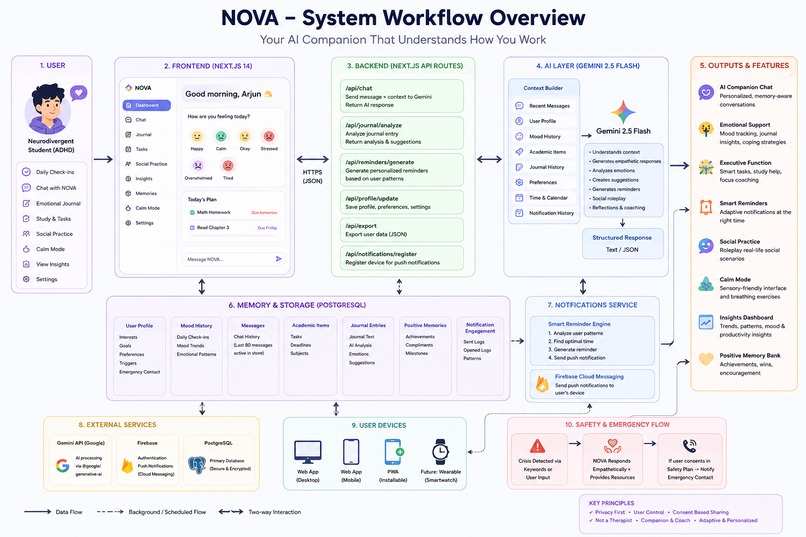
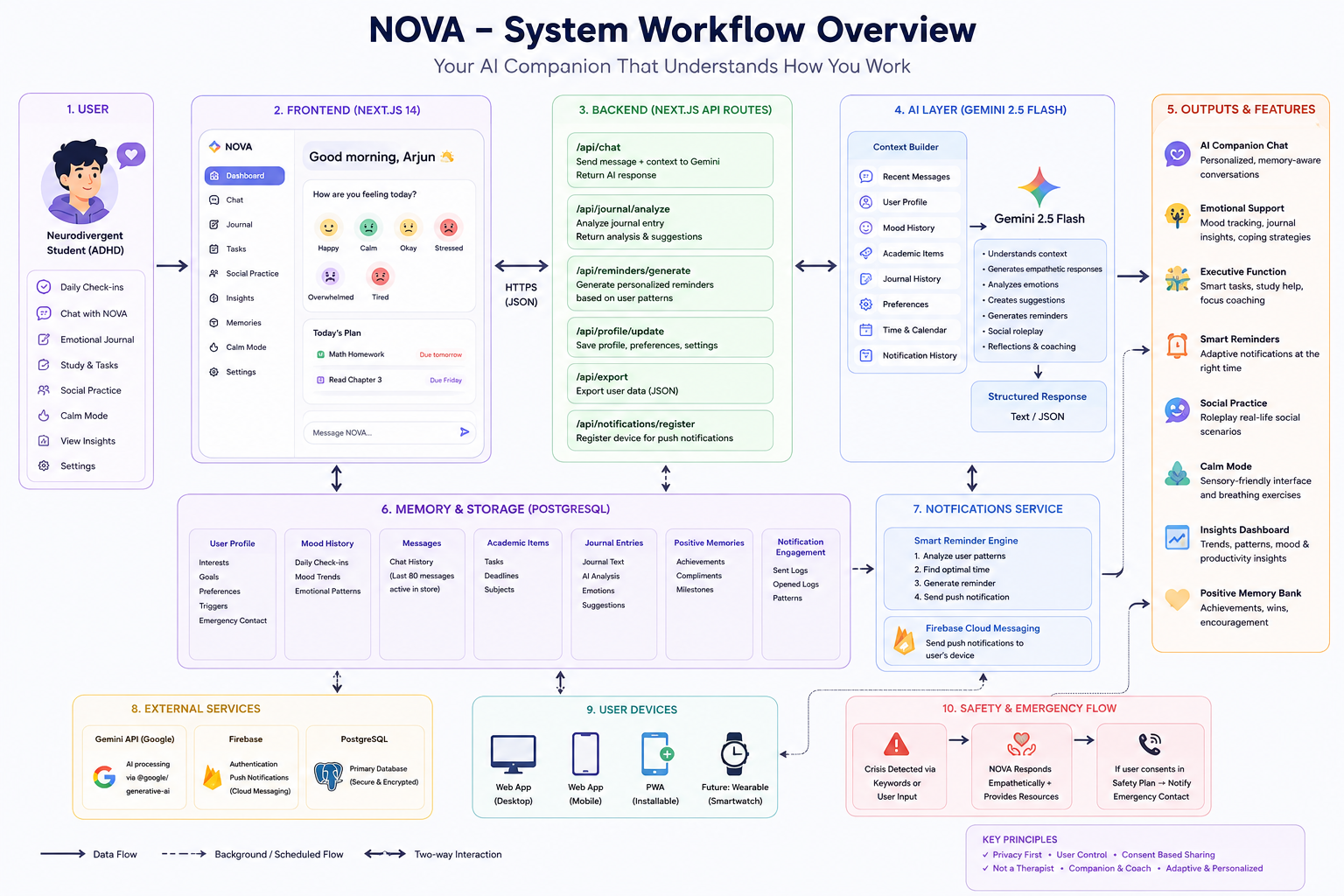
Architecture
Inspiration
Growing up or studying with ADHD is not a focus problem - it is a support system problem.
The student who stares at a blank document for two hours is not lazy. The student who forgets every deadline is not careless. The student who cannot explain to their parents why today was so hard is not being difficult. They are navigating a world that was never designed for how their brain works and most technology makes this worse, not better.
Every productivity app, study tool, and AI assistant we looked at shared the same flaw: they assumed the user would adapt to the tool. Rigid reminders at fixed times. Generic motivational quotes. Chatbots that forget everything the moment you close the tab.
We kept asking one question: what if the AI adapted to the student instead?
That question became NOVA.
What it does
NOVA is an AI-powered daily companion built specifically for neurodivergent students with an initial focus on those with ADHD. It is not a chatbot. It is not a task manager. It is not a therapy app. It is something genuinely new: a long-term relationship between a student and an AI that actually remembers them.
Here is what NOVA does every day:
- 🧠 Builds a living memory of each user their interests, emotional triggers, study challenges, goals, coping strategies, and communication style and uses that memory to personalise every single interaction
- 💬 Companion chat powered by Gemini 2.5 Flash - a warm, non-judgmental AI that references past conversations naturally, never guilt-trips, and breaks every overwhelming task into the smallest possible next action
- 📊 Mood check-ins and emotional pattern tracking - daily check-ins that over time reveal trends like "Mondays are harder for you" or "your mood improves after outdoor activity"
- 📓 Emotional journal with AI reflection - users write freely and NOVA identifies emotions, possible triggers, a coping suggestion, and a reflective question
- 🌿 Calm Mode - a full-screen sensory-reduced environment with a breathing exercise, the 5-4-3-2-1 grounding technique, and rotating affirmations - activatable from anywhere in the app in one tap
- 💪 Executive function coaching - instead of saying "finish your assignment", NOVA says "let's just open the document" - one micro-step at a time
- 🎭 Social skills practice - judgment-free AI roleplay for scenarios like talking to a teacher, attending a job interview, or resolving a misunderstanding with a friend
- ⏰ Adaptive notifications - the system learns when reminders are actually opened and automatically shifts timing to match each user's real behaviour
- 🏆 Positive memory bank - a collection of achievements and good moments that NOVA surfaces on hard days
- 🔒 Safety system - detects distress in conversation, responds with empathy, reminds users of their chosen safety contact, and provides crisis resources - all with full user consent and control
How we built it
NOVA is built on a modern, fully client-side-first stack designed for speed, accessibility, and personalisation at scale.
Frontend
- Next.js 14 (App Router) for routing, server components, and API routes
- React 18 for the component layer
- TypeScript throughout for type safety
- Tailwind CSS with a custom NOVA design token system - brand colours, calm mode colours, and warm accent colours all defined as Tailwind extensions
- Framer Motion for every animation - page transitions, breathing circle, message entrance, mood button press, Calm Mode overlay
- Zustand with persist middleware for global state management, storing the entire user memory in localStorage so NOVA remembers across sessions with no backend required in v1
AI Layer
- Google Gemini 2.5 Flash as the primary reasoning model
- Streaming responses via
chat.sendMessageStream()so NOVA's replies appear in real time - Context injection - before every API call, a rich system prompt is assembled from the user's full memory store: profile, mood history, positive memories, academic items, and conversation history (last 20 messages)
- Three dedicated API routes:
/api/chat(streaming companion),/api/journal-analyze(journal reflection),/api/social-debrief(roleplay feedback)
Design Philosophy
Every design decision was made with neurodivergent users in mind - large tap targets, reduced visual clutter, a Calm Mode that strips the entire interface back to its essentials, and animations that respect prefers-reduced-motion.
Challenges we ran into
Building genuine memory without a backend The hardest architectural challenge was making NOVA feel like it truly remembers the user without a database in v1. We solved this by engineering the Zustand store as a rich, structured memory object and injecting it fully into every Gemini system prompt. The AI has no built-in memory - but our context engine gives it one.
Gemini system prompt engineering for neurodivergent support Getting NOVA's tone exactly right took significant iteration. Generic AI responses felt clinical and cold. We had to carefully craft system prompt rules that enforce: no guilt-tripping, always break tasks into micro-steps, detect distress without overreacting, reference past events naturally, and keep responses concise enough not to overwhelm. Every word of the persona prompt was deliberately chosen.
Calm Mode as a universal overlay
Implementing Calm Mode so it could appear over any screen chat, journal, dashboard without losing the user's navigation state required careful use of Framer Motion's AnimatePresence at the root AppShell level, driven entirely by a single Zustand boolean.
Distress detection and safety Handling emotional distress in an AI product responsibly is genuinely difficult. We had to draw a clear line: NOVA is warm and supportive, but it is not a therapist and must never pretend to be. Every distress response was hand-crafted to lead with empathy, avoid clinical language, and always point toward human support not replace it.
Adaptive notification timing Building a notification system that learns when a user actually responds rather than firing at fixed times required designing a lightweight engagement tracking system within Zustand that computes timing shifts after 7 days of data, all client-side.
Accomplishments that we're proud of
- NOVA genuinely feels like a companion, not a tool - the continuity of memory across sessions creates conversations that feel real and personal
- Built a complete, production-ready feature set - onboarding, companion chat, emotional journal, Calm Mode, social practice, memory bank, adaptive notifications, and a caregiver report system all fully specified and integrated
- Calm Mode works from anywhere in the app in a single tap - one of the most important accessibility features for users in acute overwhelm
- The Gemini system prompt produces responses that are consistently warm, concise, and neurodivergent-appropriate a result of extensive prompt engineering
- The entire v1 app runs with zero backend - all state is client-side, making it fast, private, and deployable instantly
- Every design decision was made for neurodivergent users first - not retrofitted for accessibility but built from the ground up with ADHD-specific UX in mind
What we learned
- Prompt engineering is product design. The difference between a cold AI response and a warm, genuinely helpful one is entirely in how you write the system prompt. We learned to treat the prompt as a first-class product artifact.
- Memory is the foundation of relationship. Without persistent memory, AI feels transactional. With it, it feels like someone who actually knows you.
- Accessibility is not a feature it is the whole point. Designing for neurodivergent users forced us to question every default UX decision and make deliberate, considered choices at every step.
- Streaming responses change the emotional experience of AI. Watching NOVA's response appear word by word feels completely different from waiting for a block of text it feels like listening to someone speak.
- The safety boundary in mental health AI is everything. Getting the line right between supportive
Use of AI
The use of AI is done in such a way that a Chat, Journey, Memory Bank is kept to get the inputs and the AI will customize the whole personal dashboard deciding on the inputs of the person. Chat act as a friend of the Person and understands those things which only a person can understand. Journey act as a achievement record of the person through which the AI understand is the person progressing or still under the influence of the problem. Through Memory Bank the person inputs or records the previous emotions and AI understand the pattern or how things changes the mind of the person.
Built With
- ai
- gemini
- next.js
- tailwind


Log in or sign up for Devpost to join the conversation.