-
-
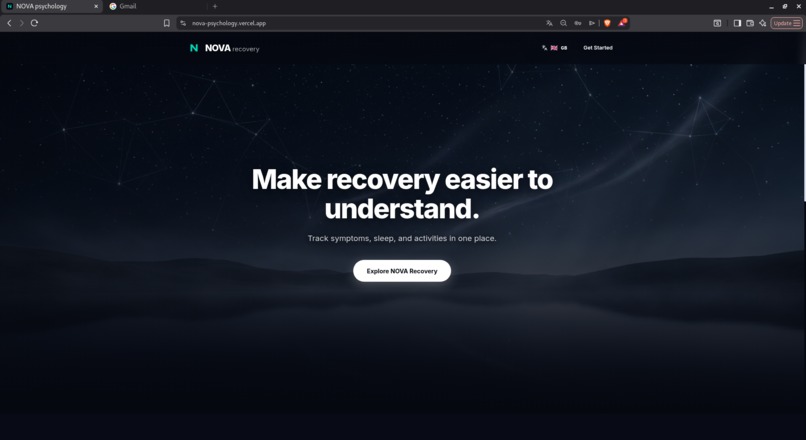
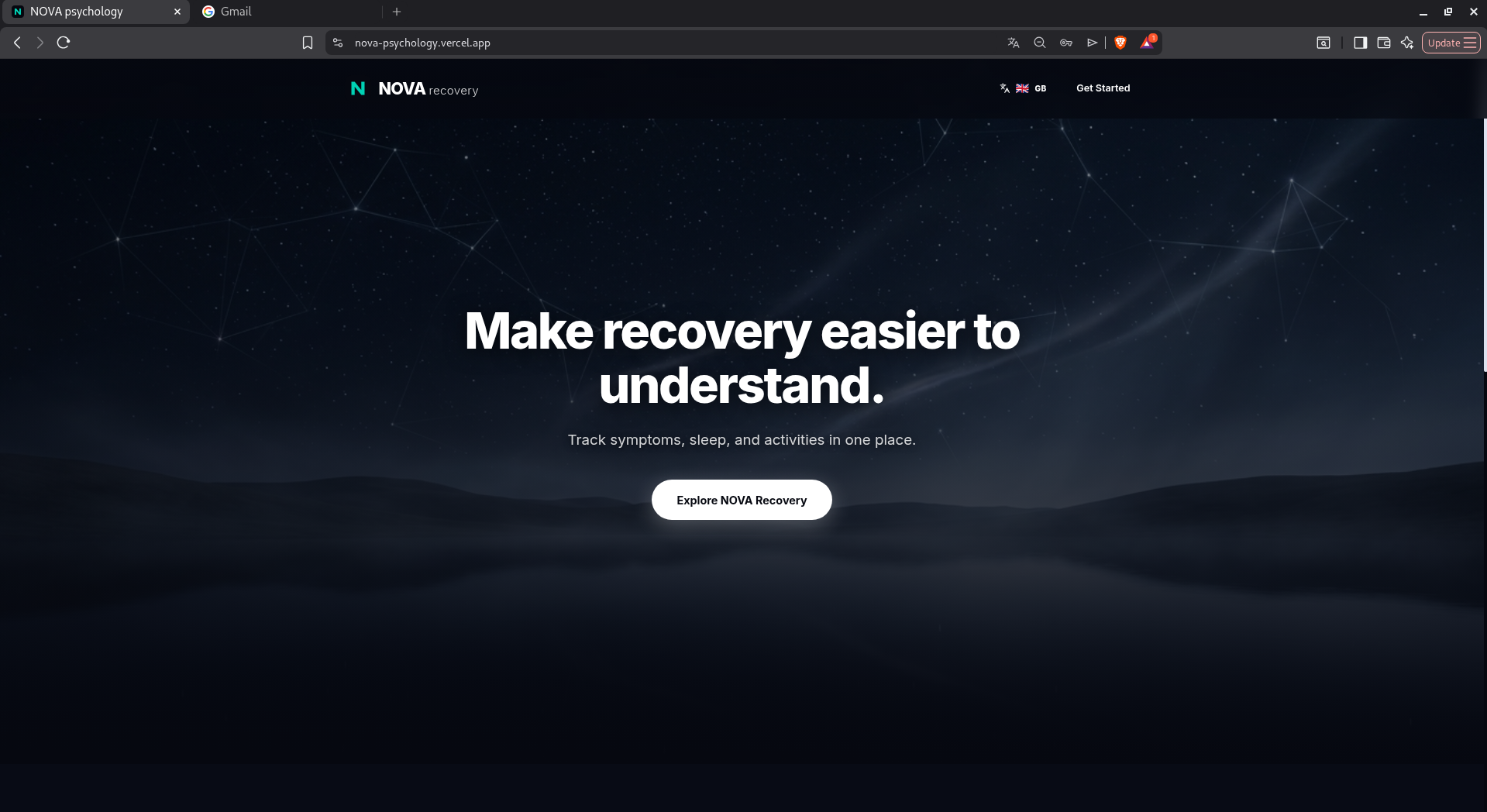
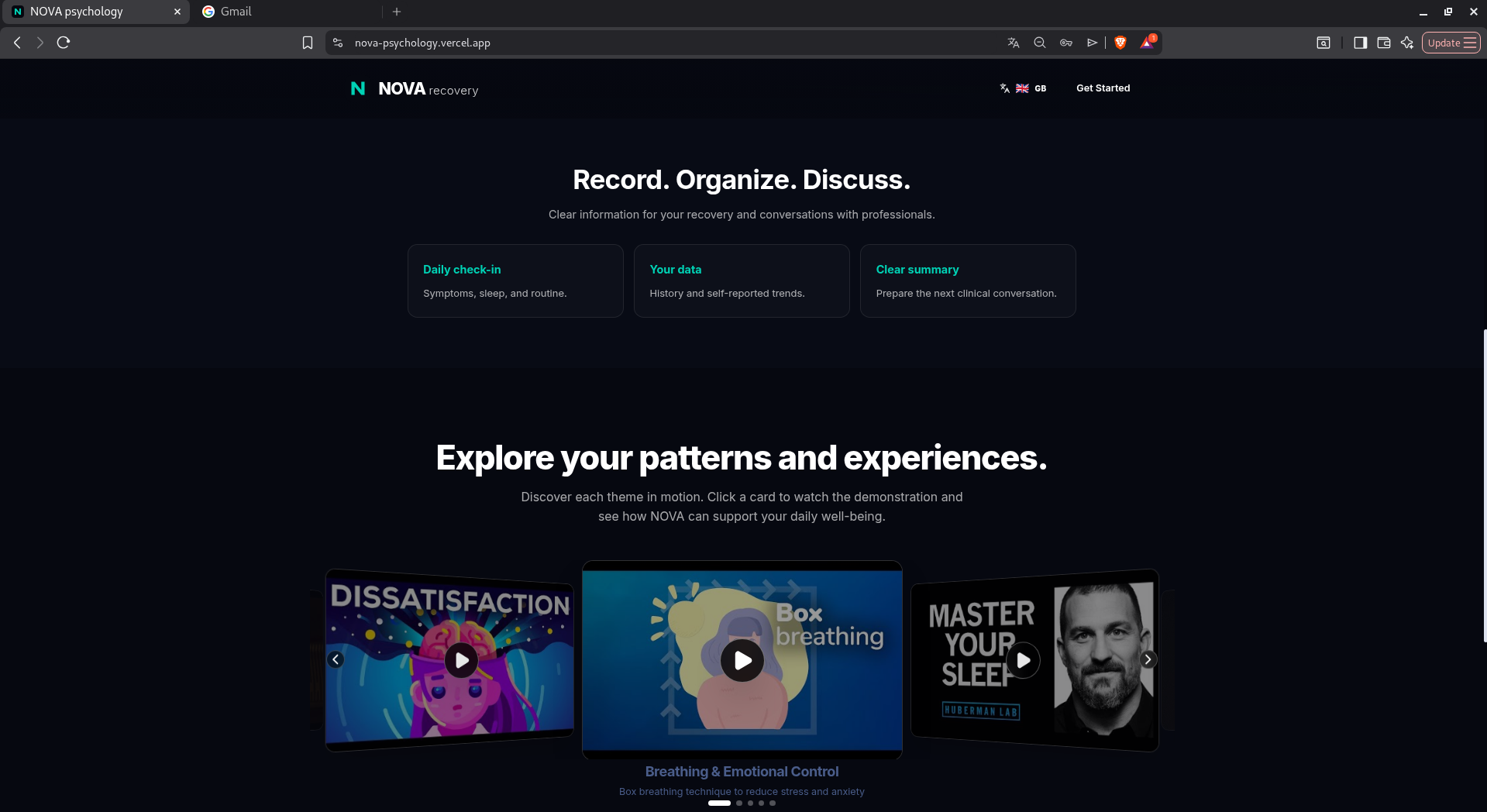
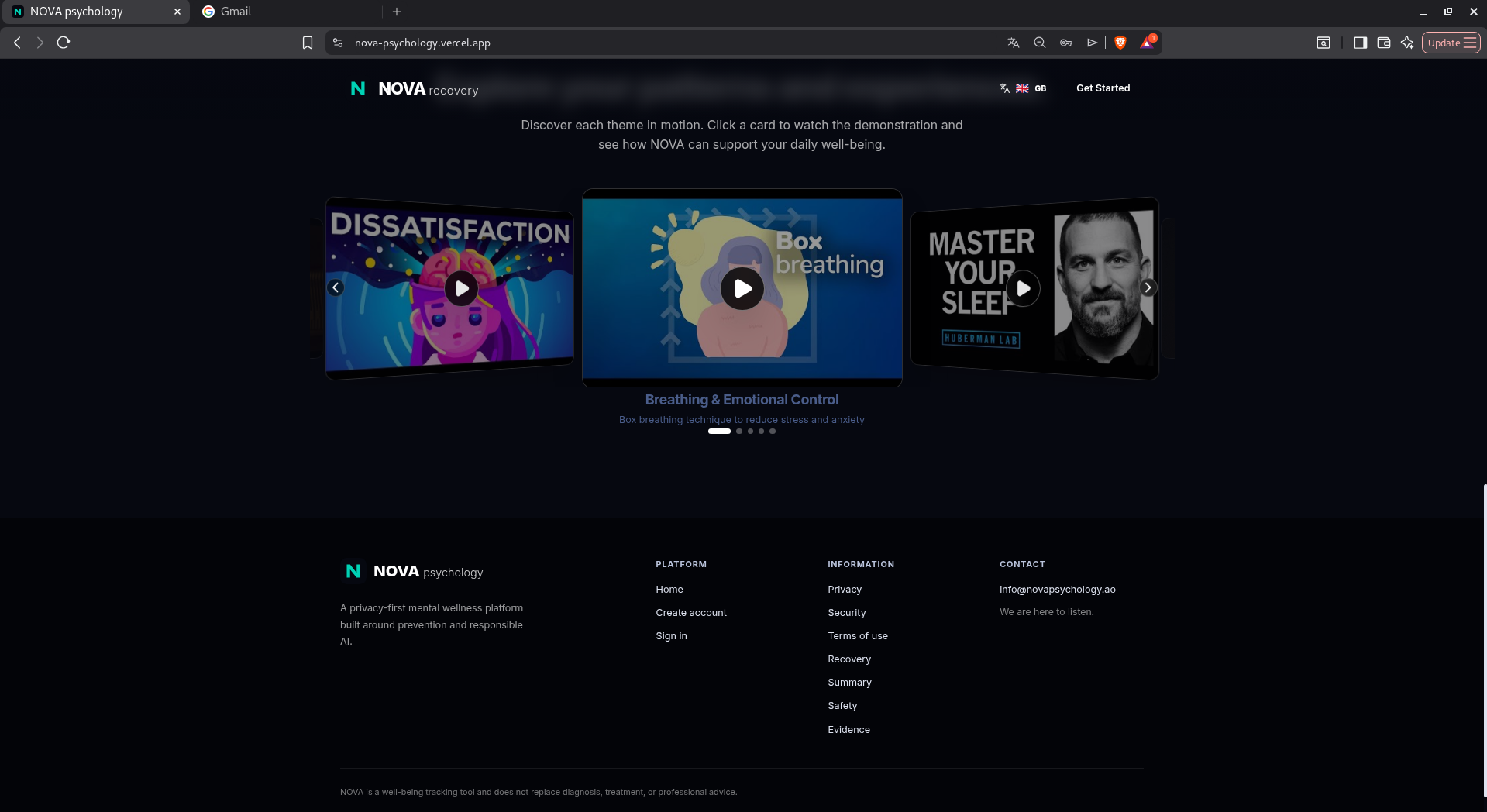
Landing page
-
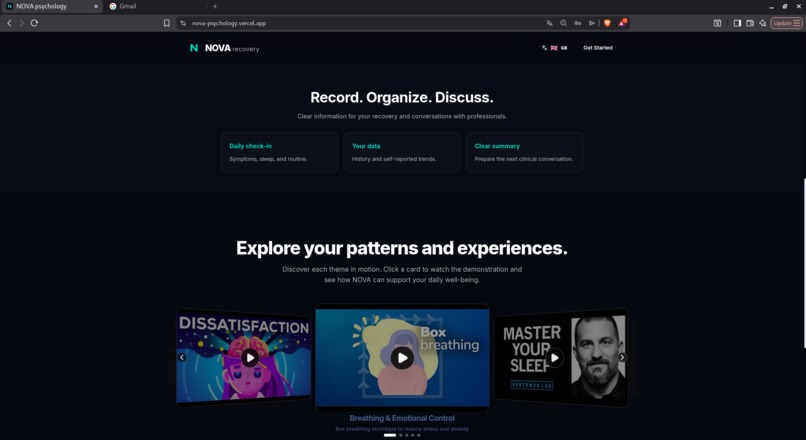
Landing page
-
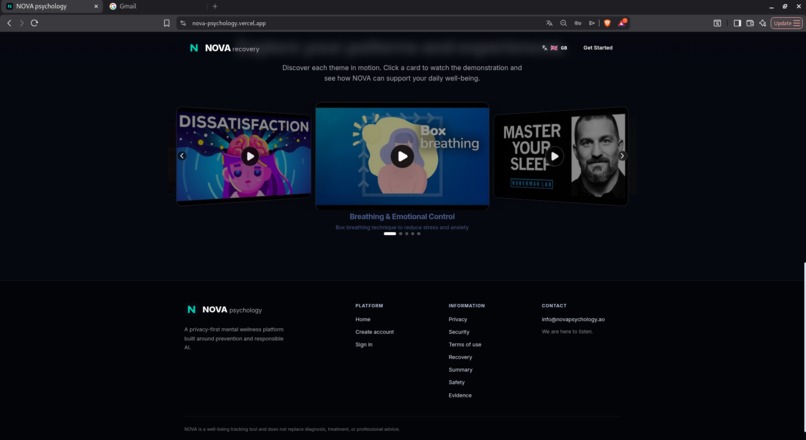
Landing page
-
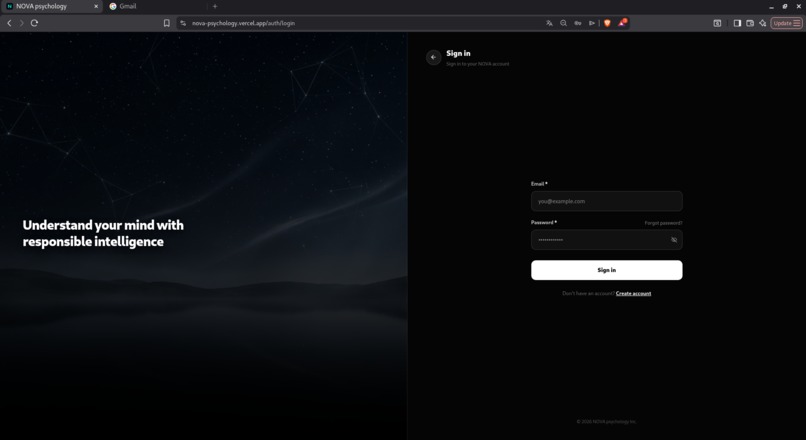
Login
-
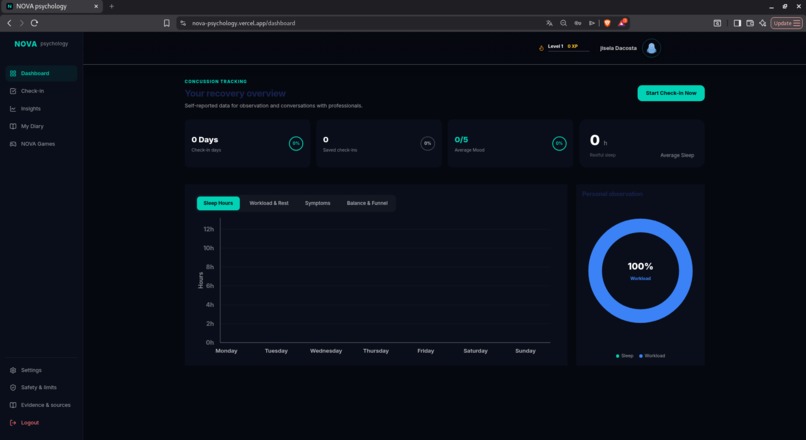
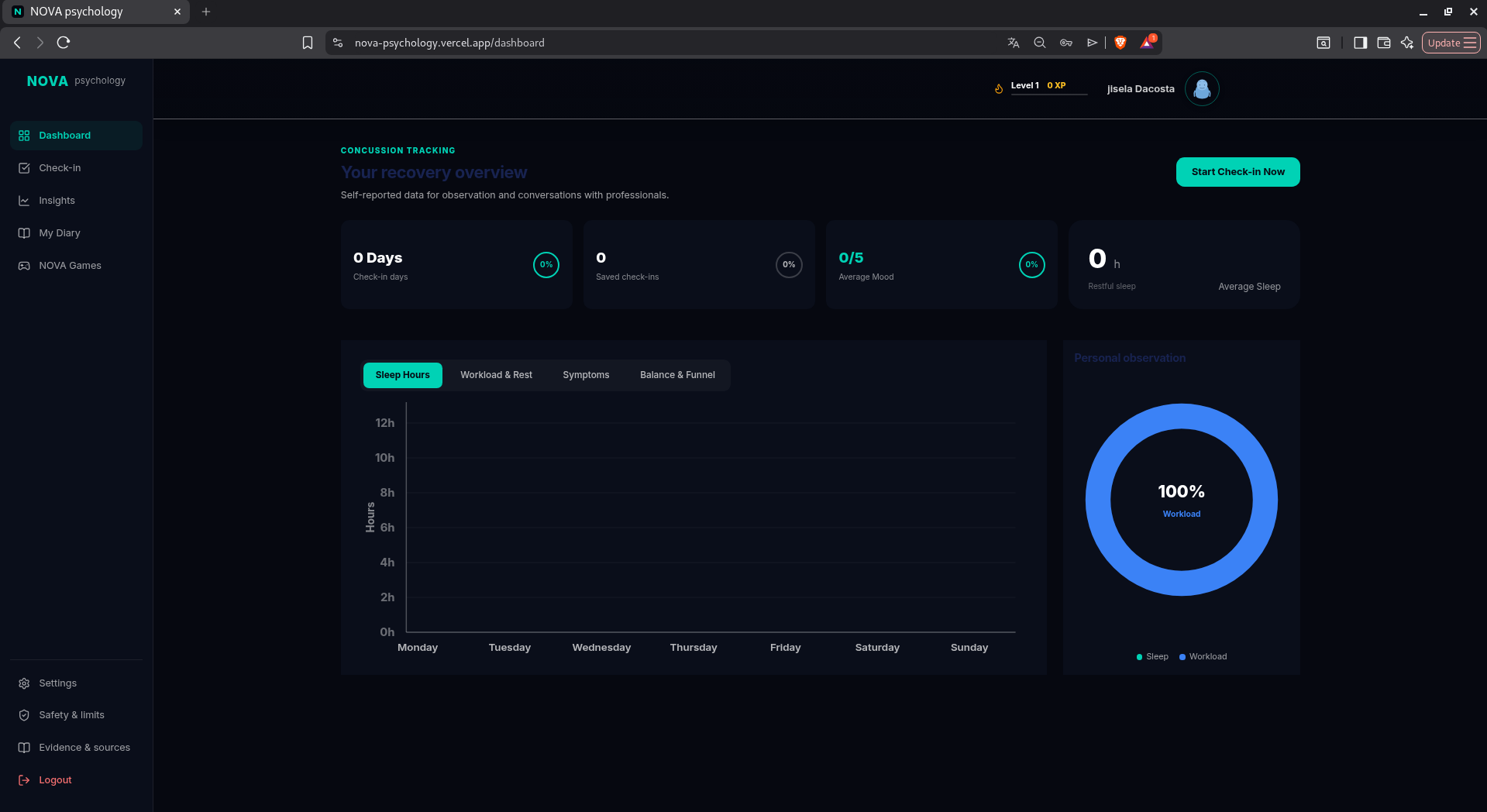
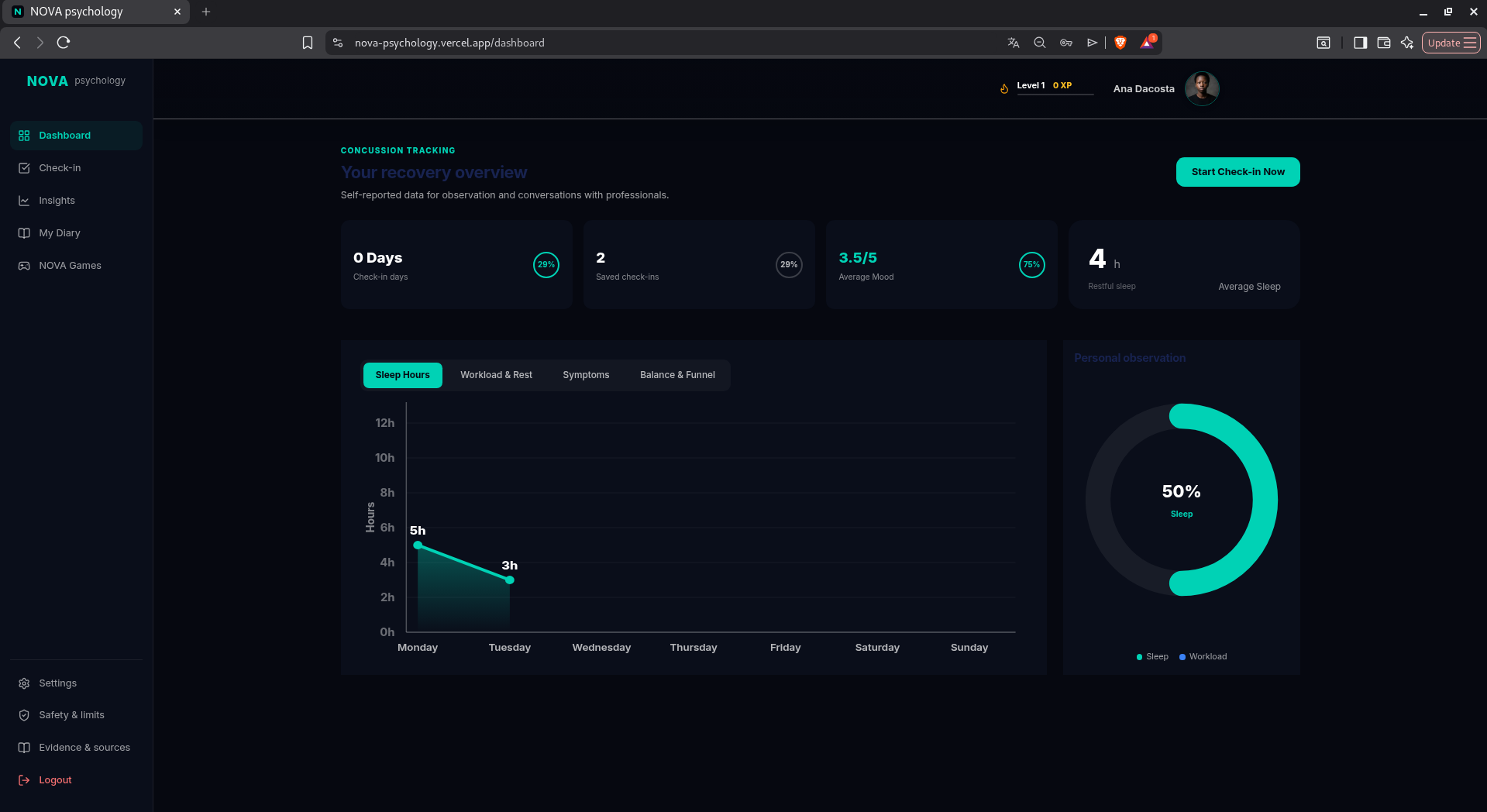
Dashboard
-
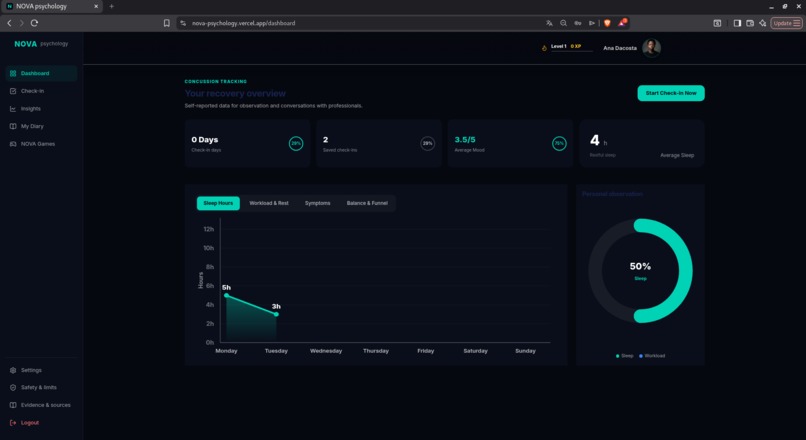
Dashboard
-
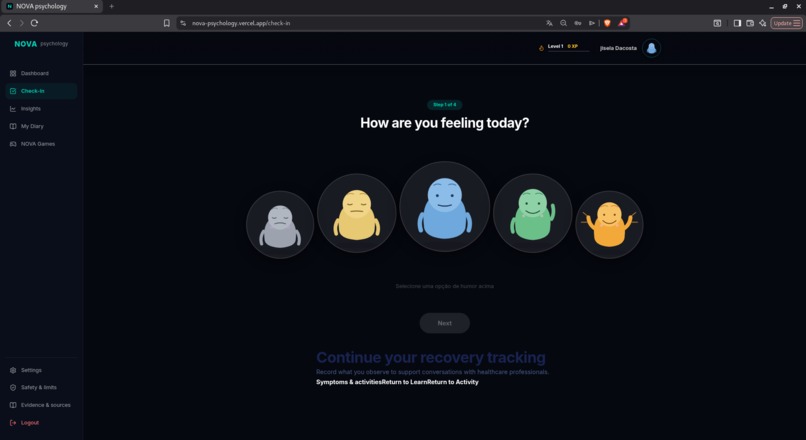
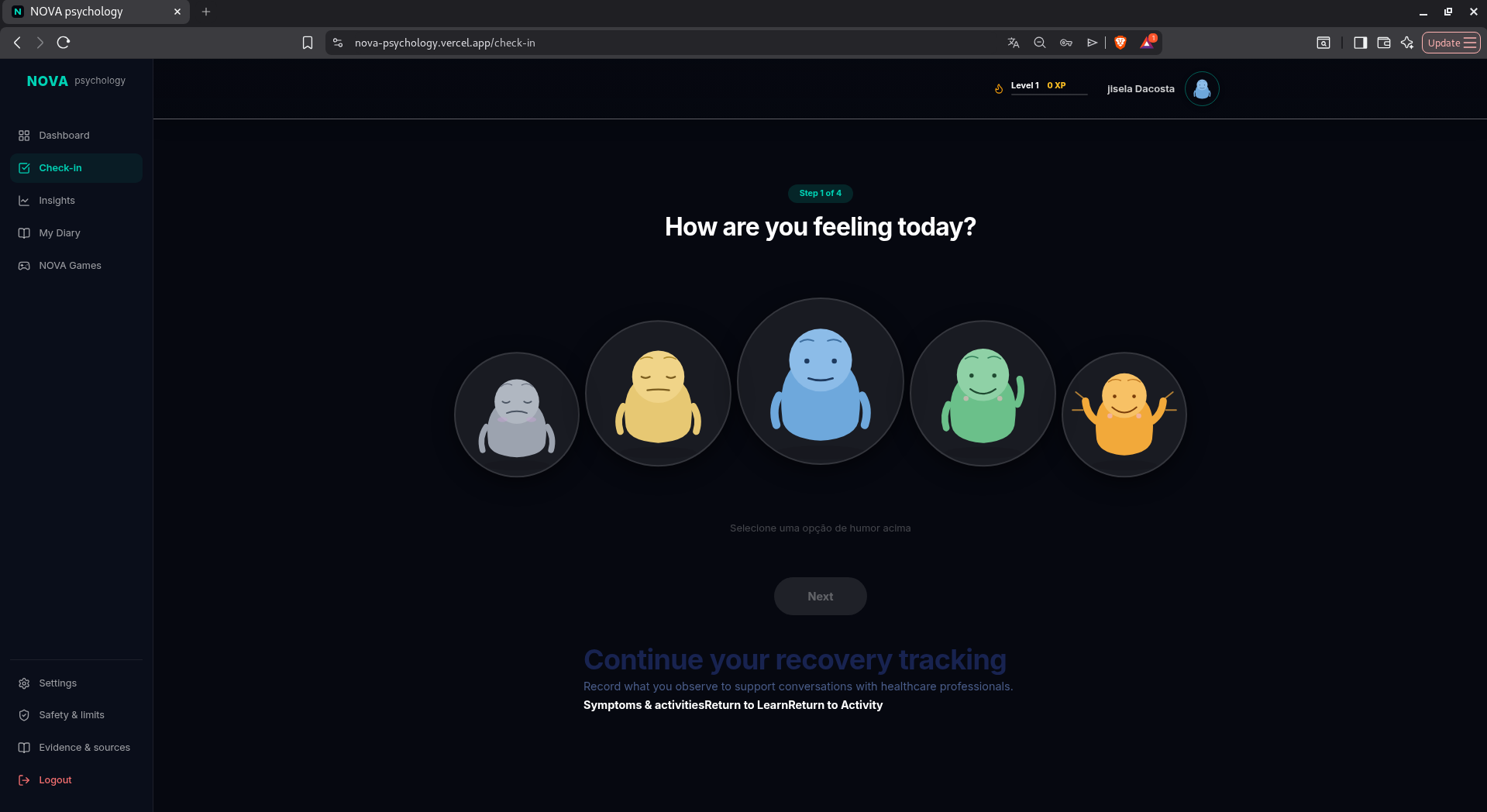
Check-in
-
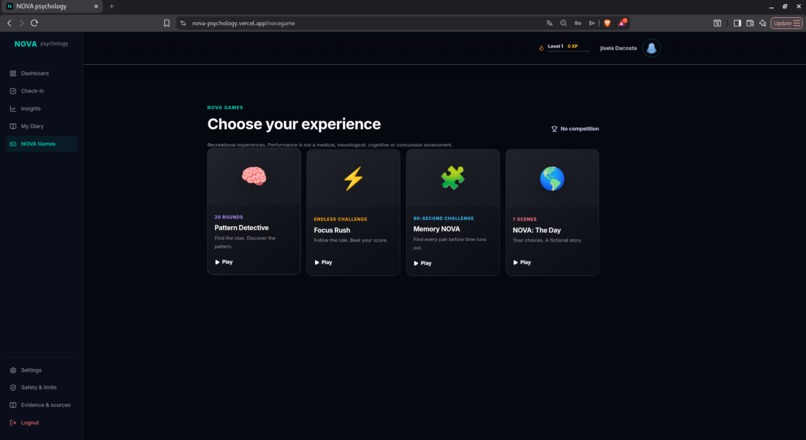
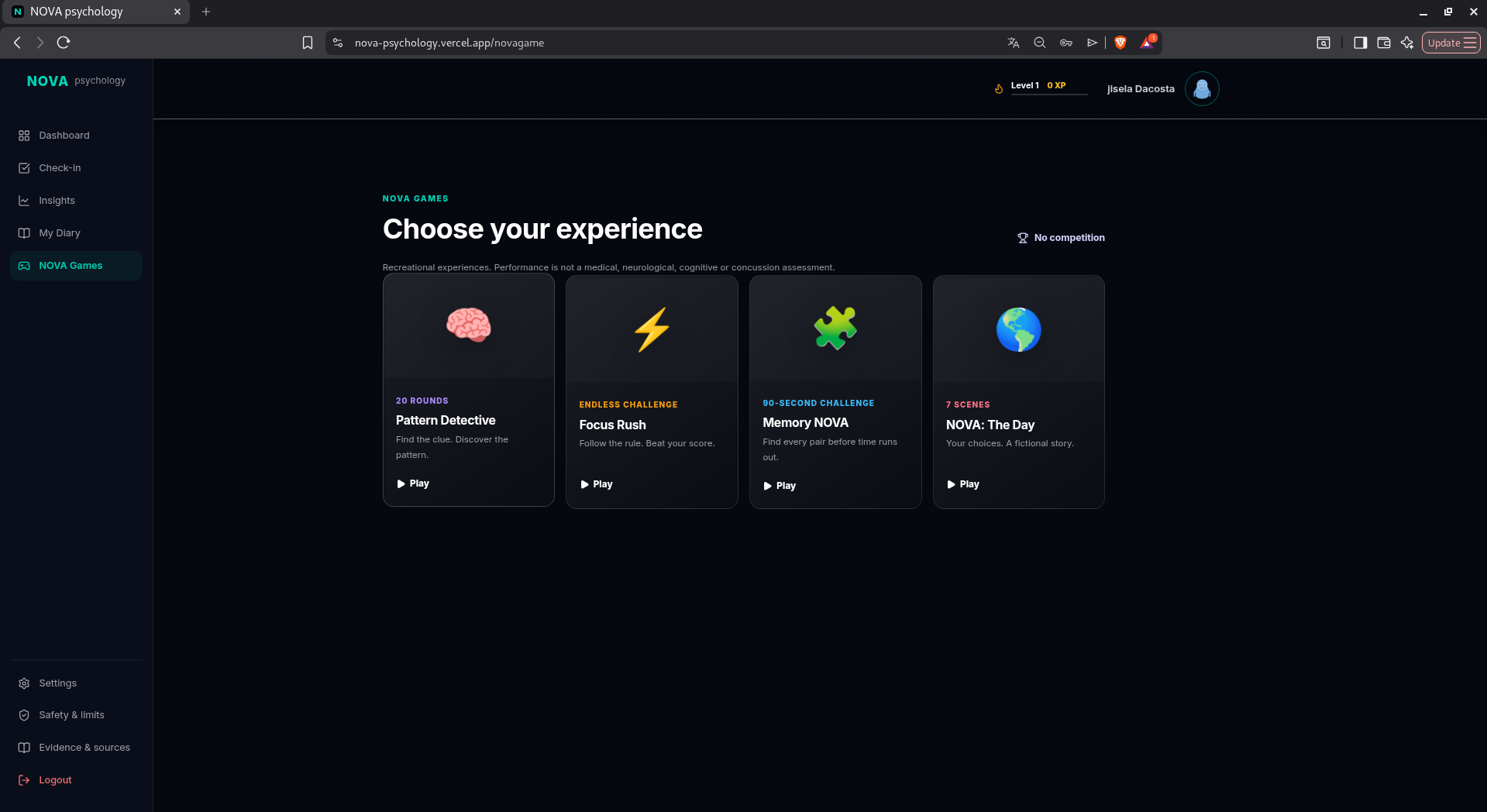
Diário / NOVA Games
-
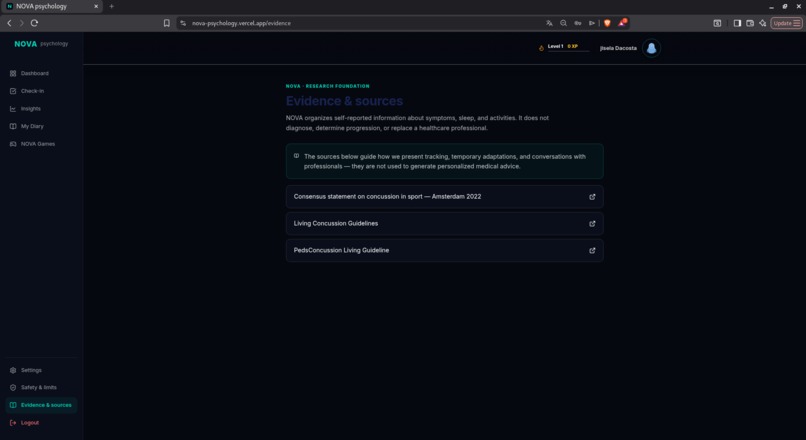
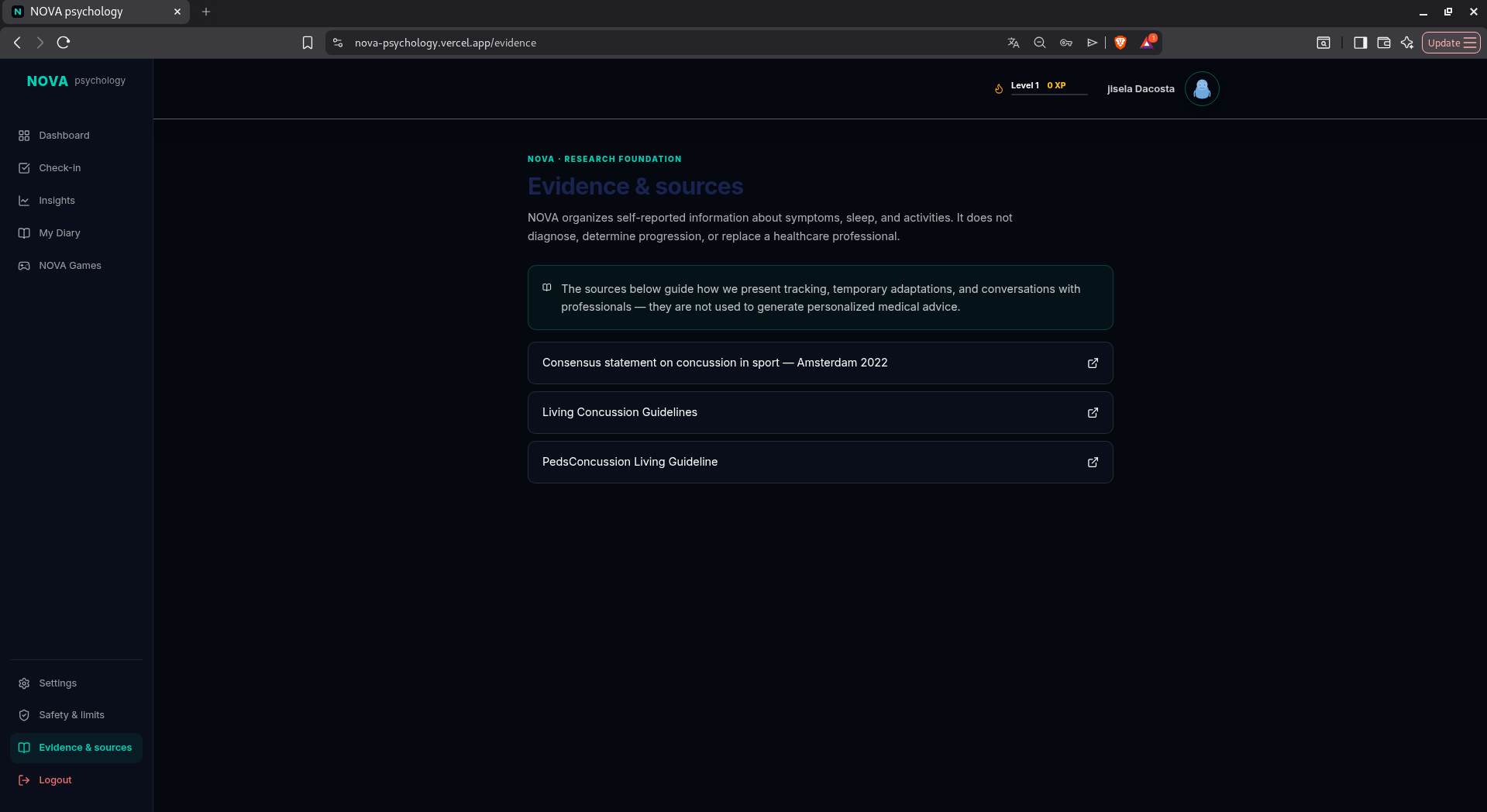
Evidence & Sources
-
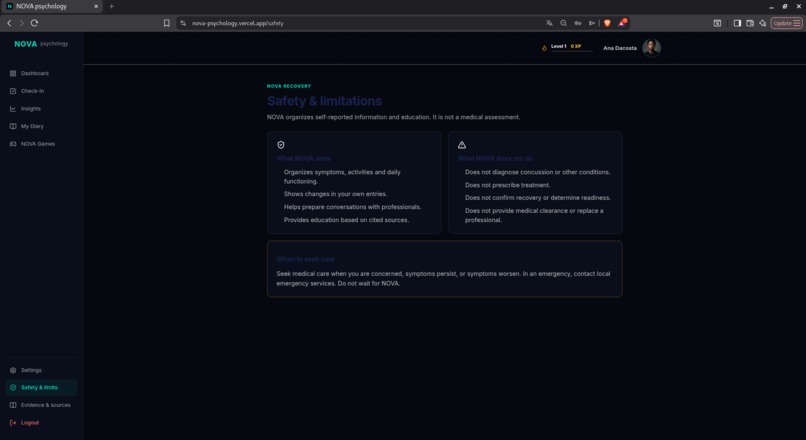
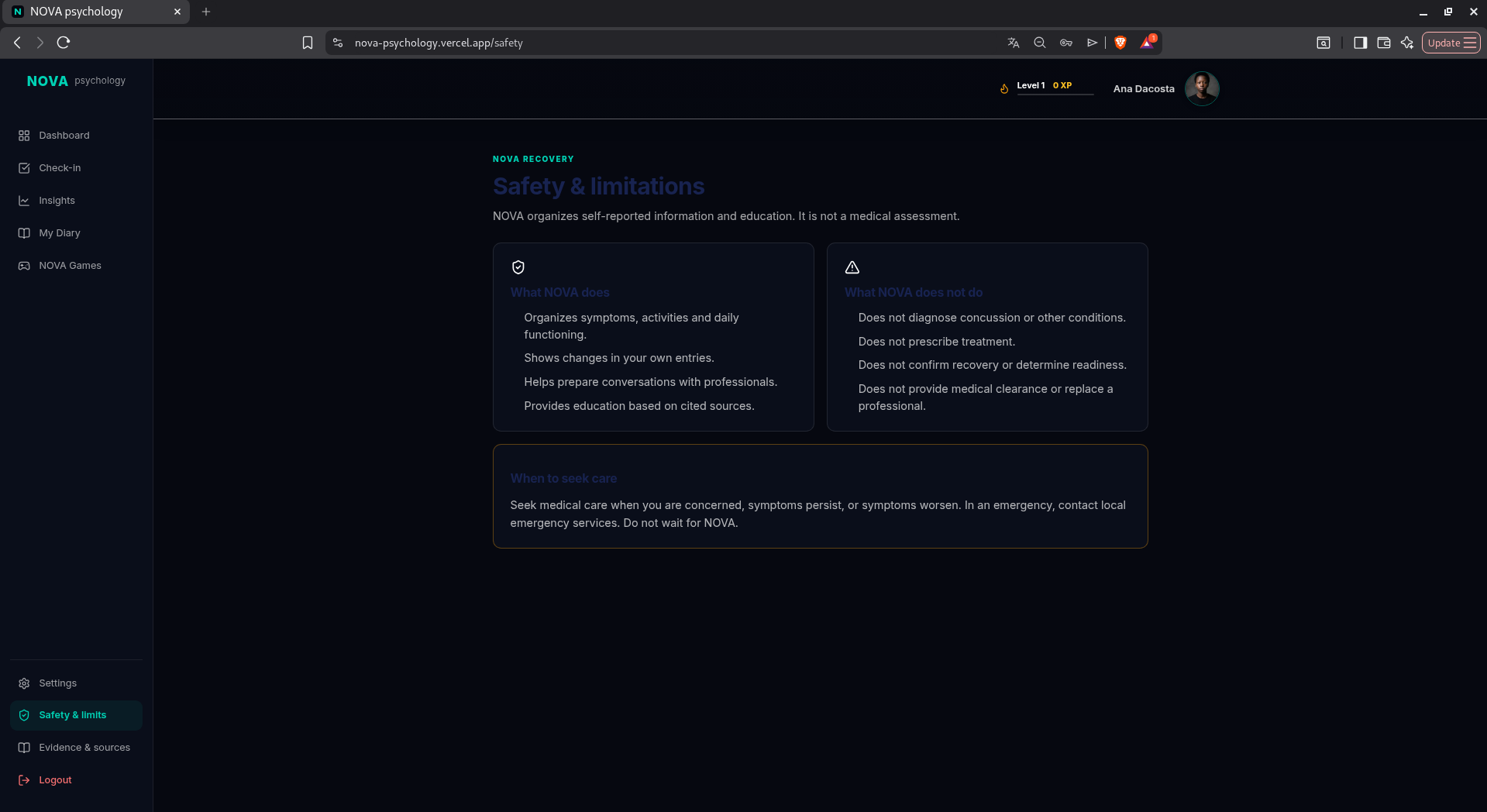
Safety & Limits
NOVA — A Privacy-First Recovery Companion
Inspiration
NOVA started from a simple observation: personal recovery and well-being information is often scattered across notes, memories, conversations, and isolated observations. Over time, this can make it difficult for people to understand how their routines and experiences change.
We wanted to build something that could help people organise their own information without pretending to diagnose them, predict their health, or replace healthcare professionals.
This led us to a broader question:
What should a technology product be allowed to do when it handles sensitive well-being information?
Instead of building another system that attempts to make medical decisions, we chose to focus on self-awareness, organisation, transparency, and user control.
That decision became the foundation of NOVA.
What it does
NOVA is a privacy-first recovery companion designed to help people organise, understand, and reflect on their own well-being information over time.
Users can record self-reported information such as symptoms, sleep, daily functioning, activities, learning adjustments, and return-to-activity observations.
Instead of leaving these records scattered across different places, NOVA transforms them into a structured personal history.
The platform can then compare information recorded by the user across time and highlight recurring patterns or changes.
The core experience follows:
Check-in → Personal information → Pattern comparison → Observed pattern → Reflection
NOVA works with the user's own records rather than relying on generic demo values or a predefined clinical score.
Its current insight engine uses deterministic comparisons to identify patterns within the user's information.
For example, NOVA may help a user notice that a particular observation has appeared repeatedly across several check-ins.
However, the system deliberately does not claim that one observation caused another. It does not diagnose conditions, predict medical outcomes, prescribe treatment or medication, or provide medical clearance.
The purpose is to help users better understand their own information and prepare clearer conversations with qualified professionals.
NOVA is therefore a companion for organisation, reflection, and self-awareness — not a replacement for professional care.
How we built it
NOVA was designed using a layered architecture that separates presentation, application, data, and insight responsibilities.
The presentation layer handles the user interface and interactions, including check-ins, personal information, history, observations, and reflection.
The application layer manages authentication, authorisation, validation, business rules, and coordination between the different parts of the system.
The data layer is responsible for persistence and controlled access to user information.
The insight layer processes the user's existing records and performs deterministic comparisons to identify recurring observations and changes over time.
This separation was especially important because NOVA can handle sensitive well-being information.
We wanted privacy and security boundaries to be enforced by the architecture rather than relying only on frontend behaviour.
The system was therefore designed around principles including:
- Data minimisation
- Least-privilege access
- Backend validation
- Backend authorisation
- Controlled access to personal information
- Secure communication
- Secret and credential protection
- Clear separation of responsibilities
- User control over personal information
The current insight engine does not send sensitive well-being information to an external AI provider.
This was an intentional decision.
We wanted to demonstrate that useful personal insights can begin with transparent and deterministic processing rather than requiring sensitive information to be sent to an external model.
The architecture also provides a foundation for future improvements while maintaining clear privacy boundaries.
Challenges we ran into
The biggest challenge was not simply building the software.
It was deciding what the software should and should not do.
Working with sensitive well-being information forced us to think carefully about privacy, security, uncertainty, data exposure, user autonomy, and responsible technology.
We had to consider questions such as:
What information should be collected?
We wanted to avoid collecting information simply because it was technically possible. Data should have a clear purpose within the user's experience.
Who should be able to access it?
Sensitive information should only be accessible through authorised application flows.
What should NOVA be allowed to infer?
We decided that NOVA could identify patterns within a user's own records, but should not turn those observations into diagnoses, predictions, or unsupported medical conclusions.
How should uncertainty be communicated?
A recurring observation is not automatically an explanation. The interface therefore needs to preserve the distinction between what was observed and what can actually be concluded.
This led to one of the most important principles in NOVA:
Observed pattern ≠ Medical diagnosis
We also learned that a technically possible feature is not automatically an appropriate feature.
In a product dealing with sensitive personal information, responsible product decisions are part of engineering itself.
Accomplishments that we're proud of
We are proud that privacy and responsible technology became architectural principles rather than features added at the end.
Our key accomplishments include:
- Building a privacy-first recovery companion around user-owned information.
- Creating a structured personal history from individual check-ins and observations.
- Implementing deterministic pattern comparison using the user's own records.
- Separating presentation, application, data, and insight responsibilities.
- Establishing backend validation and authorisation boundaries.
- Avoiding external AI processing of sensitive well-being information in the current insight engine.
- Designing observations so they are not presented as diagnoses or medical conclusions.
- Establishing clear boundaries around treatment, medication, medical clearance, and professional care.
- Designing the experience around transparency, reflection, and user control.
- Creating an architecture that can evolve while preserving its privacy principles.
Perhaps our biggest accomplishment is that we did not measure success only by how many features we could implement.
We also asked:
"What could go wrong if we implement this feature?"
That question influenced our technical architecture, product decisions, and user experience.
What we learned
Building NOVA taught us that responsible technology is about much more than implementing functionality.
When software handles sensitive information, privacy must influence the entire system:
- Where information comes from
- What information is collected
- Where it is stored
- Who can access it
- How it is processed
- How results are presented
- What happens when the system reaches its limits
We also learned the importance of distinguishing between information, observation, and conclusion.
A system can identify that two observations appear together in a user's records. That does not necessarily mean that one caused the other.
Communicating this distinction clearly is especially important when dealing with well-being information.
Another important lesson was that uncertainty is not necessarily a weakness.
Being honest about what a system does not know can make it more trustworthy.
Throughout the project, we had to balance usefulness with restraint. We did not want NOVA to appear more intelligent simply by making stronger claims.
We wanted it to be useful while staying within boundaries that we could explain and justify.
The project strengthened our understanding of the relationship between:
Software Engineering + Privacy + Security + UX + Data Governance + Responsible AI
Our biggest lesson was simple:
A technically possible feature is not necessarily a responsible feature.
For NOVA, knowing where to stop is part of building the product correctly.
What's next for NOVA
Our roadmap focuses on making NOVA more useful, accessible, transparent, and robust while preserving its privacy-first principles.
Future improvements include:
- Richer personal trends
- Improved longitudinal comparisons
- More intuitive insight visualisations
- Stronger pattern detection
- Better uncertainty handling
- Improved accessibility
- More granular privacy controls
- Stronger security testing
- Improved auditability
- Greater transparency around how observations are generated
We also want to explore how advanced AI could eventually support selected parts of NOVA responsibly.
However, introducing AI is not a goal by itself.
Any future AI capability would need to respect the principles that guide NOVA today:
- Protect sensitive information
- Minimise unnecessary data exposure
- Communicate uncertainty clearly
- Avoid unsupported medical claims
- Preserve user autonomy
- Keep users in control of their information
We do not want NOVA to become a system that makes medical decisions for people.
Our long-term vision is to build a trustworthy companion that helps people organise their experiences, recognise meaningful patterns in their own information, reflect more clearly, and have better conversations with qualified professionals.
Privacy and Responsible Technology
Privacy is not an optional feature in NOVA.
It is one of the foundations of the product.
Because well-being information can be sensitive, we designed NOVA around the principle that users should have meaningful control over their personal information.
The platform follows a privacy-first approach based on:
Data minimisation Collect only what is necessary for the intended experience.
Least privilege Access should be limited to what is necessary for each operation.
Controlled processing Sensitive information should move through authorised application flows.
Backend enforcement Security boundaries should not depend solely on frontend behaviour.
Secret protection Credentials, API keys, and other secrets should never be committed to source code.
Transparency Users should be able to understand what NOVA is doing with their information.
User autonomy The system should support users rather than make decisions on their behalf.
We also established explicit safety boundaries.
NOVA does not:
- Diagnose medical conditions
- Prescribe medication
- Recommend treatment
- Provide medical clearance
- Make medical predictions
- Replace healthcare professionals
- Replace emergency services
When a situation goes beyond the appropriate scope of a wellness and recovery companion, NOVA should encourage users to seek appropriate qualified human support.
Final Thought
NOVA is built around a simple principle:
Technology should help people understand their own information without pretending to know more than it actually does.
We believe useful technology does not always need to make the biggest claim or perform the most complex prediction.
Sometimes, the most responsible thing a system can do is help someone organise their own information, recognise an observation, understand uncertainty, and know when a human professional should be involved.
NOVA is our attempt to build that kind of technology.
A companion for organisation, reflection, and safer conversations — not a replacement for people.
Built With
- accessibility
- ai
- api
- authentication
- authorization
- css
- cybersecurity
- data
- design
- feature-sliced
- healthcare
- internationalization
- next.js
- node.js
- postgresql
- privacy
- react
- responsive
- rest
- tailwind
- technology
- typescript
- visualization
- web


Log in or sign up for Devpost to join the conversation.