Inspiration
The inspiration for Nova Tempo arose from the common struggle with reactive, manual calendar management, envisioning a proactive, intelligent assistant that could anticipate needs, resolve conflicts, and learn user preferences through natural voice interaction. The advanced capabilities of Amazon Nova 2 Sonic, particularly its real-time bidirectional streaming and agentic features, provided the ideal technological foundation to transform this vision into a dynamic, intelligent scheduling solution
What it does
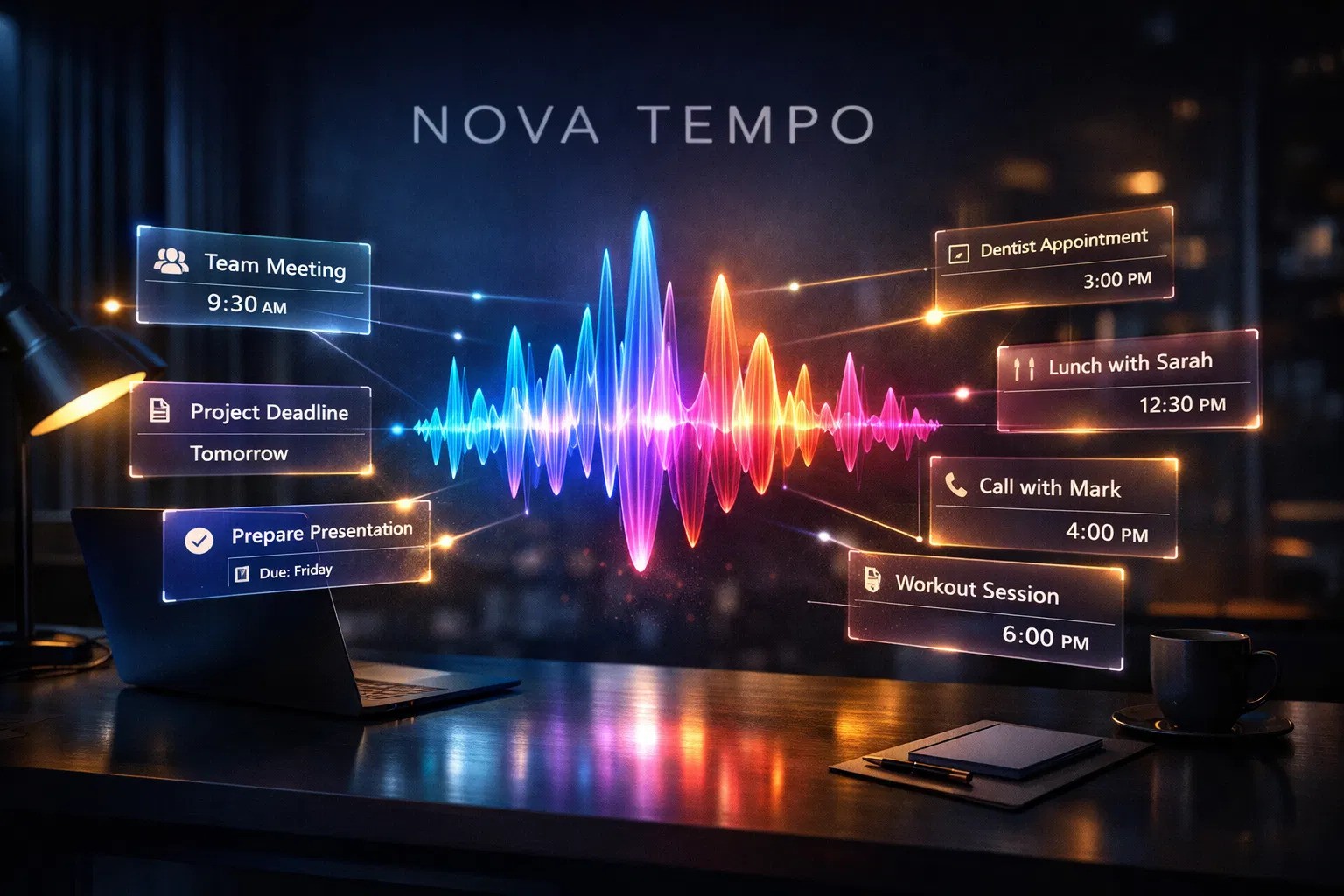
Nova Tempo is a cutting-edge, voice-controlled agentic scheduling assistant designed to seamlessly integrate with a user's Google Calendar. It allows users to manage their schedules, plan complex tasks, and receive proactive time management suggestions through natural, real-time voice conversations. Key functionalities include:
• Real-time Voice Interaction: Powered by Amazon Nova 2 Sonic, enabling fluid, bidirectional speech-to-speech communication.
• Intelligent Event Management: Users can create, modify, and query calendar events using natural language.
• Conflict Detection & Resolution: Nova Tempo automatically identifies scheduling conflicts and intelligently suggests alternative times or solutions.
• Goal-Based Planning: It can decompose high-level goals (e.g., "prepare for a presentation") into a series of actionable, scheduled tasks.
• Persistent Personalization: Leveraging Amazon Bedrock AgentCore Memory, Nova Tempo learns and adapts to individual user preferences and habits (e.g., preferred meeting times, deep work blocks) to offer truly personalized scheduling.
• Proactive Suggestions: It can proactively suggest focus time blocks, add travel time buffers, and offer intelligent reminders.
How we built it
Nova Tempo was constructed as a multi-agent system, orchestrated via a Python/FastAPI backend and a minimalist web frontend, utilizing Amazon Nova 2 Sonic through the Strands BidiAgent for real-time voice interaction. We implemented a multi-agent architecture with an Orchestrator, Planning Agent, and Conflict Resolver using Strands Agents' "Agents as Tools" pattern, integrated Amazon Bedrock AgentCore Memory for persistent personalization, and developed modular Strands Tools to interact with the Google Calendar API for comprehensive event management.
Challenges we ran into
Key challenges included establishing a stable, low-latency bidirectional audio stream between the browser and backend, which demanded meticulous WebSocket and audio data management for seamless synchronization. Navigating the evolving AWS model access policies and ensuring precise IAM permissions for Amazon Bedrock, AgentCore Memory, and Nova 2 Sonic also presented a significant hurdle, requiring a deep understanding of AWS service integration. Furthermore, designing the complex multi-agent orchestration for effective goal decomposition and coherent voice responses required extensive prompt engineering and state management.
Accomplishments that we're proud of
I am particularly proud of achieving a truly fluid, low-latency real-time voice interaction, where users can gracefully interrupt the agent mid-sentence, showcasing the power of Amazon Nova 2 Sonic and the BidiAgent framework. Our multi-agent system's ability to move beyond simple commands to proactive, goal-oriented planning, autonomously creating detailed schedules from vague user goals, represents a significant leap in intelligent assistance. Moreover, the integration of Amazon Bedrock AgentCore Memory for personalized user experiences transforms Nova Tempo into a genuine assistant that understands and adapts to individual workflows.
What we learned
This project profoundly demonstrated the transformative power of bidirectional streaming for voice AI, fundamentally enhancing the user experience by minimizing latency and enabling natural turn-taking. I also learned the critical importance of modular agent design, where delegating specialized tasks to sub-agents within the "Agents as Tools" pattern created a more robust, scalable, and maintainable architecture. Ultimately, building Nova Tempo reinforced our conviction that agentic AI, with its capacity to understand intent, decompose tasks, utilize tools, and learn over time, represents the future of human-computer interaction.
What's next for Nova-Tempo
For Nova Tempo, our future plans include expanding to multi-modal integration by displaying the agent's thought processes visually in the UI, and integrating with a broader ecosystem of productivity tools like Jira or Slack for a unified personal assistant experience. We also aim to develop team-based scheduling capabilities to optimize meeting times for groups and enhance proactive intelligence further, enabling the agent to suggest schedule optimizations, identify burnout risks, and automate routine tasks without explicit user commands.
Built With
- amazon-bedrock
- css3
- fastapi
- google-calendar
- html5
- javascript
- node.js
- python
- strands-agent

Log in or sign up for Devpost to join the conversation.