-
-
-
-
-
-
-
Project overview as of July 19th
Inspiration
I help organize the Night Kitchen, a monthly community variety show at our local theatre. Finding artists to invite often meant searching scattered event listings, venue pages, festival programs, and artist profiles one at a time. I actually had teams of people giving me names and suggestions and it created a booking (and messaging) nightmare.
I originally asked ChatGPT to help me create a database for discovering more local performers. That conversation sparked a much larger idea: what if Nova Scotia had an evidence-backed music intelligence system that could reveal not only who the artists are, but where they perform, who they collaborate with, which venues support particular genres, and where new opportunities may exist?
That idea became the Nova Scotia Music Intelligence System.
What it does
The system connects artists, events, venues, festivals, genres, geographic places, industry professionals, collaborators, ticket prices, career stages, and demand signals in a relational SQLite database.
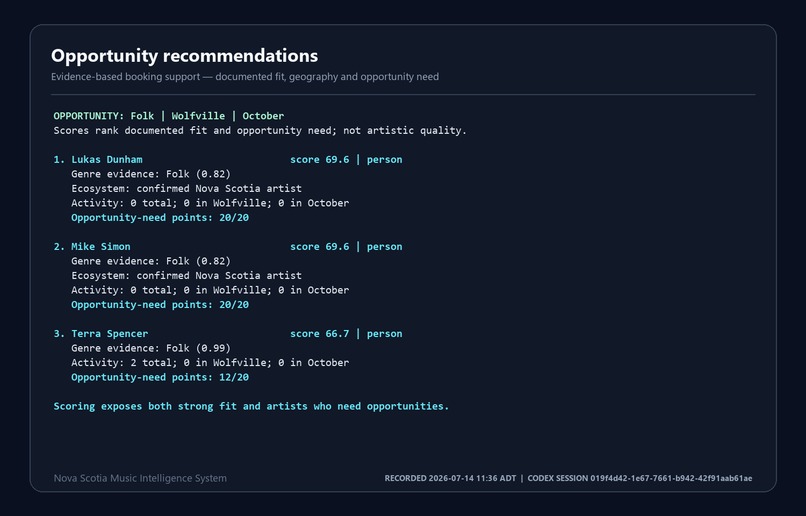
Here's where it starts to get interesting and moves beyond a simple database. The intelligence layer can support practical questions such as:
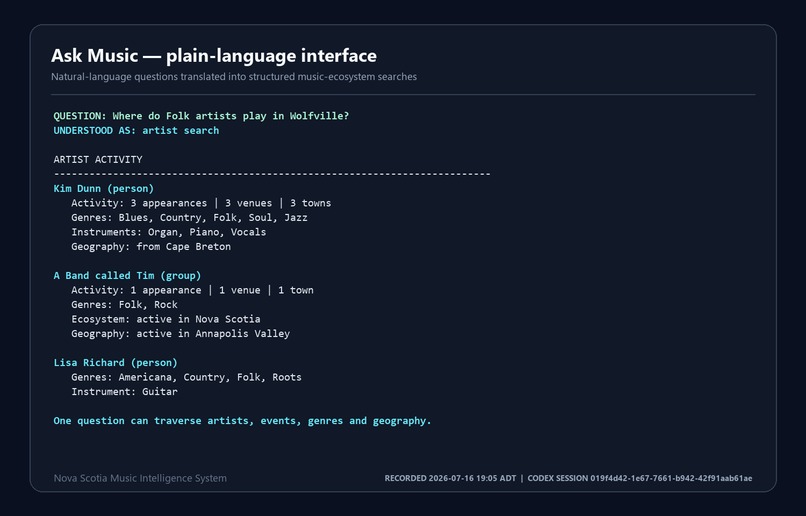
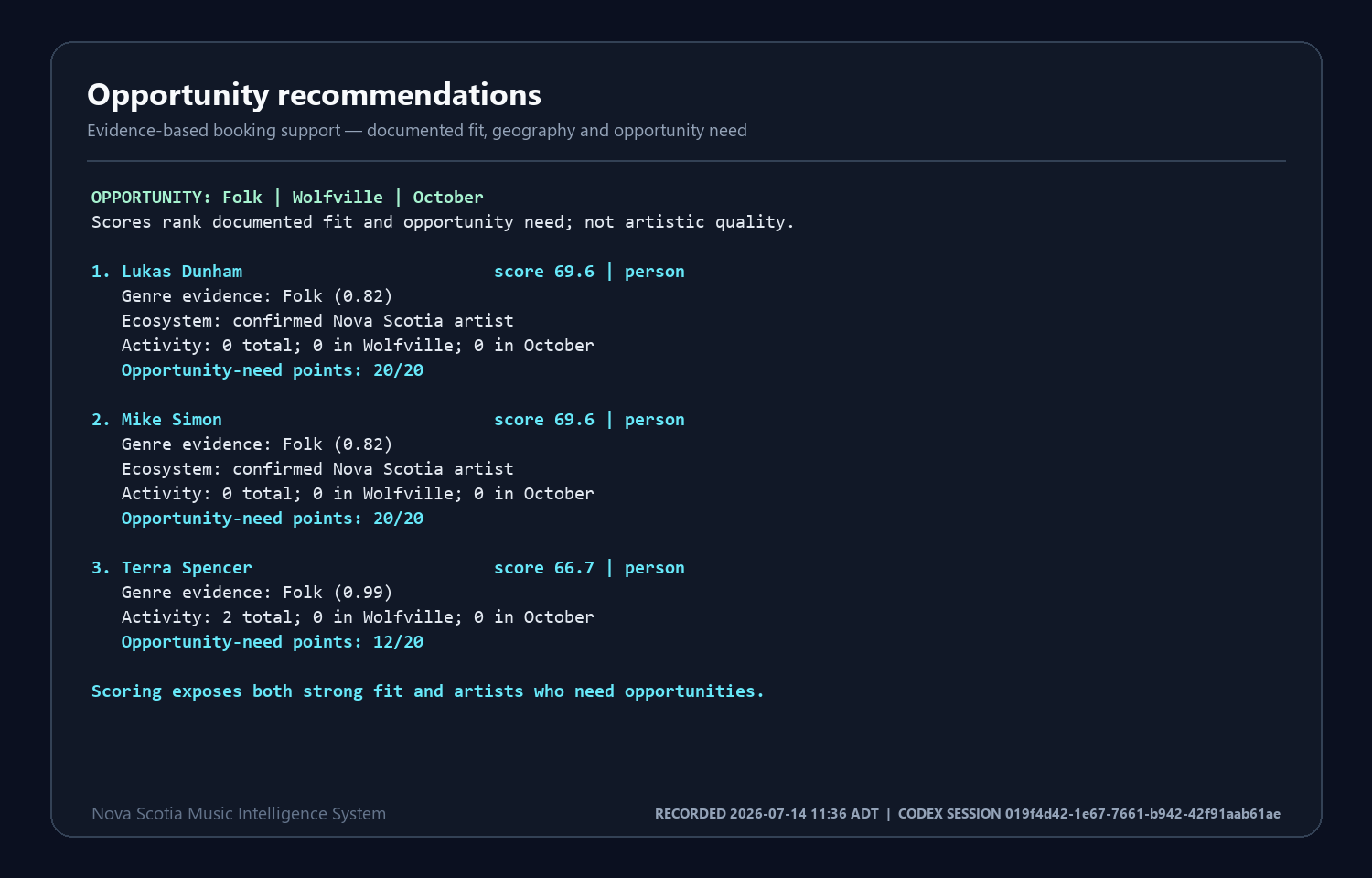
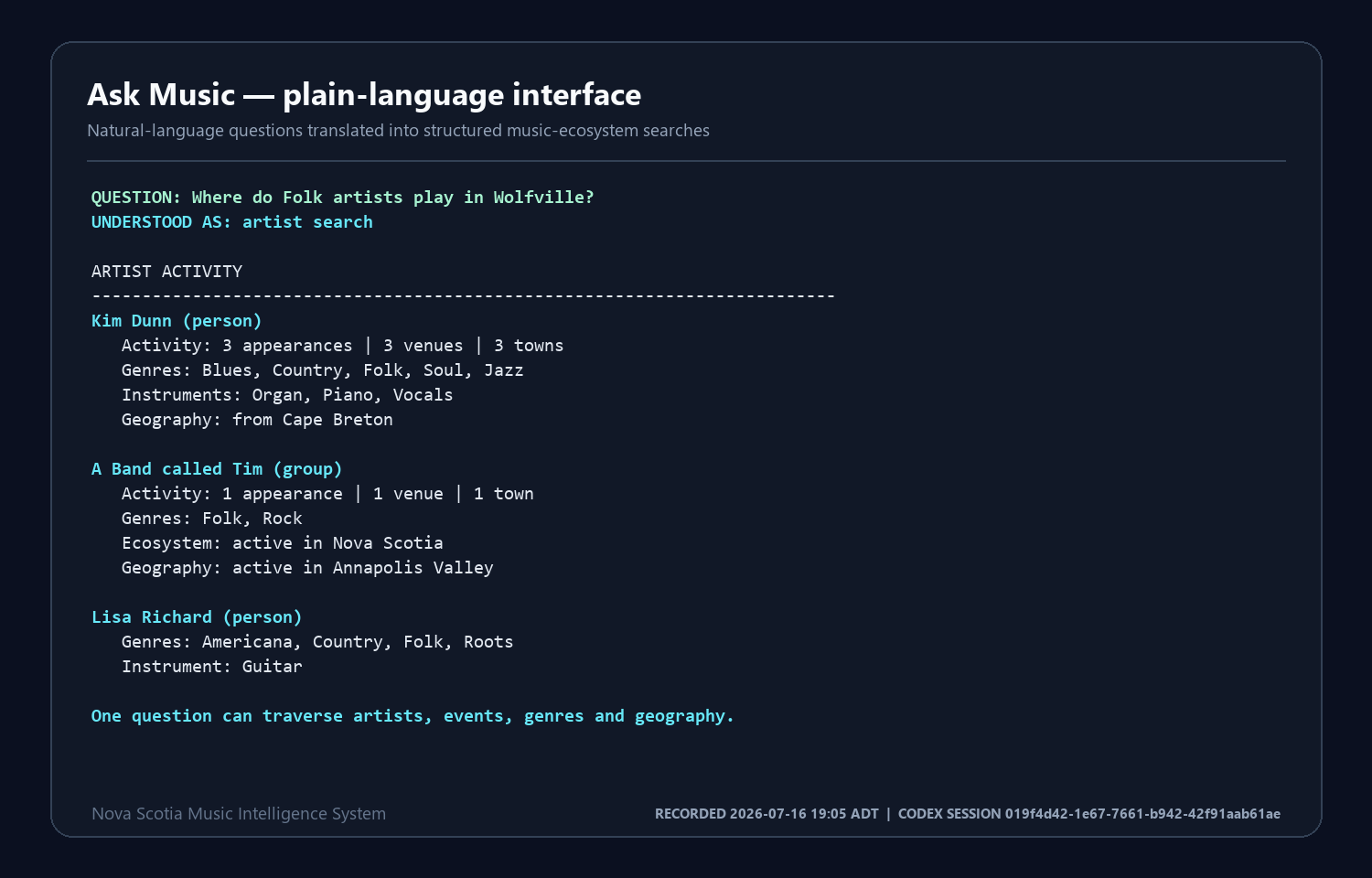
- Which Folk artists have performed in Wolfville?
- Which artists collaborate or appear together most often?
- Which venues host rock bands most often in Halifax?
- Which emerging artists may need more opportunities in a particular community?
I've been building in and working on a plain language interface so that people can easily ask questions about the music ecosystem and get relevant information. Answers are based on approved evidence and include limitations when the available information is incomplete. It does not allow generated language to invent missing database facts. The collectors I have built with the help of Codex will be able to run on a regular basis to keep the database up to date.
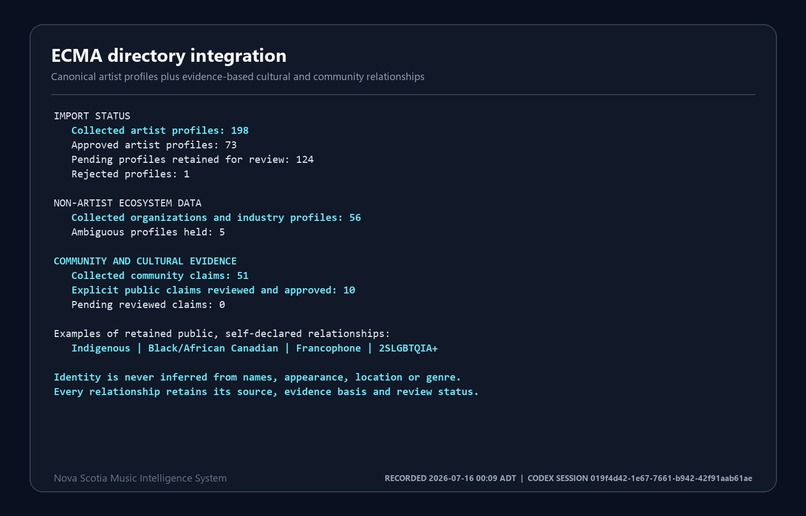
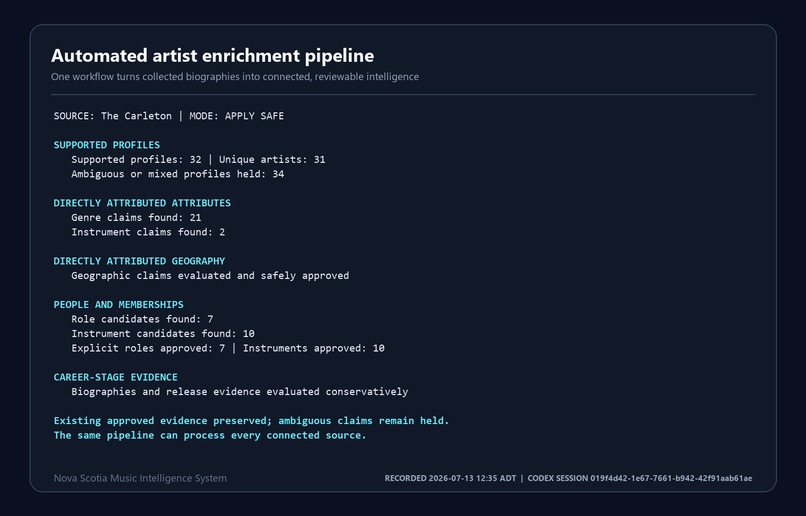
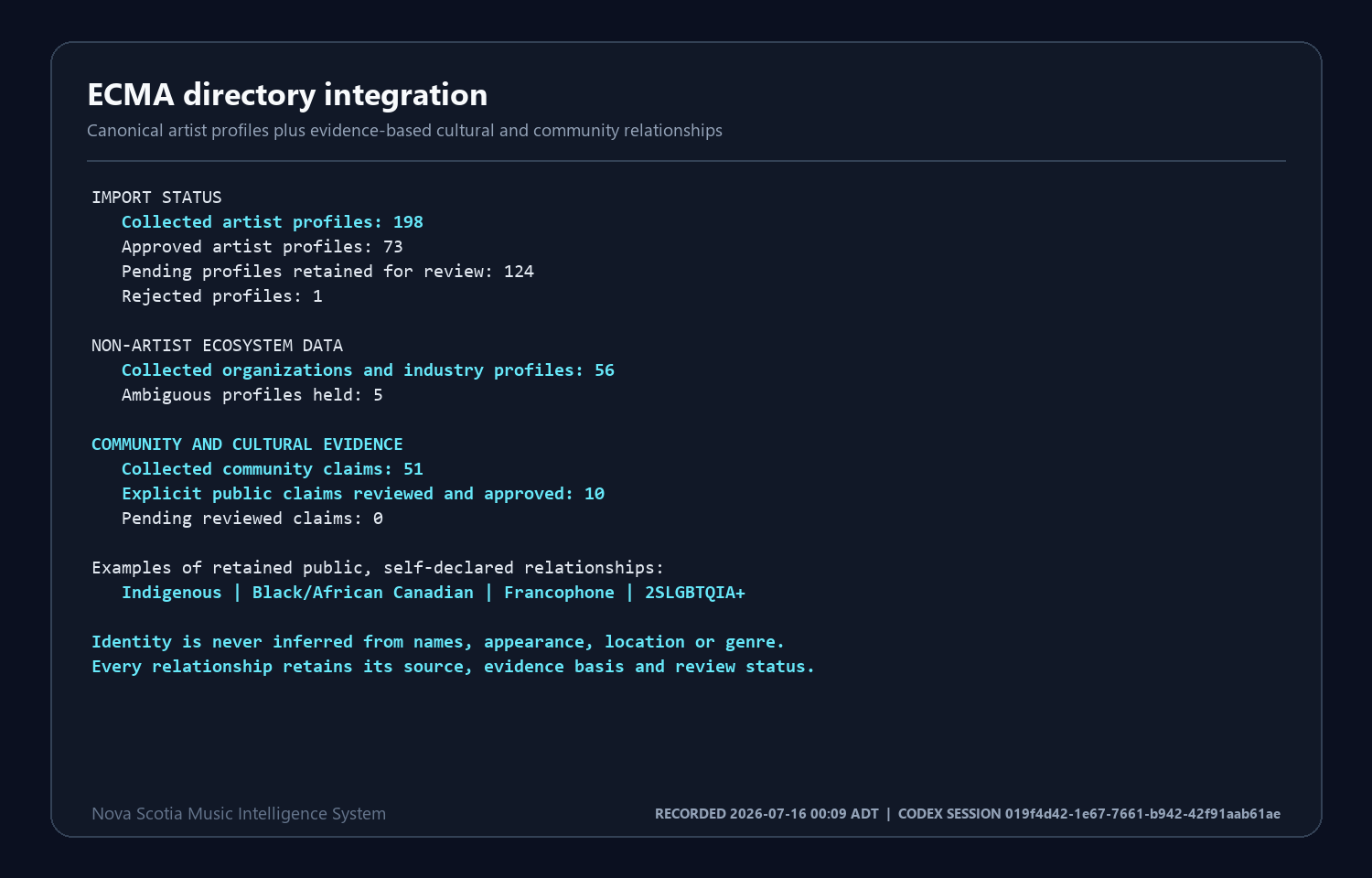
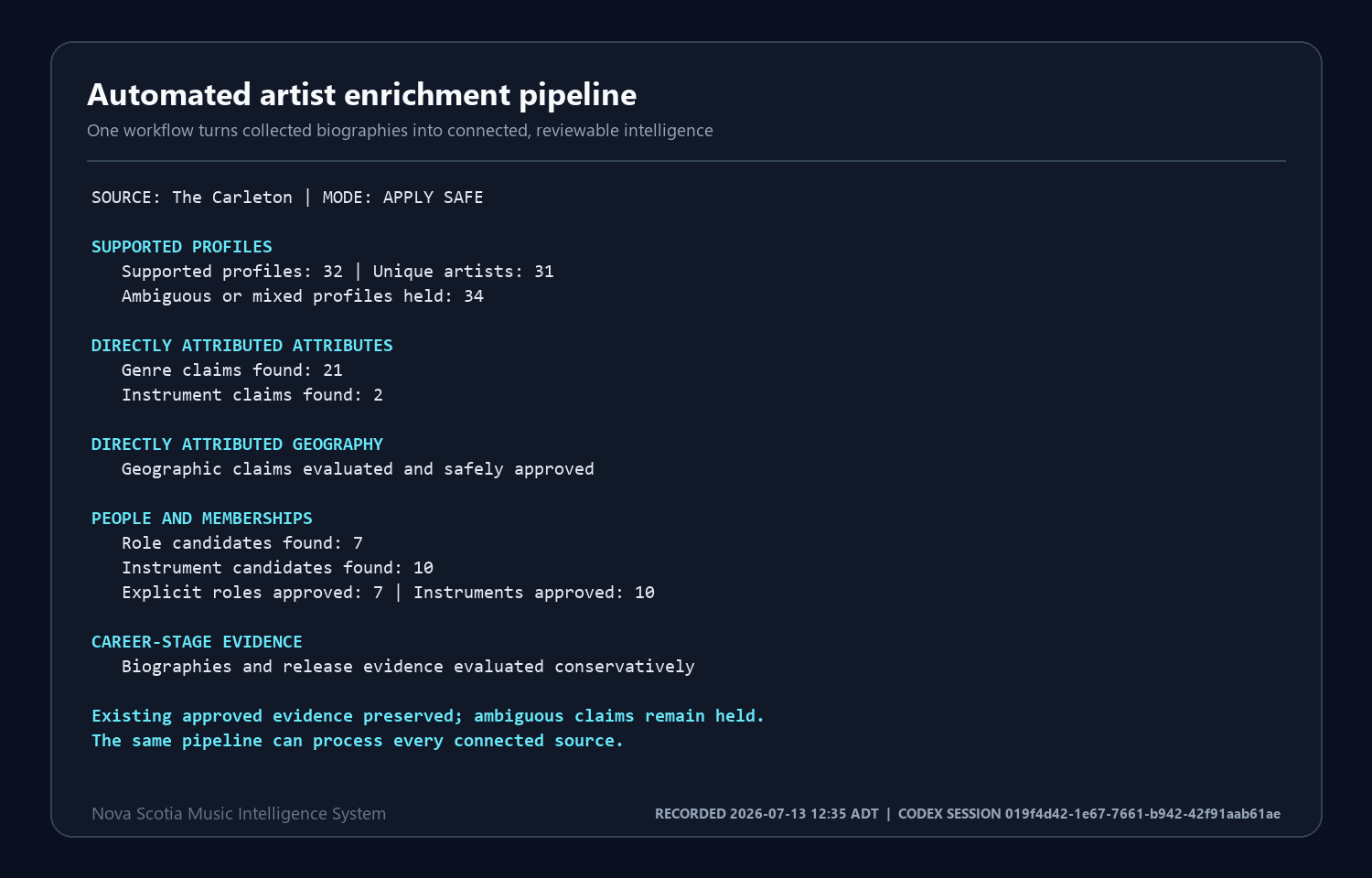
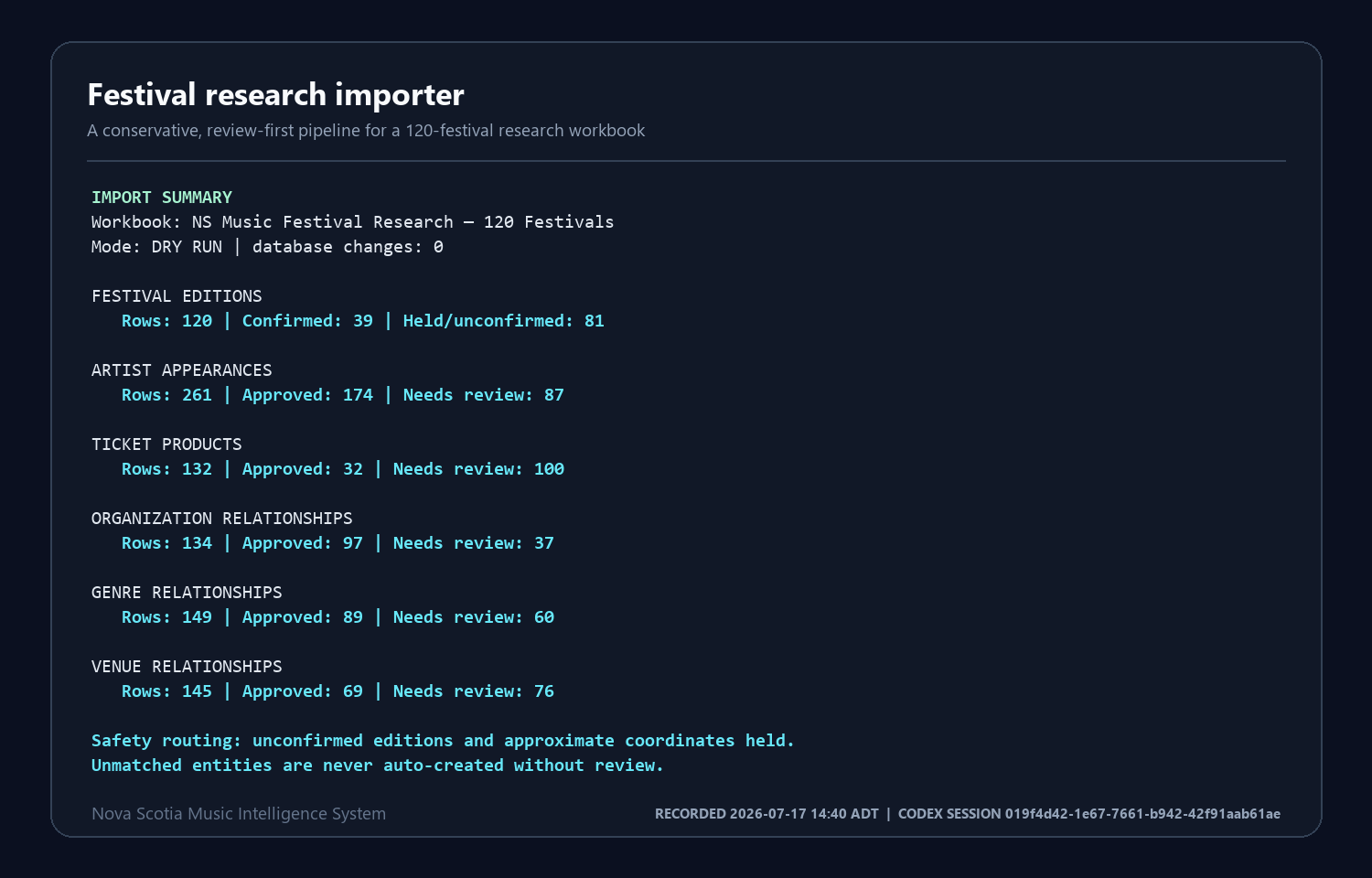
The architecture separates candidate information from approved facts. Ambiguous artist identities, duplicate events, profile matches, geographic claims, career stages, are flagged for human review before being approved to the database.
How I built it
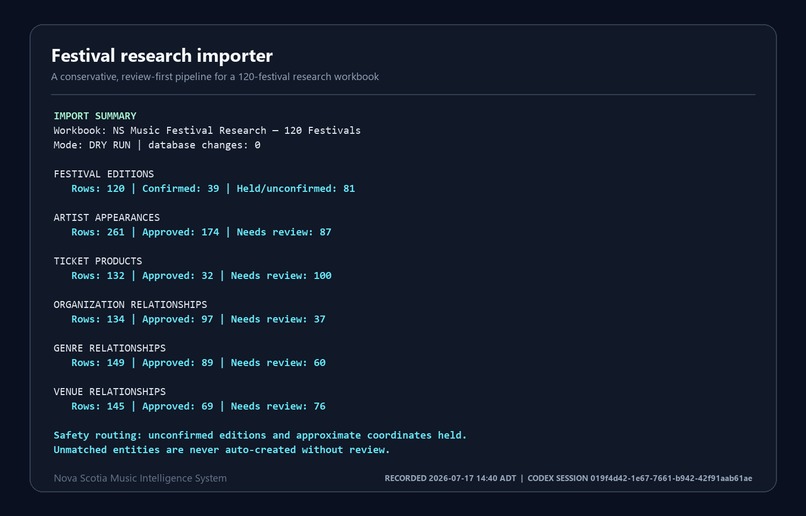
The project is built primarily with Python and SQLite. Source-specific collectors and workbook importers gather structured information from public event listings, festival research, artist directories, and profile sources. Coded tools then work to define different entities and reconcile artist names, venues, festivals, geographic places, and relationships.
The pipeline follows an evidence-first process:
- Collect or import source information.
- Normalize records into a shared structure.
- Match records against canonical entities.
- Stage uncertain claims as review candidates.
- Approve, reject, or defer those claims.
- Expose only approved evidence to reports and recommendations.
Codex with GPT-5.6 was central to building the project over the last week. It really let my creativity flow, while building and inspecting the code I was creating. As the project grew, I used it to inspect and understand the growing architecture, trace data-integrity problems across many connected tables, write tests, and build the plain-language interface. When I first started the project with Chat GPT web, I was writing code, and copy pasting. Codex's ability to generate files and code directly on my computer was revolutionary and sped the workflow up exponentially.
Codex accelerated repetitive coding, repository-wide analysis, test creation, database migrations, and verification. I watched carefully and used my own judgement to guide the project, inspecting code when necessary. I chose to focus on my home province of Nova Scotia for the database, as it seemed a manageable size and could help support my own work. I made sure to require evidence for intelligence claims, separating candidate facts from approved facts, defining the meaning of opportunity signals, and ensuring that uncertainty is visible rather than hidden.
Because the project existed before the submission period, the repository clearly distinguishes earlier work from the meaningful Build Week extension. The repository includes a timestamped activity summary, a file manifest with SHA-256 hashes, dated Git history, and documentation describing the eligible-period contribution.
Challenges I ran into
Ultimately the biggest challenge I ran into was the limited use of Codex. I was constantly hitting my usage limits and waiting for them to refresh. Luckily I did seem to get some early refreshes on my weekly usage, so that was a huge boon.
Data quality was also an issue. Artist names tended to vary between sources, multiple performers may share similar names, biographies sometimes describe more than one person, and event listings frequently omitted details. It became clear that any uncertainty needed to be highlighted, and many fixes were implemented to make sense of the data.
The scale of the project also created challenges. I had to find a workflow that allowed me to gather hundreds of artists information in a reliable way. Geography, genre, career stage, venue relationships, etc. The same went for festivals, venues, and other entities. Codex helped trace these relationships and create verification tools, while I made the final decisions about which evidence was trustworthy.
Time and computing resources were also constraints. Codex tasks sometimes took time to complete, and some browser-based sessions slowed down or crashed. I learned to divide work into focused tasks, run work in parallel when appropriate.
Accomplishments that I'm proud of
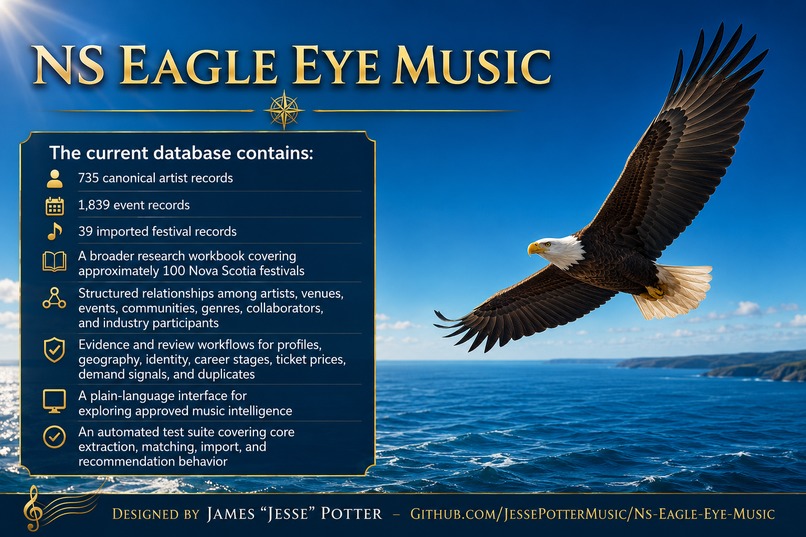
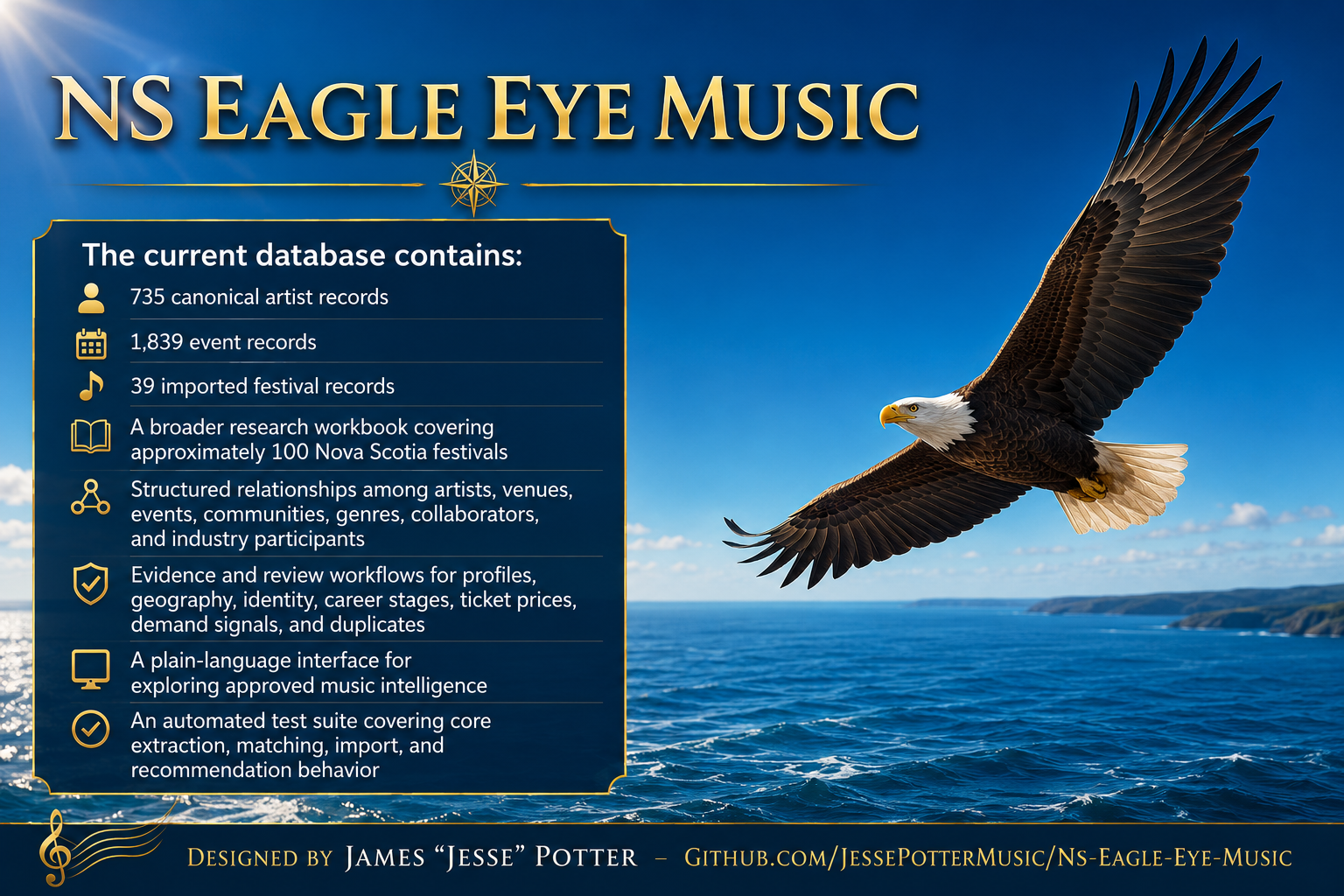
The current database contains:
- 735 canonical artist records
- 1,839 event records
- 39 imported festival records
- A broader research workbook covering approximately 100 Nova Scotia festivals
- Structured relationships among artists, venues, events, communities, genres, collaborators, and industry participants
- Evidence and review workflows for profiles, geography, identity, career stages, ticket prices, demand signals, and duplicates
- A plain-language interface for exploring approved music intelligence
- An automated test suite covering core extraction, matching, import, and recommendation behavior
What began as a way to find performers for one community event has grown into the foundation of a province-wide music intelligence system.
What I learned
The biggest lesson I learned was to dream big and imagine the impossible. I never thought I could create a project of this scale and I am amazed by what I have created in such a short time. I'm so excited to watch the project continue to grow and build upon what I have created.
Codex and GPT-5.6 are very helpful development collaborators. They allowed me to work across a much larger codebase than I could have managed manually. At the same time, I learned that AI-assisted development still requires clear direction, careful review, testing, and human judgment.
This project also transformed my own understanding of software development. I began with an idea and very limited experience, then learned to manage database migrations, entity resolution, provenance, automated tests, Git history, and a multi-stage intelligence pipeline. So I learned a lot about coding and implementing this kind of database architecture.
What’s next
The next steps are to:
- Continue expanding artist, event, venue, and festival coverage
- Add scheduled source updates and change detection
- Improve touring-artist and geographic reasoning
- Expand the plain-language question interface
- Add more transparent recommendation explanations
- Develop a public-facing web experience
- Work with Nova Scotia artists, presenters, festivals, and industry organizations to ensure the system supports real community needs
The long-term goal is a living, responsible intelligence resource that helps Nova Scotia’s music community discover connections, make better-informed decisions, and create more opportunities for artists.
Built With
- chatgpt
- codex
- github


Log in or sign up for Devpost to join the conversation.