-
-
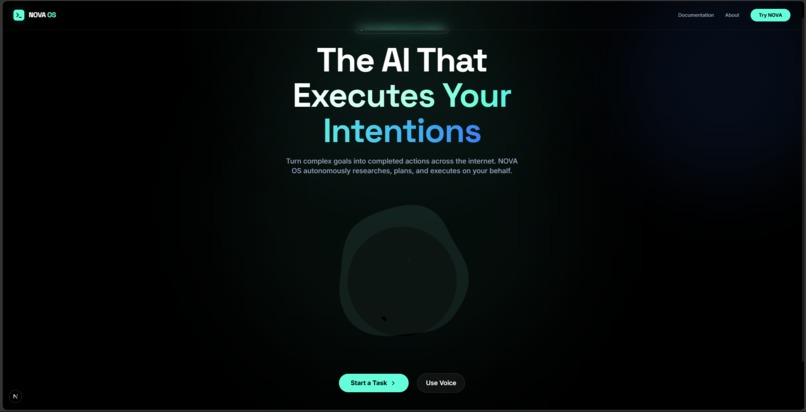
The Landing page of NOVA OS
-
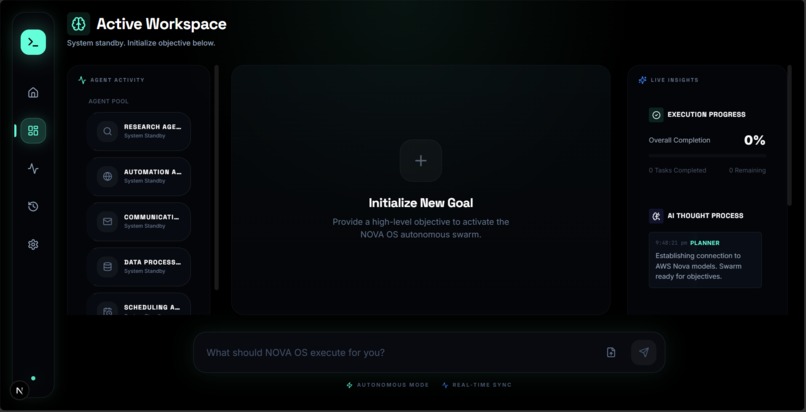
The Dashboard of NOVA OS
-
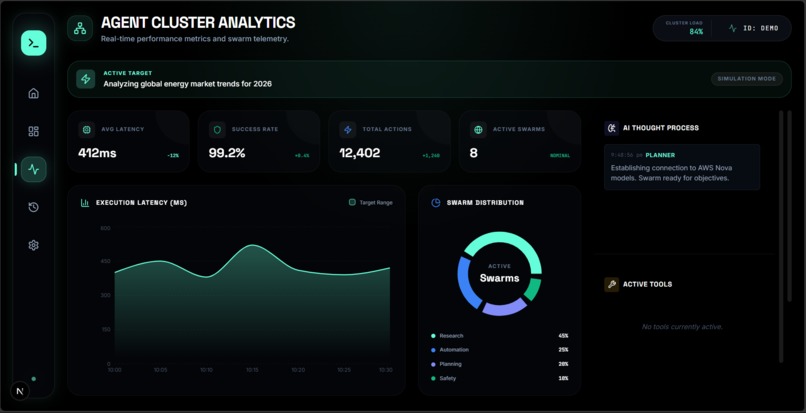
The analytics of NOVA OS
-
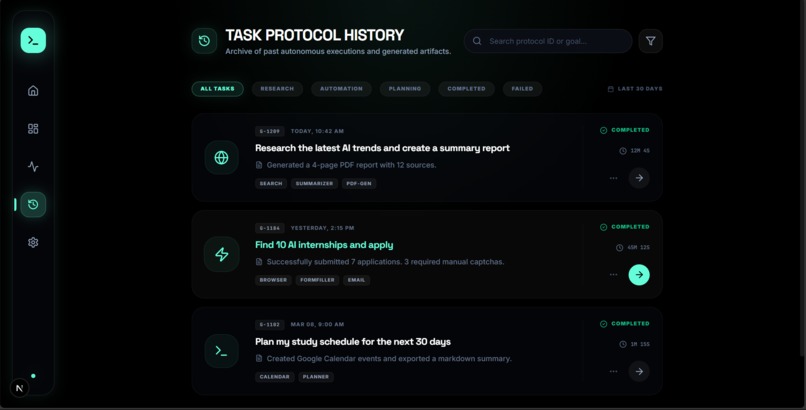
The Protocol History of NOVA OS
-
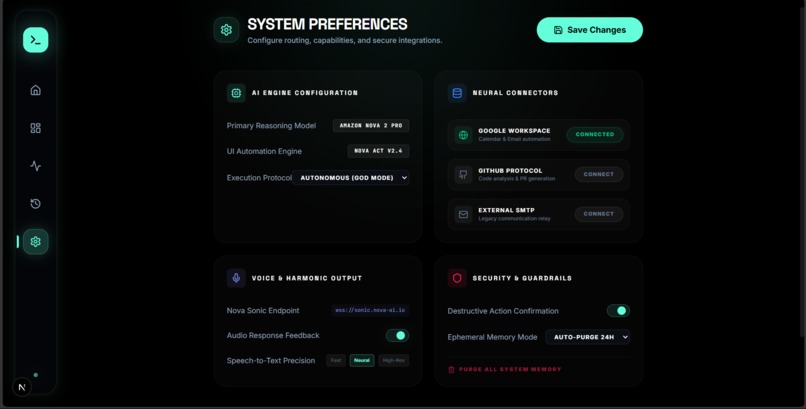
The Setting of NOVA OS


Inspiration
Modern AI assistants are incredibly powerful, but they are still passive systems. They can generate text, answer questions, and summarize information, yet they cannot execute real-world tasks across digital systems.
For example, if a user wants to complete a task like:
"Prepare a report about renewable energy startups and email it to my professor."
The user still has to:
- search the internet
- read multiple articles
- summarize information
- write the report
- open an email client
- attach the document
- send the email
This fragmented workflow inspired the idea behind NOVA OS.
What if AI could execute human intentions instead of just responding to prompts?
NOVA OS is our attempt to build an AI operating system that converts goals into real-world actions across the internet.
What it does
NOVA OS is an agentic AI system capable of transforming natural language goals into automated workflows.
The system demonstrates four key capabilities.
1. Intent Understanding
Users describe a goal in natural language.
Example:
"Plan my study schedule for the next 30 days."
The system extracts structured information including:
- objective
- timeline
- constraints
- desired output
2. Task Planning
Once the goal is understood, NOVA OS breaks it into a step-by-step plan.
Example workflow:
- Analyze syllabus
- Estimate required study hours
- Generate study schedule
- Export calendar events
3. Tool Execution
NOVA OS interacts with real-world tools to complete tasks such as:
- web research
- data collection
- document generation
- sending emails
4. Persistent Memory
The system maintains context including:
- user preferences
- previous tasks
- workflow history
This enables the AI to adapt and improve over time.
How we built it
NOVA OS uses an agent-based architecture powered by foundation models from Amazon Web Services.
The models are accessed through Amazon Bedrock, which provides the reasoning capabilities required for task planning and execution.
External integrations enable real-world actions:
- SerpApi for internet search
- SendGrid for email automation
System Architecture
The architecture consists of:
- Intent Engine
- Planning Agent
- Execution Layer
- Memory Layer
Together these components enable NOVA OS to understand, plan, and execute complex workflows.
Challenges we ran into
Task Decomposition
Breaking complex goals into structured execution plans required careful prompt design and workflow orchestration.
Tool Integration
Connecting reasoning models with external APIs required building a reliable execution layer.
Context Management
Maintaining long-term memory without overwhelming the system required designing an efficient semantic memory system.
Accomplishments that we're proud of
We successfully built a working prototype capable of:
- understanding human goals
- planning multi-step solutions
- interacting with external tools
- generating real outputs
This demonstrates a transition from AI assistants to AI operators, where AI not only provides information but also performs meaningful digital actions.
What we learned
This project highlighted several insights about modern AI systems.
The effectiveness of an autonomous system can be expressed as:
$$ AI\ Capability = Reasoning \times Tool\ Integration $$
Where:
- Reasoning is provided by foundation models
- Tool Integration allows real-world execution
Combining these elements unlocks powerful agentic behavior.
What's next for NOVA OS -- by Aditya Tukaram Vanjari
Our long-term vision is to build a universal AI operating layer for the internet.
Future directions include:
- multi-agent collaboration
- deeper productivity integrations
- personalized AI memory
- advanced workflow automation
Ultimately, we envision a world where people no longer navigate complex software ecosystems.
Instead of interacting with applications, users simply express intentions — and AI completes the work.
Built With
- amazonbedrock
- amazonnovamodel
- awscloudinfrastucture
- customaiagents
- fastapi
- framermotion
- javascript
- next.js
- playwright
- pyautogui
- python
- react
- restapi
- sendgrid
- serpapi
- tailwind
- typescript


Log in or sign up for Devpost to join the conversation.