-
-
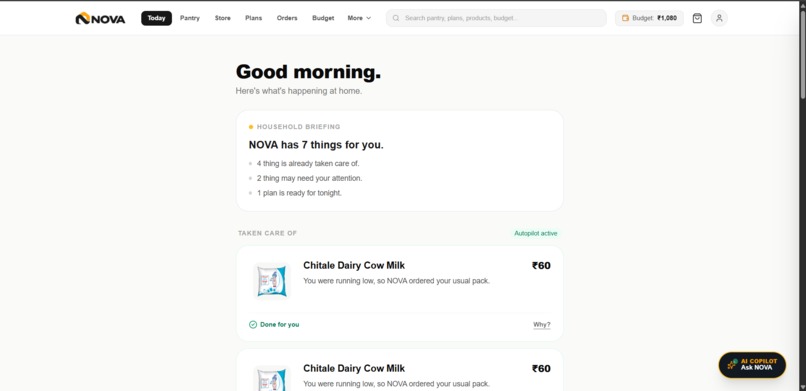
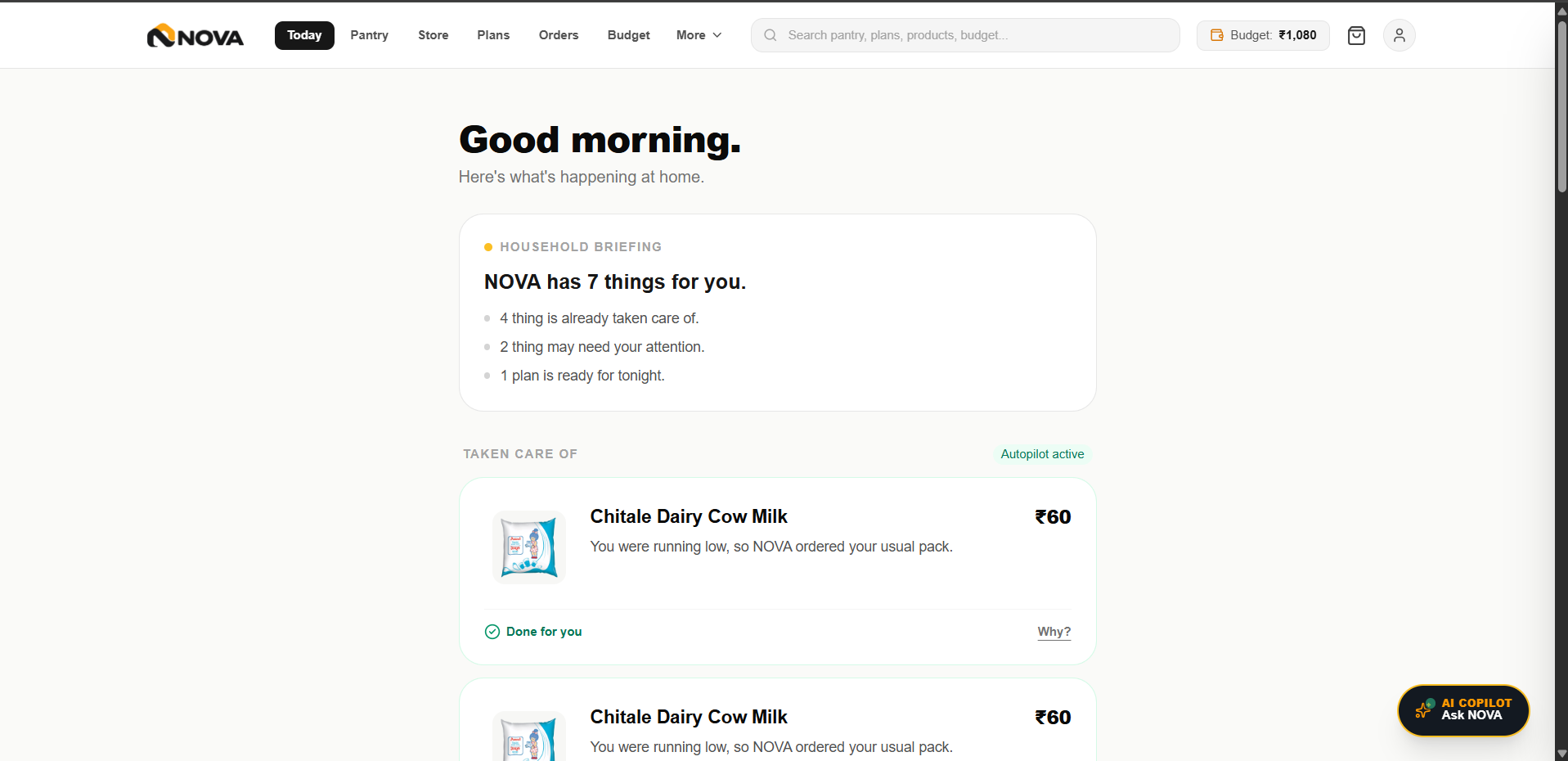
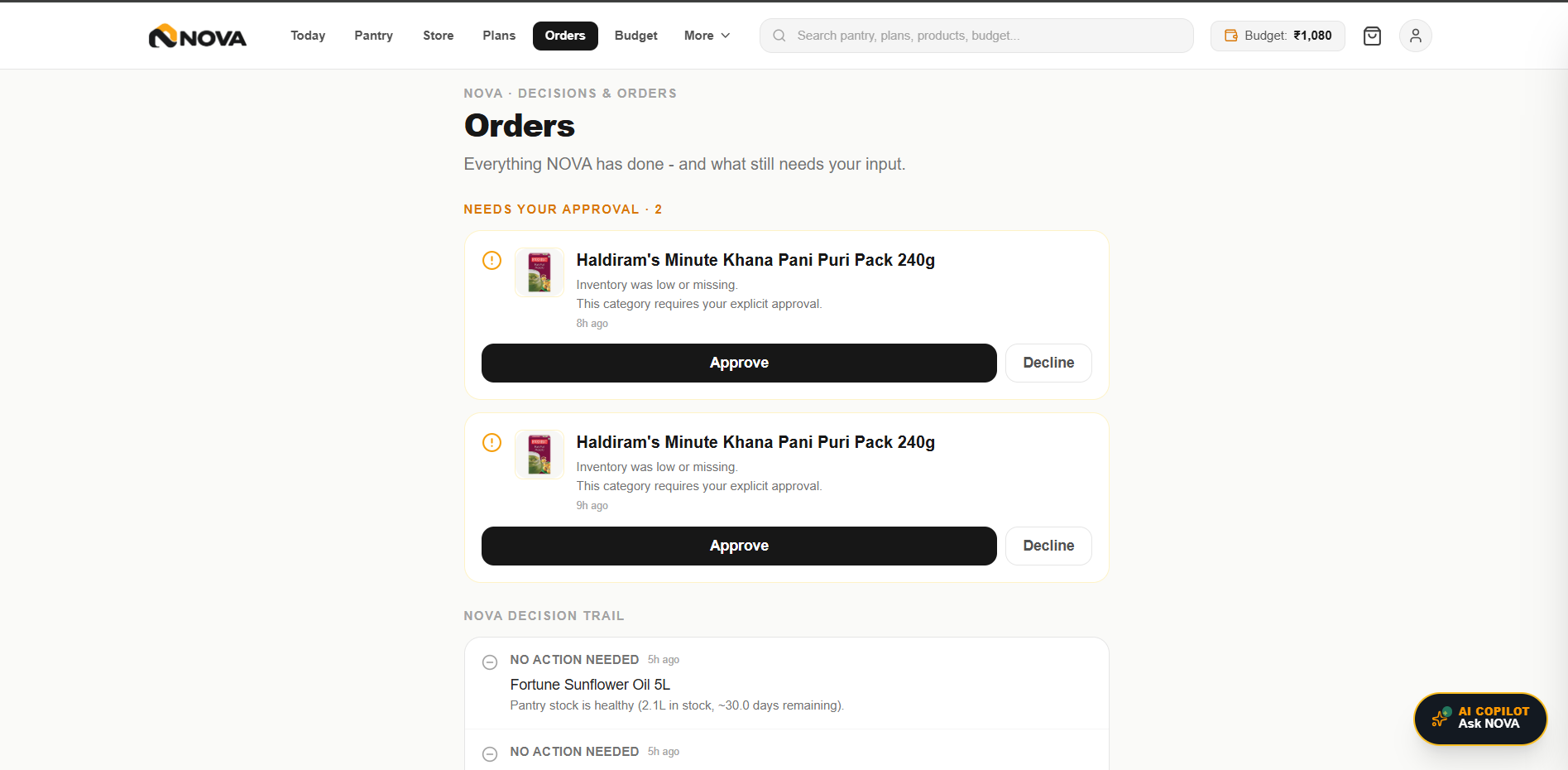
NOVA proactively monitors your household and shows what it has taken care of, what needs attention, and why.
-
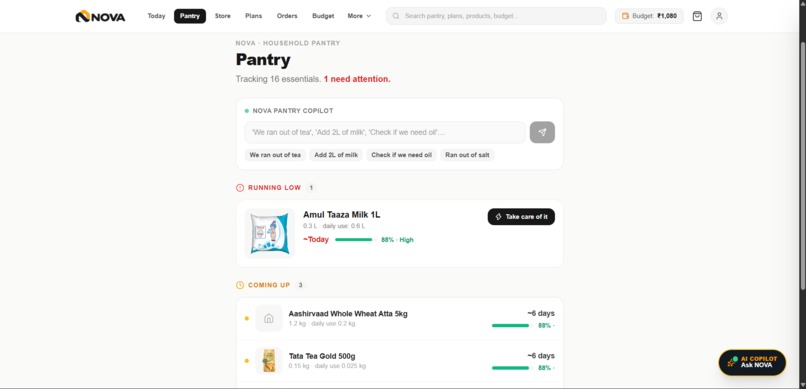
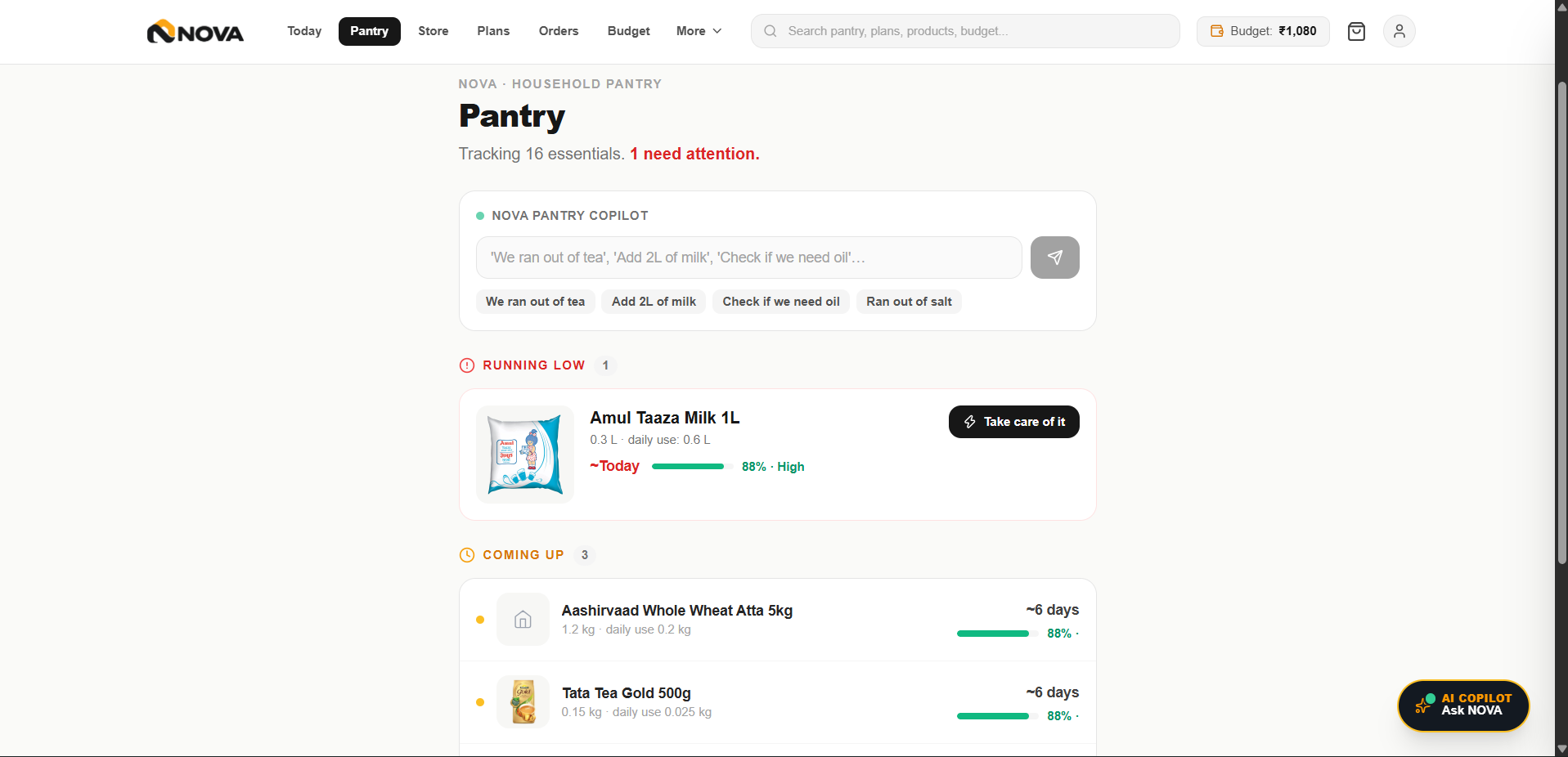
NOVA keeps track of household inventory, consumption, and predicted needs so you know what you have and what may run out.
-
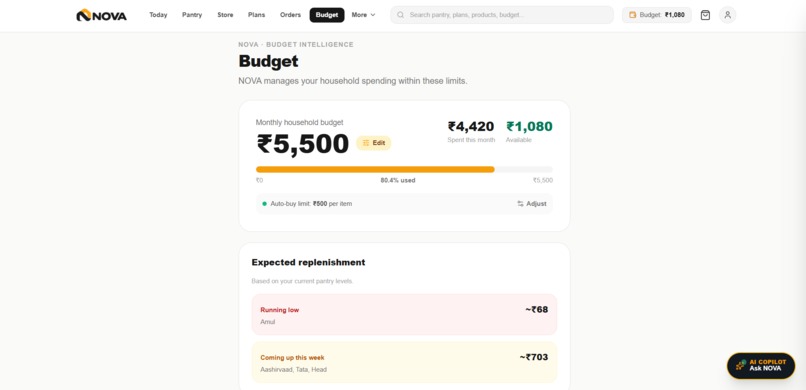
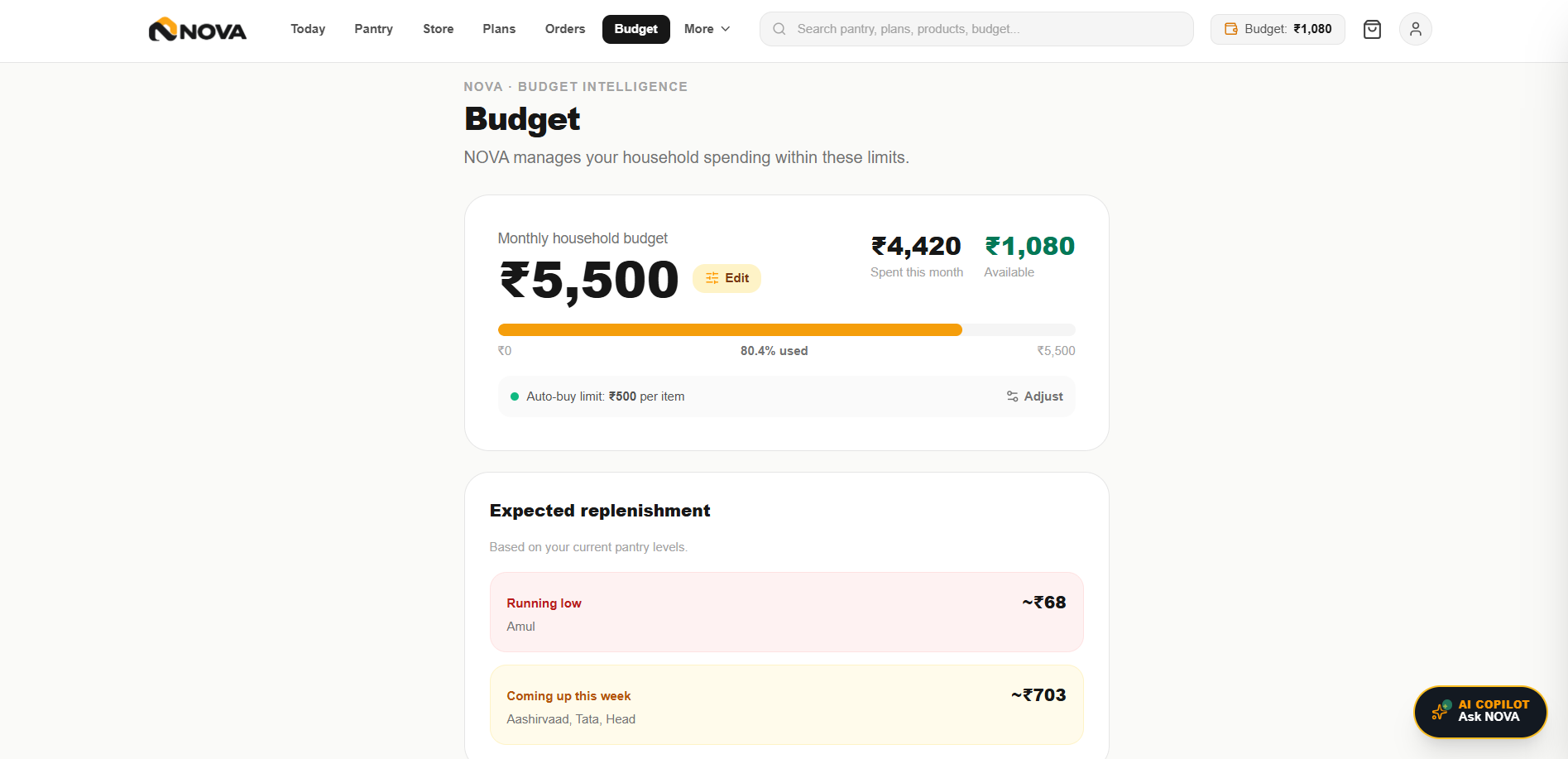
NOVA keeps spending within your budget and uses financial constraints when deciding whether a purchase should happen.
-
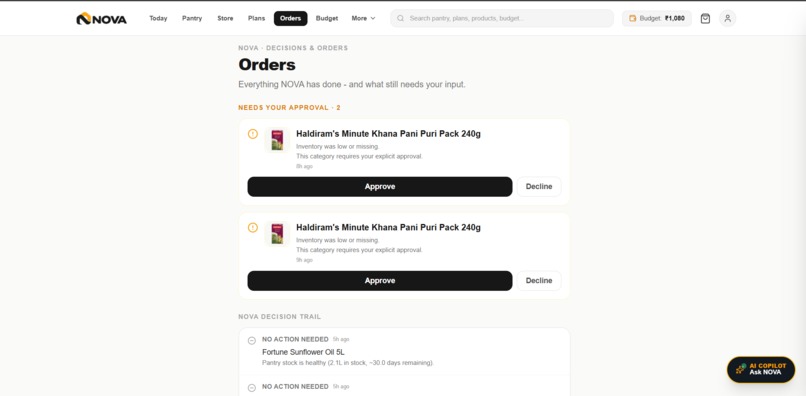
See purchases handled by NOVA, with a clear history of household actions and their outcomes.
-
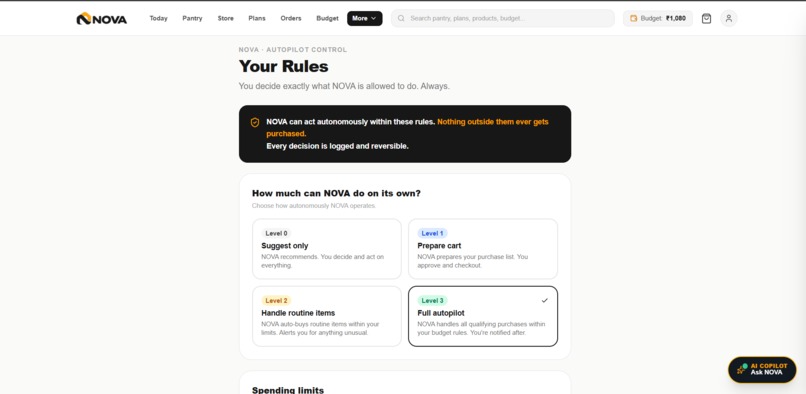
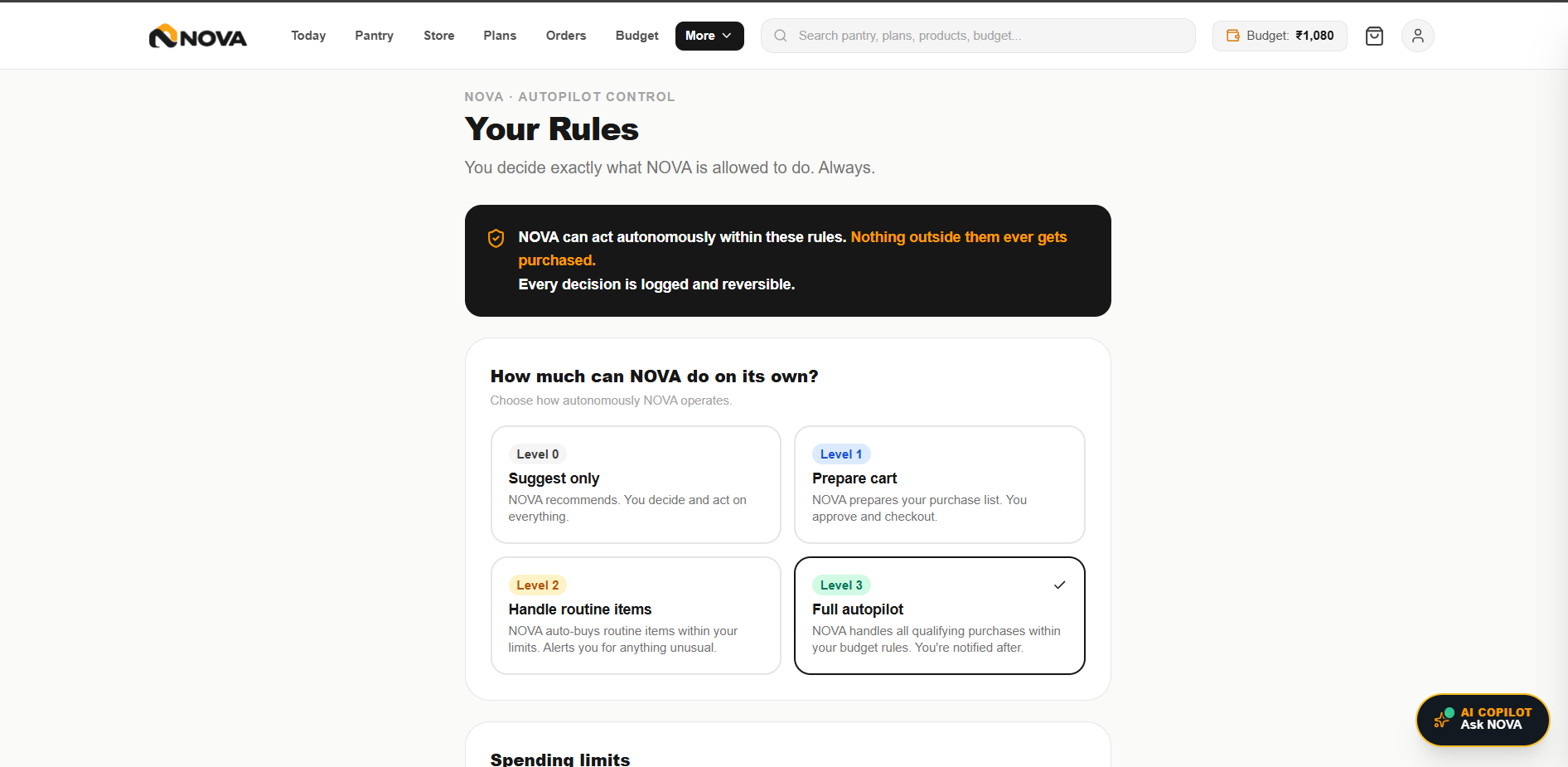
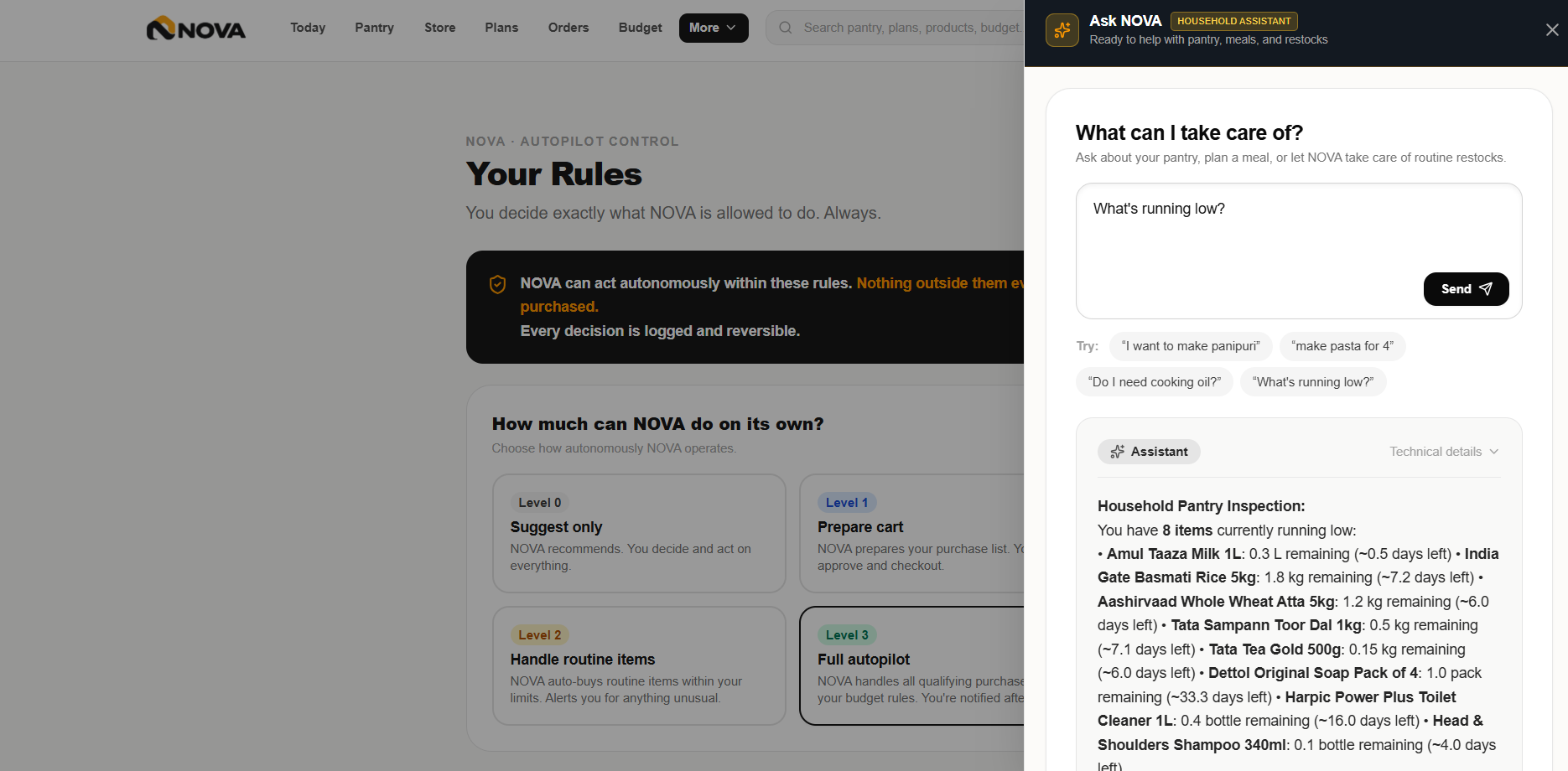
Define your household rules, spending limits, and approval preferences so NOVA knows when to act and when to ask.
-
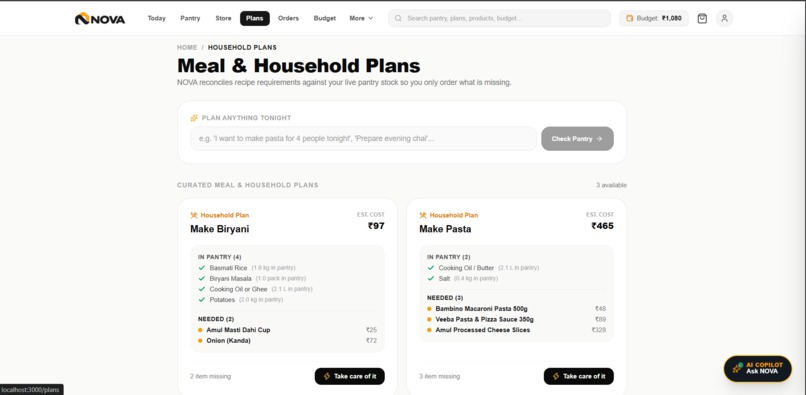
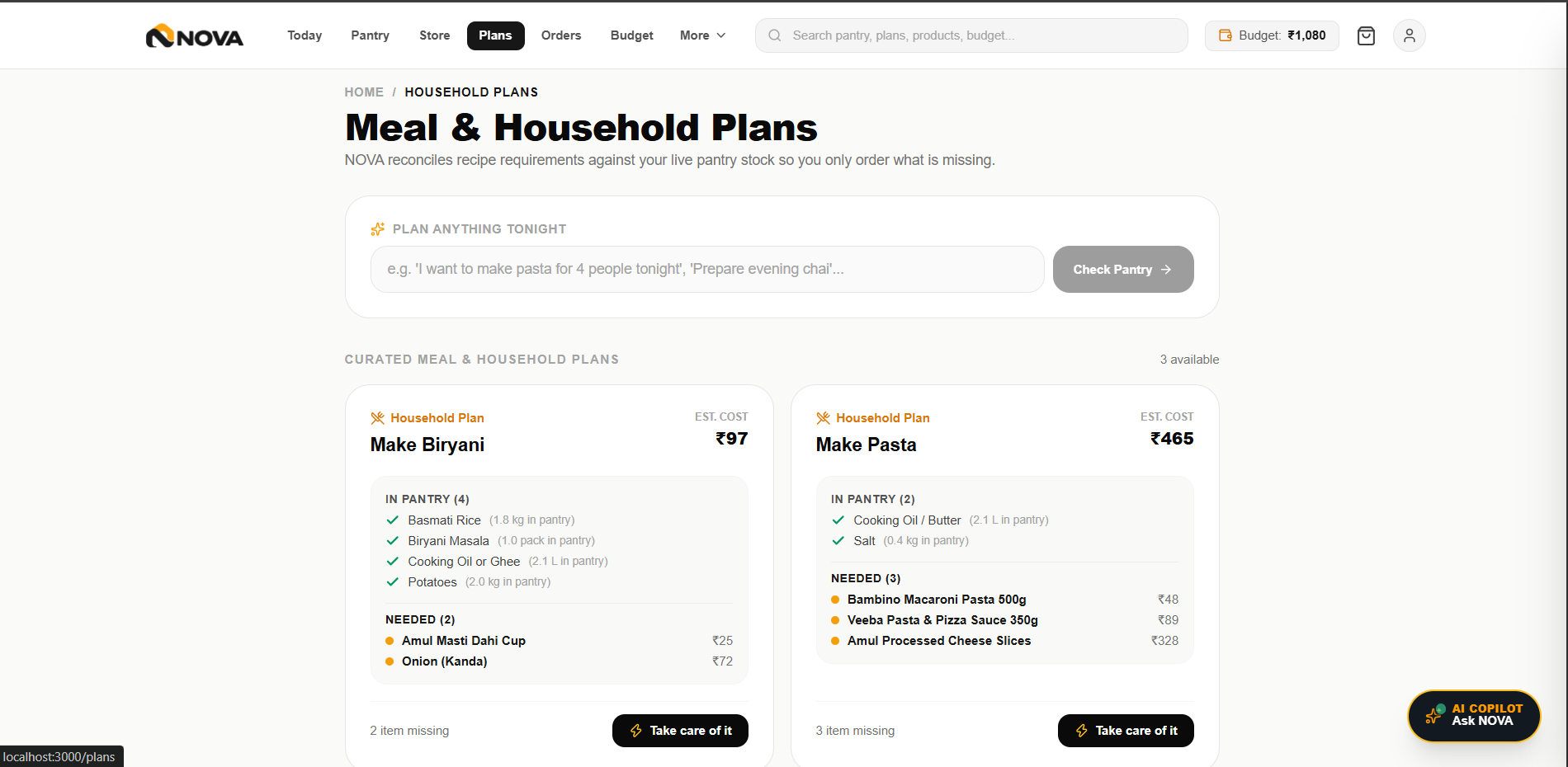
NOVA turns everyday plans into requirements, checks what is already available, and identifies only what is actually missing.
-
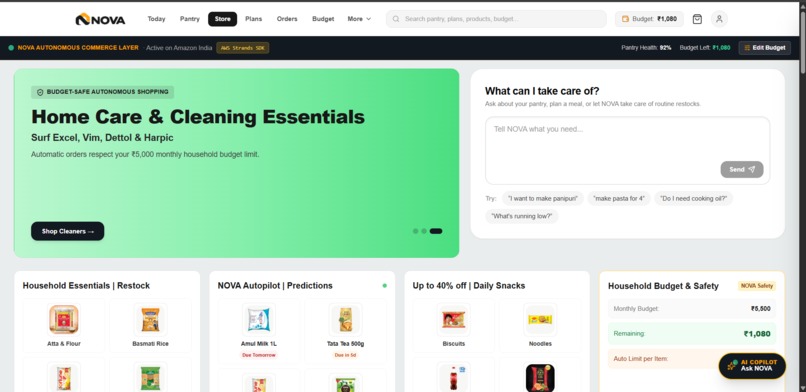
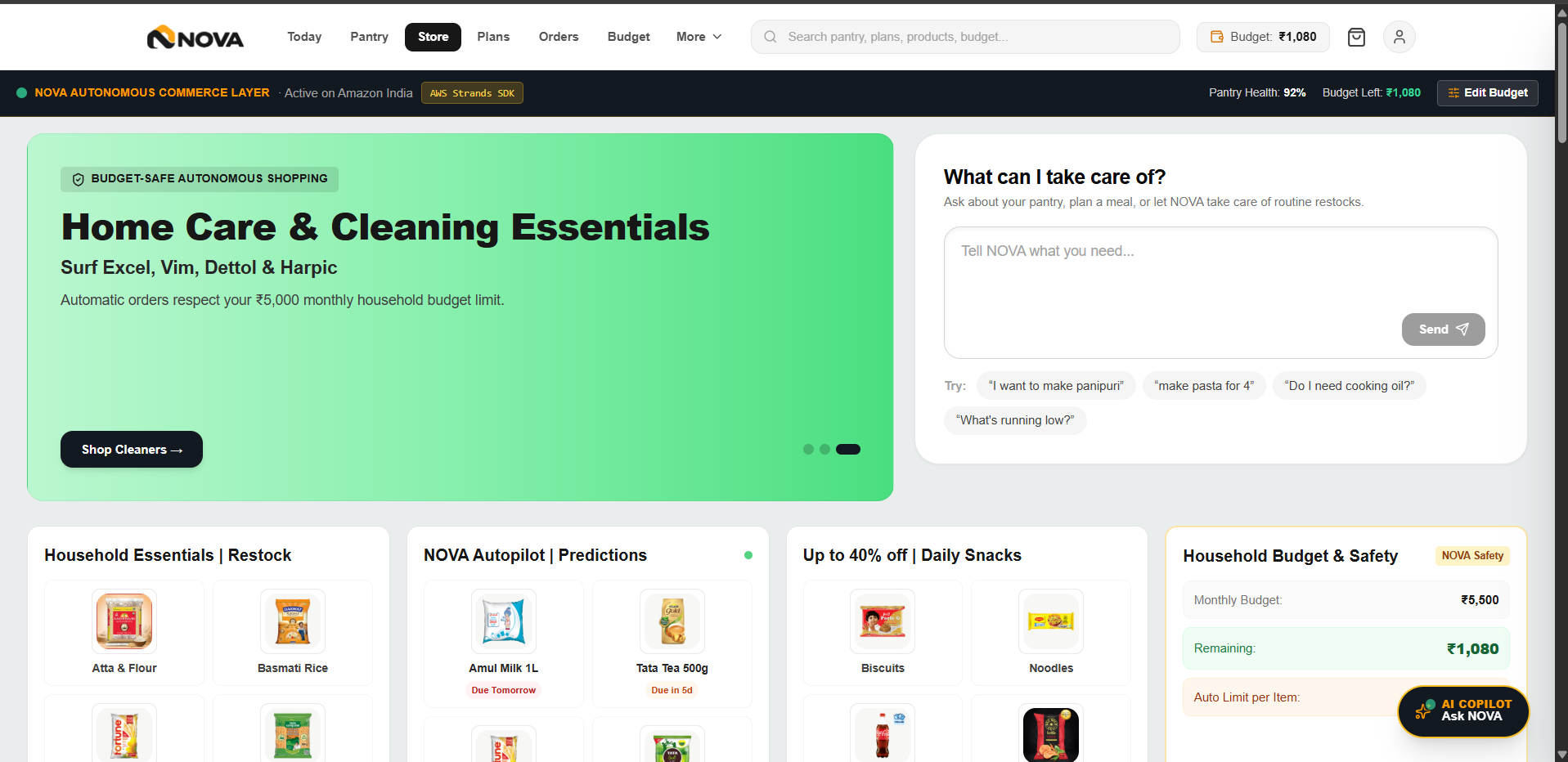
NOVA searches available products, considers preferences, price, availability, and household rules before recommending what to buy.
-
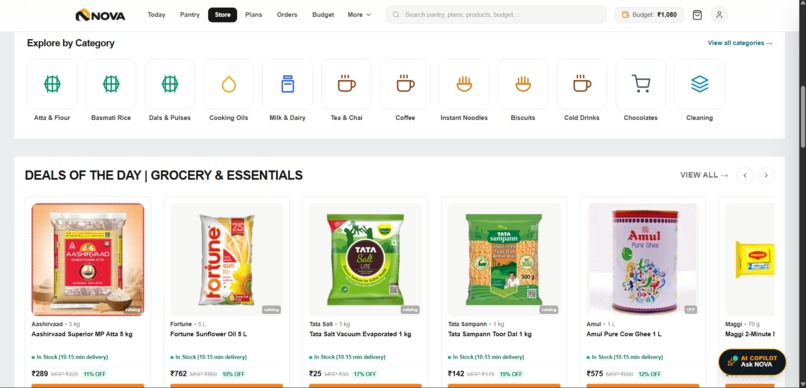
Tell NOVA what you want naturally. It understands your intent and turns everyday household goals into actionable plans.
-
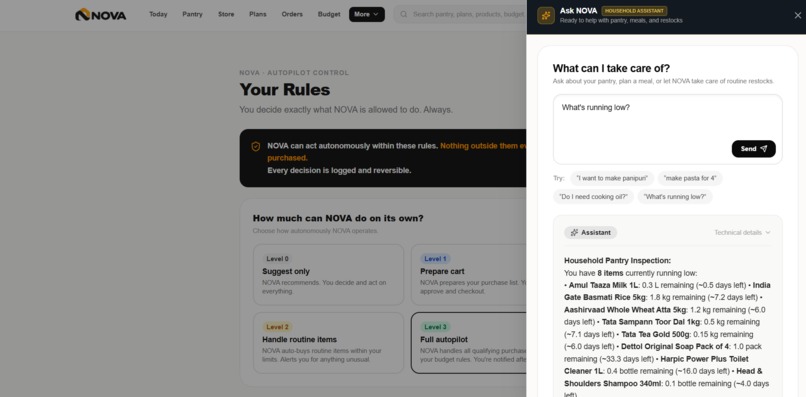
Chat naturally with NOVA. Ask for anything from a grocery item to a meal, and NOVA understands your intent and plans the required actions.
Inspiration
Every day, we spend time repeating the same household work: checking what is running low, remembering what needs to be bought, creating carts, searching through old orders and lists, comparing products, managing expenses, and placing the same orders again and again.
These tasks are not difficult, but they constantly consume our time, attention, and energy. We realized that the real problem is not grocery shopping itself. It is the continuous stream of small decisions required to keep a household running.
So we asked:
What if you only had to set everything up once, and an AI could take care of the repetition?
That idea became NOVA — Natural Orchestration for Virtual Autonomy, an AI household autopilot designed to understand your household, remember how you live, and take care of routine decisions within rules you define.
What it does
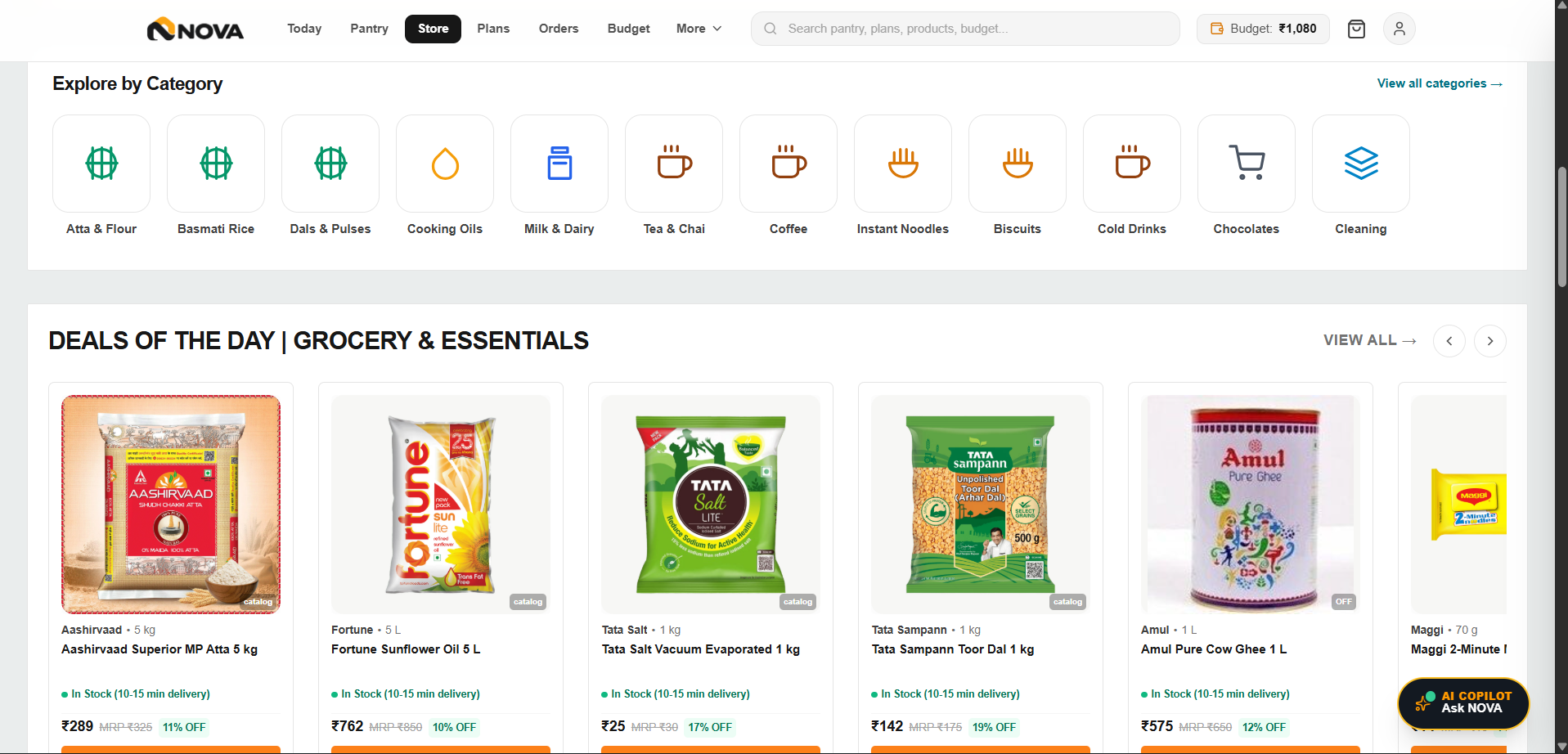
NOVA is a personalized intelligence layer over the services you already use, with the vision of becoming an intelligent layer over shopping platforms such as Amazon rather than simply another shopping interface.
You tell NOVA your household preferences, budget, routines, preferred products, and how much autonomy you are comfortable giving it. NOVA then maintains context about your pantry, consumption, purchase history, budget, and rules to determine what actually needs to happen.
For example, if milk is running low, NOVA can recognize the need, check your consumption and inventory, find the preferred product, check its price, verify the budget and purchasing rules, and take care of the purchase when it is authorized.
But NOVA is not limited to repetitive reordering. It understands human intent.
You can simply say:
"I want to make Maggi tonight."
NOVA understands the activity, determines what is required, checks the pantry to see what you already have, identifies only what is missing, considers your preferred products, availability, price, budget, and rules, and then decides whether it can take care of the purchase or needs to ask you.
NOVA can also recognize when nothing needs to be done. If you already have enough cooking oil, it will leave it alone instead of creating an unnecessary purchase.
This is the core difference between automation and autonomy.
NOVA can ACT, ASK, WAIT, DO NOTHING, or BLOCK depending on context, confidence, budget, authorization, and household rules.
It remembers your preferences and routines, tracks inventory and consumption, manages budgets and policies, keeps an activity and decision history, explains why it made a decision, and can proactively check your household in the background instead of waiting for you to ask.
The goal is simple:
Set up your household once, and stop repeatedly managing it.
How we built it
NOVA is built around a primary intelligent agent using the Strands Agents SDK and Amazon Bedrock, with AWS services providing the infrastructure for persistent and event-driven autonomy.
The agent follows a complete decision loop:
Request/Event → Retrieve State → Reason → Use Tools → Check Constraints → Decide → Act/Ask → Update State
We deliberately separated AI reasoning from deterministic execution.
The LLM handles natural-language understanding, intent recognition, reasoning, planning, and explanations. Deterministic services handle inventory calculations, consumption tracking, budget validation, policy enforcement, authorization, commerce execution, and state updates.
We use Amazon Bedrock AgentCore for the agent architecture, including runtime, memory, and gateway capabilities. Amazon DynamoDB stores household state, inventory, rules, budget information, and audit data. AWS Lambda and Amazon EventBridge enable background workflows so NOVA can proactively evaluate household needs.
NOVA's commerce layer is abstracted so the agent can search products, compare options, create carts, check availability, execute purchases, and track orders. For the MVP and demonstration, we use mock commerce so the complete agent workflow can be demonstrated reliably without depending on live retailer APIs.
The result is not simply a chatbot that recommends what to buy. NOVA can reason across multiple pieces of household context and then make a controlled decision about whether an action should actually happen.
Challenges we ran into
The biggest challenge was giving an AI agent autonomy without giving it uncontrolled access to money or real-world actions.
A language model can reason about what a user might want, but it should not be the final authority for financial or transactional decisions. We therefore created a deterministic safety boundary between NOVA's reasoning and execution.
Before a purchase can happen, NOVA checks factors such as inventory, confidence, budget limits, category policies, and authorization. If everything is within the user's rules, it can proceed. If something is uncertain or exceeds the configured authority, NOVA asks the user instead.
Another challenge was teaching the system that doing nothing can be the correct decision. A conventional automation system might see a product getting low and immediately buy it. NOVA considers the larger household context first, which helps prevent duplicate purchases and unnecessary spending.
We also had to handle uncertainty. Household consumption is not perfectly predictable, so NOVA uses confidence when deciding whether it should act autonomously or request human input.
Finally, we had to balance a technically complex agent architecture with a simple user experience. The complexity should exist behind the scenes; from the user's perspective, NOVA should feel calm, understandable, and effortless.
Accomplishments that we're proud of
We are proud that NOVA goes beyond a conversational AI prototype and demonstrates a complete autonomous decision workflow.
NOVA combines:
- Multi-step agent tool use
- Persistent household memory
- Natural-language intent understanding
- Pantry and inventory reasoning
- Consumption tracking
- Purchase history
- Confidence-aware decisions
- Budget management
- User-defined purchasing policies
- Authorization and approval flows
- Autonomous purchasing
- Explicit
DO_NOTHINGdecisions - Commerce integration
- Audit trails
- Decision explanations
- Background workflows with EventBridge
- Strands Agents SDK and Amazon Bedrock
- Amazon Bedrock AgentCore architecture
Our favorite part is that the same agent can handle both proactive and conversational situations.
It can proactively notice that milk is running low and take care of it, while also understanding a completely different request such as:
"I want to make Maggi tonight."
It can then reason about the intent, reconcile it with the pantry, determine what is missing, check the user's constraints, and decide what should happen next.
That is the behavior we wanted from a true household agent: not just answering, but understanding, deciding, and acting responsibly.
What we learned
Building NOVA taught us that creating an autonomous agent is not simply about making an LLM capable of using more tools.
The difficult part is giving the agent enough context to make useful decisions while giving it clear boundaries for when it is allowed to act.
We learned that autonomy is not the same as automation.
A good autonomous system needs to understand context, evaluate confidence, respect user-defined constraints, know when to act, and know when to stop and ask.
We also learned how important it is to separate probabilistic reasoning from deterministic operations. LLMs are excellent at understanding ambiguous human intent and creating plans, while deterministic systems are much better suited for calculations, authorization, budgets, policies, and state-changing operations.
Most importantly, we learned that the best agent experience can actually feel very simple to the user even when the reasoning underneath is complex.
What's next for NOVA (Natural Orchestration for Virtual Autonomy)
The current NOVA MVP focuses on household purchasing and the repetitive decisions surrounding it, but our vision is much broader.
We want NOVA to become a personal intelligence layer for everyday life that works across the services people already use.
The long-term vision is to connect NOVA with commerce platforms such as Amazon and other everyday services, allowing it to coordinate more household tasks while maintaining the same principles of memory, context, confidence, authorization, and controlled autonomy.
Instead of opening multiple applications, rebuilding carts, searching old orders, checking budgets, and manually coordinating every small task, users should be able to express what they want naturally and let NOVA figure out the steps.
The agent should operate quietly in the background, handle routine decisions automatically, and surface only the situations where human judgment is actually needed.
NOVA is not trying to make humans better at managing repetitive tasks. It is trying to remove the need to manage them in the first place.
Set it up once. Let NOVA remember, reason, and act.
Stop managing your household, and let your household manage itself.
Built With
- agentcore
- agents
- ai
- amazon
- amazon-web-services
- artificial
- bedrock
- dynamodb
- eventbridge
- fastapi
- gateway
- generative
- lambda
- mcp
- memory
- next.js
- python
- react
- runtime
- sdk
- services
- strands
- web

Log in or sign up for Devpost to join the conversation.