-
-
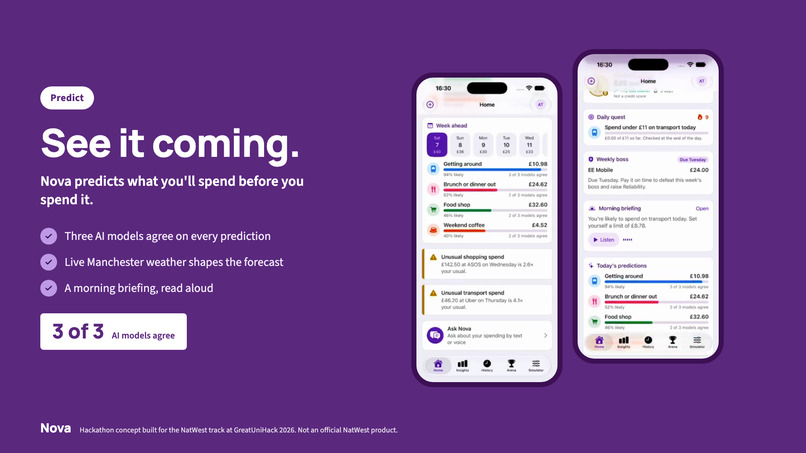
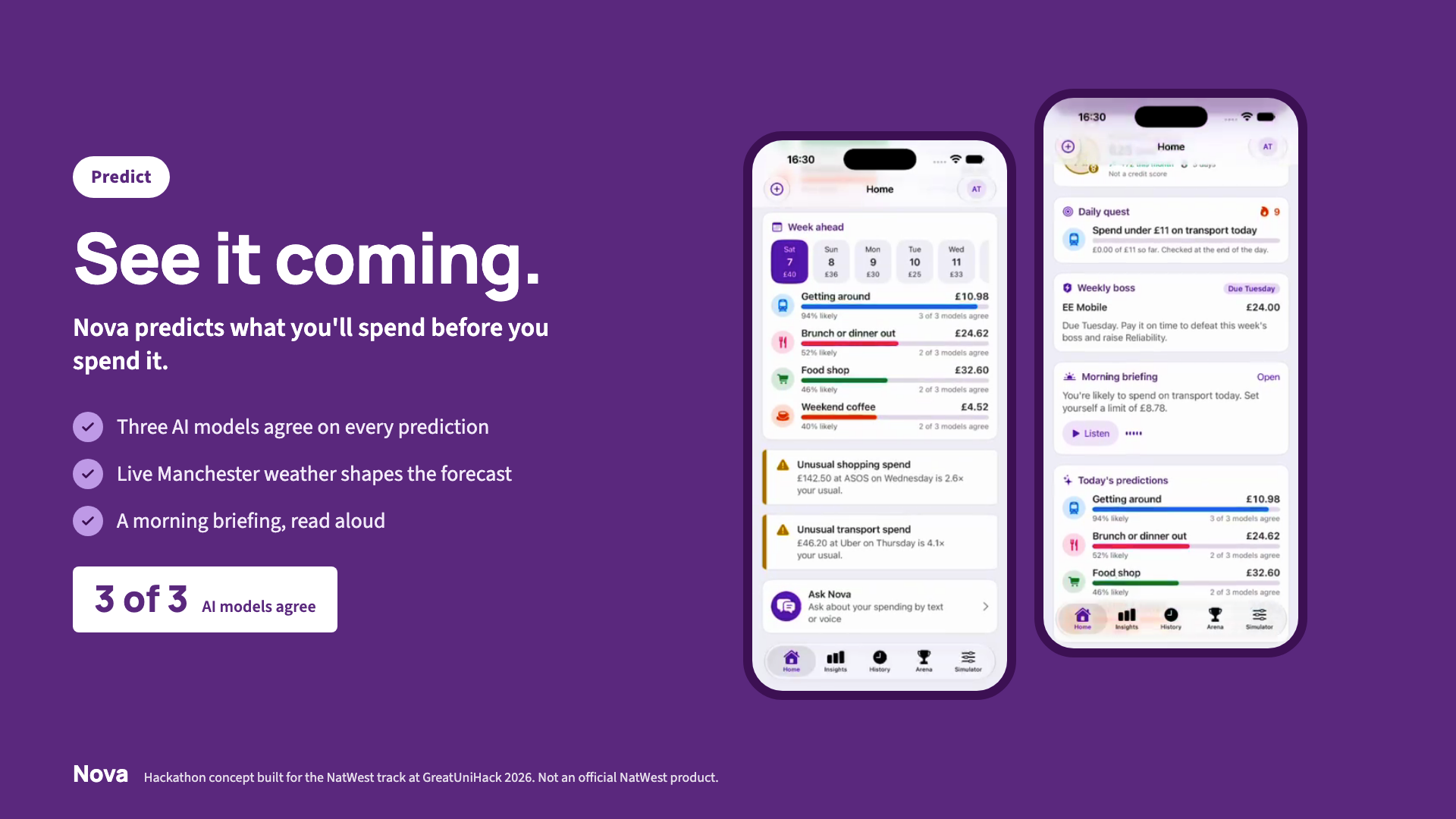
Banner one: See it coming.
-
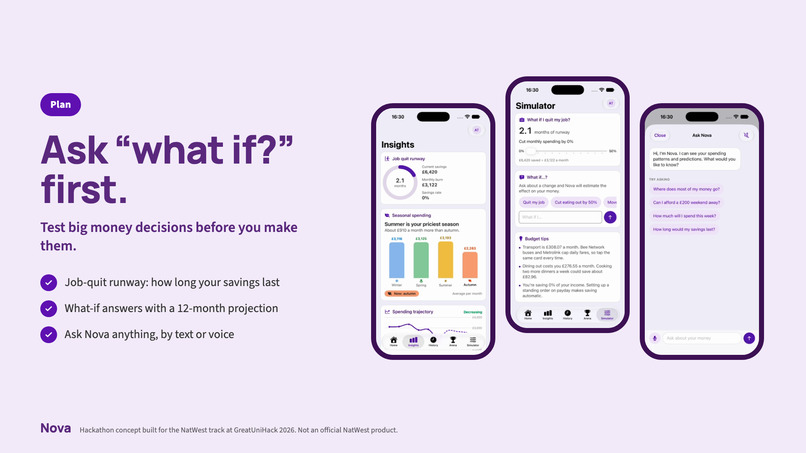
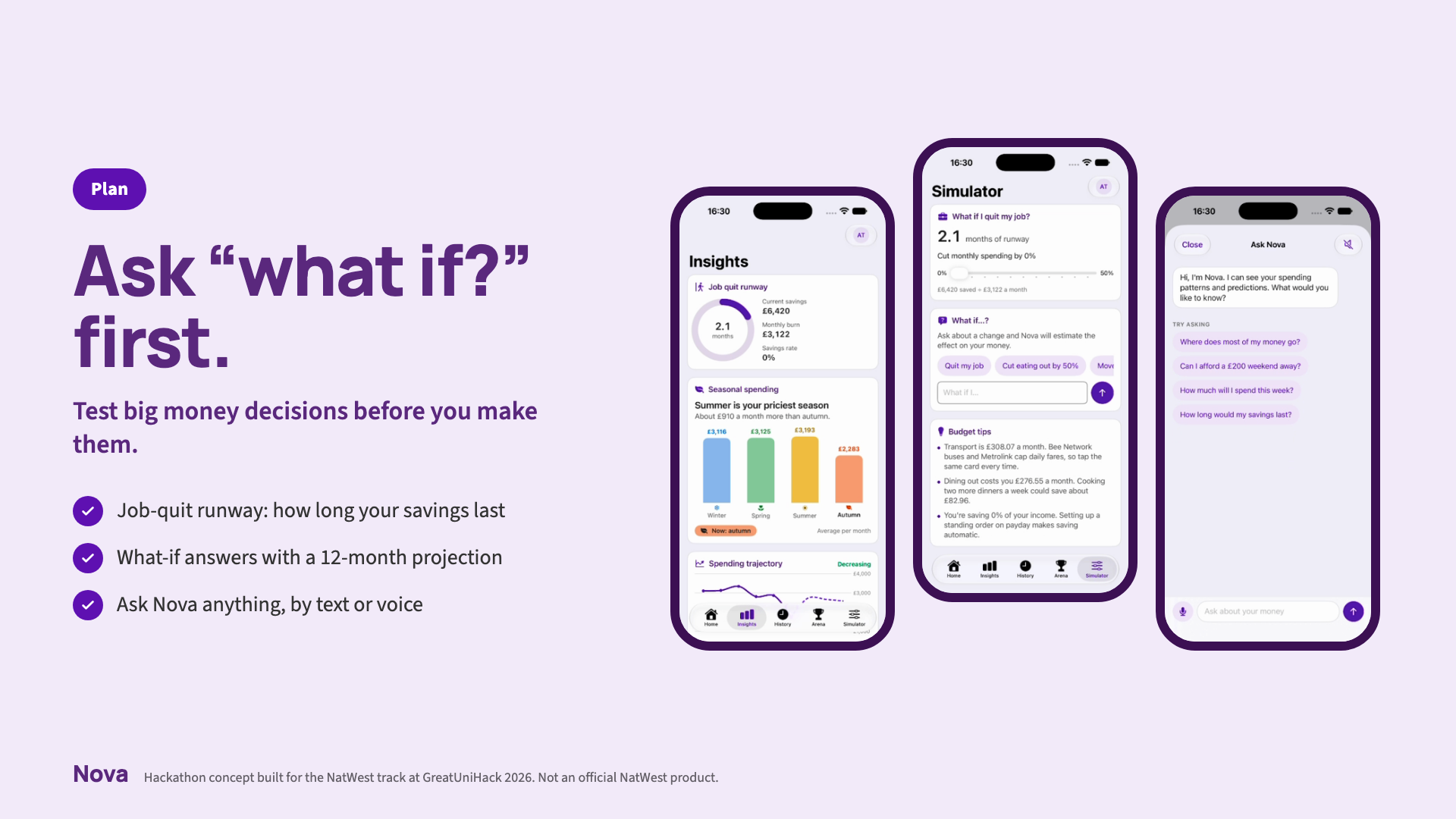
Banner two: Ask "what if?" first.
-
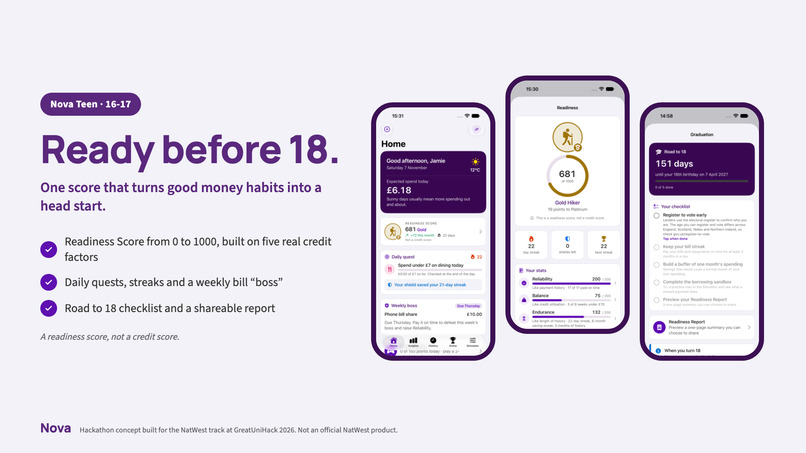
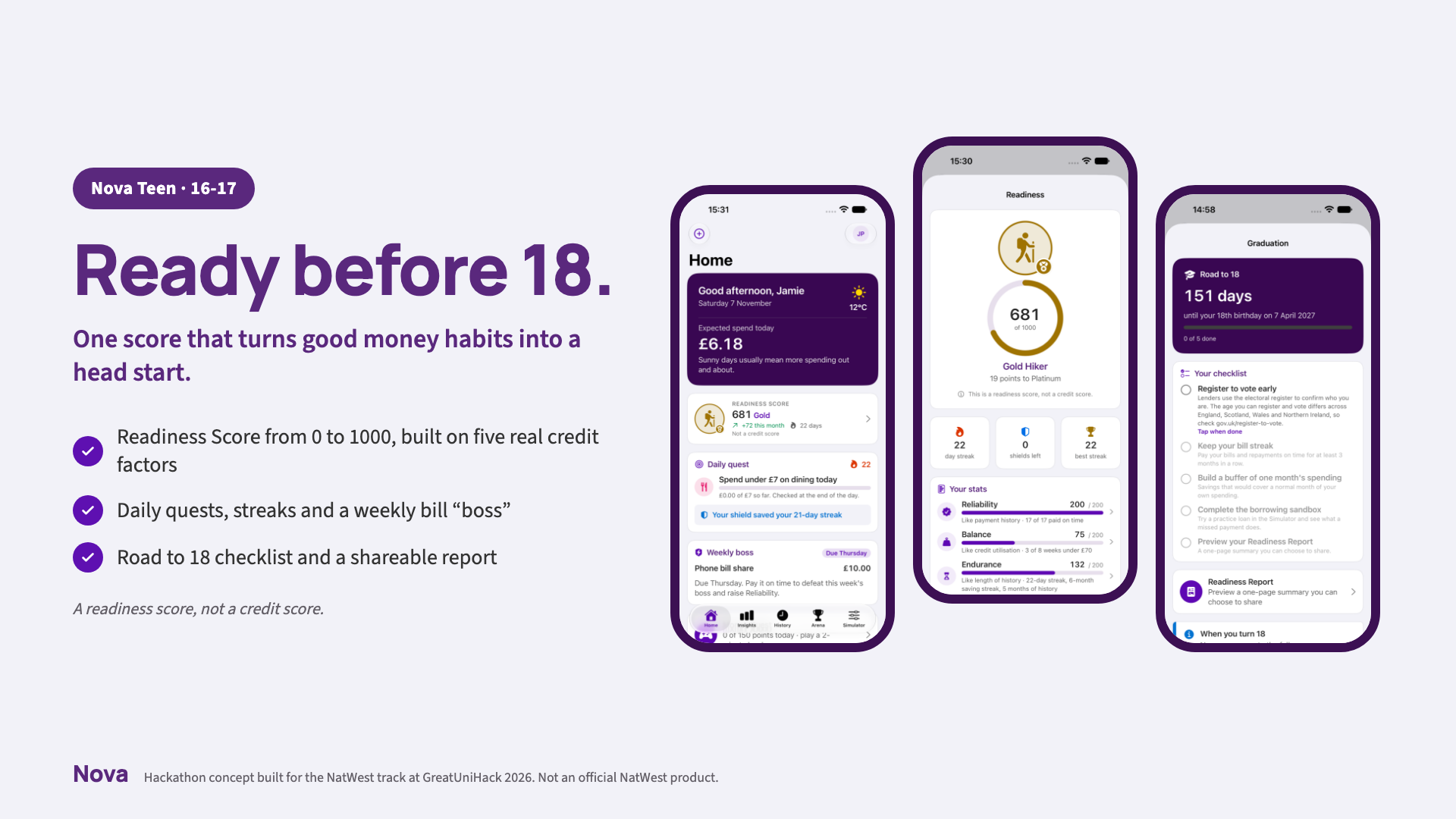
Banner three: Nova Teen, be ready before 18.
-
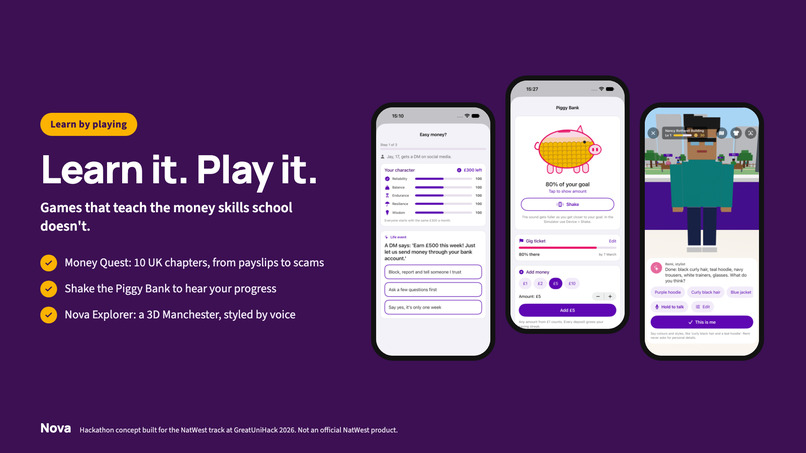
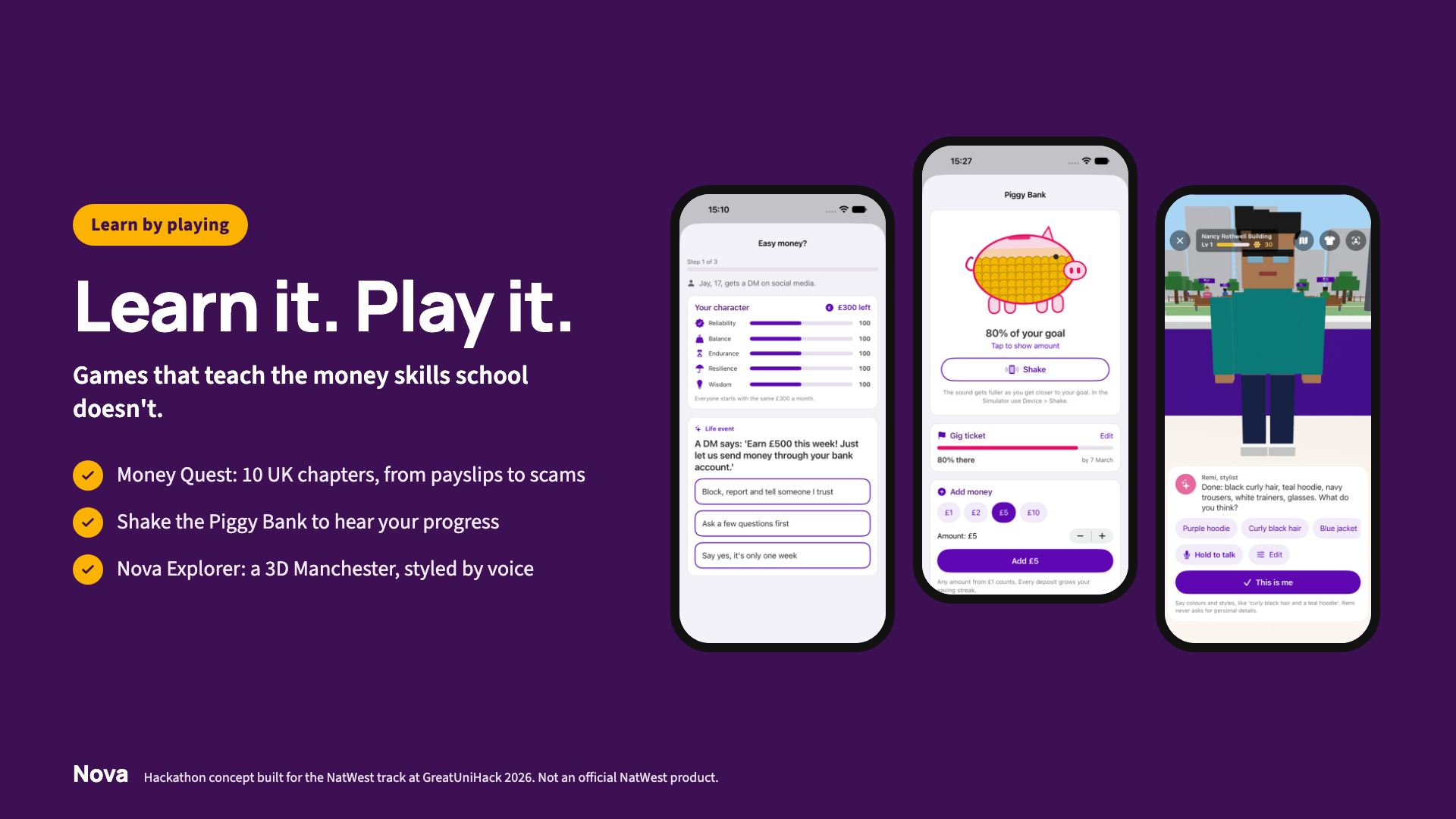
Banner four: Learn it. Play it.
-
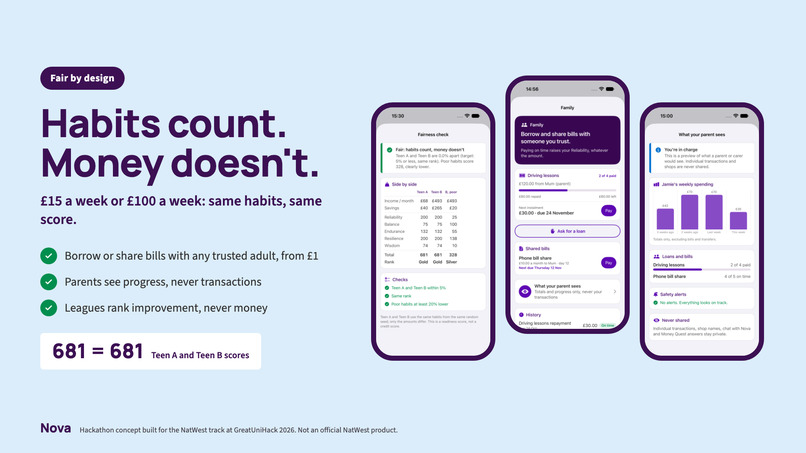
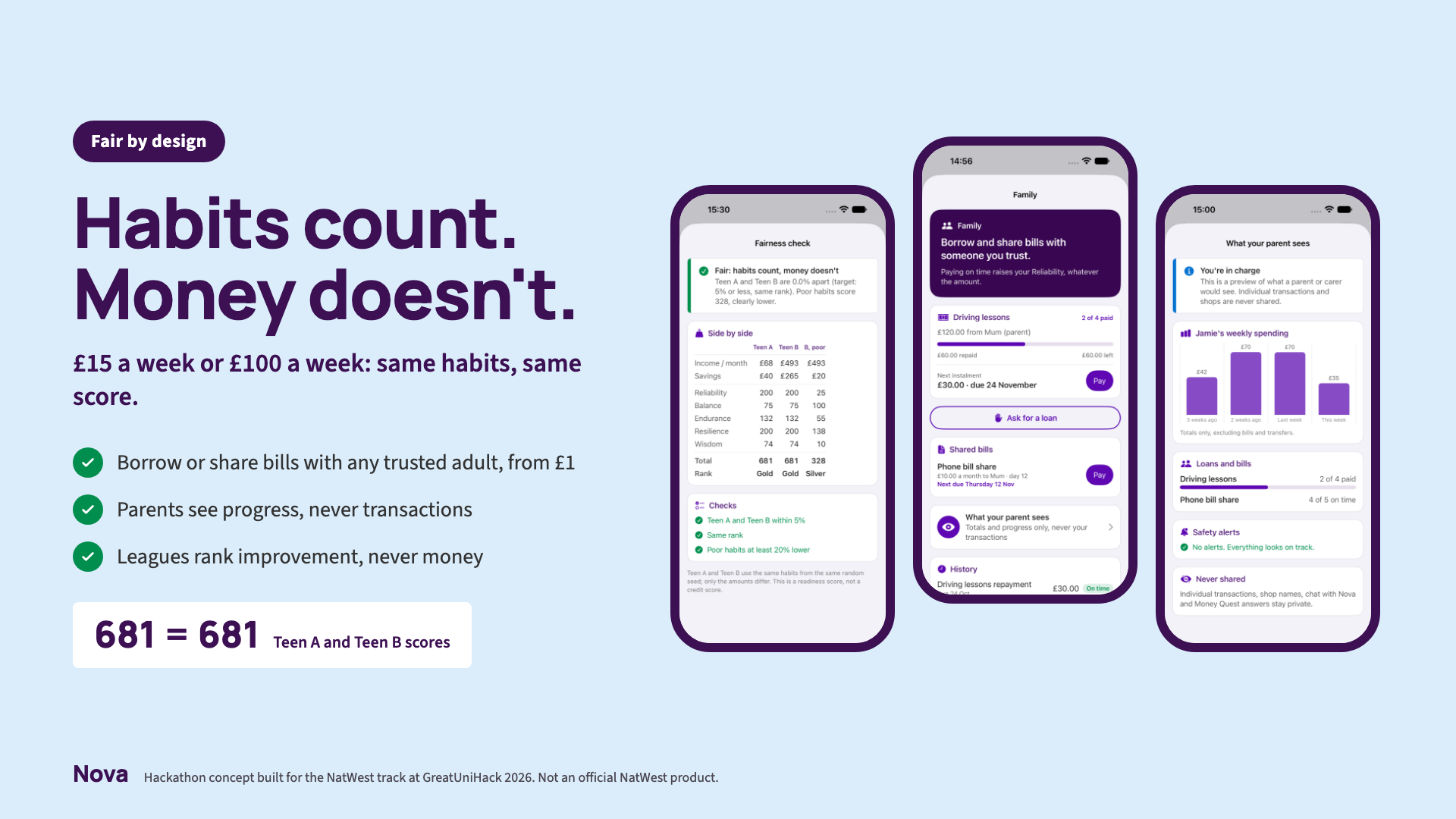
Banner five: Games are fair by design.
Come see us to try the iOS live version!
Inspiration
Your banking app tells you what you spent yesterday. We wanted one that tells you what you'll spend tomorrow.
Young adults often run short in the days before payday. Their bank only shows what has already happened, and nothing warns them in advance. The cost of living makes that gap worse.
The second problem starts earlier. At 17 you can drive, work and pay tax. Then on your 18th birthday you ask a bank for a phone contract, and it acts like you don't exist. A UK credit file can't exist before 18, so everyone starts with a blank file and no practice. That hits hardest for care leavers, international students and young people whose families never used credit. Financial education is mostly lessons and leaflets, and leaflets rarely build habits.
We built Nova for the NatWest track, AI-powered financial inclusion and resilience, to fix both problems in one app. (Nova is a student hackathon project, not an official NatWest product.)
What it does
Nova is a native iPhone app that looks ahead:
- Predict: daily spending predictions with probabilities, such as an 83% chance of a coffee for about £5.50. Three AI models make them together and show how many agree. Predictions take live Manchester weather into account, with a week-ahead calendar and alerts for unusual spending spikes.
- Morning briefing: your expected spend, the weather, the top prediction and a nudge, read aloud by a natural Mancunian voice.
- Insights and Simulator: a "job quit runway" showing how many months your savings would last with no income. You can ask any what-if, such as "What if I cut eating out by half?", and get an illustrated answer card with a 12-month projection with and without the change.
- Ask Nova: a chat assistant that knows your spending. You can type or speak, and it can answer aloud.
- Arenas: savings challenges with friends for points and badges. Most Improved mode ranks your percentage cut against your own past spending, so everyone starts level.
- Financial health report: a shareable one-page PDF with a 0–100 health score.
Nova Teen is for 16–17 year olds, inside the same app. It builds a Readiness Score from five stats, each mirroring a real credit factor:
$$S_{\text{readiness}} = \sum_{i=1}^{5} s_i, \qquad 0 \le s_i \le 200$$
The five stats are Reliability (payment history), Balance (utilisation), Endurance (length of history), Resilience (affordability) and Wisdom (money skills). It's a readiness score, not a credit score: it is never shared with credit reference agencies.
Teens learn through Money Quest, a game with 10 UK chapters (payslips, scams and money mules, phone contracts and more). They save in a Piggy Bank they can shake to hear the coins. With Family, they can borrow from or share a bill with any trusted adult (a parent, carer, grandparent or key worker) from £1, building a real record of paying on time. At 18, Teen mode becomes the full app and keeps their score and history.
How we built it
- A native iOS app with a Python backend on Vercel, designed for the NatWest brand family.
- Three models in parallel: Claude, Gemini and GPT each analyse the spending history, and the backend combines their outputs into a consensus shown as "N of 3 models agree".
- ElevenLabs voices the morning briefing and Ask Nova's spoken answers.
- Statement upload works with NatWest, Royal Bank of Scotland, Ulster Bank and other UK banks, with 12 months of Manchester demo data for testing.
- Arenas are shared between real users through the backend.
- Accessibility was built in from the start: VoiceOver, Dynamic Type up to the largest sizes, Dark Mode, Reduce Motion, colour-blind-friendly chart colours, and voice in and out.
Challenges we ran into
- Making the score fair. The obvious version of a money score rewards having money. We built every stat from ratios, on-time rates and progress towards your own goals instead of balances. A £1 payment counts the same as £100, and daily caps stop points being about free time. Hardship protection eases goals when income falls by more than 30%:
$$\frac{I_{\text{now}}}{I_{\text{before}}} < 0.7 \;\Rightarrow\; \text{goals ease}$$
We then tested it with a fairness check:
- Teen A, about £15 a week of pocket money: 681, Gold
- Teen B, about £100 a week from a job, same habits: 681, Gold
- Teen B with poor habits: 328, Silver
- Getting three models to agree. Each model returns its own predictions, so we had to combine them into one consensus with a clear agreement count.
- Making the voice sound human. Amounts had to be spoken properly, so "£3.60" is read as "three pounds sixty".
- Designing safely for under-18s. Parents see weekly totals and progress, never individual transactions. Teens never stake money, teen leagues show no pound amounts, and Ask Nova never recommends credit products in Teen mode. We designed around UK GDPR, the ICO Children's Code and the FCA Consumer Duty.
- Keeping it honest. We kept a strict line between what's built and what's planned, and we don't claim prediction accuracy we haven't measured yet.
What we learned
- Fairness has to be designed and then tested. Our fairness check changed how we weighted every stat.
- Showing how much the models agree gives users a sense of how confident a prediction is, without hiding uncertainty.
- Accessibility is much easier to build in from the start than to add later, and voice opens Nova to people who would rather listen than read.
- A readiness score can build real habits without pretending to be a credit score.
What's next
These are plans, not features yet:
- Cost-of-living tools: a payday shortfall warning, spotting bill rises, a support finder and a hardship mode.
- A credit file link: with a credit reference agency partner and consent, on-time payments made at 16–17 could be reported at 18, the way rent reporting works today.
- Nova Explorer: a 3D game of Manchester city centre where characters teach money skills.
- Open Banking instead of statement upload, Android, and a possible partnership with Rooster Money for under-16s.
Nobody should turn 18 with a blank file. Nova. See it coming.
