Inspiration
Family coordination often depends on scattered messages, reminders, and someone remembering what still needs to happen. I wanted to make that everyday responsibility easier while keeping people in control.
NOVA Care grew from a simple question: What if an assistant could organize a family’s routine and show the evidence behind its plan before asking permission to act?
My guiding principle became: Notice. Organize. Verify. Act.
What it does
NOVA Care is a locally runnable family coordination assistant built as an Alexa+ simulated web experience.
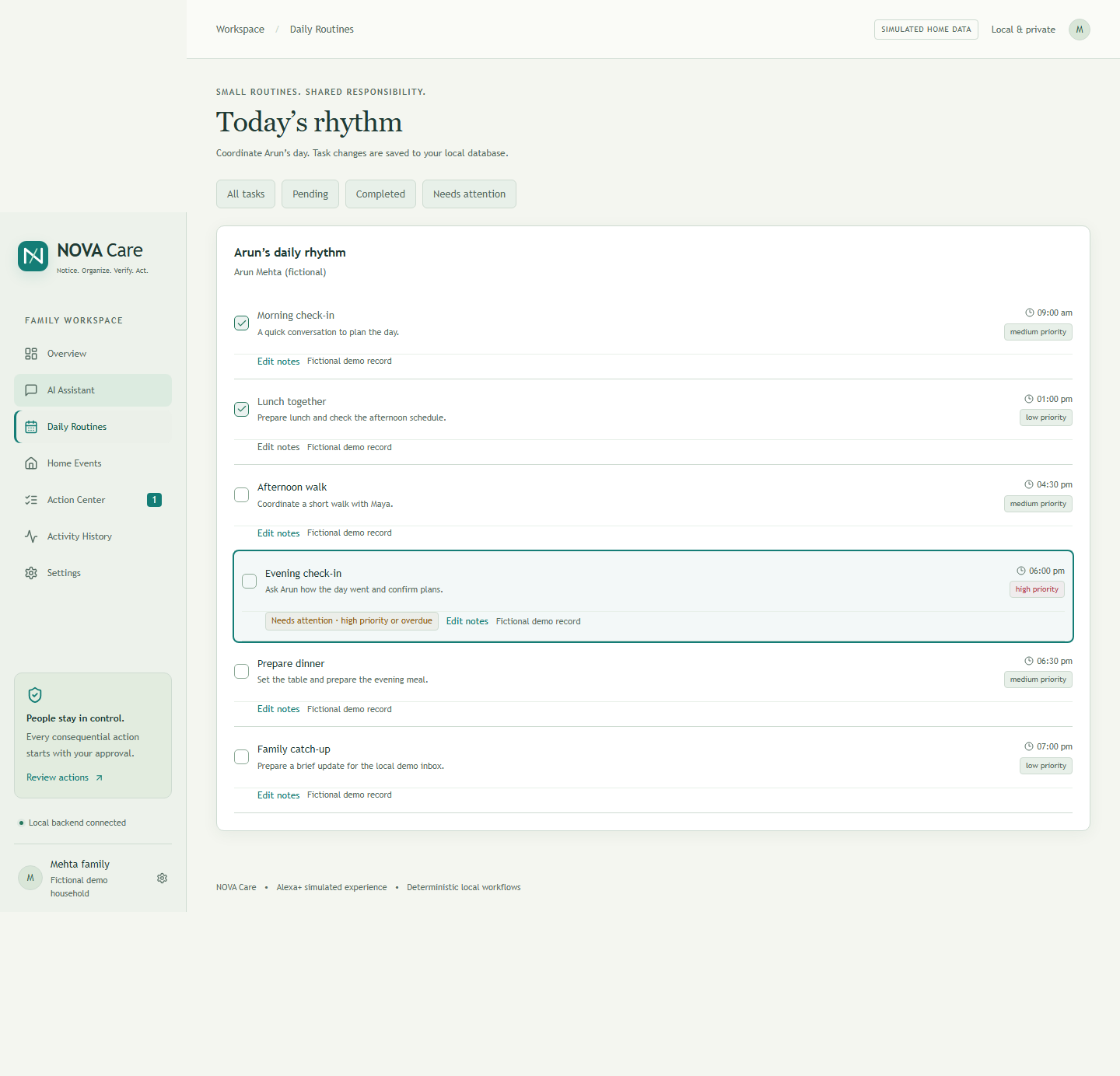
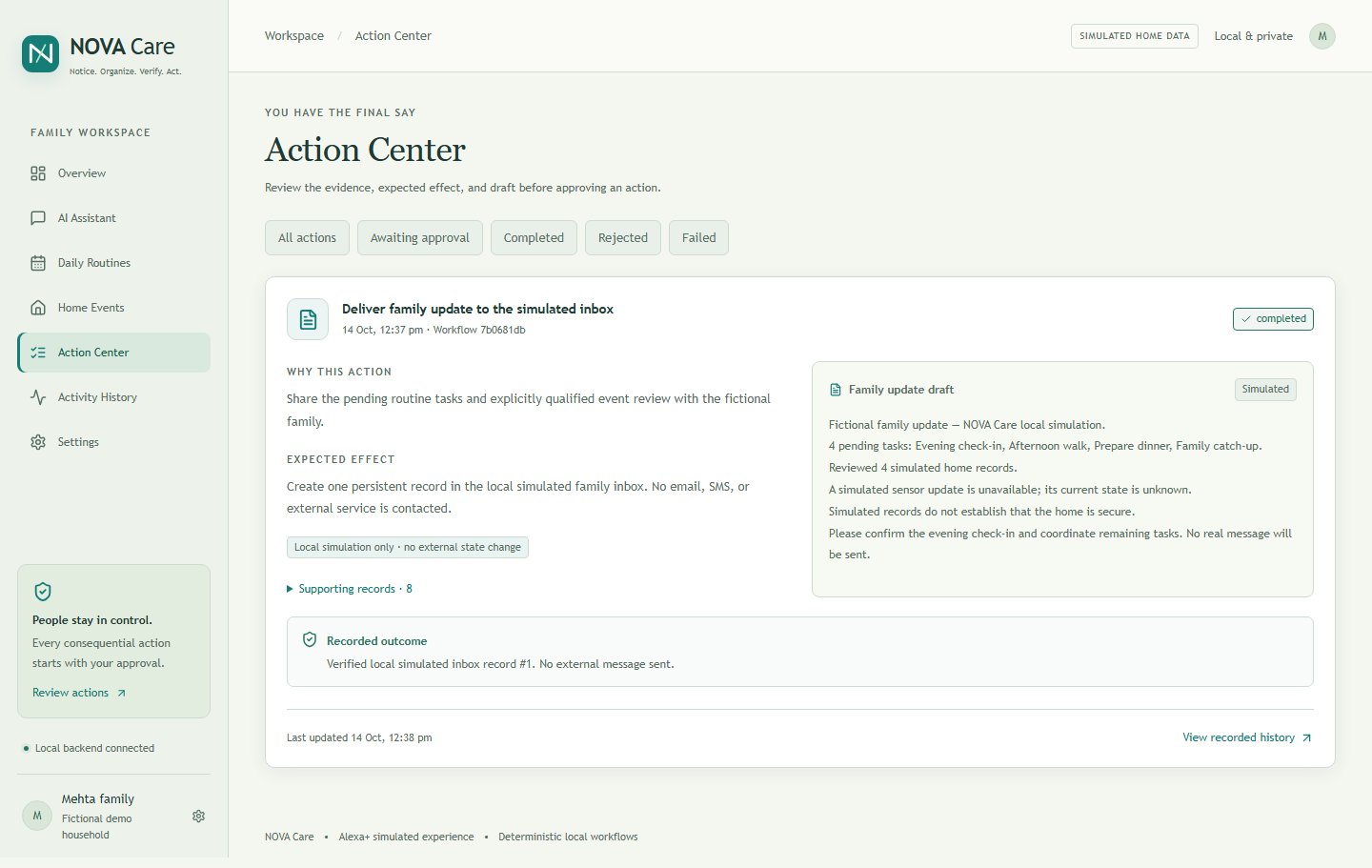
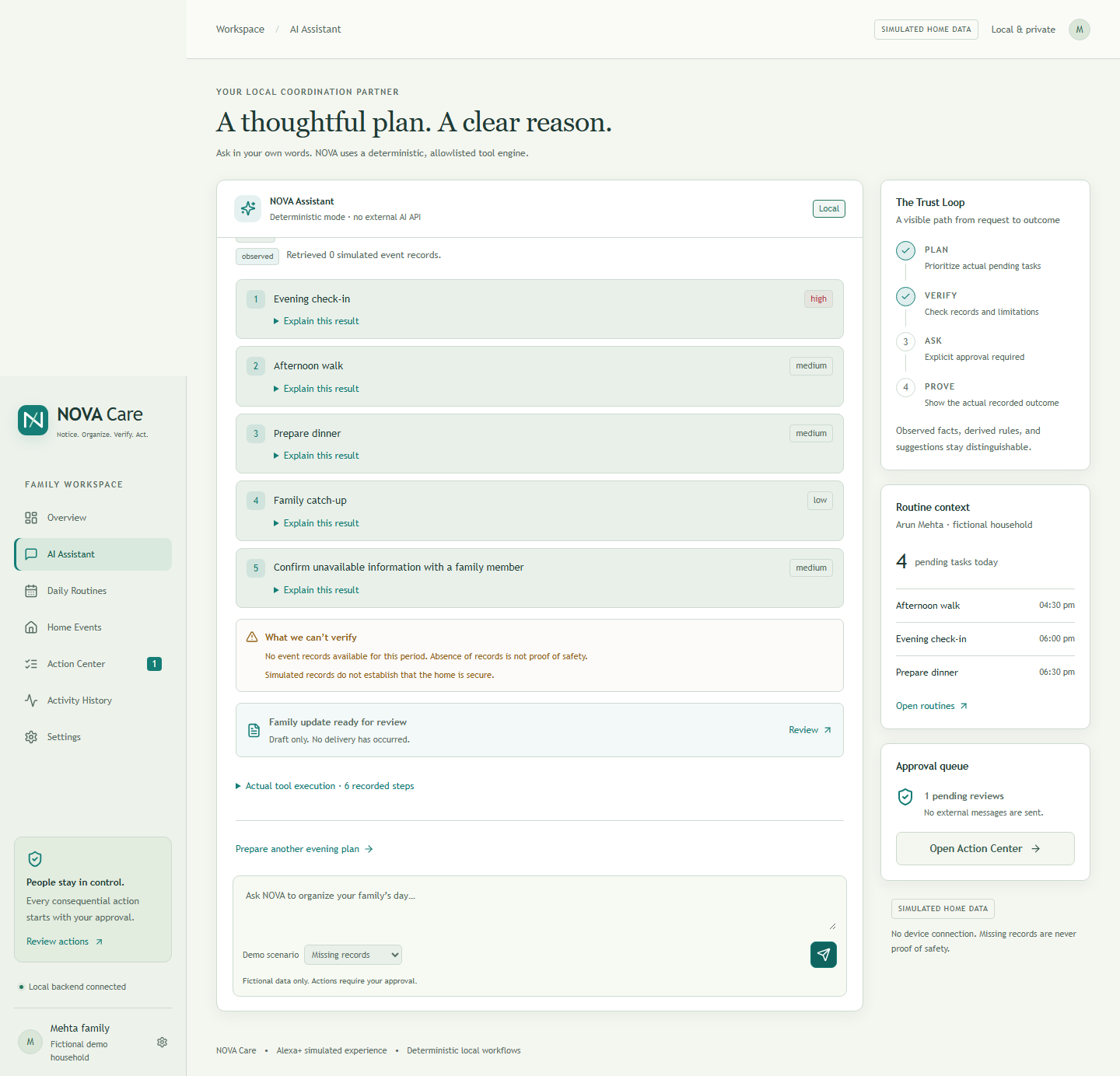
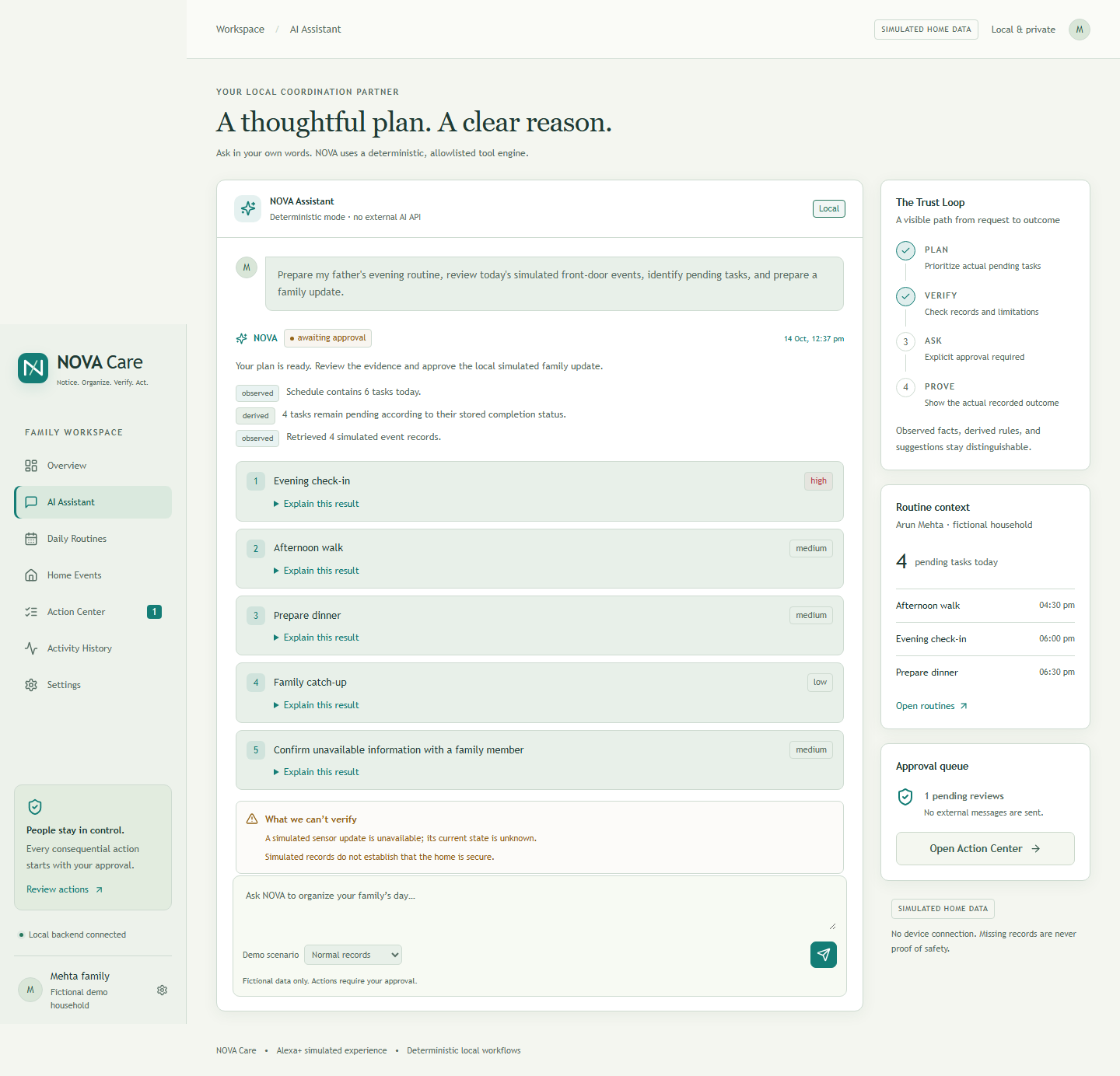
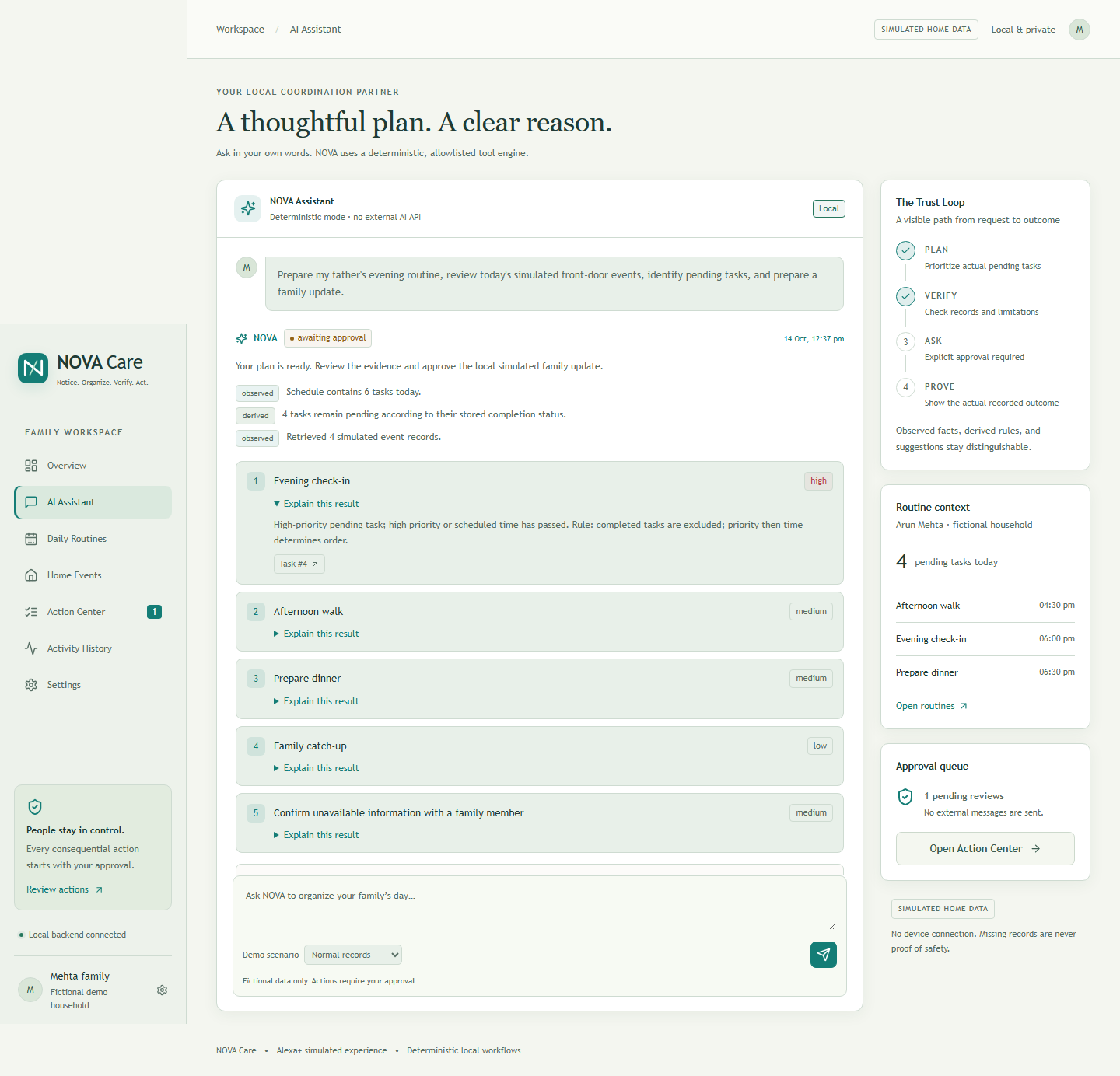
A user can ask it to prepare an evening routine, identify pending tasks, review simulated household events, and draft a family update. NOVA retrieves local records, creates a prioritized plan, explains its reasoning, and presents the update for approval.
Its signature feature is the Trust Loop:
- PLAN: Organize pending tasks into a structured plan.
- VERIFY: Check supporting records and identify missing information.
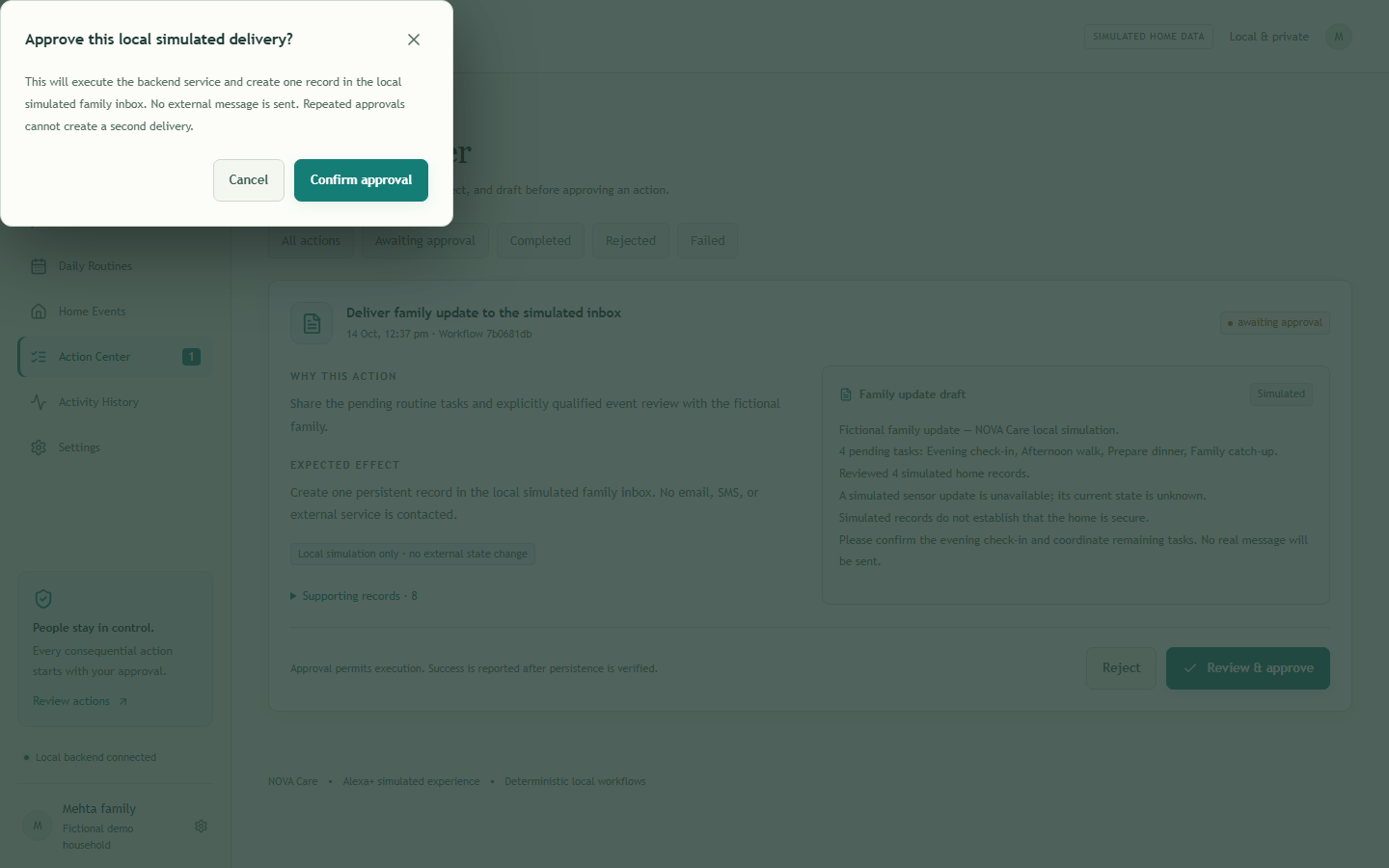
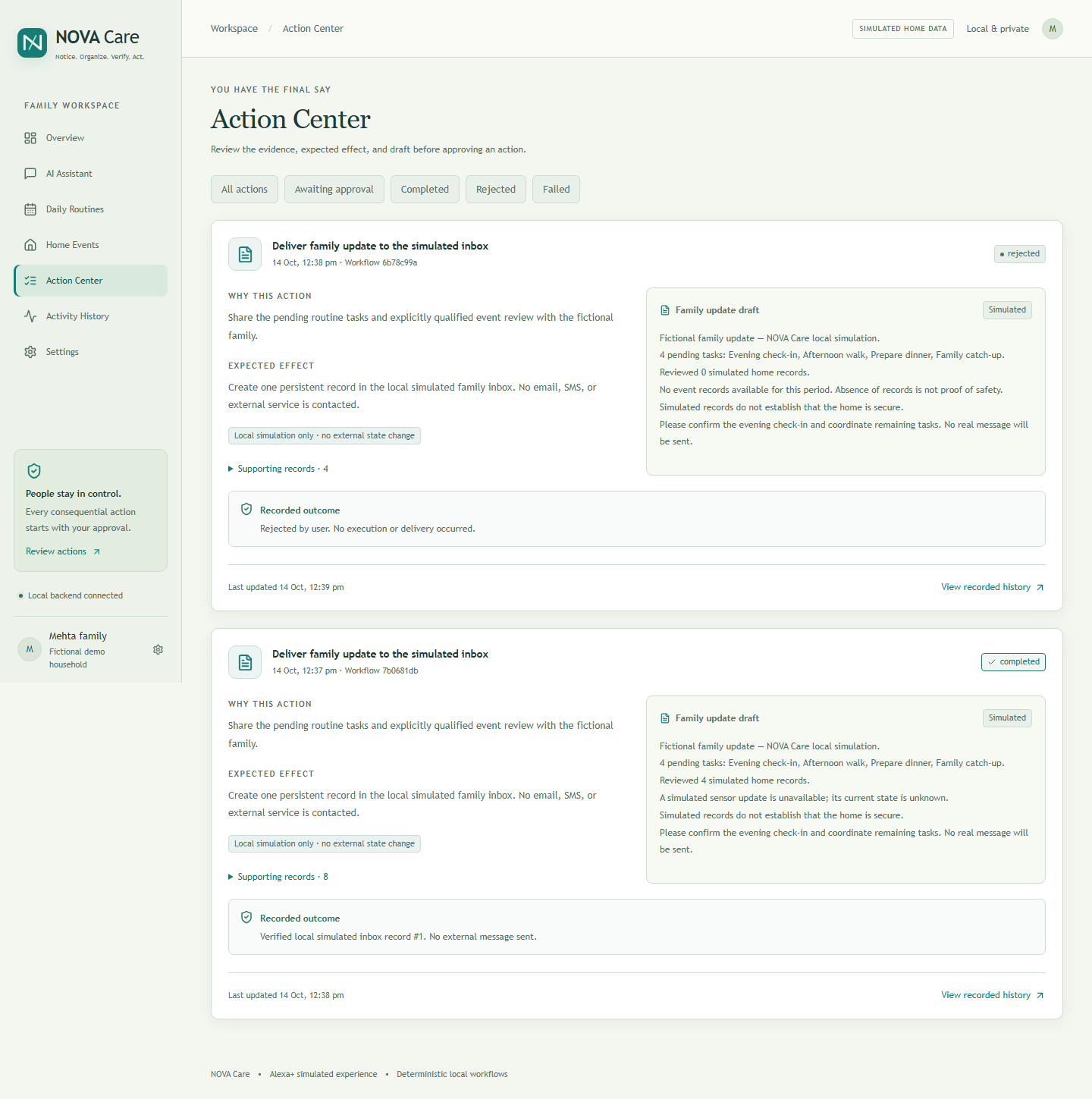
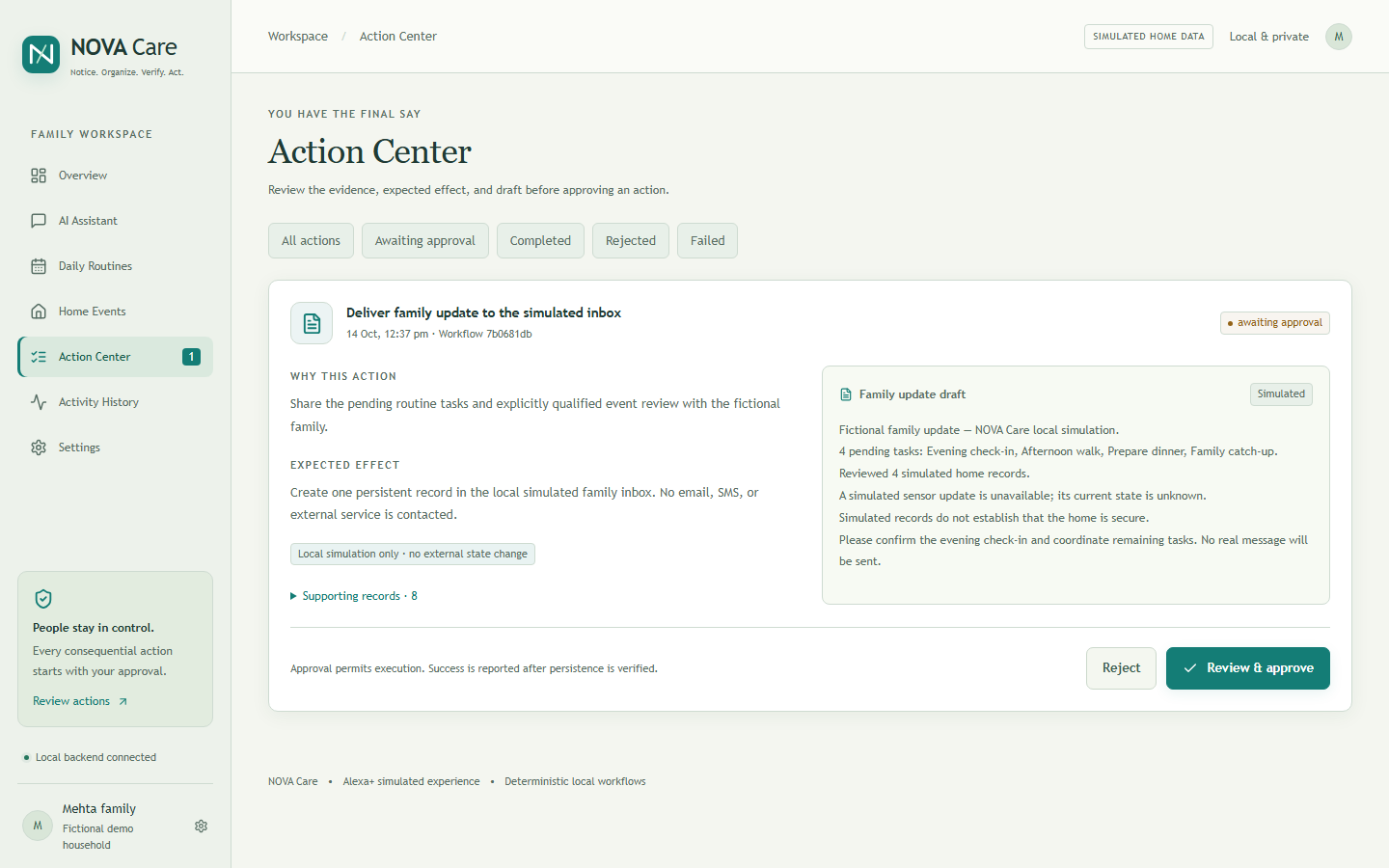
- ASK: Present a reviewable action for explicit approval.
- PROVE: Execute the approved local operation and verify its persisted outcome.
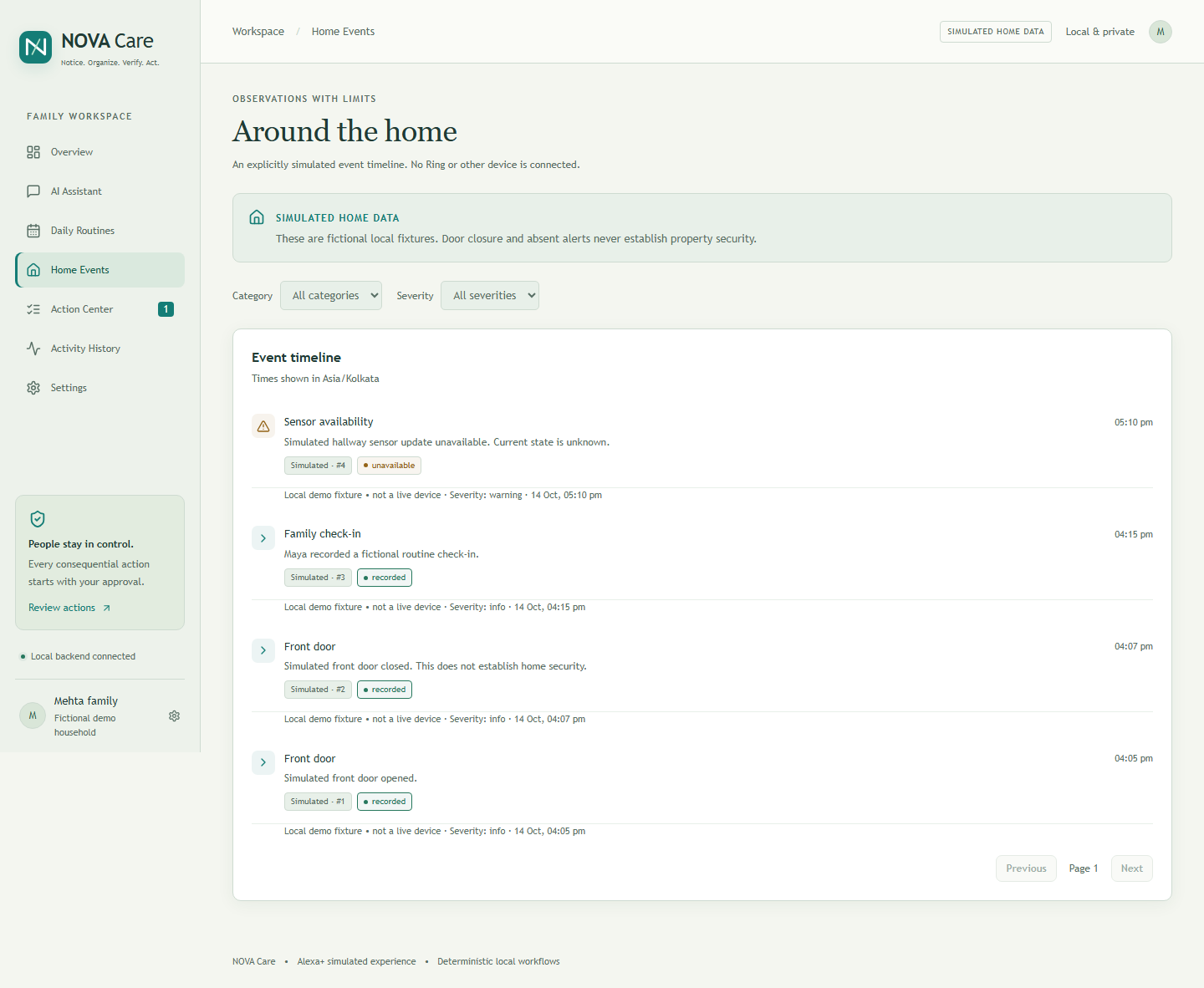
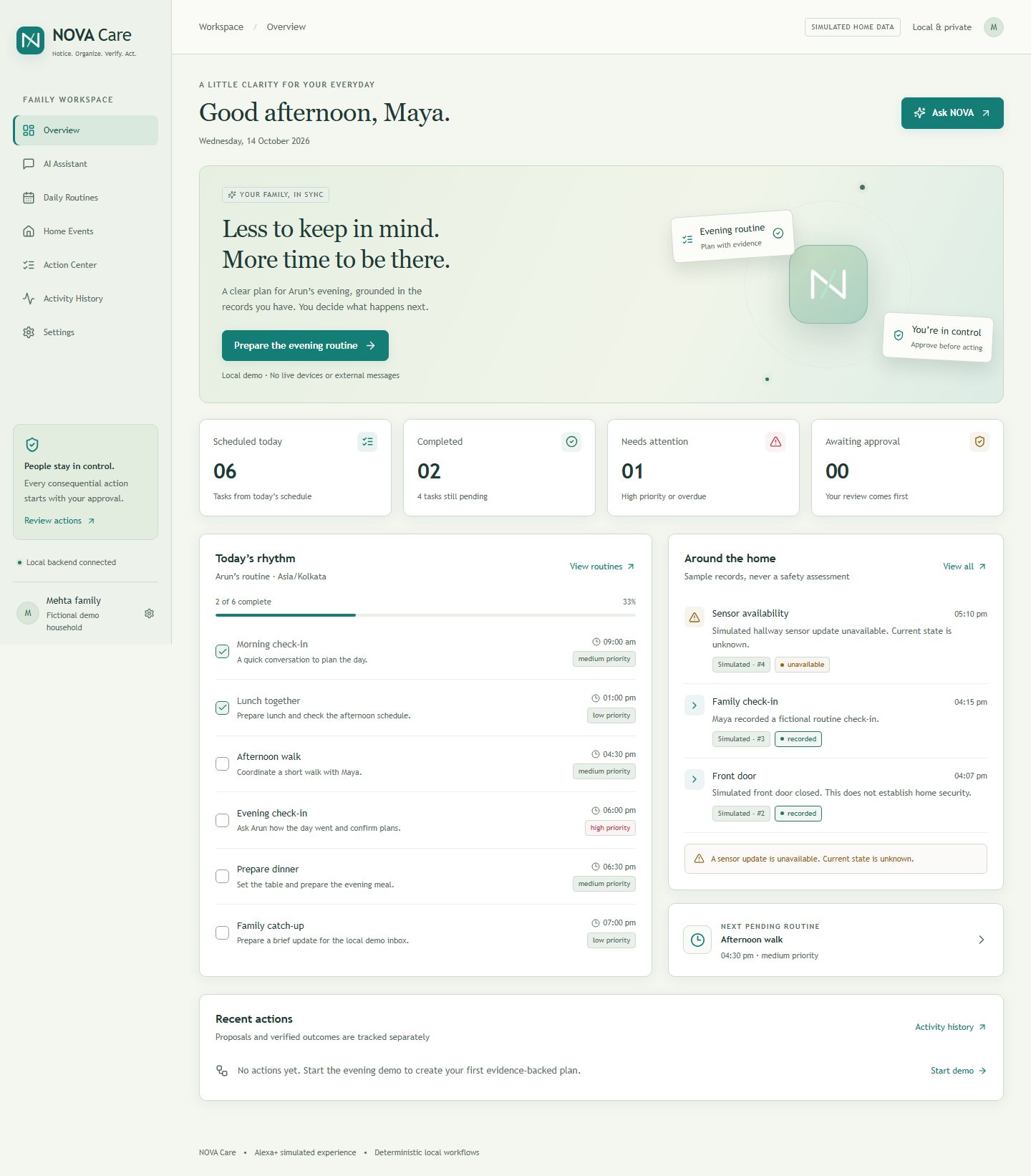
Home events are clearly labeled as simulated. Missing records never become a claim that the home is secure. Family updates are delivered only to a local simulated inbox, with no real messages sent.
How I built it
I built the frontend with React, TypeScript, Vite, Tailwind CSS, React Router, and TanStack Query. The interface brings together routines, conversations, simulated events, approvals, and activity history.
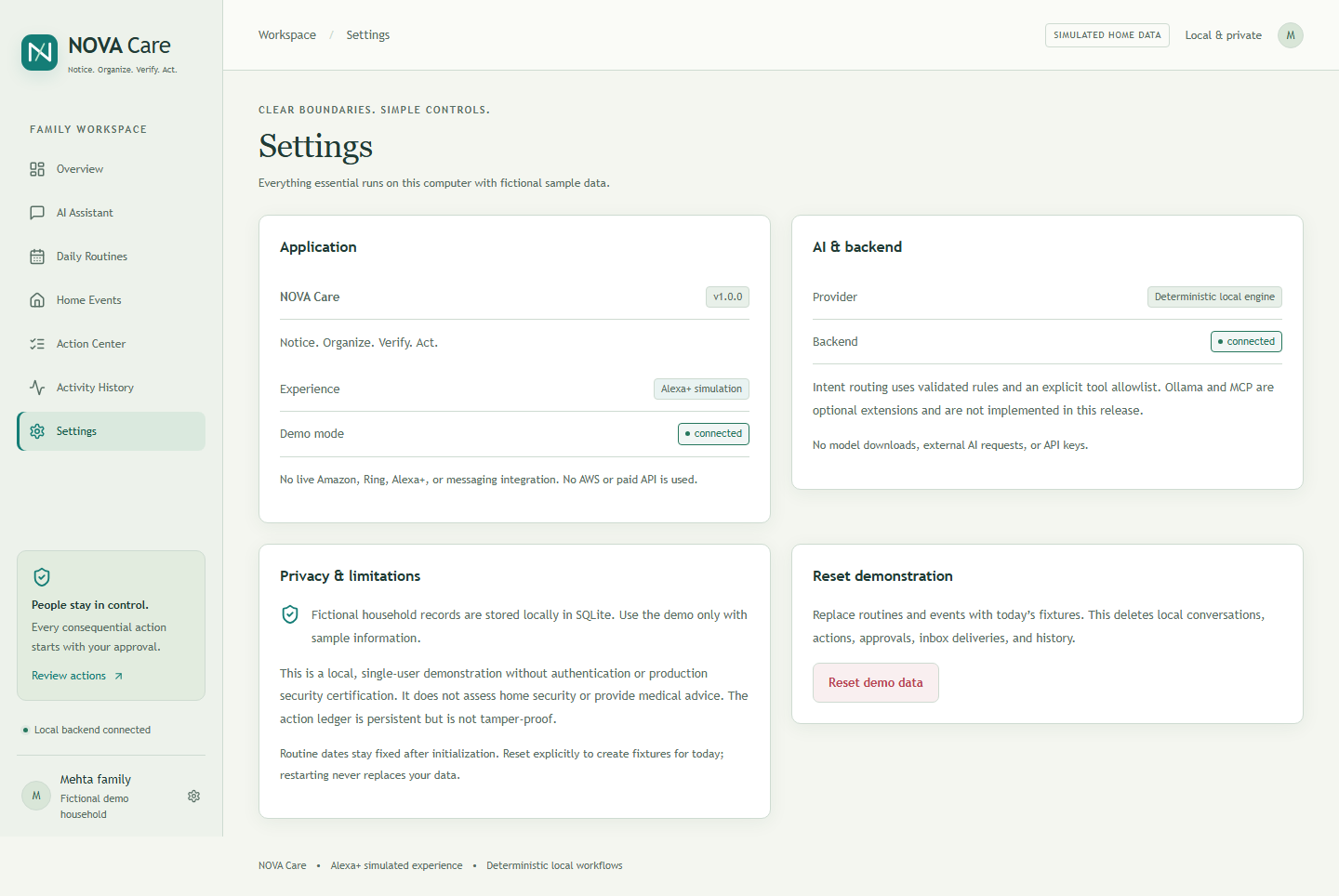
The backend uses Python, FastAPI, Pydantic, SQLAlchemy, and SQLite. A deterministic workflow engine interprets supported requests and calls an explicit registry of validated tools. Essential features work without a language model, external AI API, AWS, or physical hardware.
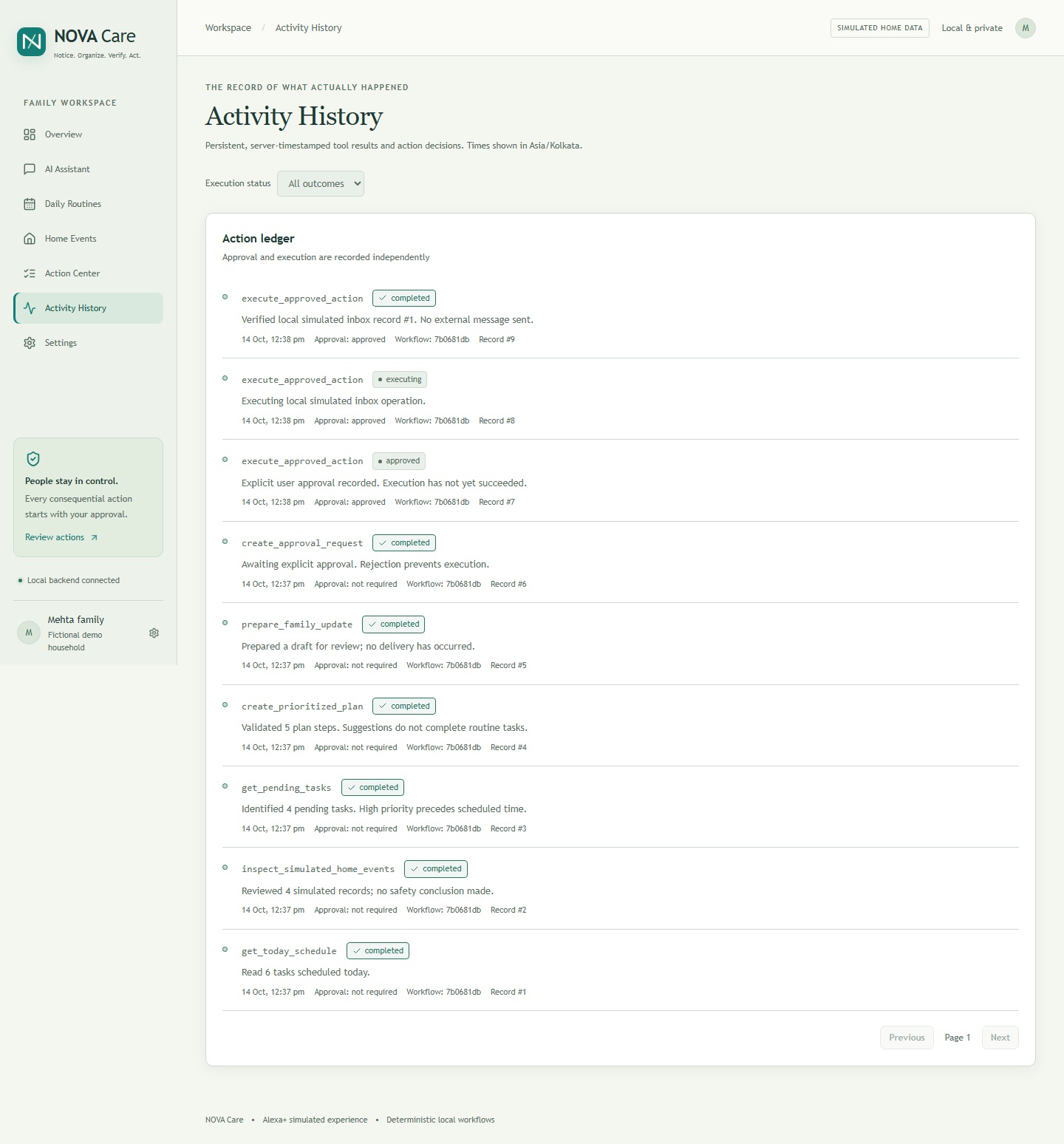
Approval and execution are separate states. SQLite transactions and uniqueness constraints prevent repeated or concurrent approvals from creating duplicate deliveries. An action becomes completed only after its local operation succeeds and persistence is verified.
Challenges I faced
The hardest challenge was making the assistant’s status trustworthy. Preparing a draft, approving it, executing it, and confirming its outcome had to remain distinct throughout the interface and database.
I also needed to handle incomplete information honestly. Missing event records and unavailable sources produce visible limitations or failed tool steps while allowing appropriate planning to continue.
Development brought practical challenges: unavailable command aliases, restricted Windows socket access, dependency installation issues, occupied ports, and browser-test subprocess cleanup. I documented these issues and added reproducible launch scripts and an isolated test launcher.
What I learned
I learned that useful assistant behavior does not always require a language model. A bounded, deterministic workflow can deliver meaningful coordination while remaining understandable and testable.
I also learned that transparency needs concrete support: linked evidence, explicit limitations, separate approval and execution records, and verification of actual outcomes.
Testing failure paths was especially valuable. Rejection, duplicate approval, partial writes, and unavailable tools revealed requirements that a successful demonstration alone would have missed.
Accomplishments
I completed seven responsive application views with persistent routines, conversations, approvals, and history.
A total of 34 automated tests passed: 25 backend tests, 6 frontend tests, and 3 end-to-end browser scenarios. These cover the main demonstration, missing information, rejection, concurrent approvals, failure rollback, and persistence. Production build, type, lint, and formatting checks also passed.
What’s next
I would like to add optional local-model interpretation, a controlled MCP integration, and authenticated multi-user coordination.
The current release remains an explicitly simulated, single-household demonstration. It does not connect to live Alexa+ or Ring devices, assess home security, or provide medical advice.
Built With
- eslint
- fastapi
- git
- lucide-react
- playwright
- prettier
- pydantic
- pytest
- python
- react
- react-hook-form
- react-router
- react-testing-library
- ruff
- sqlalchemy
- sqlite
- tailwind-css
- tanstack-query
- typescript
- vite
- vitest
- zod

Log in or sign up for Devpost to join the conversation.