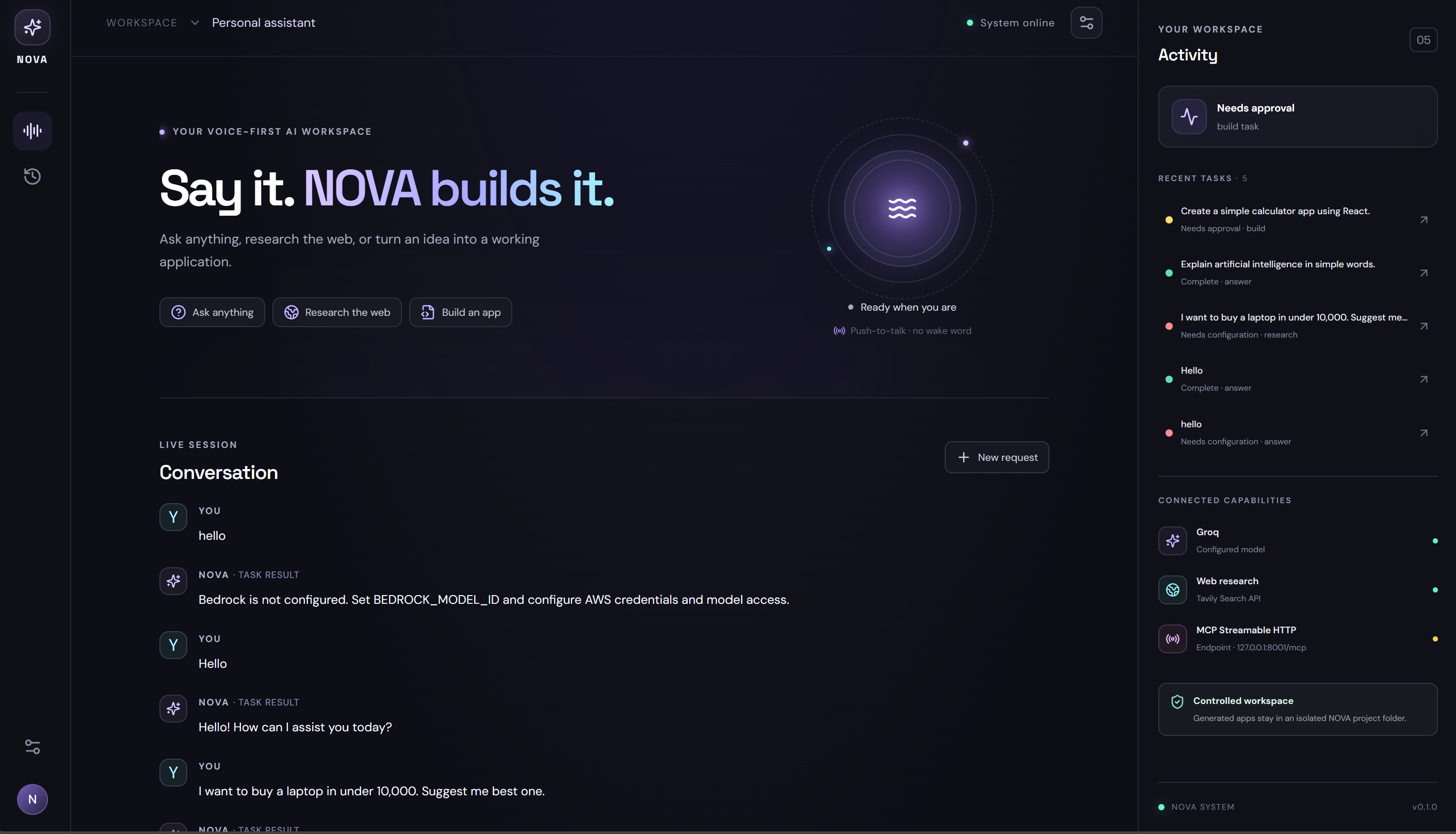
NOVA AI - Say It. NOVA Builds It.
Inspiration
Ideas often start with a simple question: What if I could describe what I want, and an AI assistant could help me make it happen?
We use different tools to ask questions, research topics, and build applications. Switching between them can make even simple tasks complicated. I wanted to explore a more natural experience where users can communicate their ideas through conversation and move from asking questions to creating something useful.
This idea inspired NOVA AI, a voice-first AI assistant designed to bring conversational AI, web research, and application generation into one place.
What NOVA Does
NOVA is built around three core workflows.
Ask: Get AI-generated answers and explanations through a conversational interface.
Research: Search for information and present relevant sources when usable search results are available.
Build: Describe a small application in natural language and generate project files for review.
NOVA also supports browser-based push-to-talk voice interaction and includes a self-hosted Model Context Protocol server designed to expose assistant capabilities through a standard tool interface.
The project explores a simulated conversational assistant experience for the Alexa+ hackathon track. NOVA is an independent project and is not an official Alexa+ integration.
How I Built It
I built NOVA using a frontend, backend, AI provider, and tool integration architecture.
Frontend: React, TypeScript, and Vite provide the interactive user interface.
Backend: Python and FastAPI coordinate AI requests, research workflows, task execution, and project generation operations.
AI Integration: Groq provides the configured language model integration. Amazon Bedrock is retained as an optional provider integration.
Web Research: The search layer uses the configured search provider and includes a fallback path when applicable.
MCP Integration: A self-hosted Python MCP server is designed to expose assistant capabilities to compatible clients through Streamable HTTP.
Persistence: SQLite supports local application data storage.
Project Generation: NOVA can create application files from natural language instructions. Generated projects can be reviewed and run separately, with approval controls intended to protect sensitive operations.
The goal was to keep the architecture modular so that the interface, AI provider, research functionality, and tool integrations could evolve independently.
What I Learned
Building NOVA helped me understand that creating an AI application involves much more than connecting a language model to a chat interface.
During development, I learned about:
- Integrating large language model APIs into a full-stack application.
- Structuring a Python backend using FastAPI.
- Connecting a React frontend to backend services.
- Designing workflows that combine language models with external tools.
- Exploring MCP as a standard interface for AI tool integration.
- Handling search results and source links in research workflows.
- Using browser speech recognition and speech synthesis.
- Generating application files programmatically.
- Designing approval controls for operations that modify files or execute commands.
- Debugging dependencies, environment configuration, and communication between multiple services.
One of my biggest takeaways was that a useful AI assistant must be evaluated as a complete system, not just by the quality of its model responses, but also by its reliability, security, and ability to perform useful actions.
Challenges I Faced
One challenge was coordinating multiple components that run independently, including the frontend, API backend, MCP server, and generated applications. Each component has its own dependencies, configuration, and potential failure points.
Another challenge was making web research useful and trustworthy. Search functionality needs to handle missing credentials, network failures, empty results, and source URLs carefully instead of presenting fabricated information.
Project generation introduced additional challenges. Creating files is only the first step. The generated application must have a sensible structure, valid dependencies, and a practical way to run it. Operations such as installing dependencies or executing commands also require appropriate safeguards.
Finally, I learned the importance of testing. A frontend that loads successfully does not necessarily mean the backend, AI provider, voice interaction, and MCP tools work correctly together. This encouraged me to approach NOVA as a complete application that requires end-to-end verification.
What's Next
My next priorities are to strengthen end-to-end reliability, improve error handling, verify the MCP implementation against the required specification, and make the setup and demonstration process easier for others.
I also want to explore how NOVA's conversational workflows could connect to more capable agentic systems while maintaining clear user approval and control over sensitive operations.
Final Thought
NOVA started with a simple idea: make the journey from an idea to a useful application more conversational.
Say it. NOVA builds it.
Built With
- amazon-web-services
- fastapi
- genai
- groq
- llms
- mcp
- python
- react
- sqlite
- typescript


Log in or sign up for Devpost to join the conversation.