-
-
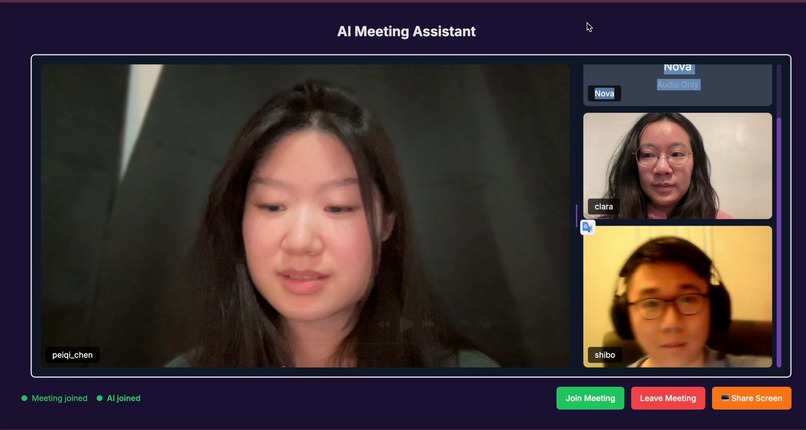
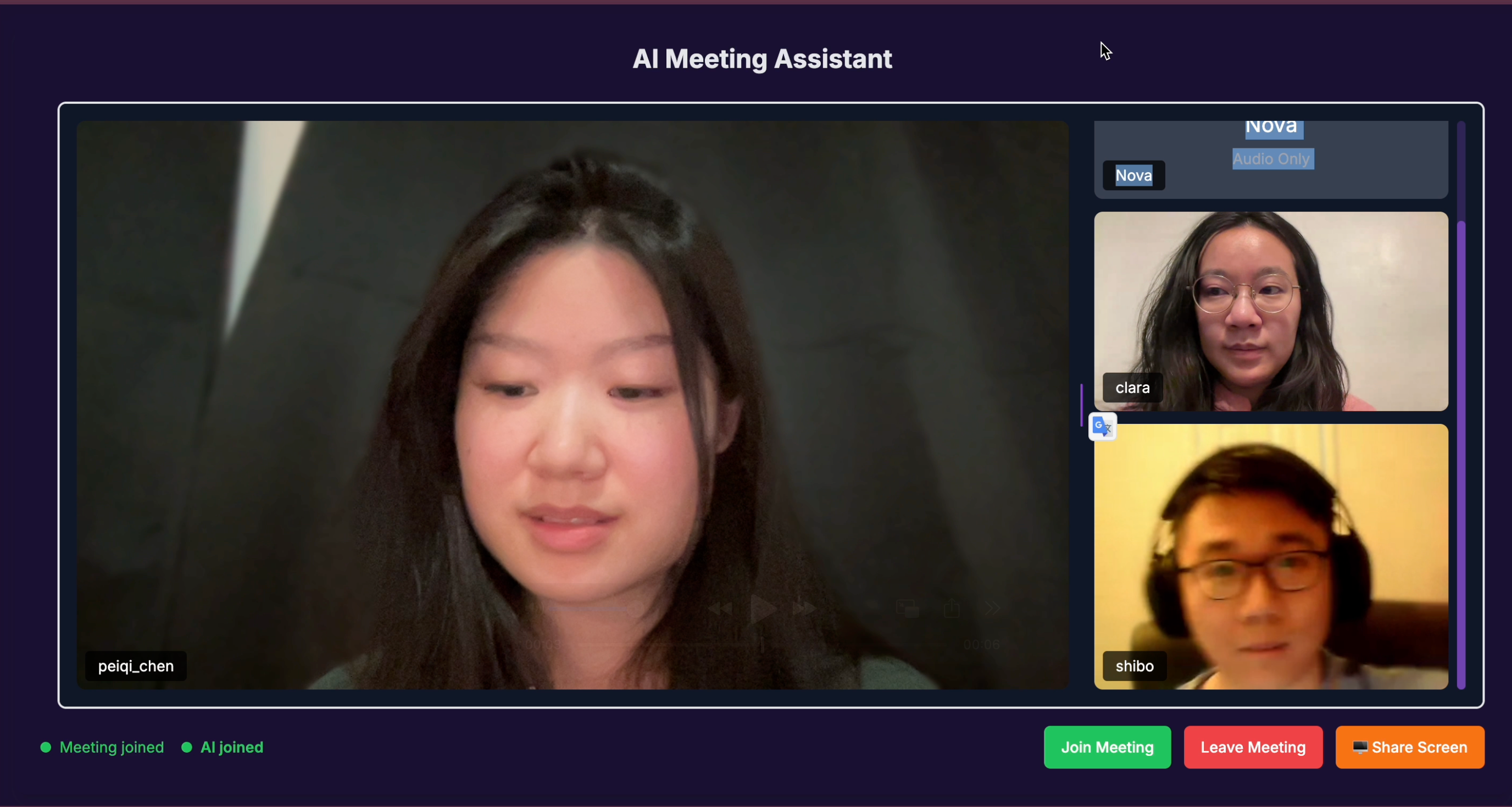
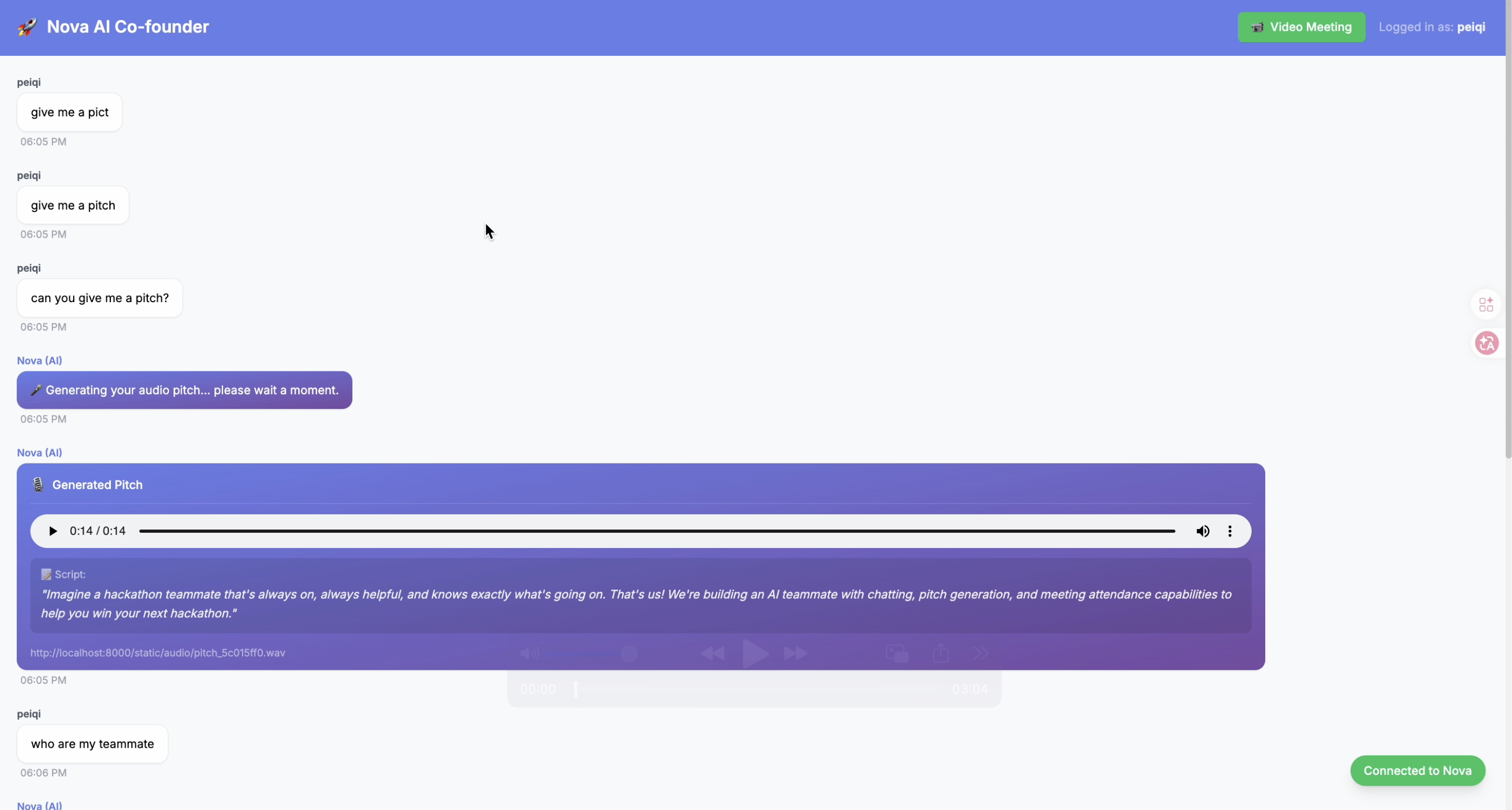
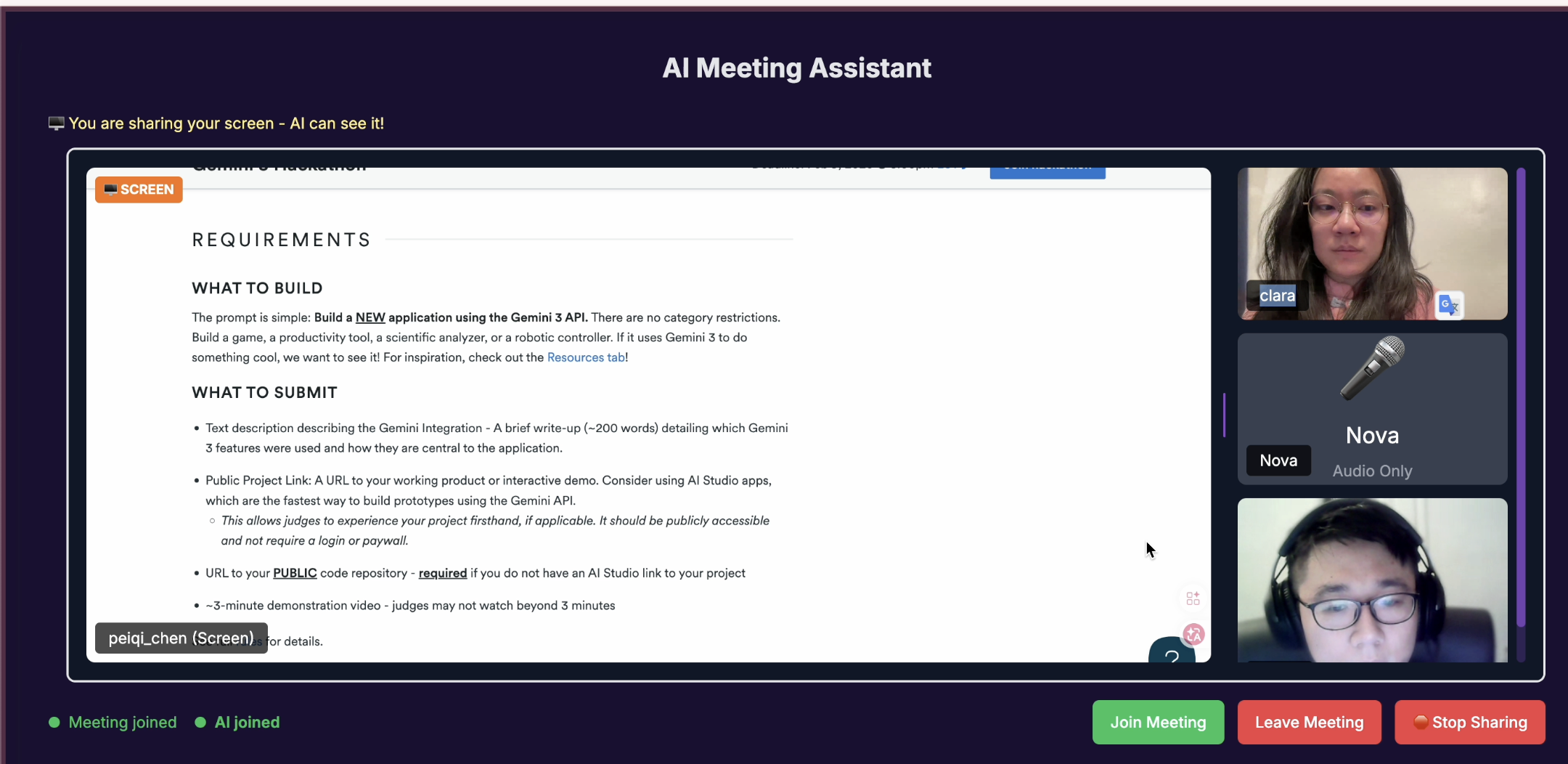
Team meeting with ai temmate
-
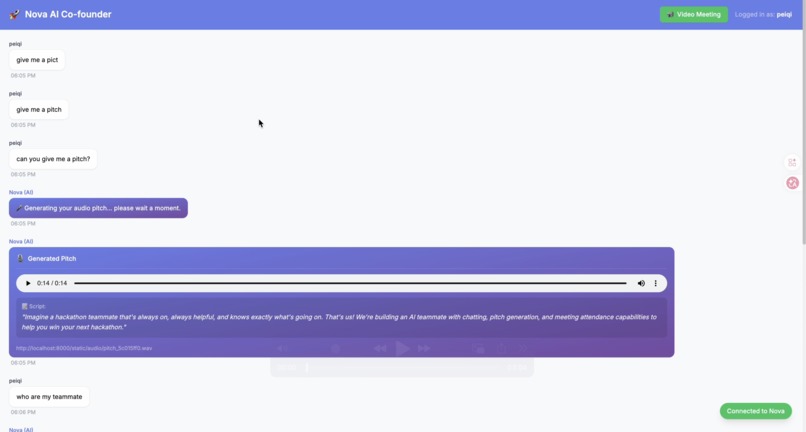
Generate pitch for your project
-
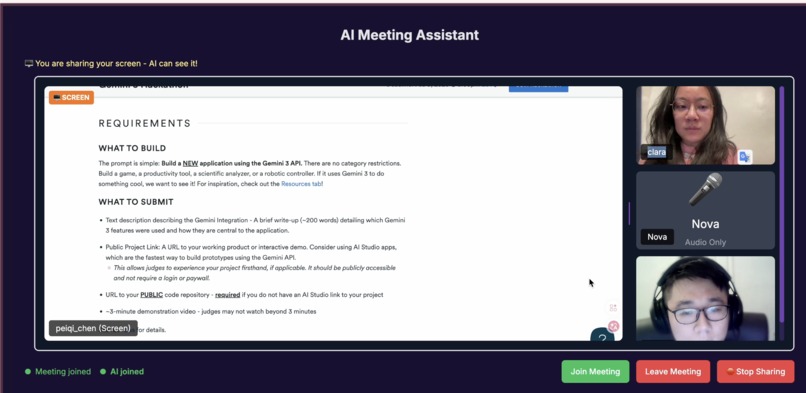
Sharing screen with ai teamate
Inspiration
Hackathons are exciting, but finding the right teammates is often the hardest part. We've all been there — scrambling in a Discord channel, posting "looking for teammates" messages, and hoping someone with complementary skills happens to see it. The result? Mismatched teams, duplicated skill sets, and missed potential. We were inspired by how dating apps use multi-signal matching to connect people, and asked ourselves: what if we could bring that same intelligence to hackathon team formation? We wanted to go beyond simple keyword matching and build something that truly understands what makes a great team — the right balance of technical skills, soft skills, shared interests, and complementary strengths.
What it does
Nova is an AI-powered platform that handles the full hackathon journey — from finding your dream team to building your project together.
- Smart Team Matching: Upload your resume or fill out a profile, and Nova's 5-signal matching engine finds you the most compatible teammates. It doesn't just match on skills — it evaluates skill complementarity, diversity, soft skills balance, interest alignment, and semantic similarity using 3072-dimensional vector embeddings.
- Soft Skills Analysis: Nova uses Gemini AI to evaluate your leadership, collaboration, technical depth, initiative, and communication style, ensuring teams are well-rounded beyond just technical ability.
- Real-Time Team Chat: Once matched, teams get a dedicated chat room with an AI assistant that observes conversations, extracts knowledge, and provides context-aware responses — like having a smart project manager built in.
- Video Meetings with AI Bot: Jump into video calls powered by Daily.co, and activate "Nova" with a wake word for real-time voice assistance. Nova joins your meeting, listens to context, and helps with brainstorming, planning, and decision-making.
- Project Memory: Every conversation is analyzed and stored — decisions, tasks, roles, and key facts are automatically extracted and persisted, so nothing gets lost.
How we built it
We built Nova as a full-stack application with a clear separation between the intelligent backend and a responsive frontend:
- Frontend: Next.js 14 with TypeScript and Tailwind CSS for a smooth, modern UI. We used the Daily.co SDK for video conferencing and native WebSocket for real-time chat.
- Backend: FastAPI (Python) powers the API with async support. SQLAlchemy 2.0 handles database operations with MySQL in production and SQLite for development.
- AI & Matching: Google Gemini 2.0-Flash drives the LLM capabilities — chat responses, soft skills analysis, resume parsing, and tool calling. Gemini-embedding-001 generates 3072-dimension vectors stored in ChromaDB for semantic search. Our custom 5-signal reranking algorithm scores candidates across embedding similarity (20%), skills complementarity (25%), skill diversity (25%), soft skills balance (15%), and interest alignment (15%).
- Meeting Bot: We used the Pipecat framework with Gemini Live for a multimodal voice bot that joins Daily.co meetings, listens for the "Nova" wake word, and responds with context from the team's chat history.
- Infrastructure: Docker Compose orchestrates the full stack (backend, frontend, Nginx), with deployment automated on GCP Compute Engine via a custom script.
Challenges we ran into
- Matching Algorithm Tuning: Getting the 5-signal weights right was an iterative process. Too much emphasis on skill similarity led to homogeneous teams; too much on diversity created teams that couldn't communicate. We spent significant time calibrating the balance.
- Real-Time AI Responses: Handling Gemini API rate limits (429 errors) during active chat sessions required implementing exponential backoff and a 2-second debouncing window to batch messages before triggering AI responses.
- Voice Bot Integration: Getting Pipecat + Gemini Live to work reliably in Daily.co meetings was challenging. Wake word detection, transcription buffering, and managing the bot's lifecycle (active → idle → listening) required careful state management.
- ChromaDB Cloud vs Local: We needed the platform to work seamlessly whether connected to Chroma Cloud or running locally. Building the fallback pattern with lazy initialization solved circular dependency issues but added complexity.
- WebSocket State Management: Keeping chat connections stable, handling reconnections gracefully, and synchronizing in-memory room state with database persistence across multiple concurrent users was a non-trivial distributed systems challenge.
Accomplishments that we're proud of
- The 5-Signal Matching Engine: Our retrieve-then-rerank approach combines vector similarity search with a multi-factor scoring algorithm that produces genuinely well-balanced teams. It's not just matching — it's team optimization.
- Seamless AI Integration: Nova's AI assistant doesn't just respond to prompts — it observes conversations, extracts knowledge, builds project memory, and provides contextually rich responses. It feels like a real team member.
- Voice-Activated Meeting Bot: Saying "Hey Nova" in a video call and getting an intelligent, context-aware voice response that references your team's actual discussion is a magical experience.
- End-to-End Flow: From registration to profile creation to team matching to collaboration — the entire hackathon team journey works in a single platform with no context switching.
- Dual Memory Architecture: The knowledge + cognition dual-store system in ChromaDB means every decision, task, and insight from team conversations is preserved and retrievable, giving teams persistent project memory.
What we learned
- Multi-signal matching beats single-metric approaches: Combining semantic similarity with structured scoring (complementarity, diversity, soft skills) produces dramatically better team compositions than any single signal alone.
- AI works best as an observer, not just a responder: Having the AI passively extract knowledge from conversations and build context over time creates far more useful assistance than simple prompt-response interactions.
- Graceful degradation is essential: Building fallback patterns (Gemini → gTTS for audio, Chroma Cloud → local ChromaDB, AI scoring → heuristic scoring) made the platform resilient and testable across environments.
- Real-time systems require careful state management: WebSocket connections, in-memory caches, database persistence, and vector stores all need to stay synchronized — and handling edge cases (disconnections, race conditions, stale state) is where most of the complexity lives.
- Pipecat + Gemini Live is powerful but emerging: The multimodal bot framework is incredibly capable but required creative workarounds for production reliability, especially around audio pipeline management and context injection.
What's next for Nova AI
- AI Real-Time Strength Analytics: Continuously analyze user behavior across chat conversations, meeting participation, and project contributions to dynamically update internal strength scores (leadership, collaboration, technical depth, initiative, communication). Unlike static profile-based scoring, this living data evolves with every interaction — making it the most valuable and profitable asset of the entire platform. Over time, Nova builds the richest dataset of verified hackathon talent, enabling premium features like talent scouting for companies, skill-verified developer profiles, and predictive team performance modeling.
- Expanded Matching Signals: Incorporate timezone compatibility, availability windows, and past hackathon performance data into the matching algorithm.
- Post-Hackathon Analytics: Generate team performance reports, contribution summaries, and retrospective insights from the project memory store.
- Multi-Hackathon Support: Allow organizers to create hackathon events with custom matching criteria, team size constraints, and themed skill pools.
- Improved AI Bot: Add screen understanding capabilities so Nova can see what teammates are sharing and provide visual context in responses. Expand beyond voice to support text-based meeting assistance.
- Mobile Experience: Build a responsive mobile interface so teams can collaborate on the go — quick chat, meeting join, and match notifications from anywhere.
- Integration Ecosystem: Connect with GitHub for repo creation, Devpost for submission tracking, and Slack/Discord for notifications — making Nova the central hub for the entire hackathon workflow.
Built With
- chroma
- gemini
- pipecat
- python
- typescript


Log in or sign up for Devpost to join the conversation.