-
-
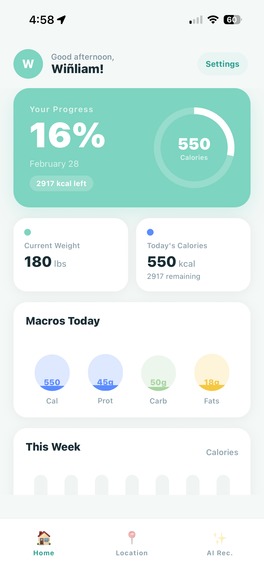
Nourish Home Page
Inspiration
Our inspiration for Nourish came from the challenge of maintaining healthy habits while living a fast-paced, on-the-go lifestyle. As students and busy individuals, we often found it difficult to make food choices that aligned with personal health goals when eating out. Many existing food apps focus on convenience or reviews, but very few help users make decisions based on nutrition, wellness goals, and real-time location.
What it does
Nourish is a mobile application that helps users find nearby food options that align with their personal health and nutrition goals.
Using integrations with Gemini AI, Google Places API, and Geocoding services, the app: Detects nearby restaurants based on the user’s location -Analyzes available food options -Generates personalized meal recommendations tailored to user goals (such as healthier eating, balanced nutrition, or lifestyle preferences) -Suggests specific menu items instead of just restaurant locations
In addition, Nourish allows users to track daily food intake and water consumption, helping them stay accountable and aware of their habits throughout the day. By combining location intelligence with AI-powered recommendations, the app turns everyday food decisions into goal-oriented choices.
How we built it
We built Nourish using React Native with Expo, allowing us to rapidly develop a cross-platform mobile application during the hackathon timeframe.
Our development process included: -Designing the mobile interface using React Native components -Implementing location services to retrieve user coordinates -Integrating Google Places and Geocoding APIs to identify nearby restaurants -Connecting Gemini AI to analyze user goals and generate intelligent meal suggestions -Building tracking systems for food intake and water consumption -Implementing map functionality with navigation support through Google Maps Expo enabled fast iteration, live testing, and efficient collaboration among team members, allowing us to focus on both functionality and user experience.
Challenges we ran into
One of our biggest challenges involved securely integrating external APIs. GitHub prevented us from hardcoding API keys into the repository due to security risks, which initially caused issues with deployment and testing.
To solve this, we had to quickly learn and implement secure key management practices, including environment variables and alternative configuration methods. This required us to rethink our architecture mid-development while ensuring the app remained functional.
Additionally, working with multiple APIs simultaneously introduced challenges related to data formatting, asynchronous requests, and coordinating responses between location services and AI-generated outputs. Debugging these integrations under time pressure pushed us to improve our teamwork and problem-solving skills.
Accomplishments that we're proud of
We are especially proud of successfully building a fully functional, AI-powered mobile application within a hackathon timeframe.
Key accomplishments include: -Implementing an interactive map that identifies nearby food locations in real time -Enabling seamless navigation by linking directly to Google Maps directions -Integrating AI to generate personalized menu recommendations aligned with user goals -Creating a working food and water intake tracking system -Learning and applying an entirely new mobile development framework as a team Most importantly, we transformed an idea into a usable product that demonstrates real-world potential and scalability.
What we learned
This project was every team member’s first experience using React Native with Expo, making the hackathon a hands-on crash course in mobile development.
We learned: -Fundamentals of cross-platform app development -API integration and managing asynchronous data flows -Secure handling of API credentials -Rapid prototyping and iterative design under time constraints -Effective collaboration and division of responsibilities in a technical team Beyond technical skills, we learned how quickly ideas evolve during development and how adaptability is essential when building real products.
What's next for Nourish
Our vision for Nourish extends far beyond the hackathon prototype. Moving forward, we plan to: -Improve AI responsiveness and recommendation accuracy -Personalize suggestions using user behavior and historical data -Expand dietary goal options (fitness goals, dietary restrictions, allergies, etc.) -Enhance UI/UX for smoother onboarding and tracking experiences -Build a scalable backend to support real user accounts and saved progress -Incorporate user feedback to guide feature development Ultimately, we aim to evolve Nourish into a smart nutrition companion that proactively helps users make healthier decisions wherever they are — turning everyday eating into a personalized, goal-driven experience.

Log in or sign up for Devpost to join the conversation.