For judges: models during judging. We built Understudy on Nemotron 3 Nano and Nemotron 3 Super, which Nebius Token Factory retires on 9 November 2026, before judging. The NASA samples replay the runs we recorded on them and need no model. Everything live runs on the Nemotron models that stay: Nemotron 3.5 Lightning, Nemotron 3.5 Super VL and, for a stuck patch loop, Nemotron 3 Ultra; the samples' similar tasks were run on them too. We have not been able to test these newer models as fully, but how well the earlier ones did is a good sign. If a model is gone when you try, each step says so and plays its recording.
Inspiration
On a space station, the scarce resource is the astronaut's hour. NASA's pricing policy values one hour of ISS crew time at $130,000 for commercial activities. The robots meant to take over routine crew work need three things a station already produces: a clear task, a rehearsed program, and labelled data. Crews are filmed doing procedures all the time.
On the ground the problem is the same, only cheaper per hour. Teaching a robot is expensive (NVIDIA's GR00T N1 took about 50,000 H100 GPU-hours to pretrain), and much of the waste comes after collection. In the DROID dataset, about one recorded demonstration in six was marked failed. One vendor's cost model puts re-collection after the first policy test at 30 to 50% of the original budget. And nobody asks the person who did the task what mattered.
Understudy started as a month of research into that gap. The hackathon week is where it became software.
What it does
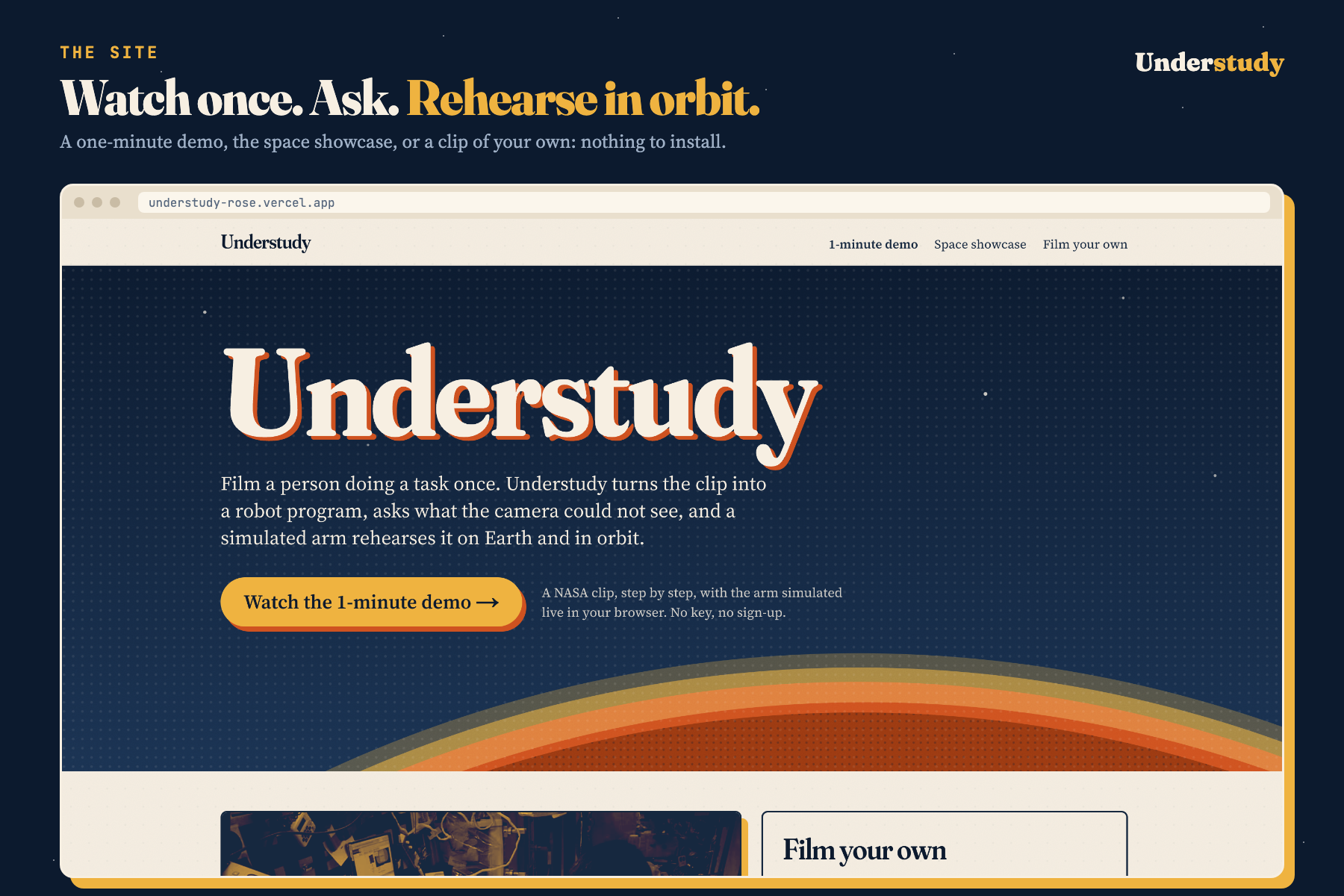
Understudy turns one clip of a person doing a task into a robot program that has been rehearsed, on Earth and in orbit, before anyone pays for a robot or a data campaign. The site has three doors.
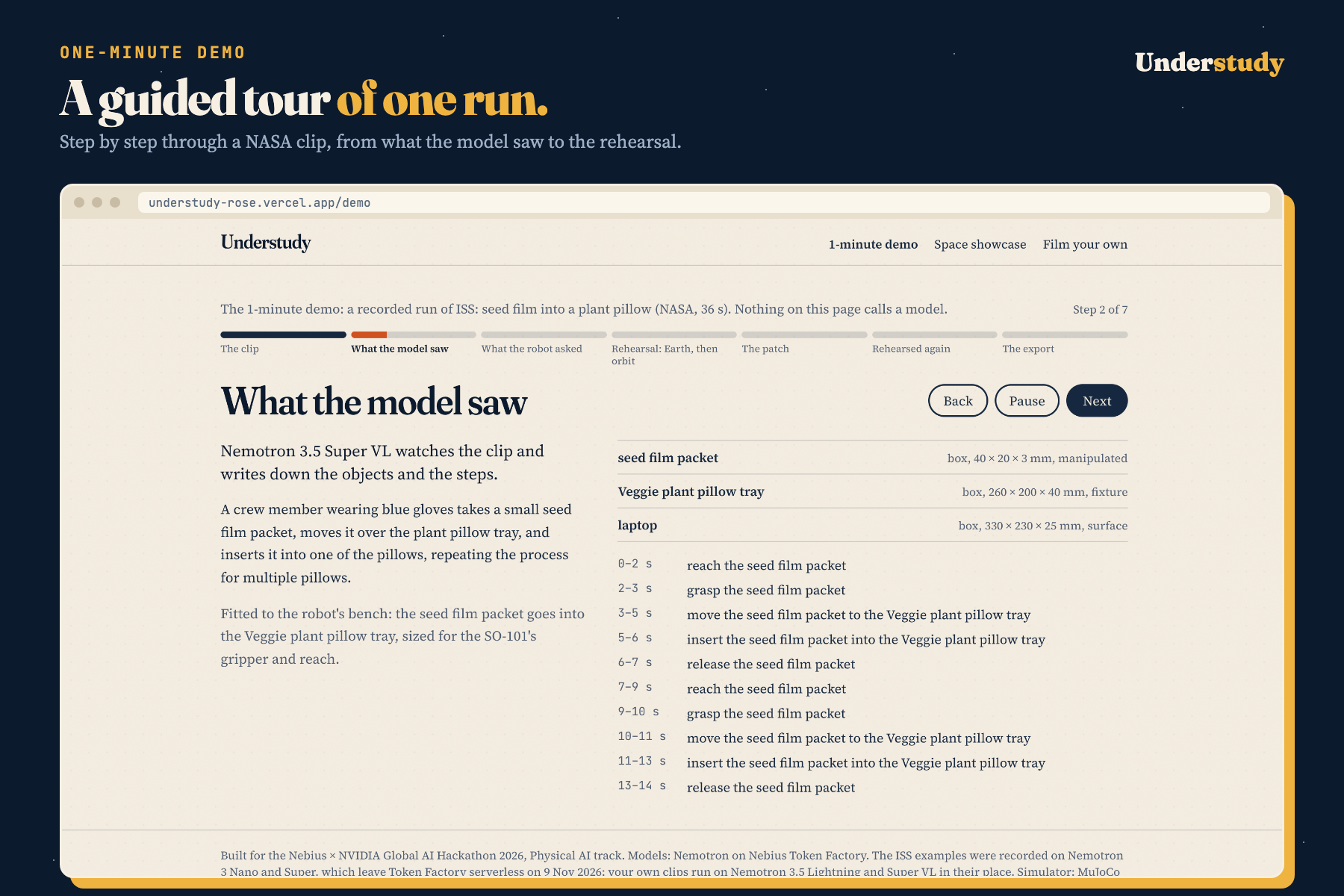
One-minute demo. A guided tour of one recorded NASA run, step by step, with the arm rehearsing live in your browser and no model call. Its last step downloads that run as a LeRobot v2.1 skeleton in the layout GR00T reads: joint values, no video, format-valid but not training data, and not yet checked with GR00T's loader.
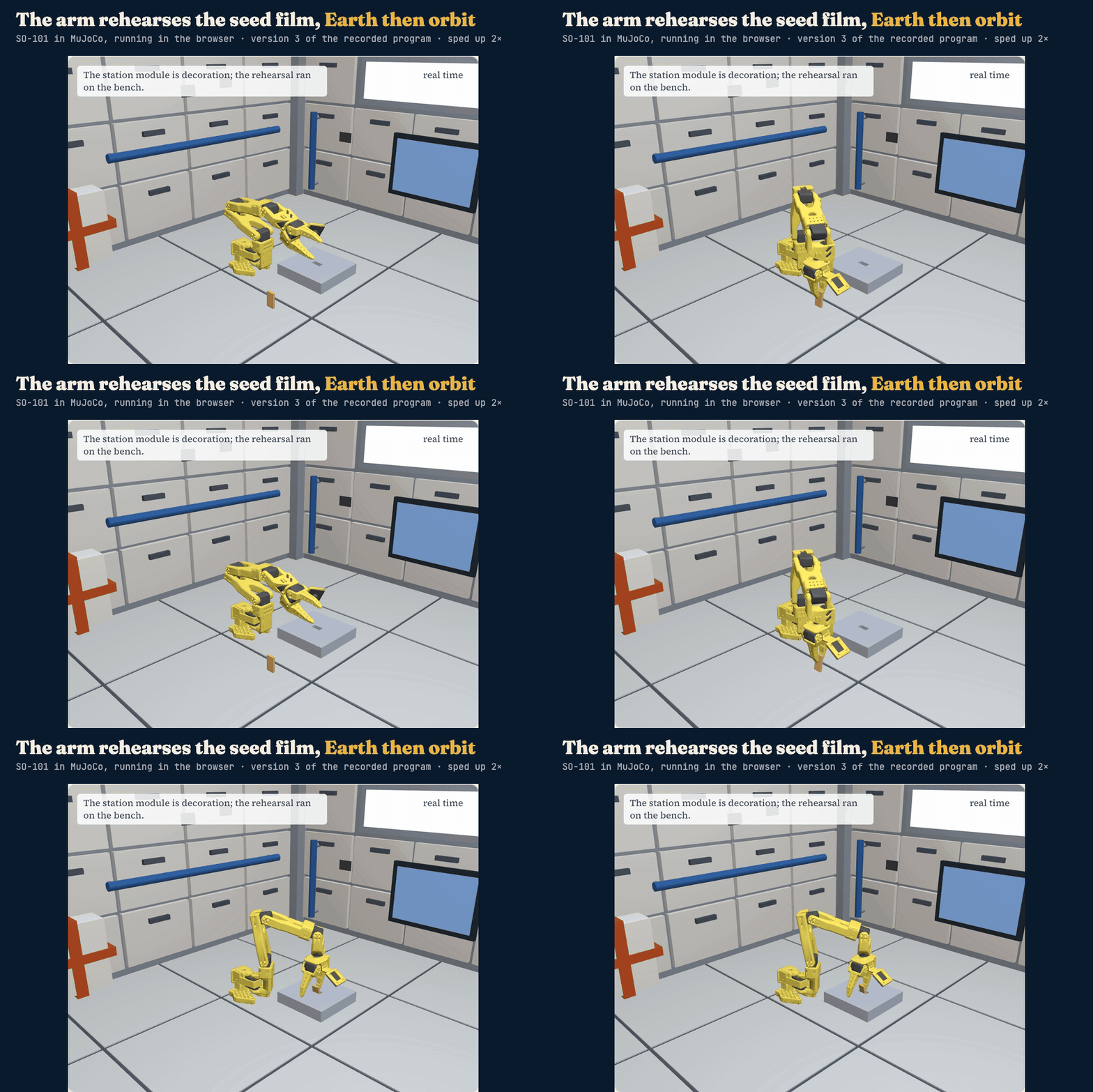
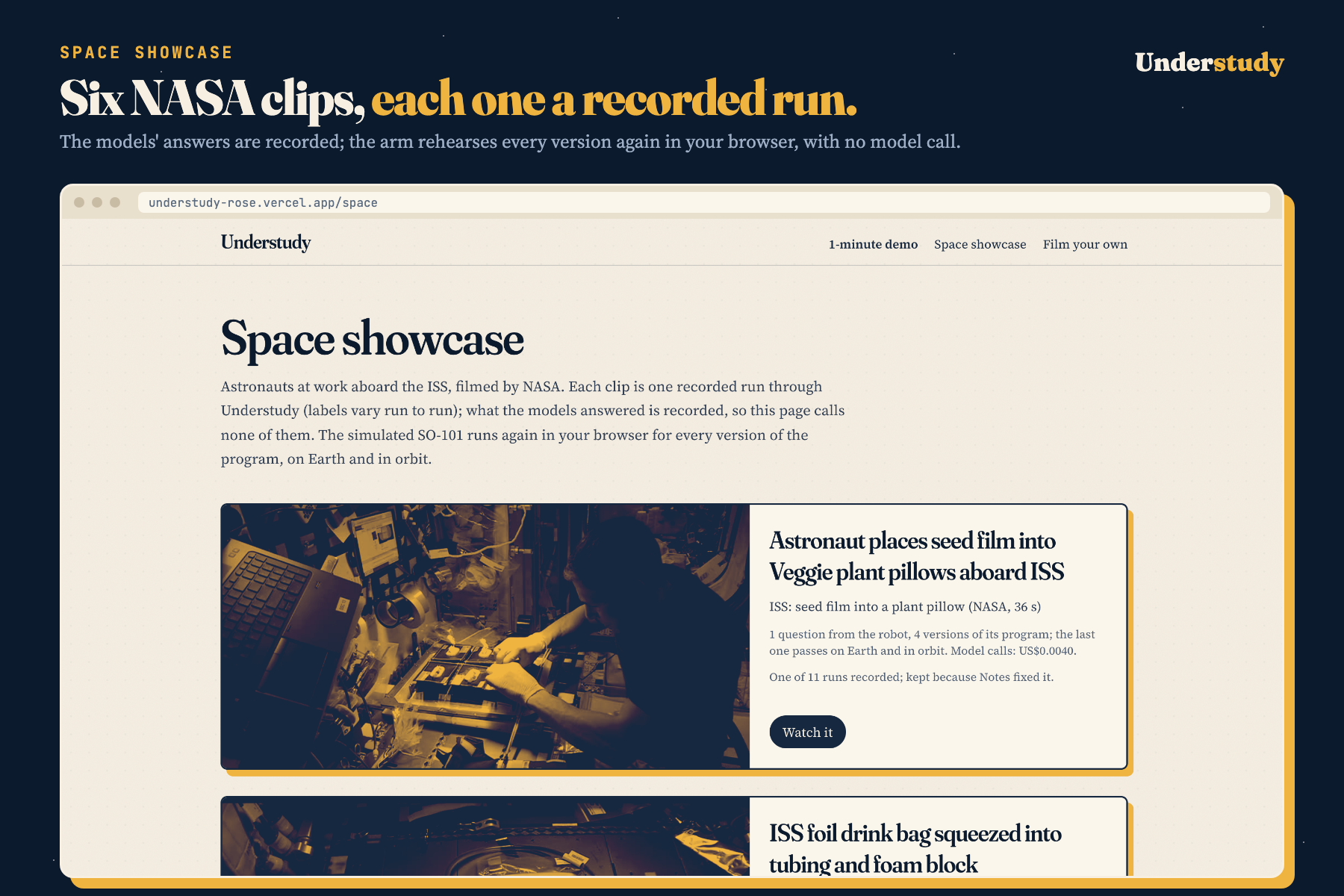
Space showcase. Six NASA clips of astronauts at work on the ISS: seed film into the Veggie plant pillows, a pipette into a sample cartridge, a drink bag squeezed into foam, chess, a wave to the camera. Each one is a recorded run through Understudy: what the model saw, the robot's questions, every version of the program and how it improved. The model answers are recorded; the simulated arm runs again in your browser, at 2× speed, on the bench, in a station module or on a kitchen counter. A button on each run page scores every version of its program under the same twelve perturbations, blind and sensed, on Earth and in orbit, after a baseline written by fixed rules with no model.
Film your own. Pick an ISS sample (it plays its recording in under a second, its similar tasks too: they were run ahead of time), upload an MP4 or an iPhone .MOV, or film yourself for 8 seconds (both with the consent box ticked). Each step says what it is doing and how long it usually takes.
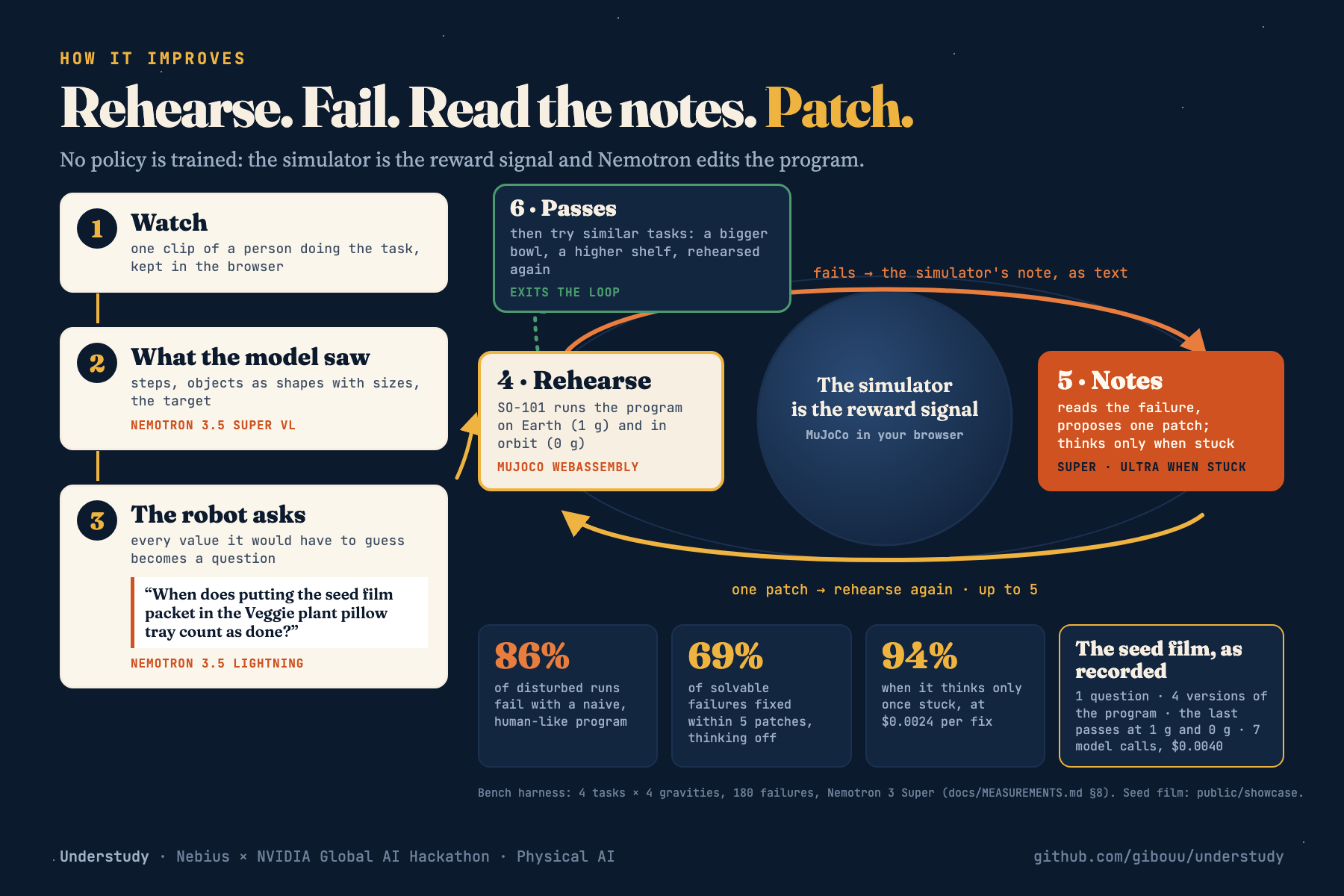
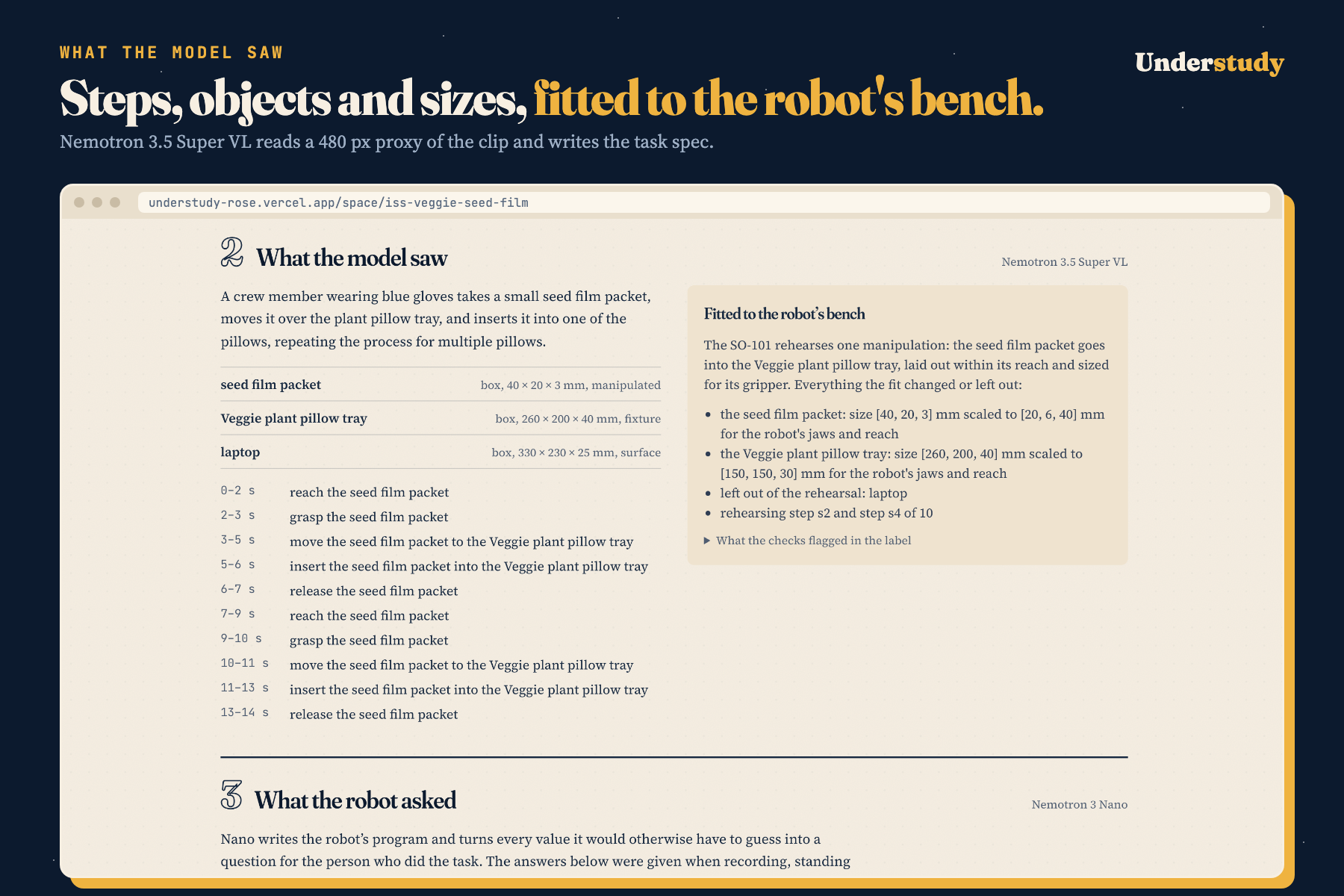
- What the model saw. The browser makes a small proxy of the clip (480 px wide, 4 fps), and Nemotron 3.5 Super VL labels the task: the steps, the objects as simple shapes with sizes, and the target (a pocket, a zone or a stack). A one-line hint says what the person is doing.
- Fitted to the robot's bench. The spec is scaled to what a SO-101 arm can reach, with a report of what was changed.
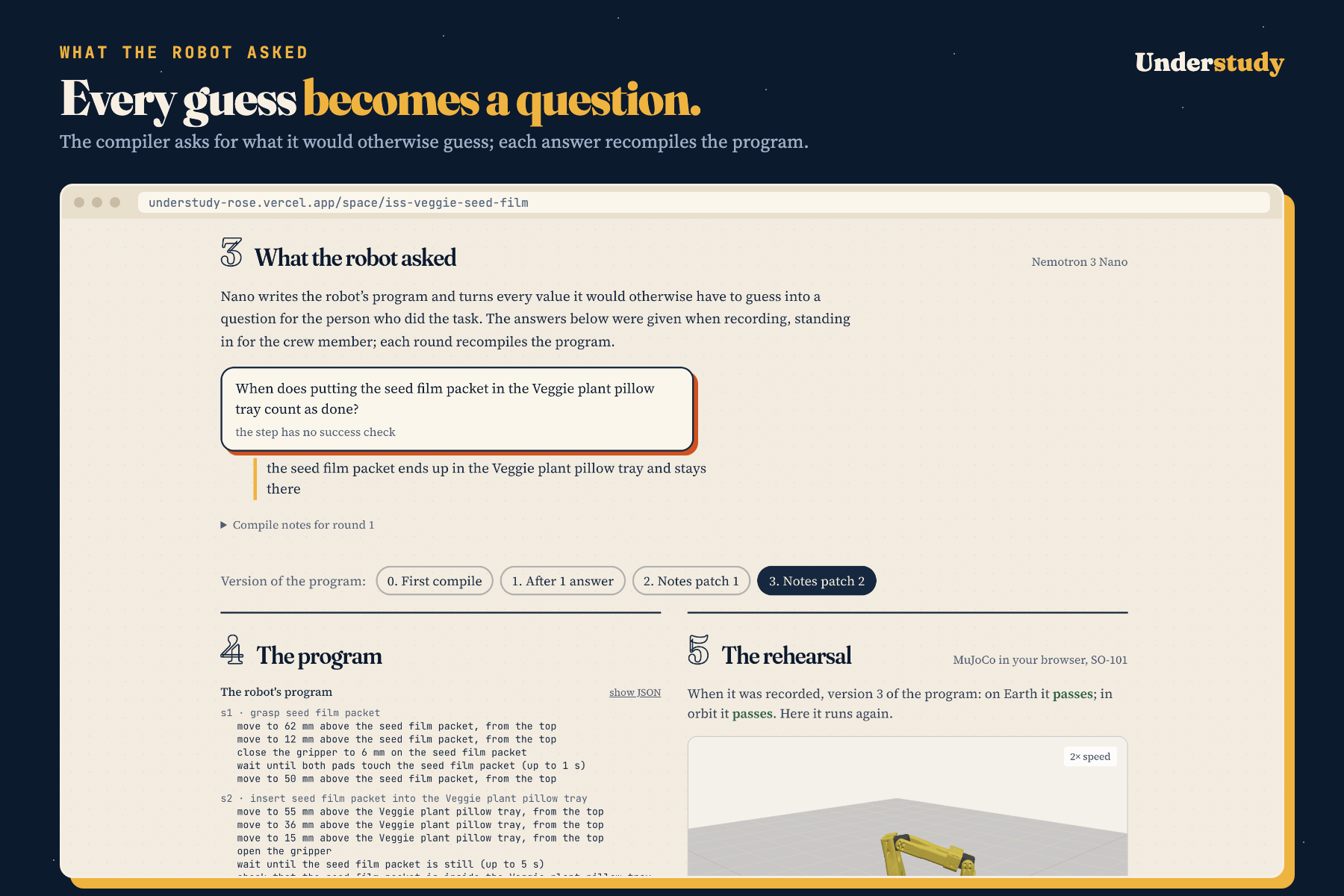
- Questions from the robot. A Nemotron compiles the spec into a robot program. Whatever it cannot execute becomes a question: how tight is the pocket, what counts as success. Each answer recompiles the program.
- Rehearse. A simulated SO-101 arm runs the program in MuJoCo, in your browser, on Earth and in orbit. A pour moves simulated liquid; a wave follows the hand's path from the clip.
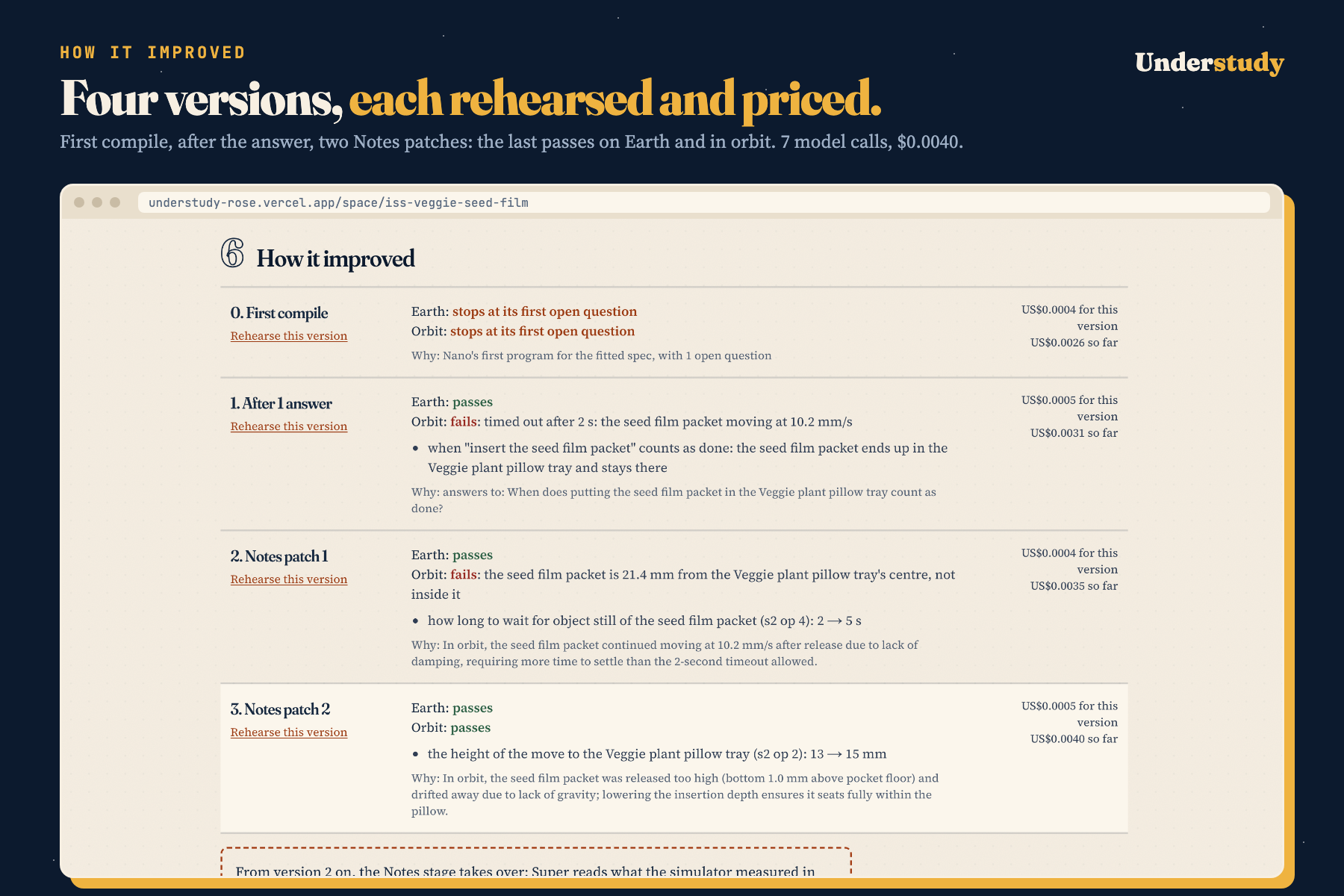
- Notes. When a run fails, a Nemotron reads the simulator's failure note and patches the program, then the arm tries again.
- Perturb the world. The program that passed runs under twelve perturbations written by the model (or built from the spec with no model), each blind (the program does not know the shift) and sensed (it does), on Earth and in orbit: 48 rollouts in about two seconds, and a perception budget per axis.
- Score against a baseline. A scoreboard runs every version of the program on those twelve, after a baseline, "retarget and replay": a program written by fixed rules from the label, with no model and no answers. On the five NASA clips the baseline does as well as our last version or better on Earth on three (24 against 24, 22 against 21, 24 against 22 of 24) and falls behind in orbit on all five (3 against 15, 0 against 19, 8 against 13, 0 against 22, 0 against 22).
- Reshoot list. On a click, Nemotron 3 Ultra reads the run's evidence and returns failure classes, open risks and what to film again, kept only for fields that came from the clip or from an answer.
- Similar tasks. The model suggests variants (a bigger bowl, pour it back) or takes one you type ("put it on a higher shelf"), and rehearses each without filming again. For a gesture (a wave), three are built from the traced path with no model: the other side, slower, and bigger.
- Download. Once the program passes in both worlds, the run downloads as a LeRobot v2.1 skeleton with one MP4 per episode drawn again from the simulator: a picture of the simulation, never footage. Format-valid, not checked with GR00T's loader, not training data.
Every result names the model that answered it. Tavily search adds sourced hazards and preconditions as chips you can accept. A Use the playbook switch, off by default, sends the compiler six hand-written rules from earlier fixes, each with its evidence, only for their own kind of task; measured, it makes things worse (below).
In the simulator, not on the site yet: toss, catch and contact. The rehearsal runs them from hand-written programs and the compile route refuses them, so no clip reaches them yet.
How we built it
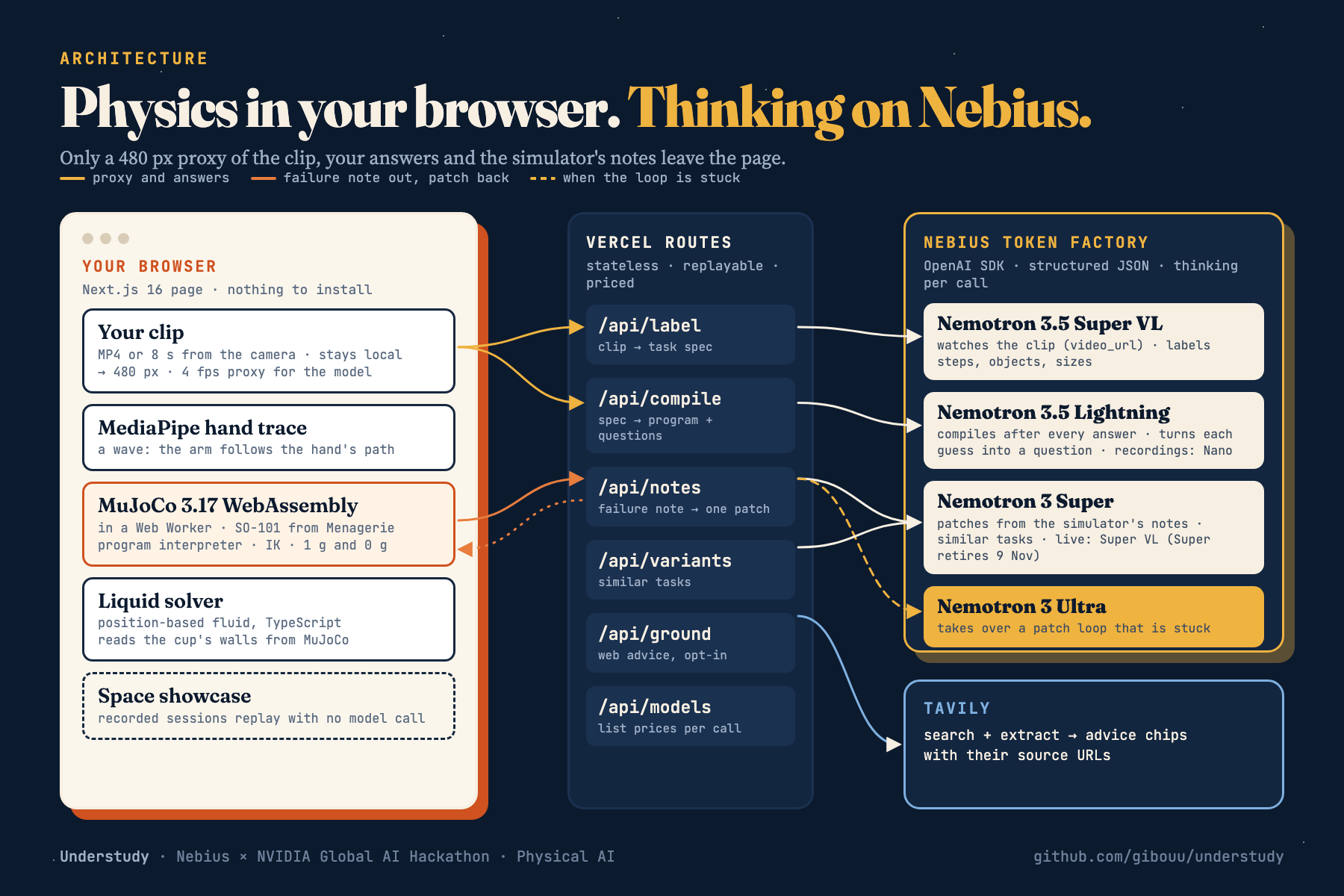
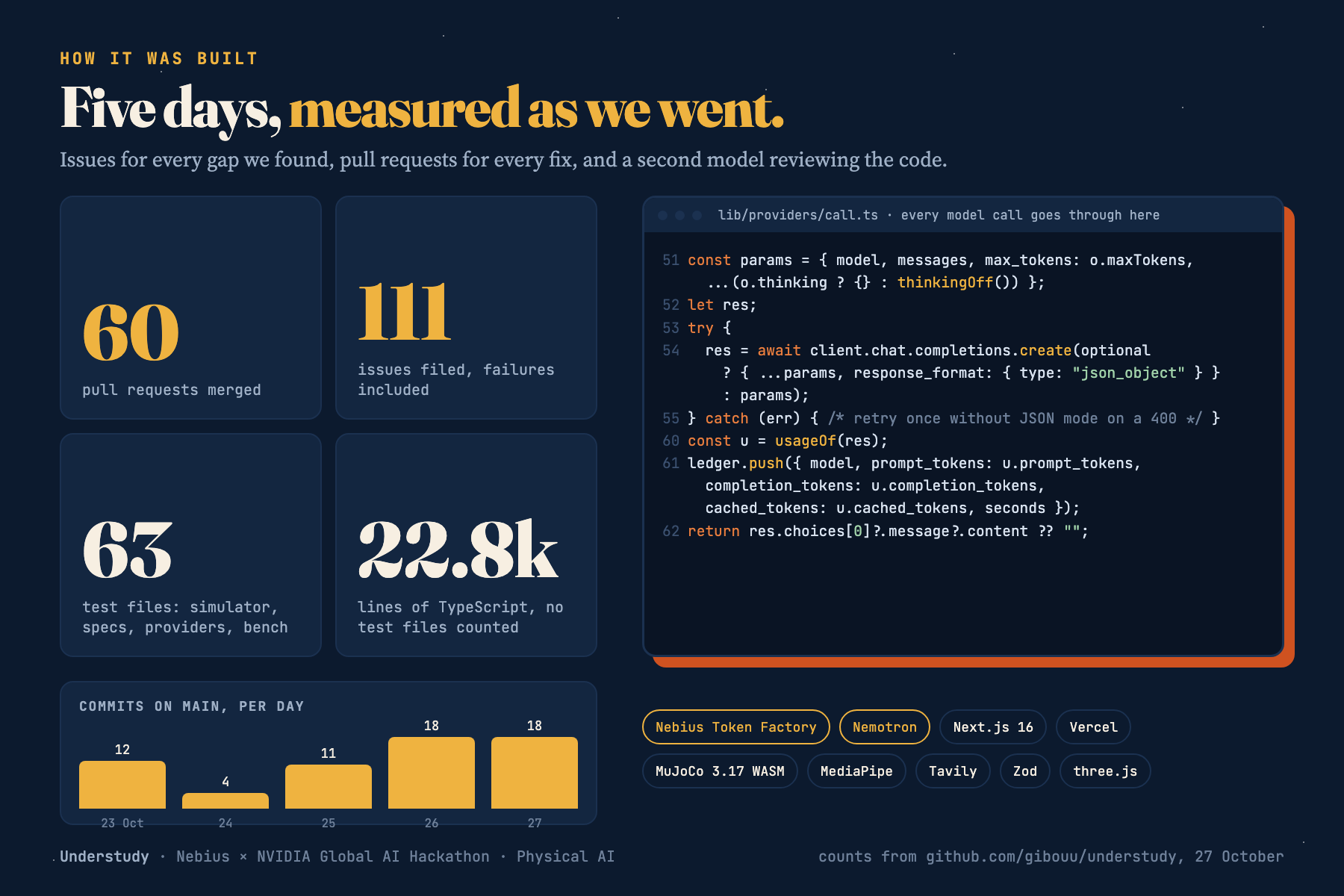
- Nebius Token Factory, through the OpenAI SDK, runs every model call:
nvidia/Nemotron-3.5-Super-VLlabels the video proxy.nvidia/NVIDIA-Nemotron-3-Nano-30B-A3Bcompiles specs into programs, with thinking off.nvidia/nemotron-3-super-120b-a12bpatches failing programs from the simulator's notes and suggests similar tasks.nvidia/Nemotron-3-Ultra-550b-a55btakes over a patch loop that is still stuck after two failed patches.- Token Factory retires Nano and Super from serverless on 9 November 2026, during judging. The ISS examples are recordings made on them on 27 October. A clip of your own runs on the replacements Token Factory names, measured on the same benches: Nemotron 3.5 Lightning for Nano, Super VL for Super, and Ultra when a patch loop is stuck.
- MuJoCo 3.17 compiled to WebAssembly runs in a Web Worker, with the SO-101 arm from MuJoCo Menagerie. On top of it we wrote IK on the arm's tip, grasp and release, a program interpreter, and the checks a program can ask (is the tube seated, still, touching). Gravity is a scenario setting: the site rehearses on Earth and in orbit, and our bench harness also runs Mars and the Moon.
- A liquid model. MuJoCo has no liquid you can pour, so we wrote a position-based fluid solver in TypeScript that reads the cup's walls from MuJoCo each step.
- A baseline and a playbook. The baseline takes the object, carries it 20 mm over the target, lowers it and lets go, with no waits and no checks. Playbook rules are plain text tagged by kind of task (pocket, zone, pour), sent only for a spec with a step of that kind; with the switch off, the request is byte for byte the one from before.
- The export's video is drawn again in the browser with three.js from the simulator state and encoded with WebCodecs (H.264, else VP9).
- A spend cap. Live spend stops at US$250 for testing and judging (Upstash Redis keeps the total); after that every step replays its recording and says why. A clip of your own is kept as training data only when you tick the consent box.
- Next.js 16 on Vercel, with recorded sessions so the demo works without credits.
What we measured
Every claim in our pitch has a number behind it, with the scripts and raw data in the repository (docs/MEASUREMENTS.md).
- A recorded session costs under a cent in Token Factory calls: 1 to 7 calls, $0.0007 to $0.0059, in the space showcase (the seed film: 7 calls, $0.0040).
- The self-improvement loop works (bench harness, small probe programs). Across four tasks at four gravities, a naive program fails 86% of the disturbed runs. Nemotron 3 Super reads the simulator's failure notes (measured facts, never the answer) and patches the program. Within five patches, it fixes 69% of the solvable failures with thinking off. When it escalates to thinking on only when it gets stuck, it fixes 94%, at $0.0024 per fix.
- The playbook does not carry over. On the bench's probe programs, two rules distilled from Earth and Mars repairs raised first-try success on the Moon and in orbit by 28 points with the cheap model, against a matched control. On the site's own compile, on four NASA pocket clips, rules learned on the other clips lowered it by 19 points (0 of 32 against 6 of 32 for the matched control), so the switch is off by default.
- A scripted baseline matches us on Earth. It scores as well as our last version or better on three of five NASA clips on Earth, and falls behind on all five in orbit, where a released object drifts unless the program holds it.
- Perception matters most in orbit (twelve perturbations, rigid-body physics with a geometric grasp). On the seed-film clip, the final program survives all 12 on Earth whether or not it sees the shift; in orbit it survives 5 of 12 blind and 10 of 12 sensed. Across that run's recorded versions, the orbit score goes 1, 1, then 15 of 24 after the second patch.
- The liquid model matches physics. A cup's drain time stays within 2.8% of Torricelli's law, and the liquid's surface tilts within 0.09° of theory under acceleration. It also overturned a conclusion: the bead stand-in said pouring in orbit was impossible, while with the liquid model, turning the cup over in one second lands the water and keeps it there in 3 of 6 seeds.
- Gloved hands. On the ISS clip, the hand model found no hands at all. Wrist crops find them in 149 of 360 frames.
- Toss, catch and contact, in the simulator only. A box tossed up is caught again 8 of 10 times on Earth and 0 of 10 in orbit. A held object follows a rigid stand-in under a 2 N force limit 20 of 20 times on a flat one, at 1 g and 0 g, and 0 of 20 on a curved one (peak 2.41 N).
Challenges we ran into
- The vision model never recognised the seed film. In 0 of 35 labels did it name the film; most called the pillows battery packs. A one-line hint from the user fixes most of it, so the flow has a hint field.
- Gloves and far cameras made the hand model blind; a sepia-toned crop around each wrist fixed it.
- MuJoCo has no liquid. We built one and had it reviewed by a second model over three rounds, fixing 18 findings with a regression test each.
- Our own numbers. A matched control showed that most of an early "playbook" gain came from an extra model call, not from the learned rules. We publish the corrected figure.
- Models retiring during judging. Two of our four models leave Token Factory on 9 November. We recorded every ISS run on them and moved clips of your own to the named replacements, measured on the same benches.
- A failure that was our bug. Writing up three failing rollouts, one turned out to be a simulator bug: a tilted object started 3.2 mm inside the table. Fixing it turned that failure into a pass and moved six scoreboard counts by one or two; the write-up says so.
Accomplishments that we're proud of
- A NASA clip becomes a robot program rehearsed in orbit, in a browser, for under a cent.
- A measured self-improvement loop, with confidence intervals, instead of a promise.
- Every number in the pitch is measured by us or checked twice against its source.
- We publish our negative results: the baseline matches us on Earth, the playbook makes first tries worse, the rehearsal ignores the gripper opening, the catch fails in orbit. Three failing rollouts are written up, each replayed by a test.
What we learned
- Gravity mostly sets the clock. Tasks fail on what does not scale with it: a hand-off velocity, a vehicle's acceleration, and in orbit the absence of anything that settles an object.
- The cheap model with thinking off does most of the work. Escalating to reasoning only when it gets stuck fixes as many failures as always-on reasoning (94%) for a quarter less per fix.
- A baseline keeps you honest. Fixed rules with no model do as well on Earth; the answers and patches earn their keep in orbit.
- A pass says less than it looks. The rehearsal does not read the gripper opening: a 5 mm grasp on a 25 mm object passes.
What's next
- Playbook rules that carry over from one clip to the next, measured against the same matched control.
- An export checked with GR00T's loader, video in the one-minute demo's export, and the scoreboard's passes in the Try it export.
- A grasp that reads the commanded opening, a catch that works in orbit, contact that stays under the limit on a curved surface, and a label that reaches those ops.
- The Moon (0.1654 g) on Try it, and the answers as tolerance bands.
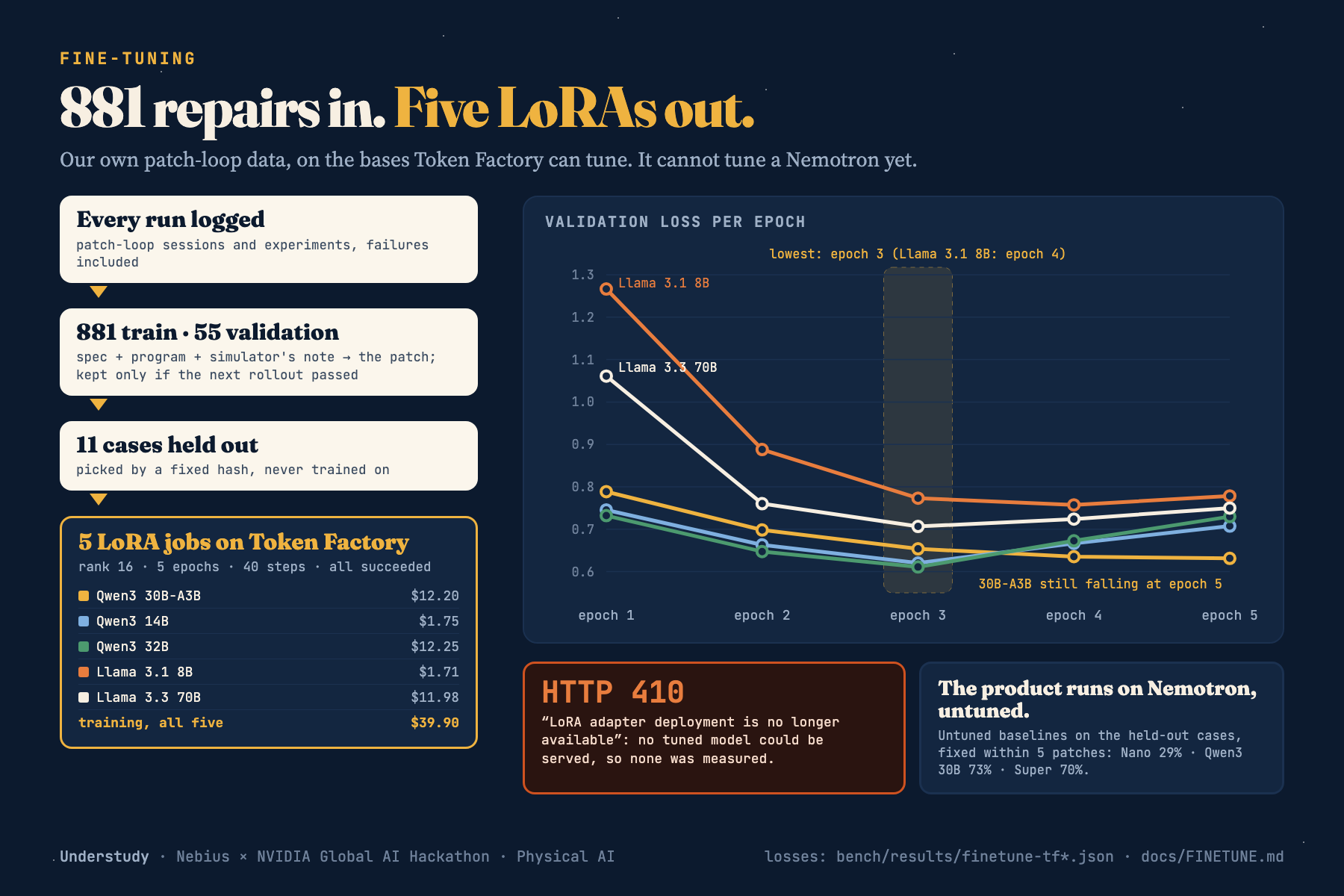
- A Nemotron fine-tuned on our logged repairs. The data is ready (881 training and 55 validation repairs, 11 held-out cases), and five LoRA fine-tunes on Token Factory finished for US$39.90 (Qwen3 30B-A3B, Qwen3 14B, Qwen3 32B, Llama 3.1 8B, Llama 3.3 70B), for loss curves only: Token Factory cannot fine-tune a Nemotron and no longer deploys LoRA adapters (HTTP 410), so no tuned model was measured. The product runs on Nemotron, untuned. Details:
docs/FINETUNE.md.
What the rehearsal proves, and what it does not: a scripted SO-101 program executes the clarified task in rigid-body physics with a geometric grasp. It does not prove that a learned policy would succeed or that a real grasp would hold.
Built With
- mediapipe
- mujoco
- nebius-token-factory
- nemotron-3-nano
- nemotron-3-super
- nemotron-3-ultra
- nemotron-3.5-lightning
- nemotron-3.5-super-vl
- next.js
- react
- tavily
- three.js
- typescript
- upstash-redis
- vercel
- webassembly
- webcodecs
- zod

