-
-
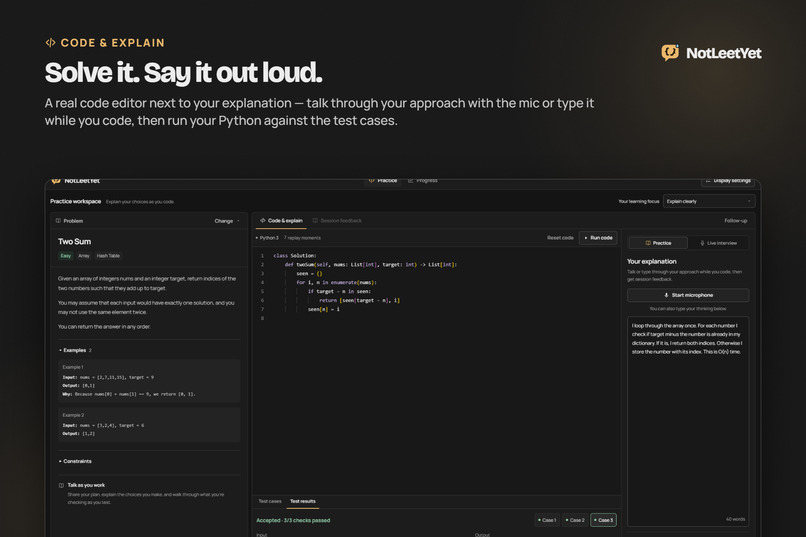
Workspace
-
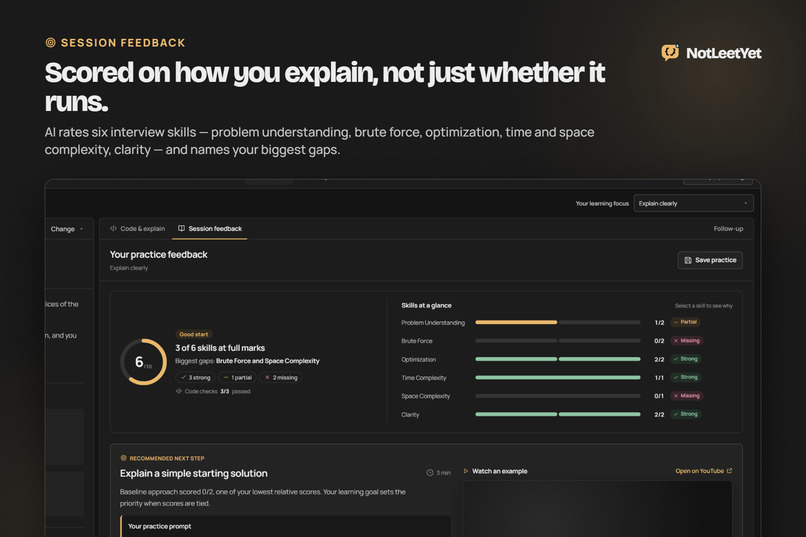
Summary
-
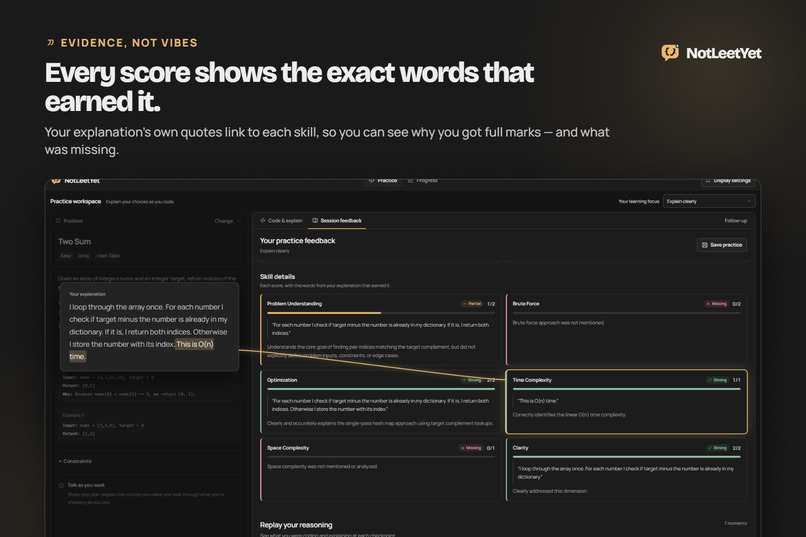
Evidence
-
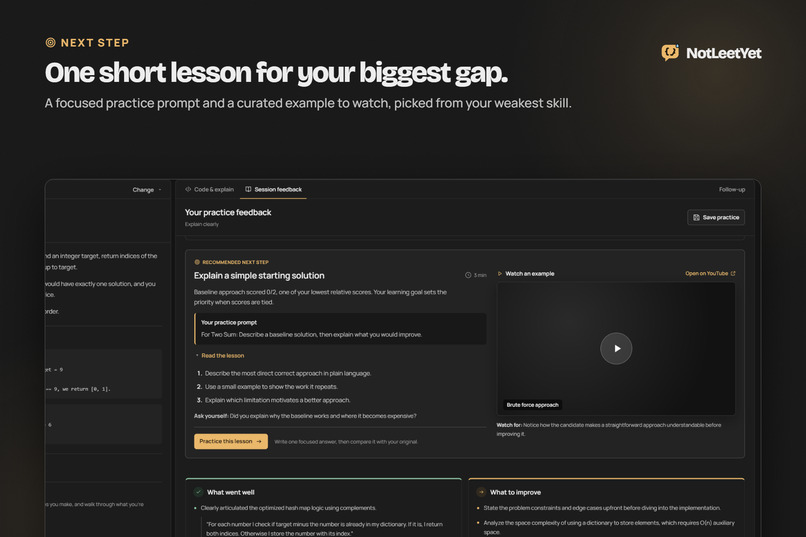
Lesson
-
Retry
-
Replay
-
Progress
-
Live
-
Values
Inspiration
NotLeetYet came from a frustrating experience a lot of us share: you solve the LeetCode problem, the tests pass, and then the interviewer says "walk me through your approach." Suddenly you're rambling, you skip the brute-force solution, and you never mention space complexity. Technical interviews don't just grade whether your code runs; they grade how clearly you explain your thinking. Yet every practice tool we used stopped at "Accepted" or "Wrong Answer." We wanted to build something for the people who aren't leet yet: developers who can solve the problem but haven't learned to talk through it under pressure. The goal was a tool that coaches the part you can't grind.
What it does
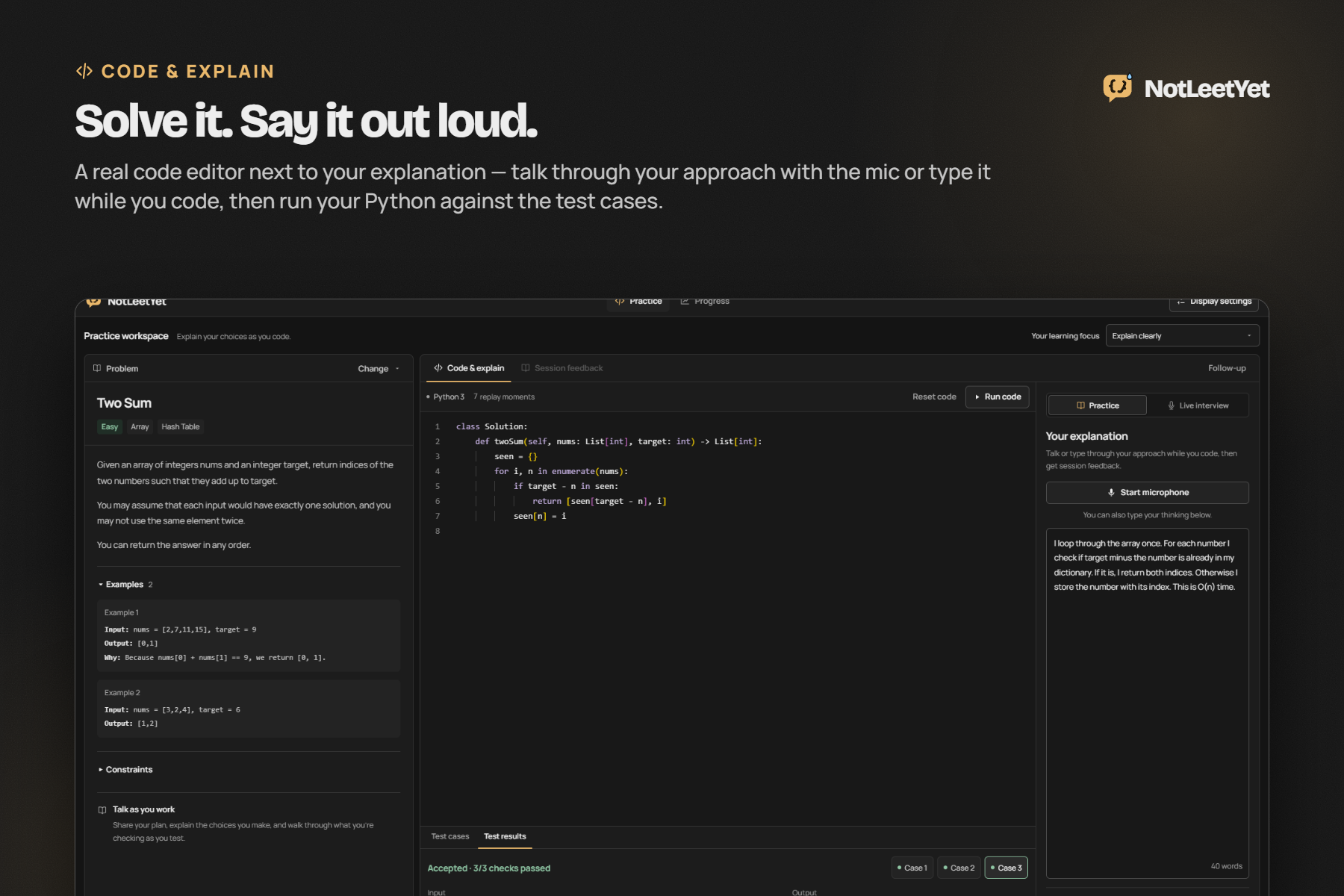
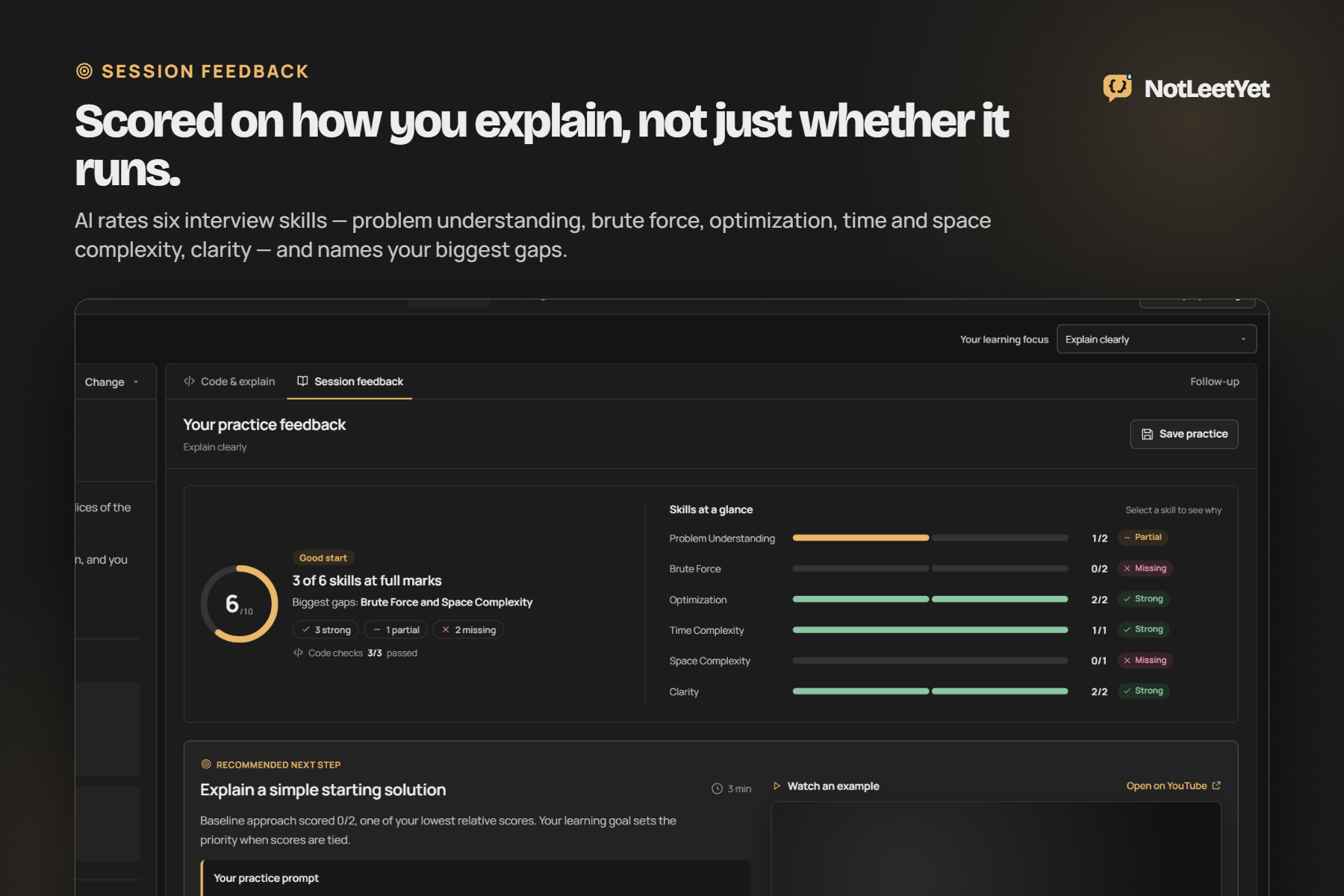
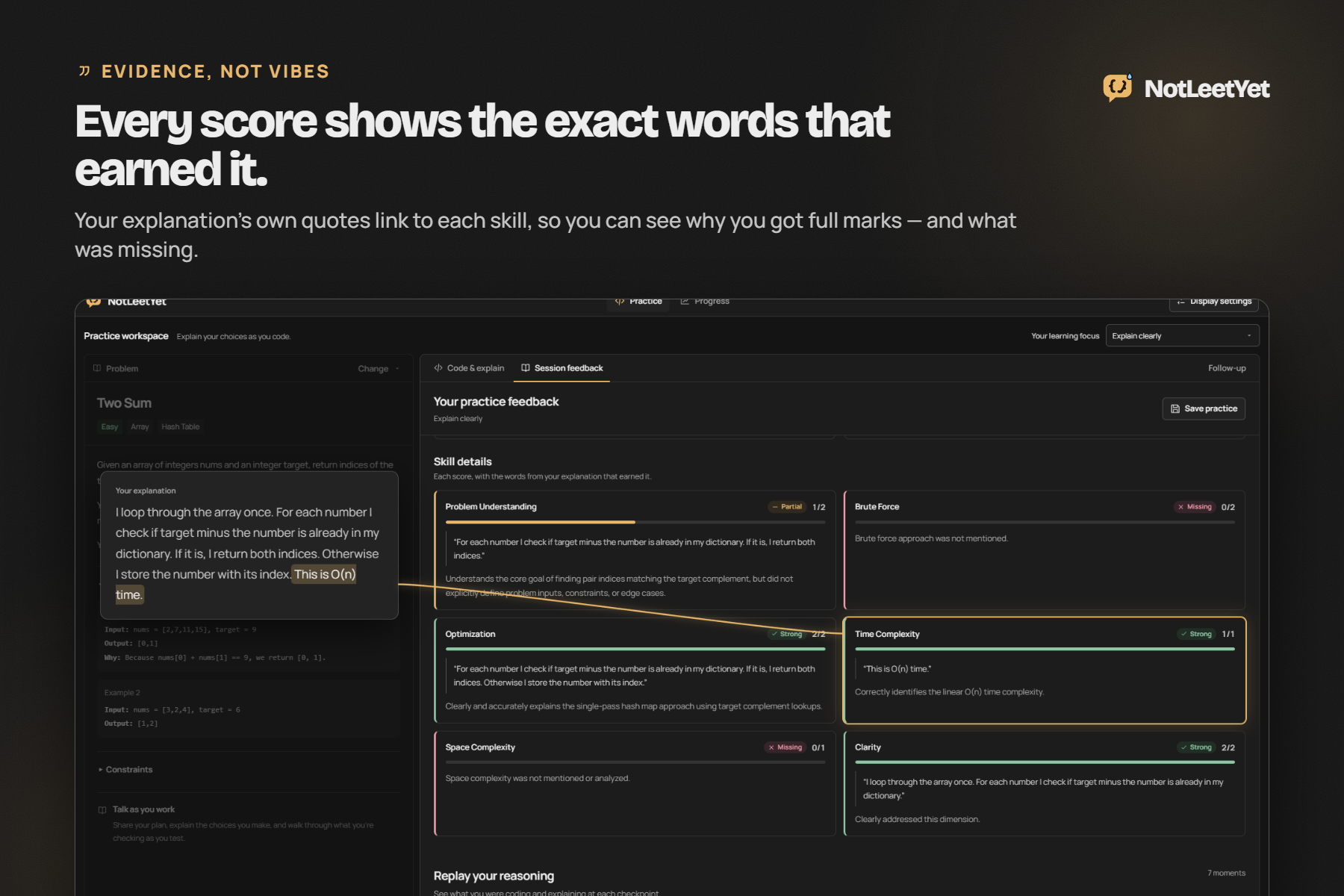
NotLeetYet is a coding-interview practice workspace that grades your explanation, not just your solution. You pick a problem, write your solution in a real code editor, and explain your approach out loud or by typing while you code. After running your Python against the test cases, you get session feedback. AI scores your explanation on six interview skills (problem understanding, brute force, optimization, time complexity, space complexity and clarity), and every score quotes the exact words from your explanation that earned it.
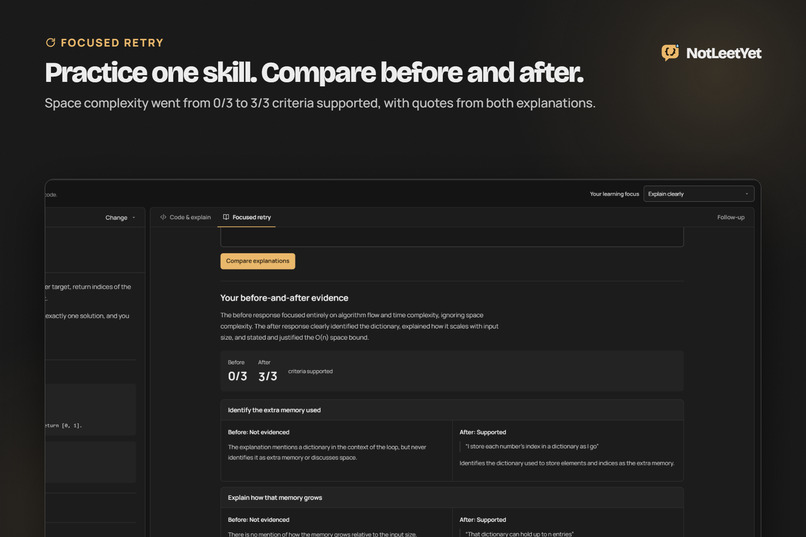
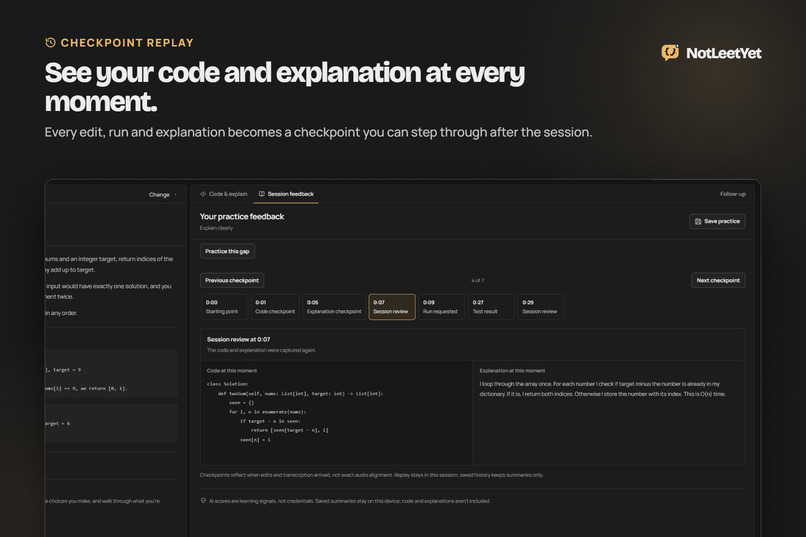
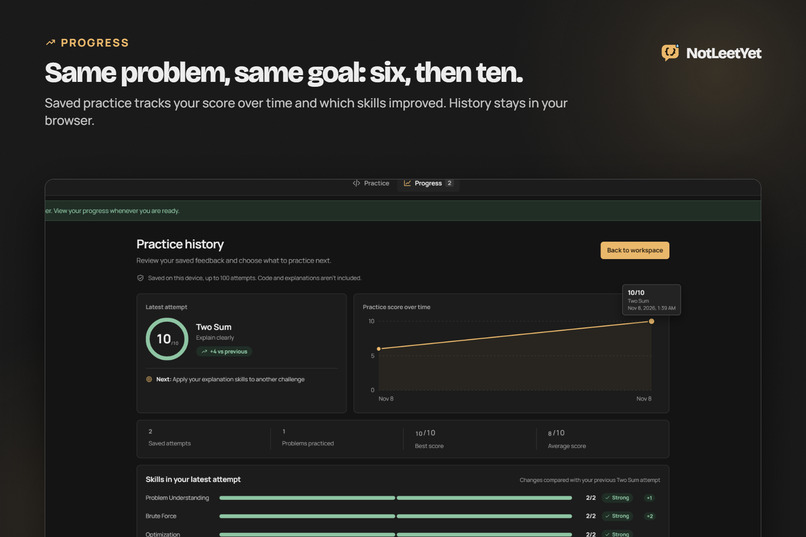
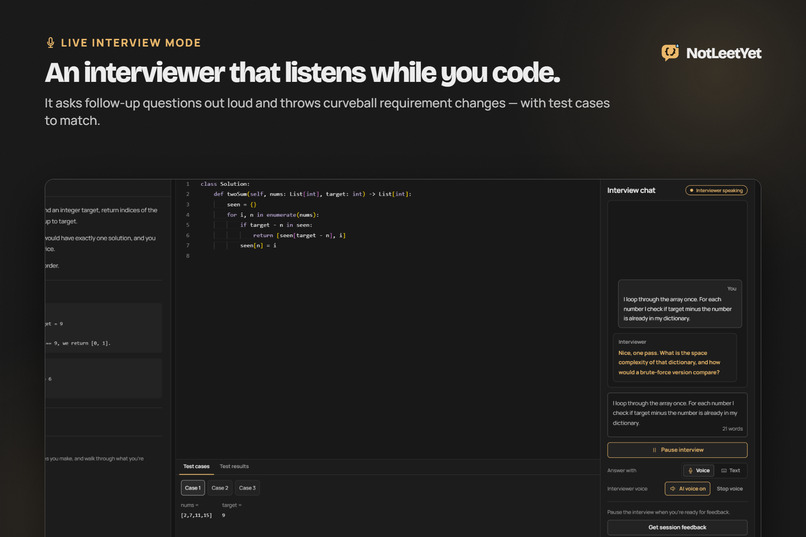
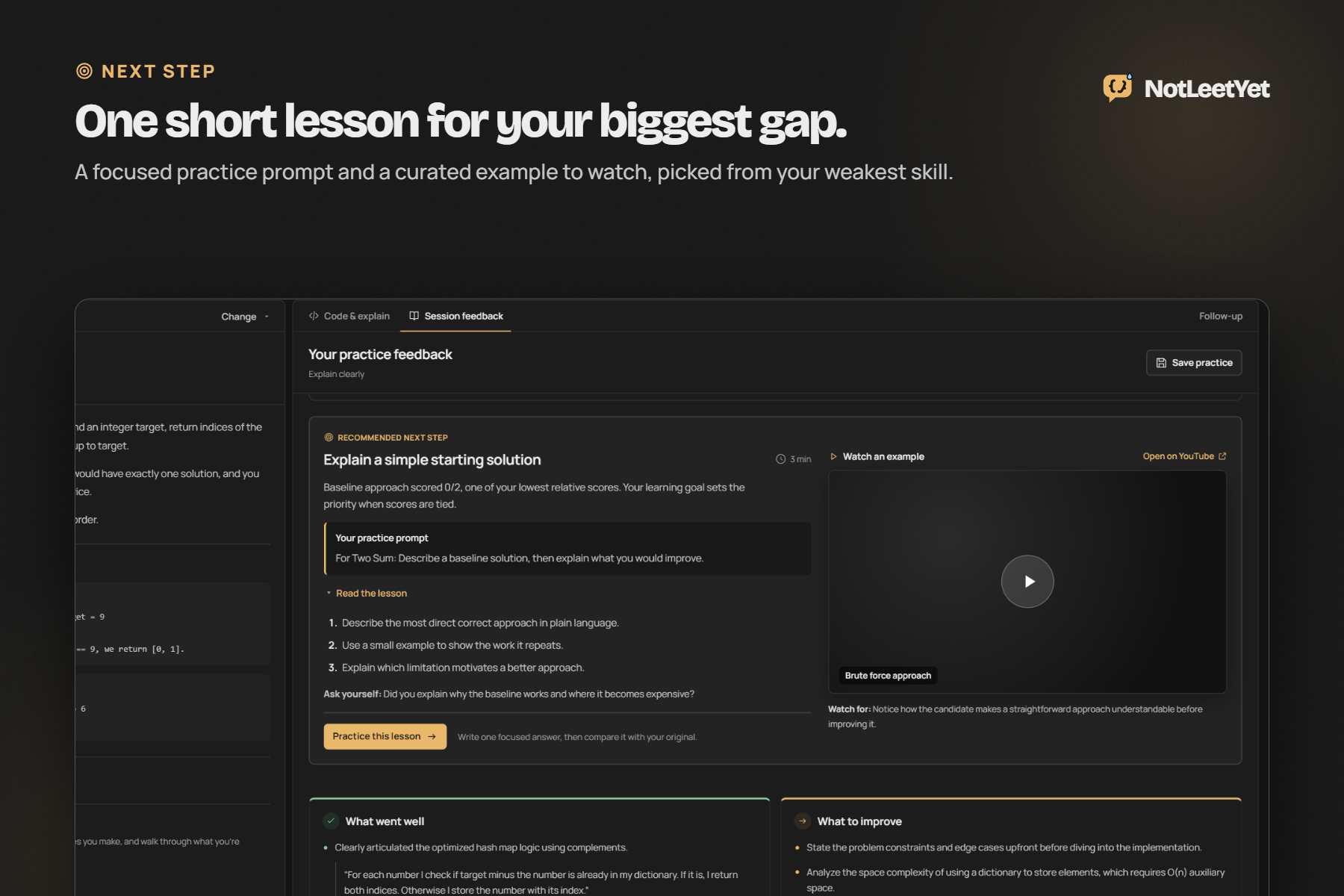
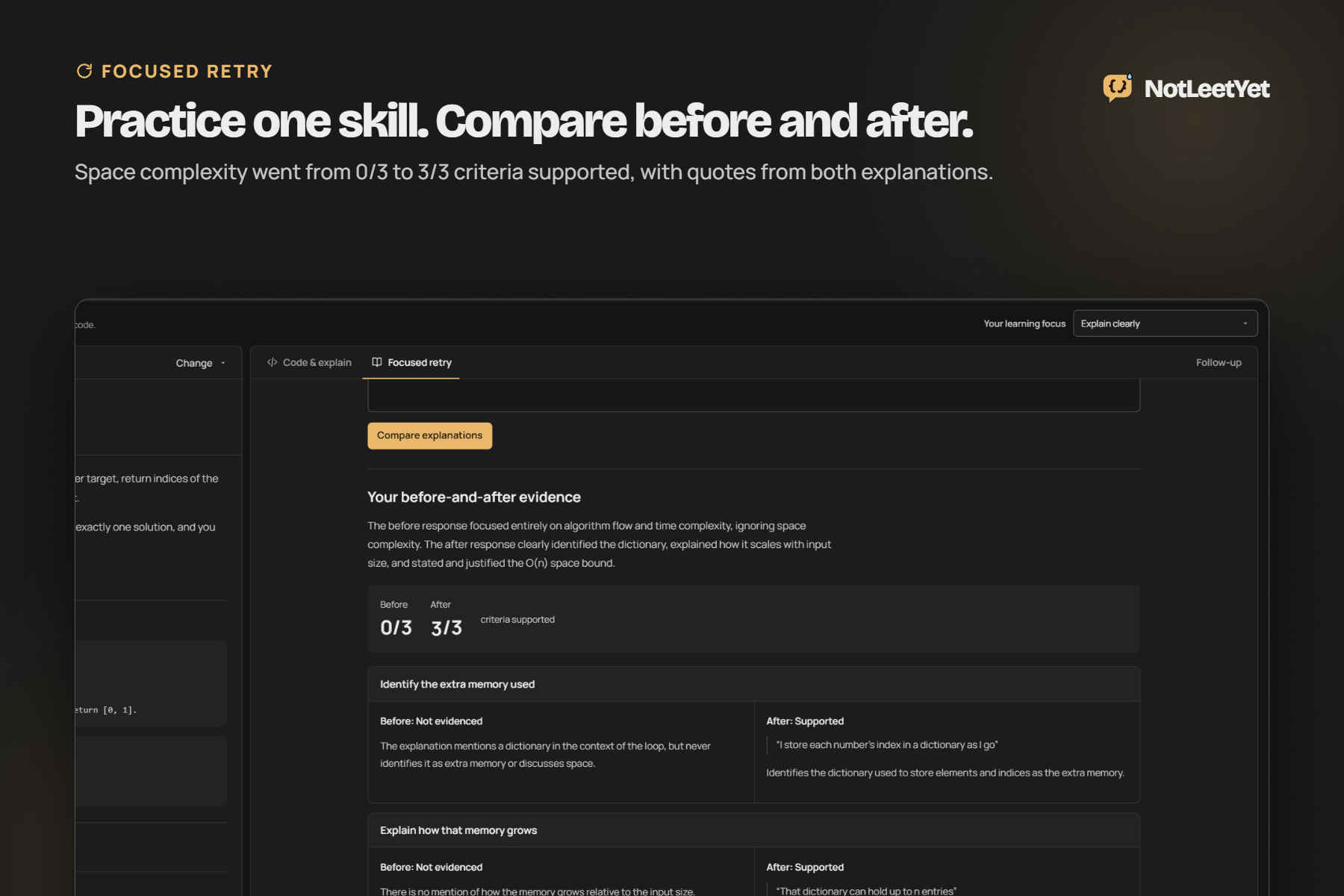
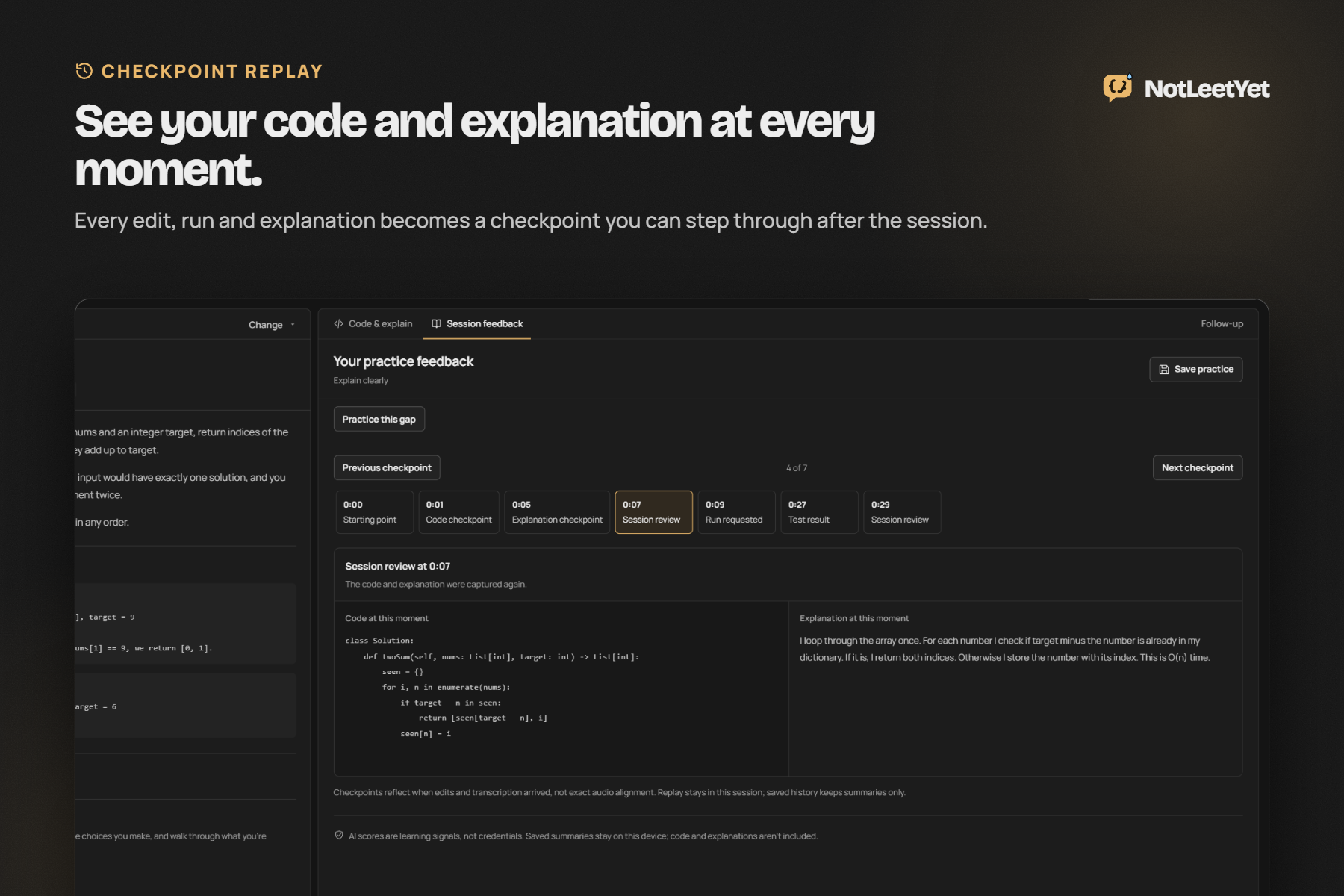
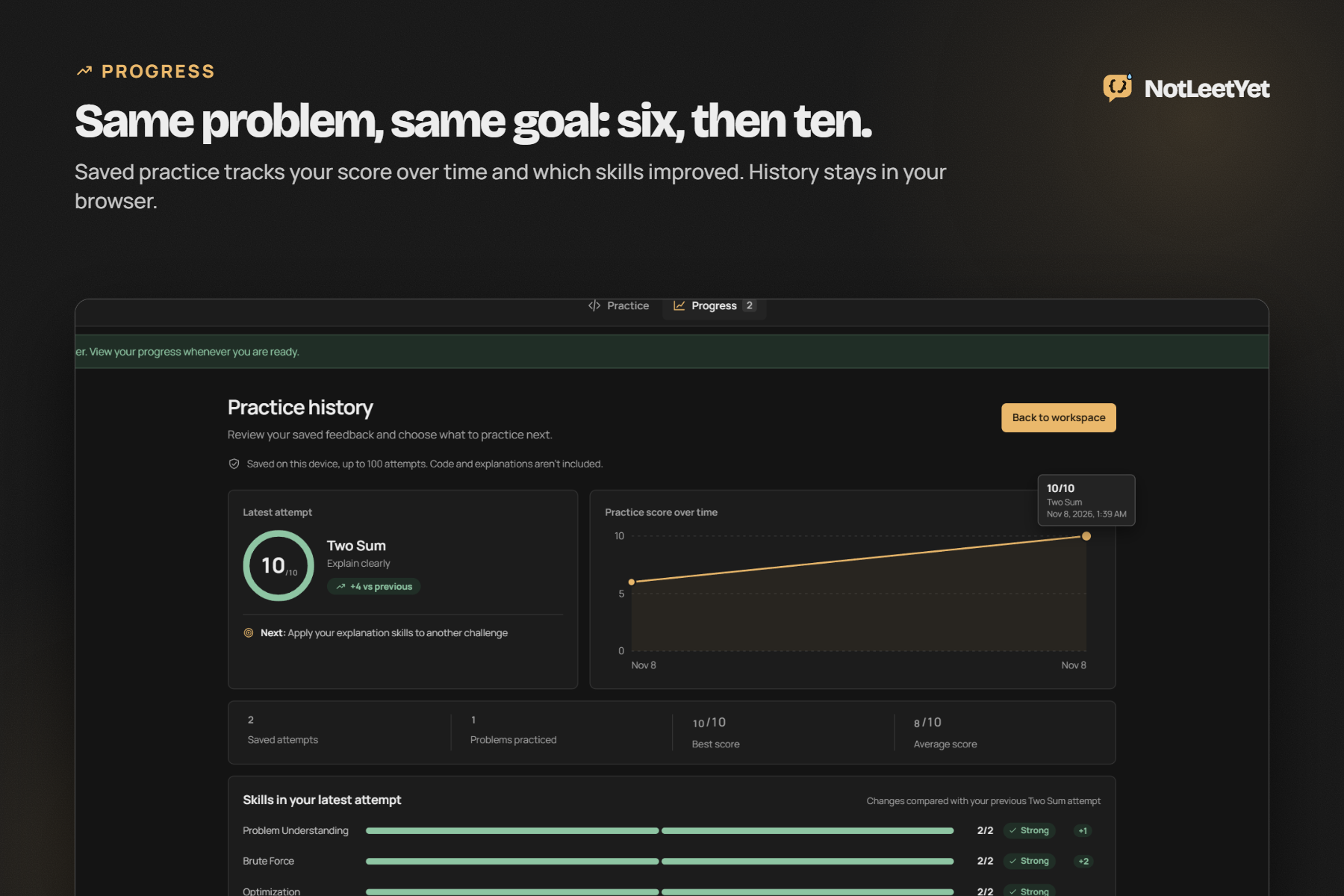
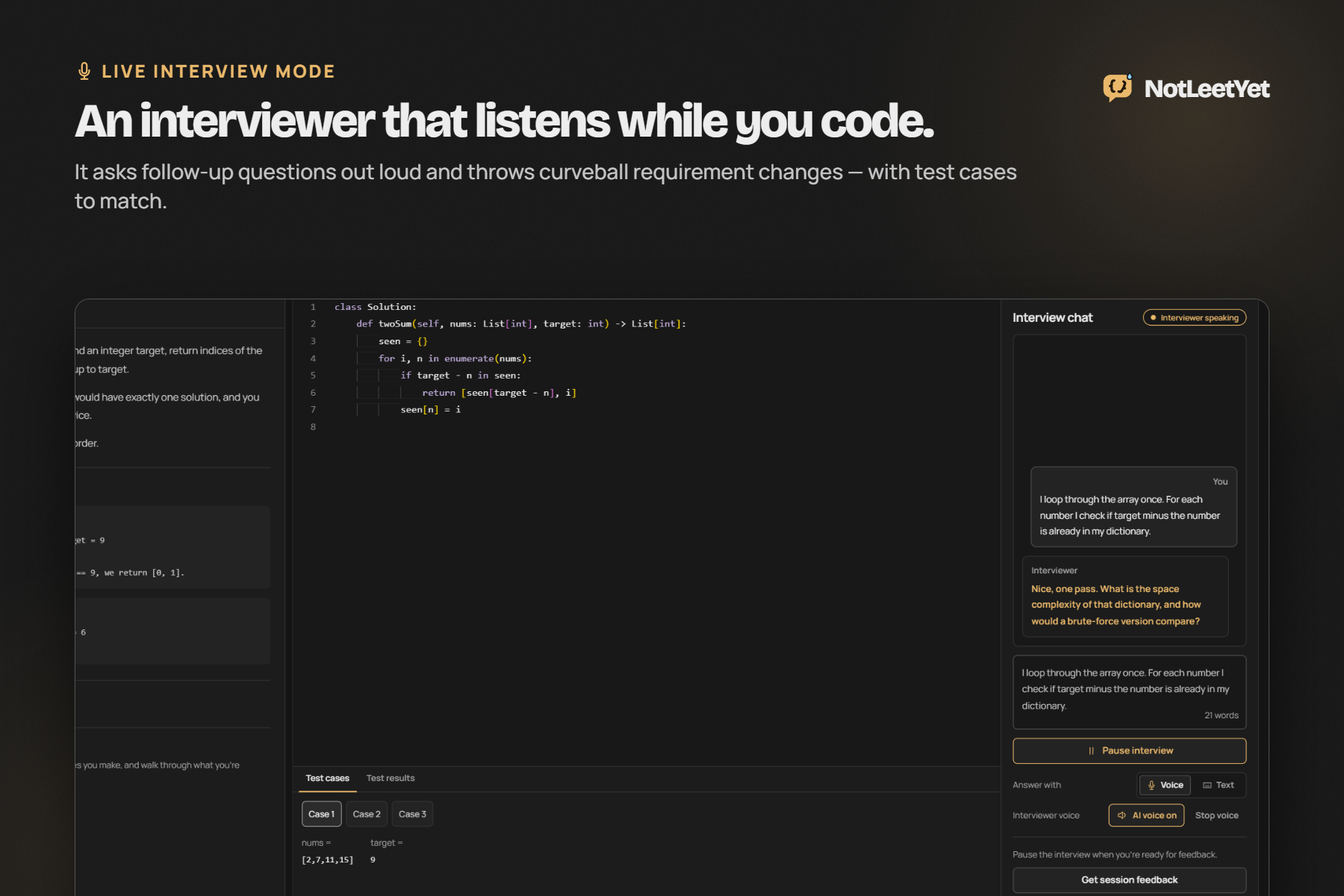
From there, NotLeetYet turns feedback into a next step. It recommends one short lesson for your biggest gap, with a curated example to watch, and a focused retry lets you practice just that skill and compare the evidence before and after. Checkpoint replay shows what you were coding and explaining at each moment of the session, and saved progress tracks your scores over time. For extra pressure, Live interview mode adds an AI interviewer that listens while you code, asks follow-up questions out loud, and throws curveball requirement changes with test cases to match.
How we built it
We built NotLeetYet as a full-stack app with a React and Vite frontend, the Monaco code editor, and a Flask backend with a local Python test runner. For the AI layer, we used Gemini with structured JSON output. Instead of free-form feedback, the model scores against a fixed six-part rubric and has to back every score with a direct quote from the user's explanation. Lesson recommendations are chosen deterministically from the rubric gaps, using the learner's goal to break ties, so they don't need an extra model call.
For the live interviewer, we used the browser's Web Speech API for hands-free input: a short pause ends each spoken turn and hands it to the interviewer, and Gemini text-to-speech gives it a voice. Curveballs were designed carefully. The AI can only choose parameters inside pre-defined problem variants and the expected answers are computed by our own reference functions on the server. On the frontend, we focused on making a dense tool feel calm. That meant a summary you can read at a glance, separate Practice and Live modes, evidence linked to every score, keyboard shortcuts and adjustable display settings.
Challenges we ran into
The biggest challenge was making AI feedback trustworthy. Early versions produced generic comments like "great job, consider complexity," which don't help anyone improve. We solved this by requiring evidence quotes for every score and every before/after judgment, and by adding checkpoint replay so learners can see exactly why they got a score. A related challenge was letting the AI change the problem mid-interview without breaking it. An AI that invents test cases will eventually invent wrong ones, so we limited curveballs to validated templates and computed every expected answer on the server.
Another challenge was coordinating the microphone, speech recognition and the AI's voice without the interviewer hearing itself. The mic stays off while the AI is thinking or speaking, and late responses can't restart a paused interview.
Accomplishments that we're proud of
We're proud that NotLeetYet became a complete learning loop rather than a chatbot bolted onto a code editor: practice, get evidence-based feedback, take a targeted lesson, retry, and see measurable improvement. In testing, a weak explanation scored 6/10, a focused retry took space complexity from 0/3 to 3/3 criteria, and a full re-attempt scored 10/10 on the same problem. We're also proud that the feedback explains itself. Every number ties back to the learner's own words, which makes the AI feel fair instead of random.
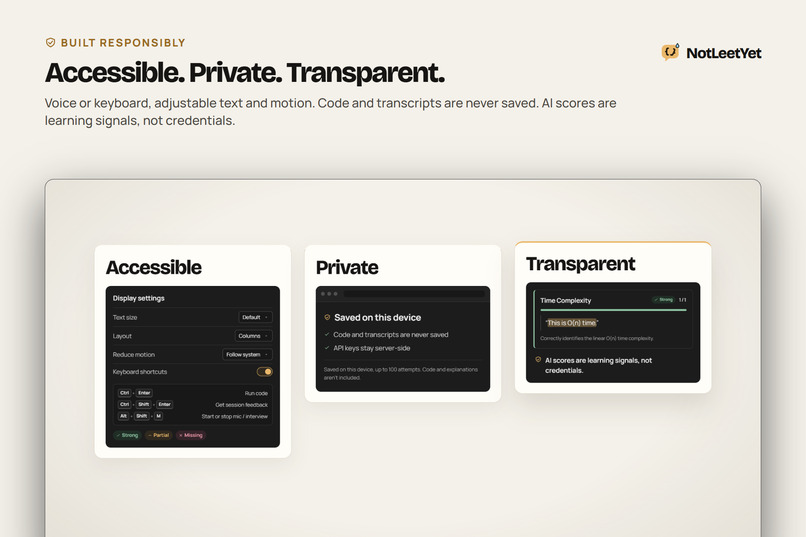
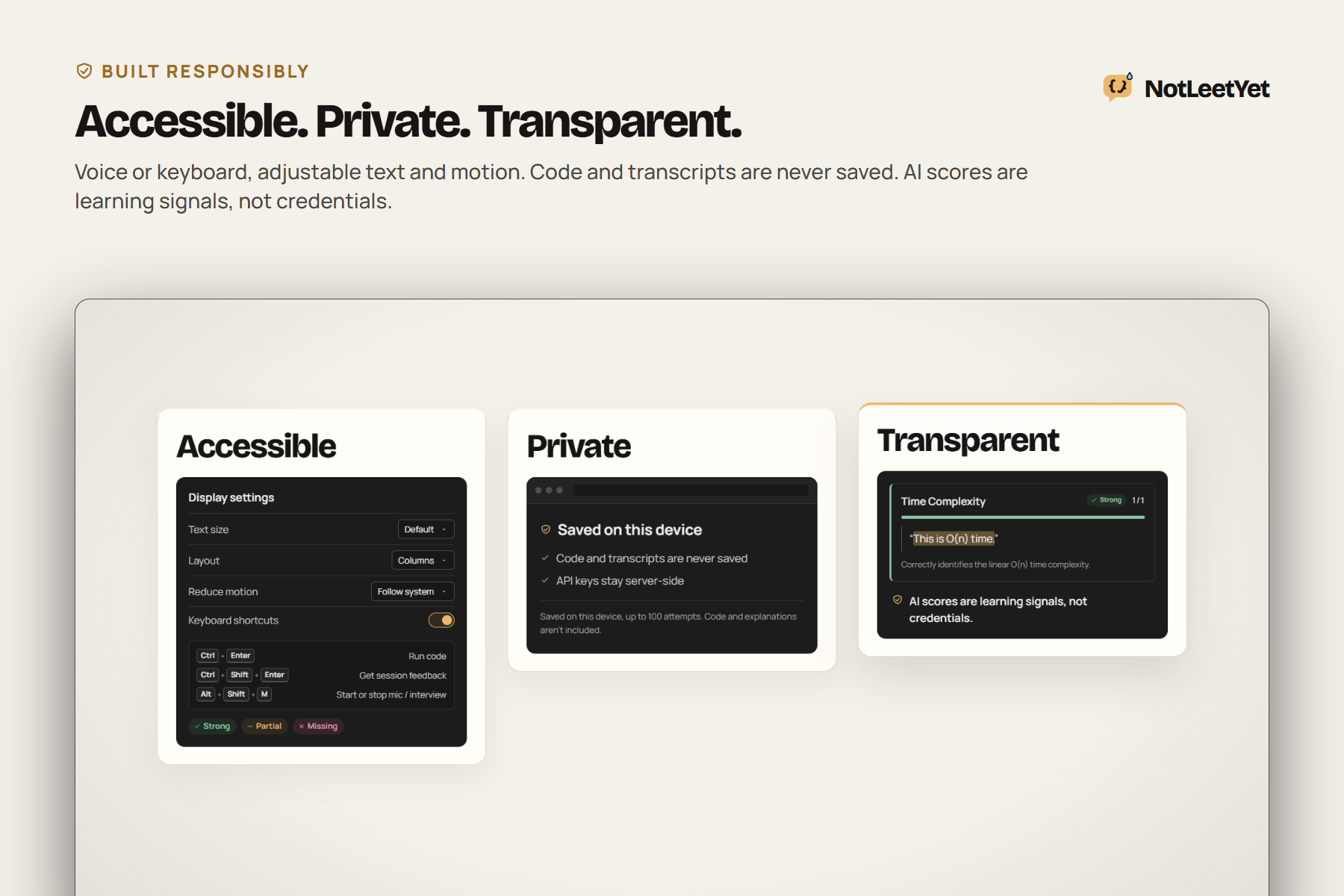
We're proud of the live interviewer too: it asks real follow-up questions out loud and changes the requirements mid-problem, the way real interviewers do, while still keeping the tests correct. And we're proud that accessibility was built in from the start rather than added at the end. That covers voice or keyboard input, shortcuts that work with screen readers and can be turned off, adjustable text, layout and motion.
What we learned
We learned that practicing communication needs evidence, not vibes. Learners only trust feedback when they can see where it came from, so quotes and replay mattered as much as the scores themselves. We also learned that constraining AI makes it more useful: fixed rubrics, required quotes and validated curveballs turned a chatty model into a reliable coach. On the design side, we learned that accessibility shapes the whole product. Supporting voice and text, keyboard and mouse, and motion and no motion changed how we built nearly every screen. And like any hackathon project, we learned that polish matters: clear status, readable feedback and a calm interface made the product feel trustworthy.
What's next for NotLeetYet
The next step is expanding the practice library with more problems and languages beyond Python. We also want sandboxed code execution, so NotLeetYet can be hosted publicly instead of run locally. Beyond that, NotLeetYet could grow into a fuller interview-prep platform: spaced-repetition practice that brings back your weakest skills over time, full mock interviews that mix several problems, and optional peer practice where learners explain solutions to each other.
AI disclosure
We used AI in two ways:
- In the product: NotLeetYet uses the Google Gemini API to score explanations, compare retries, run the live interviewer (follow-up questions and curveballs) and generate the interviewer's voice.
- While building: We used AI coding assistants (Claude Code and OpenAI Codex) to help write and debug code, refine the UI, and helped with documentation and write ups. We directed the work, reviewed the AI's output, and tested the app ourselves.
Built With
- flask
- javascript
- monaco
- python
- react
- vite
