Inspiration
Across India, millions of small shop owners and dealers run their businesses entirely through mobile notifications. Orders arrive on WhatsApp, payments come through UPI apps like GPay or PhonePe, and marketplace updates come from platforms like Amazon Seller or Meesho.
For a single shop owner, managing this constant flow of information is extremely chaotic.
Throughout the day they receive messages like:
"bhaiya 3 kilo aata bhej dena"
"Rahul ne 15000 bheja"
"Suresh ko 500 ka maal udhar dena"
"2 kurti ready rakhna kal pickup hoga"
All of these represent important business operations — orders, payments, credit entries, and preparation requests.
But these messages arrive from multiple apps and are written in informal Hinglish. Shop owners usually manage everything manually in notebooks or try to remember transactions mentally. As the number of messages grows, it becomes difficult to track what has been ordered, who has paid, and how much inventory is left.
Because of this chaos, small businesses often:
- Miss customer orders
- Forget to record payments
- Lose track of credit transactions
- Mismanage inventory
- Spend hours manually maintaining records
Existing business software expects structured inputs and does not understand the informal way people actually communicate in real life.
We wanted to solve this real-world problem by building an AI system that understands informal business notifications and automatically converts them into structured business operations.
That idea became NotiFlow.
What it does
NotiFlow is an AI-powered business operations assistant that converts informal business messages into structured digital records automatically.
Instead of manually tracking everything, the business owner simply receives messages like usual. NotiFlow reads these notifications, understands the intent, extracts the key information, and updates the business records automatically.
For example:
"bhaiya 3 kilo aata bhej dena"
becomes:
Intent: Order
Item: Aata
Quantity: 3
The system then automatically:
- Records the order
- Updates inventory
- Generates an invoice
- Stores the transaction in a Google Sheets ledger
- Updates the dashboard in real time
NotiFlow can process different types of business events including:
- Orders
- Payments
- Credit transactions
- Returns
- Preparation requests
It also understands Hinglish business language, which is extremely common in real-world communication across India.
The result is a unified system where scattered notifications become structured business intelligence.
How we built it
NotiFlow is built as a modular AI pipeline that processes every notification through multiple intelligent stages.
The system architecture includes:
Frontend
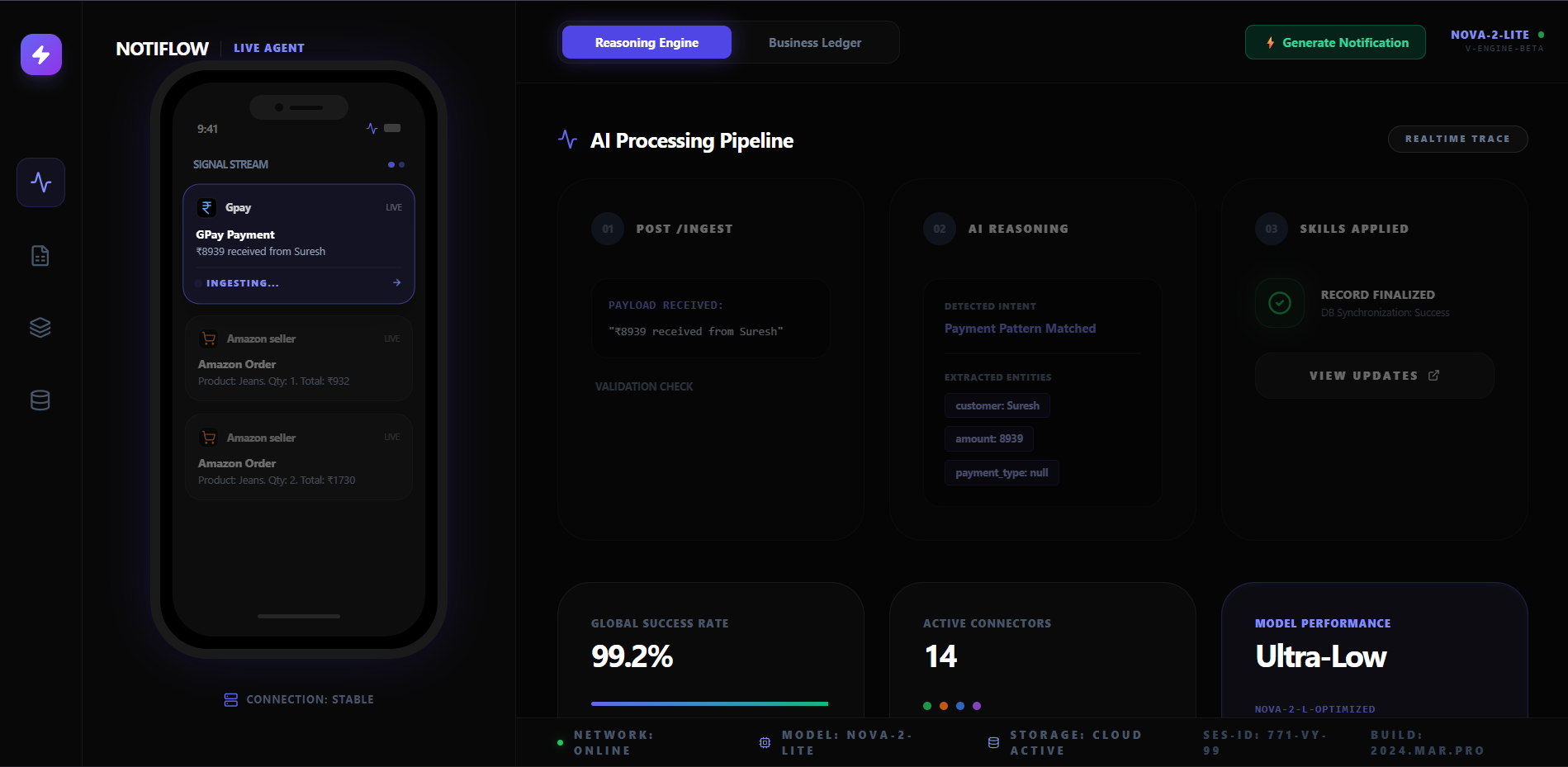
A React dashboard that shows the reasoning pipeline, processed events, and business ledger in real time.
Backend
A FastAPI server that receives notifications through REST APIs and WebSockets.
AI Engine
Amazon Nova Lite via Amazon Bedrock is used for natural language understanding tasks including:
- Intent classification
- Entity extraction
Pipeline Architecture
Every message goes through five stages:
Notification ingestion
The system receives messages from sources like WhatsApp, UPI notifications, or marketplace apps.Intent detection
Amazon Nova determines what type of business operation the message represents.Entity extraction
Key data such as customer name, item, quantity, and amount are extracted.Data validation
The system normalizes data, parses numbers, and standardizes payment types.Skill execution
The appropriate business skill is triggered (order processing, payment recording, credit logging, etc.).
After processing, the system synchronizes the transaction to a Google Sheets ledger, ensuring a live and easily accessible record for the business owner.
The system also includes:
- Inventory tracking
- Invoice generation
- Agent memory for recent customers and items
- A real-time dashboard showing the AI reasoning pipeline
🏗 Architecture
┌─────────────────────────────┐
│     React Dashboard         │
│  (Real-time Pipeline View)  │
└─────────────┬───────────────┘
              │ POST /api/notification
              ▼
┌─────────────────────────────┐
│     FastAPI Backend          │
│   (notification_routes.py)   │
└─────────────┬───────────────┘
              │ run_notiflow(message, source)
              ▼
┌─────────────────────────────┐
│     AI Agent Pipeline        │
│                              │
│  ┌─────────────────────┐     │
│  │  1. Intent Agent     │    │
│  │  (Amazon Nova Lite)  │    │
│  └──────────┬──────────┘     │
│             ▼                │
│  ┌─────────────────────┐     │
│  │  2. Extraction Agent │    │
│  │  (Amazon Nova Lite)  │    │
│  └──────────┬──────────┘     │
│             ▼                │
│  ┌─────────────────────┐     │
│  │  3. Data Validator  │     │
│  └──────────┬──────────┘     │
│             ▼                │
│  ┌─────────────────────┐     │
│  │  4. Skill Router    │     │
│  └──────────┬──────────┘     │
│             ▼                │
│  ┌─────────────────────┐     │
│  │  5. Google Sheets   │     │
│  │     Ledger Sync     │     │
│  └─────────────────────┘     │
└─────────────────────────────┘
Challenges we ran into
One of the biggest challenges was handling informal business language.
Real-world messages rarely follow structured grammar. Many messages are written in Hinglish, mixing Hindi and English words, abbreviations, and shorthand. Designing prompts and extraction logic that could reliably interpret these messages required careful experimentation.
Another challenge was building a pipeline that could gracefully handle failures. Since the system depends on external services like AI models and Google Sheets APIs, we implemented fallback mechanisms to ensure that one failure would not break the entire pipeline.
Integrating multiple technologies across frontend, backend, AI services, and cloud APIs also required careful architecture design to keep the system modular and scalable.
Accomplishments that we're proud of
We are proud of building a fully functional AI-powered operations assistant that solves a real problem faced by millions of small businesses.
Some key achievements include:
- A complete end-to-end AI processing pipeline
- Native understanding of Hinglish business messages
- Automated conversion of unstructured notifications into structured data
- Real-time dashboard showing the reasoning pipeline
- Live Google Sheets synchronization acting as a digital ledger
- Modular "skill" architecture allowing the system to easily support new business operations
Most importantly, the system demonstrates how modern AI can be used to automate everyday business workflows for people who may not use traditional enterprise software.
What we learned
Through this project we learned several important lessons about building real-world AI systems.
We learned that understanding user context is just as important as building the model itself. Small businesses communicate in informal and highly contextual ways, and AI systems must adapt to that reality.
We also learned how to design robust AI pipelines that combine multiple stages such as intent detection, entity extraction, validation, and execution.
Additionally, we gained practical experience integrating cloud AI services, building scalable APIs, managing real-time frontend dashboards, and designing modular backend architectures.
What's next for Notiflow
NotiFlow is just the beginning. There are many opportunities to expand the system further.
Future improvements include:
- Direct integration with WhatsApp Business API
- Voice message processing for spoken orders
- Automatic invoice PDF generation sent to customers
- AI-powered inventory forecasting
- Support for additional Indian languages
- Mobile applications for shop owners
- Analytics dashboards for sales and cash flow insights
Our goal is to transform NotiFlow into a complete AI operating system for small businesses, helping millions of dealers and shop owners manage their businesses effortlessly through intelligent automation.
Built With
- amazon-nova-lite-(amazon-bedrock)
- fastapi
- google-auth
- google-gemini-api
- google-sheets-api
- gspread
- node.js
- openpyxl
- pandas
- python
- react
- tailwind-css
- typescript
- uvicorn
- vite
- websockets

Log in or sign up for Devpost to join the conversation.