What I built
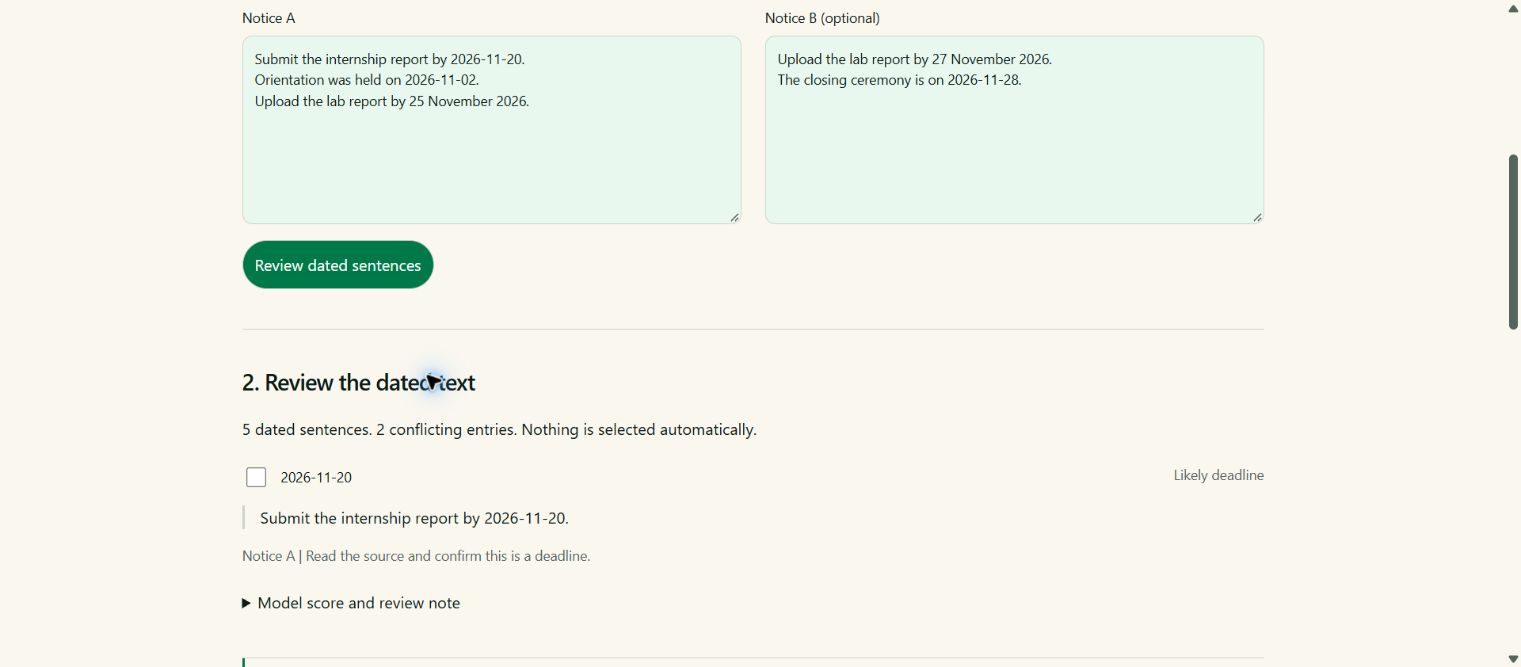
NoticeProof is a browser-local deadline review queue. A tiny learned model ranks explicitly dated sentences from pasted notices. Every candidate keeps its verbatim quote and source ID. Nothing is selected automatically, and no calendar account is connected.
The problem and baseline
A date pattern also finds orientations, closing ceremonies and publication dates. A simple keyword filter can mistake a discussion about deadlines for an actual deadline. I wanted a compact review workflow that keeps evidence beside each date and refuses conflicting exports, rather than silently turning every date into an event.
How it works
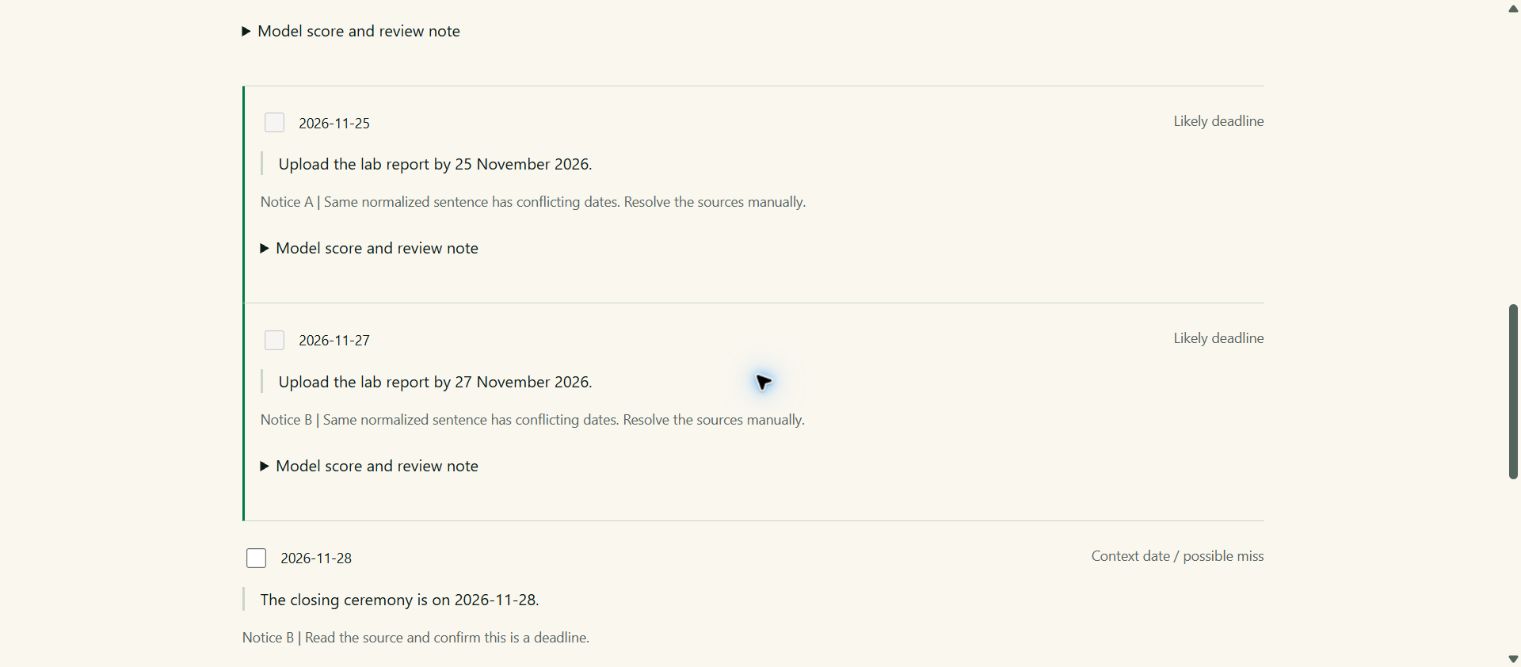
The browser extracts literal YYYY-MM-DD or DD Month YYYY dates. An 11.6 KB multinomial naive Bayes model, trained with word/bigram features, ranks the sentences. Exact normalized-sentence conflicts and multi-date sentences are blocked. Low-scoring context dates remain visible because a model can miss a genuine deadline.
After explicit review, a user can download an all-day ICS reminder. The export checks each quote and date against current sources, checks conflict state again, escapes calendar text and folds lines by UTF-8 bytes. Source edits clear prior selections and approval; no automatic calendar changes occur. Always check the original cutoff time and timezone.
Actual evidence
The first fixed synthetic evaluation used 32 labeled sentences, with labels and the threshold recorded before model fitting. The model correctly classified 31/32: 15 true positives, zero false positives and one missed deadline. A predefined keyword baseline scored 22/32, with five misses and five false positives. A broader post-hoc rule diagnostic scored 27/32, retaining all true deadlines but flagging five context dates. The model and threshold were not tuned after evaluation.
These are tiny, related English template families authored with Codex assistance, not real-inbox accuracy, a user study or a guarantee. The stronger rule diagnostic's recall is why every dated sentence stays visible. All labels, raw scores, baselines and the model miss are public. Eight Node test groups include Python/browser score parity on every evaluation case, invalid dates, source grounding, conflicting versions, review gating and ICS injection/folding checks. An actual downloaded calendar was inspected: one reviewed event and no blocked lab-date reminders.
Tools and development provenance
I used JavaScript, HTML/CSS and a dependency-free Python training script. Inference is actual local ML, not an LLM, a cloud demo or a mocked provider response. There is no API key, paid inference or external notice-text transmission.
The unsubmitted NoticeProof work began on 3 November, inside GenHacks' window, initially with a proposed cloud extraction route. Free access was unavailable, so this version replaced it with trained local inference. It has not been submitted to the other event. I used substantial ChatGPT/Codex assistance for implementation, synthetic data, evaluation, project preparation and documentation. Hallmark Dose scaffolding retains its MIT notice. Own source, model and synthetic data are MIT licensed.
Limits and next steps
Relative dates, missing years, slash dates, exact times, non-English text and paraphrased task identity are not inferred. Exact-sentence conflict detection can miss paraphrases. The UI handles two bounded notices and 40 dated sentences. No genuine user benefit or institutional adoption is claimed. Next work is consented real-notice evaluation and broader conflict detection, with the simple baselines retained.
