-
-
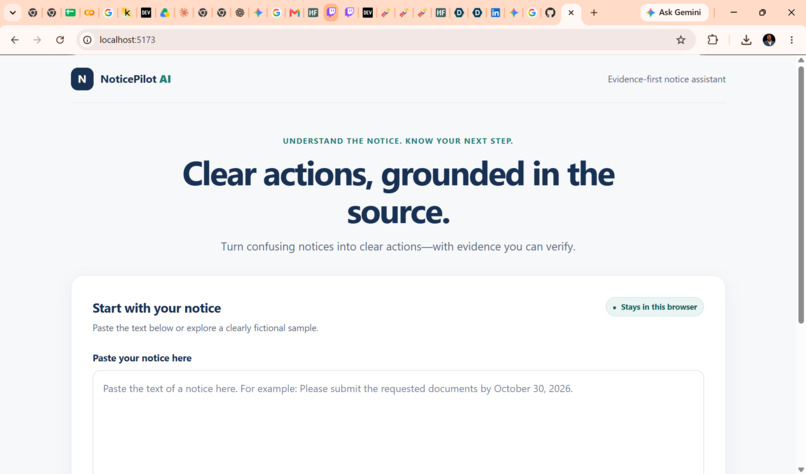
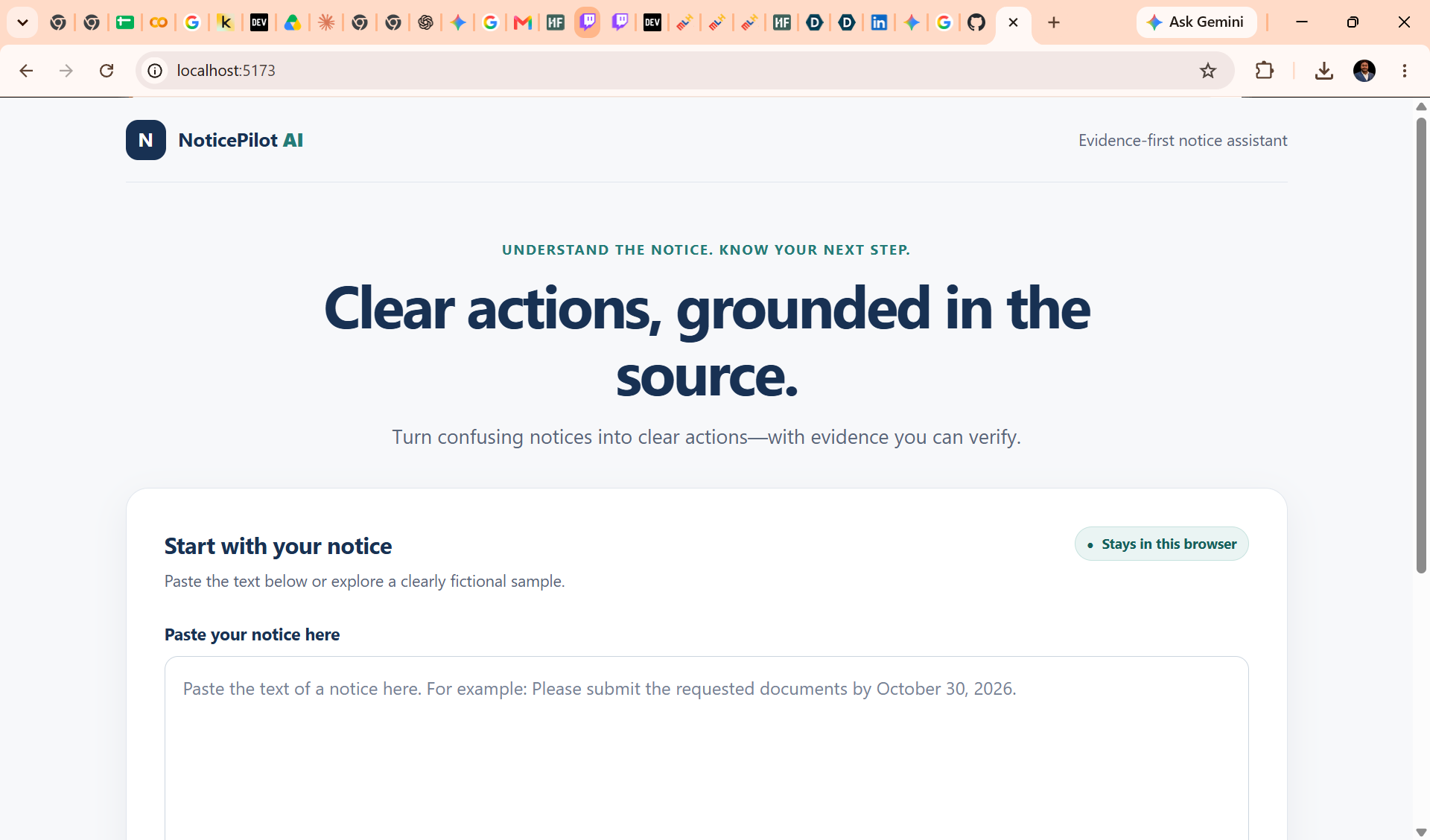
Notice pilot Ui demo
Inspiration
Administrative and public-service notices often contain important deadlines, eligibility conditions, and document requirements buried in dense or confusing language. Missing one detail can create unnecessary stress or cause someone to miss an important step.
We wanted to make these notices easier to understand without asking people to blindly trust AI. That inspired NoticePilot AI: an evidence-first assistant that prioritizes clarity, traceability, and honest uncertainty.
What it does
NoticePilot AI turns pasted administrative notices into a structured, plain-language guide. It organizes relevant information into:
- A concise summary of the notice
- Important dates and deadlines
- Required documents and instructions
- Practical next steps
- Supporting source excerpts for verification
It distinguishes information explicitly supported by the notice from ambiguous or conflicting details and information that could not be found. Instead of inventing answers, it highlights what needs further verification.
How we built it
We used the Devpost Learn Skill Pack to follow a structured, planning-first development process. We defined the project scope, translated it into product requirements, and developed a technical specification before implementation.
The planned application uses React, Vite, and TypeScript, with a focus on deterministic text extraction, source-linked findings, explicit verification states, and a responsive interface. The goal is to keep the core experience lightweight, explainable, and usable without requiring an external AI API key.
Challenges we ran into
The central challenge was balancing usefulness with reliability. A notice can contain inconsistent dates, unfamiliar wording, or instructions that do not fit predefined patterns. Producing a confident-looking answer is easy; producing one that users can verify is harder.
We addressed this challenge in the design by prioritizing explicit source evidence, distinguishing uncertainty from confirmed information, and avoiding unsupported conclusions. Another challenge was keeping the scope small enough to build and verify within the hackathon timeframe.
Accomplishments that we're proud of
We are proud of centering the product around a simple but important principle: every important finding should be traceable to the original notice.
NoticePilot AI also emphasizes transparent uncertainty rather than treating every extracted detail as equally reliable. Its focused scope and planning-first workflow aim to make the result maintainable, understandable, and practical rather than an unnecessarily complex AI prototype.
What we learned
We learned to treat planning as an essential part of building with coding agents. A clear scope, explicit requirements, and a technical specification help constrain implementation and keep decisions connected to the user's needs.
We also reinforced an important lesson for AI-assisted products: trust does not come from generating more text. It comes from making the basis of an answer visible, communicating uncertainty clearly, and giving users a way to verify the result.
What's next for NoticePilot AI
Next, we want to improve extraction across more notice formats, strengthen detection of conflicting dates and requirements, and expand test coverage for unfamiliar or incomplete text.
Longer term, NoticePilot AI could support document uploads, multilingual explanations, accessible summaries, and carefully designed workflows for different public-service domains. Any expansion would preserve the core principle: help people understand the source document without replacing official guidance or inventing facts.
Built With
- css3
- devpost
- git
- github
- html5
- javascript
- learn
- node.js
- npm
- react
- skill
- typescript
- vite

Log in or sign up for Devpost to join the conversation.