Prototype link: Prototype link (Please submit a link to a playable prototype, not a link to your design file) Link
Responses to questions about the user research and design thinking process **Describe your project (Max 150 words)
From the popularization of the term Boomer to the stereotype that Generation Z grew up with iPads in their hands, there has always been negative perceptions about every generation, creating distance. Although older generations have seen more, experienced more, and learned their fair share of life lessons, they can find it hard to share their knowledge with younger generations. So how might we promote authentic and positive storytelling for multi-generational users so that they are able to overcome cultural and social barriers, forming genuine connections through lived experiences?
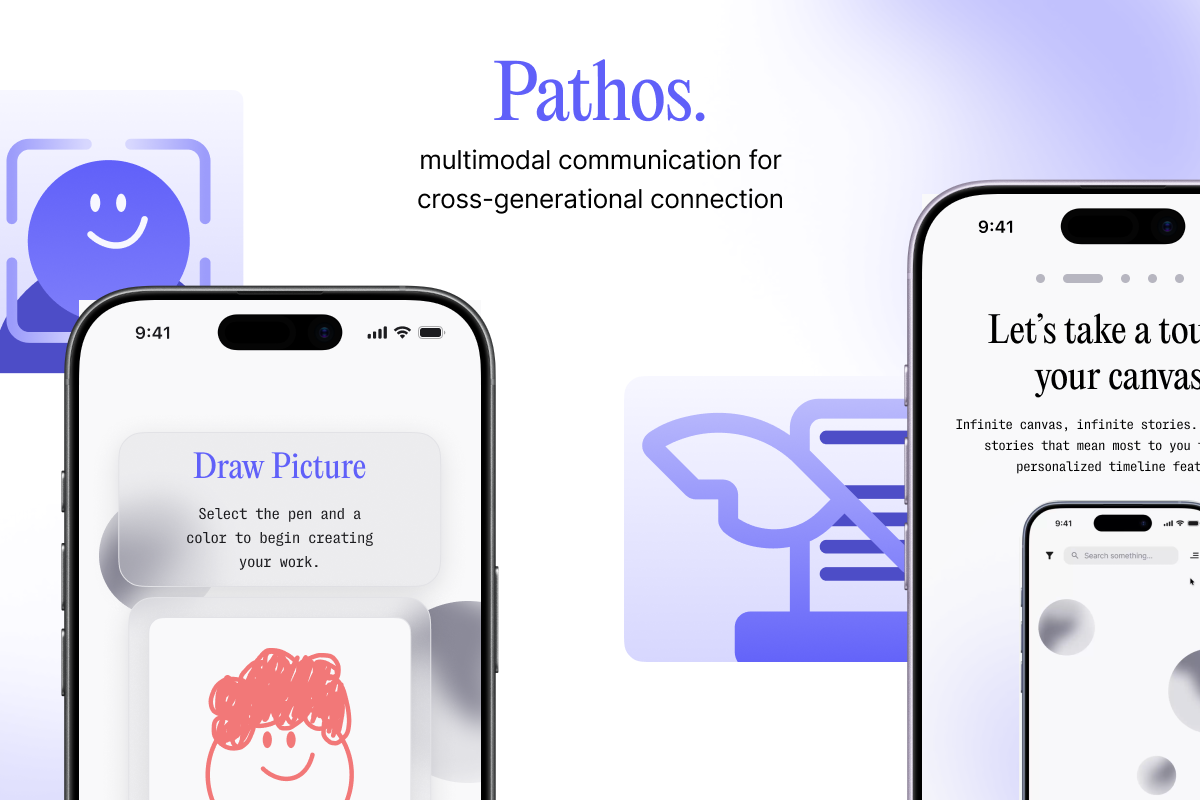
Pathos empowers younger and older generations to connect over shared experiences and storytelling by providing users with an infinite canvas on which to store their multimodal entries, that can take the form of written notes, hand-drawn pictures, or voice recordings accompanied by subtitles, within. Create to your heart’s content and freely fill and personalize your canvas for their connections to explore
Describe your research process and findings. If you conducted any surveys or interviews, please include the survey form and/or interview questions here. If you conducted secondary research by pulling from online sources, please include a link to your sources. (Max 500 words)
Through our mixed-methods research, our team aimed to dive deeper into the methods of communication between different generations, specifically when sharing stories, values, and lived experiences with one another. We intentionally chose our research methods to ensure a combination of both qualitative and quantitative data. We conducted secondary research with the goal of better understanding the gaps between generations and the potential causes of these pain points, while additionally gathering survey responses using a Google Form on social media platforms to gain personal perspectives on interacting with generations other than their own. Using affinity mapping techniques, we extracted key research insights that helped inform our design direction.
Results and Insights: Through our secondary research, we learned about the true effects of intergenerational gaps, but also the benefits that come from addressing them. Intergenerational contact improves mental and physical health, lowering risk of depression, and fosters feelings of purpose, according to an Innovation in Aging article. Pulling from our quantitative survey data, 54.5% of respondents interact with someone from another generation daily, with these generations ranging from Baby Boomers to Generation Alpha, and did so through methods like in-person interactions, video calling, and social media. However, when evaluating the effectiveness of these methods, only 64% of respondents said current methods ranked 8/10 or higher in effectiveness when communicating with other generations, while 36% of respondents said current methods ranked 7/10 or lower.
Looking at our qualitative research, we identified three key insights spanning the experiences of our respondents. The first insight is that social and cultural differences influence the ability to share stories and experiences. Intended messages become misconstrued due to language barriers, values, and perspectives, according to survey respondents. Additionally, emotions influence storytelling participation and deter users from interacting with others. Unapologetic and authentic connection is clouded by fear of social perception and suspicions of disingenuity. Lastly, learning through shared stories and lived experiences makes connection enjoyable. Digital platforms enable users to learn from those with different experiences than their own, and four respondents specifically mentioned that learning from others makes connection enjoyable.
Combining our knowledge from survey results, secondary research, and literature review, we were ready to design a solution that promoted authentic and positive storytelling for multi-generational users so that they are able to overcome cultural and social barriers, forming genuine connections through lived experiences.
Describe your most important design decisions. What research findings and/or user testing results led you to make these decisions? (Max 500 words)
Before beginning to ideate and design, our team developed a set of design principles based on our design question and research insights. The first principle we decided on was low-friction design, as our product is intended for cross-generational use and should be easily navigated by all, disregarding technical adeptness. Our second principle is multicultural sincerity, since our product empowers respectful, authentic representation of shared experiences and cultures through an unapologetic lens. The features included in Pathos are a product of these design principles.
Varied Viewing Modes: When wireframing our application, we wanted to ensure that we were not excluding any potential user, no matter their generation. We had adequate representation of each generation in our survey, with 72.7% representing Generation Z, 9.1% representing Generation Alpha, and 18.2% representing Generation X. In our secondary research, we learned that one major pain point between younger and older generations is the gap in technological fluency. To ensure our product can be used by both groups of generations, we chose to have two main viewing modes: an infinite canvas and a timeline. This way, the preferences of younger and older generations are included in the final design.
Intuitive Mapping: Once users are done creating an entry, they can categorize it in a way that is unique to them and their understanding of their own experiences by creating personalized labels. Survey respondents recounted times in which they felt uncomfortable telling their own stories due to social anxiety, fear that they had already forgotten the story, or fear that others wouldn’t understand their experiences. With Pathos’ intuitive and personal mapping feature, our users’ connections can effectively understand the mind of our user and the context in which their experiences and stories exist.
Multimodal Entries: Pathos provides users with multiple mediums through which to create an entry. In our research, we discovered that there are at least five different ways that generations communicate with one another, and we wanted our product to reflect this understanding. Users can choose from sticky notes, voice memos, videos, and photos, and can choose to recount a story, document a pivotal moment, or share an entertaining experience.
Sharing through Stories: In our user research, 50% of respondents answered 10 on a scale from 1 to 10 to represent their interpretation of the value of sharing stories and experiences, while the other 50% of respondents answered between 9 and 7. This data is overwhelmingly positive, and so to facilitate intergenerational connections, we chose to use storytelling as a vessel, not only due to its popularity among our survey results, but also because of its wide breadth as a solution to solving generational disconnect.
Overall, these design decisions and creations help lay stable foundations for Pathos rooted in user and secondary research, empathetic approaches, and putting our users first.
If applicable, describe how you utilized AI in your design process in detail. Please explain where AI fit into your workflow, which tools you used, and the specific purpose AI served at that stage. Include a concrete example of how AI influenced a design decision. (Max 500 words)
We did not use AI throughout the Rice Design-a-Thon.
Built With
- figma
- framer

Log in or sign up for Devpost to join the conversation.