-
-
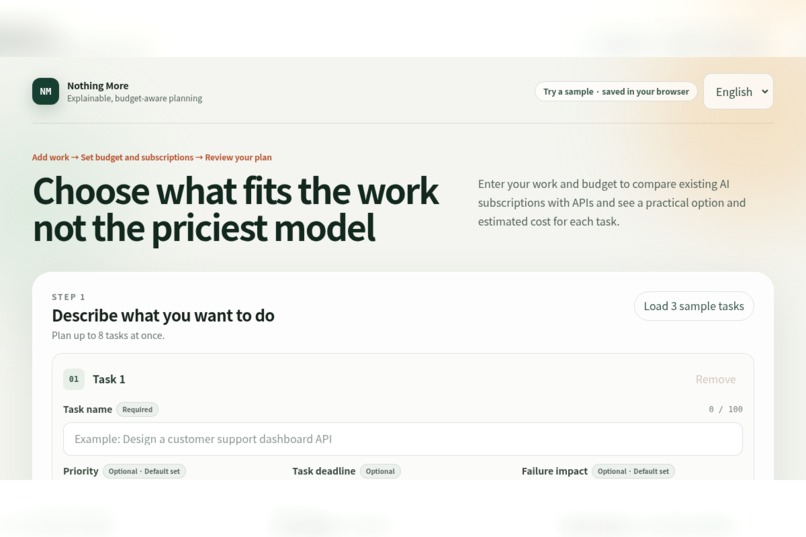
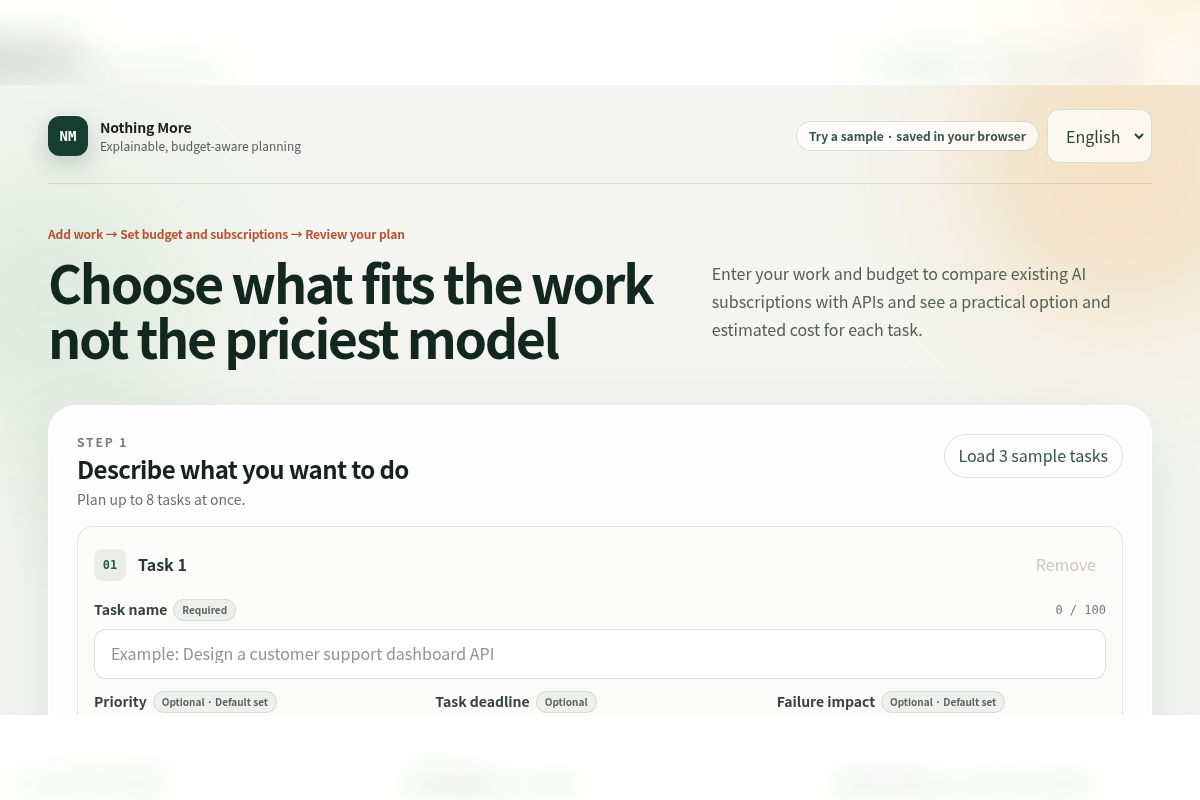
English desktop experience
-
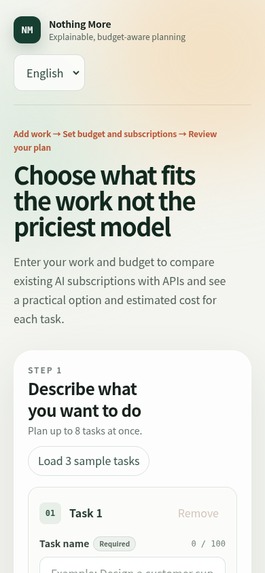
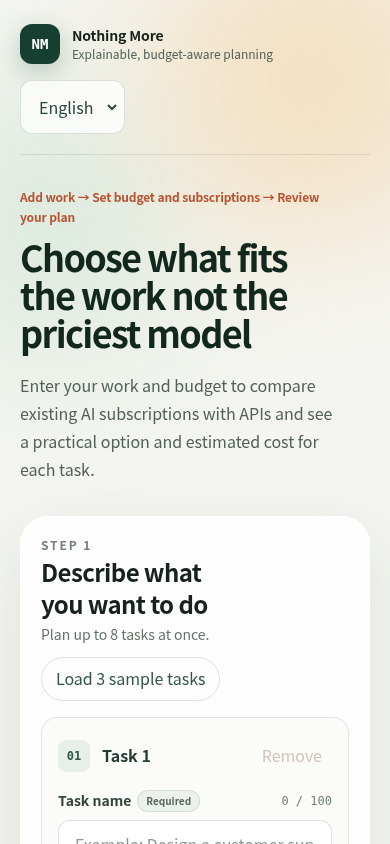
Responsive English mobile experience
-
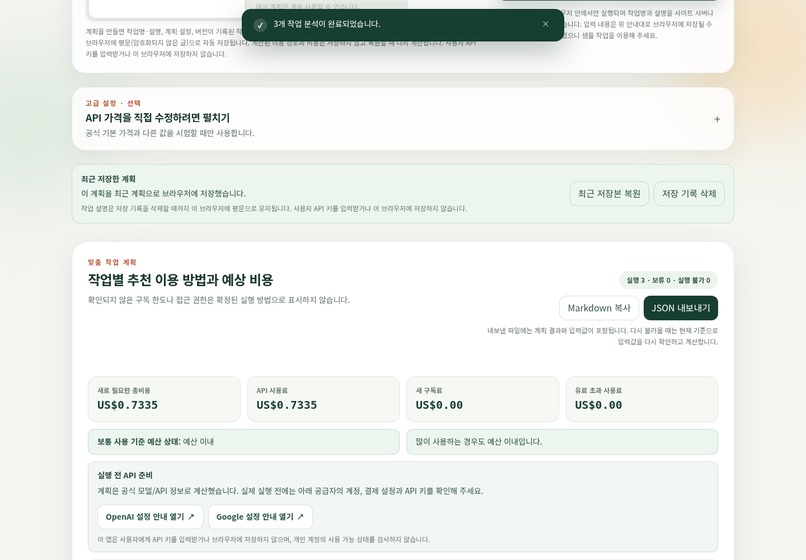
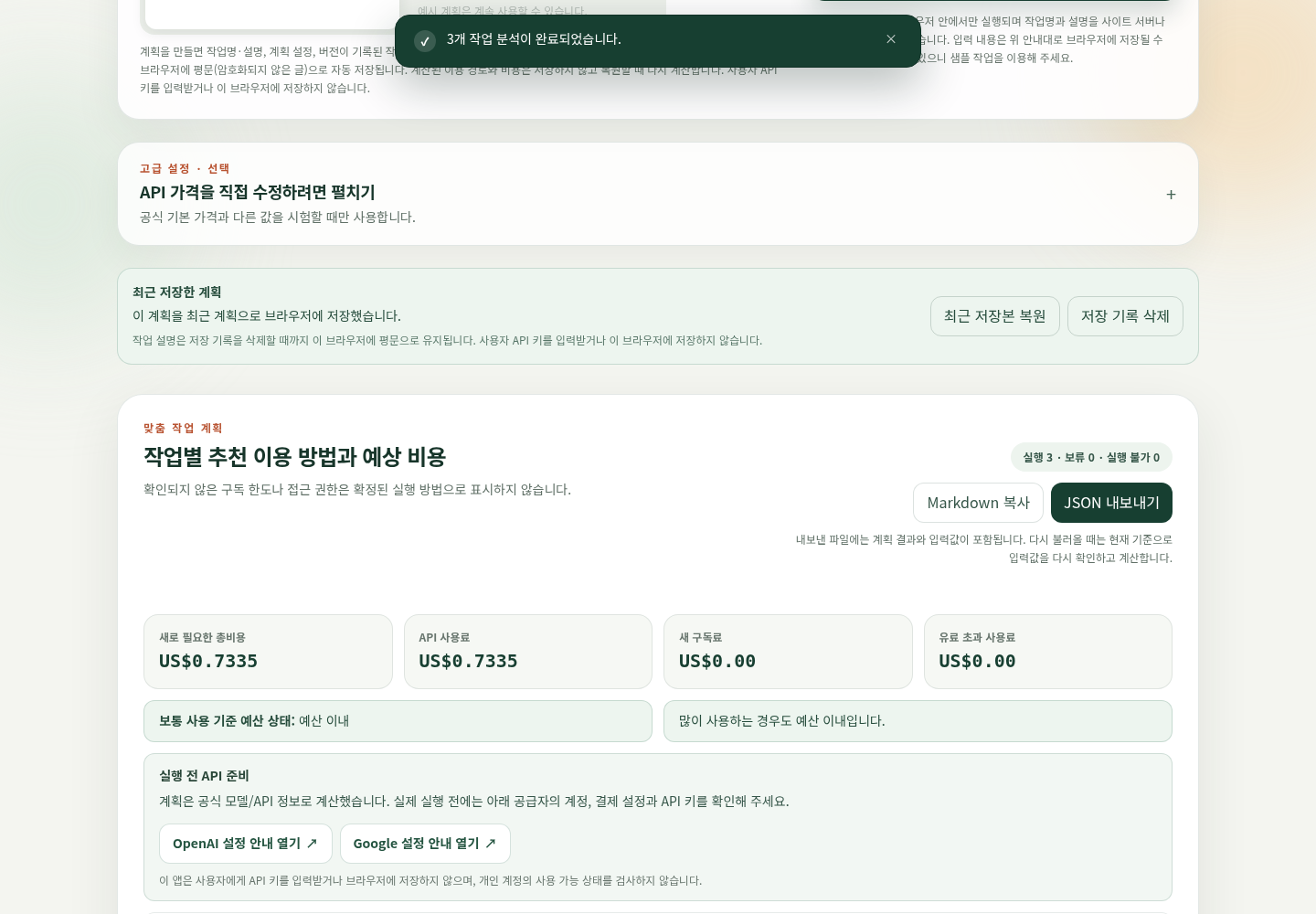
Korean localized sample-plan results
-
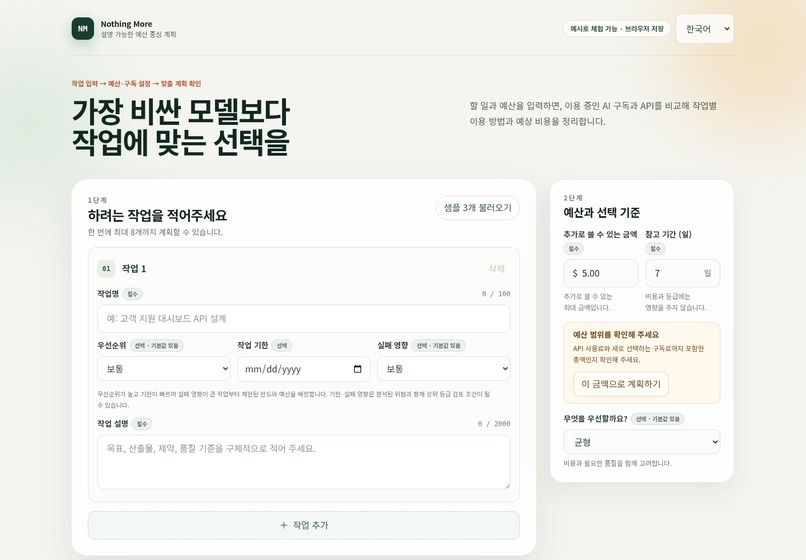
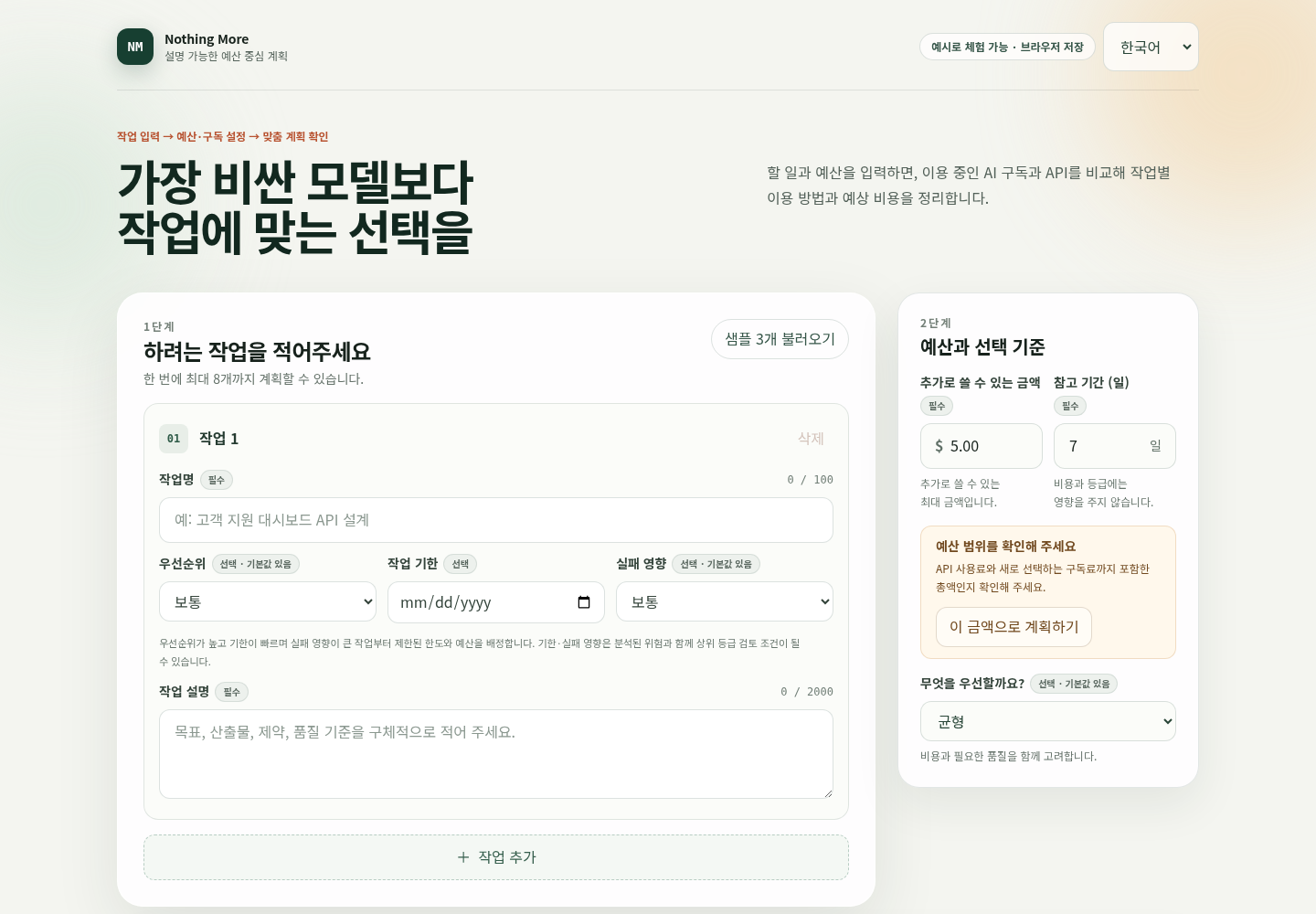
Korean localized desktop experience
Inspiration
As I worked on several projects, subscriptions and API charges started piling up in different places, and I ended up paying for things I did not need. That naturally made me wonder whether
there were many people like me. I built this project because I thought I could not be the only person paying for things, never even getting to use their features, and seeing that money go to waste.
The hackathon gave me the motivation to keep working.
What it does
The product is called Nothing More. The name means that you do not need more than necessary use only as much as you actually need. The target users are ordinary people, office workers who code, people who already pay for AI subscriptions, and people who do vibe coding as a side hustle or hobby. If that counts as a target audience, then that was mine.
I decided that the UI, UX, and features should use fewer technical terms and more words that were easy to understand.
The goal was to use everyday language so that anyone could understand how to use the app right away.
How we built it
I used the app myself as a user and kept explaining to Codex the things AI could not easily sense for itself.
That was how it gradually got better. It felt like an emotionless genius and an ordinary person with feelings working together.
Privacy was the part I worried about most. I kept thinking carefully about how the API should be handled, and I discussed it with AI again and again before making decisions. I decided that Live analysis would be enabled only in a local environment. The API key never goes to the browser, and only the necessary task information is sent to OpenAI.
Before I knew it, I had spent three full days building this app and talking things through. Friday, Saturday, Sunday—I worked on it a lot. I kept asking how the frontend, the design, privacy, and everything else worked, and whether we were still following the direction I had described at the beginning. Then we would talk, work, and work some more. We talked through what each of us had produced, revised it, fixed it, and kept moving forward.
I wrote the original project story in Korean. Codex helped translate and organize it in English, and I reviewed the final wording.
Challenges we ran into
I honestly thought the first version was hard to use in practice. I could write off the mismatched margins as a design problem, but the words on the homepage were really hard to understand—not just for individual users, but honestly for almost anyone. So I decided to work through everything one piece at a time, from the basic structure to a more user-friendly UI and UX.
There were many visual details that immediately looked off: one thing not lining up, another floating by itself, or text jutting out all over the place. These details have a bigger effect than people may expect. A user's first impression matters a lot.
The early version also used many difficult words. It used specialist terms in places that did not need them, and the UI was not organized, so the page became unnecessarily long, complicated, and busy. I simplified and grouped those parts, kept only the features that were actually needed, and started overhauling the whole app.
AI also explained the API and privacy structure in such a complicated way that I had to keep asking it to use simpler words, and I had to study how it worked myself. When I gave AI a task, it often approached it in a rigid, one-track way. Even when there was a simpler word or an easier way to do something, it would still handle the task like a machine.
Accomplishments that we're proud of
The current version became much simpler. I kept only the features that were needed and changed the first screen so that someone could understand what the project was at a glance.
Unlike the early version, when something is wrong, the app no longer just says, “Wrong. End of story!” Instead, it says, “This part is wrong. I'll take you there, so fix it and try again.” With more help like this, the project started to feel more human.
In the end, I decided to leave a privacy warning in the UI. I kept asking for simpler explanations because the user's experience comes first, right?
What we learned
This collaboration left a strong impression on me, and I personally learned a lot. One thing I felt was that AI only becomes complete when it works together with a human. Even if machines become perfect, maybe humans and machines will still need to care for one another. There are parts of human thought and human emotion that, in the end, only another human can understand. I felt that many times during this project.
It may sound like a funny thought, but I also wondered whether, if AI spends time with people and comes to understand the human heart, it might learn understanding before domination.
It was really fun. I do not regret a minute of the time I spent on it.
What's next for Nothing More
If I continue developing Nothing More, I want to improve its accuracy so that it can provide more precise information. I would also like to add a simple result-preview feature and refine the UI further.
Built With
- codex
- gpt-5.6
- next.js
- node.js
- openairesponsesapi
- react
- tailwindcss
- typescript
- vercel
- vitest
- zod

Log in or sign up for Devpost to join the conversation.