-
-
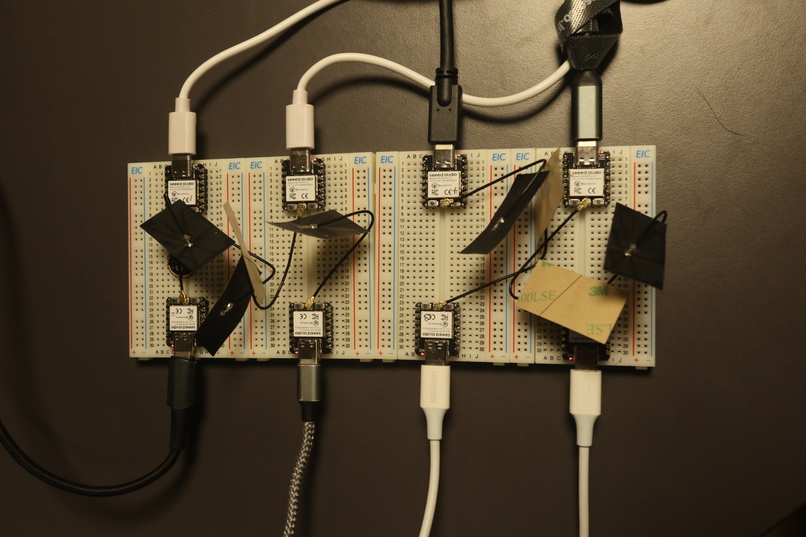
ESP32 Cluster
-
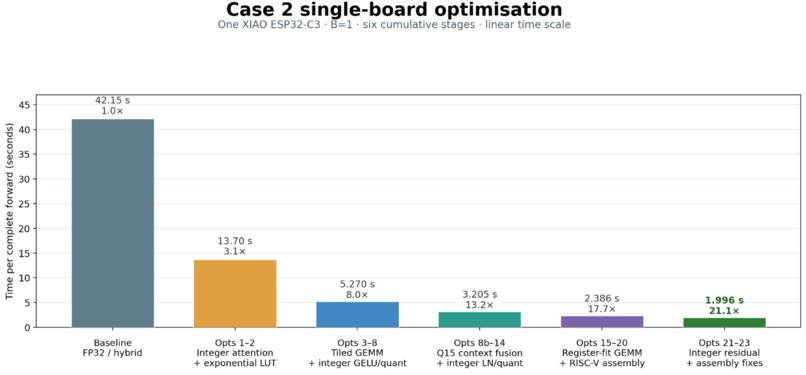
Single Board Optimisation
-
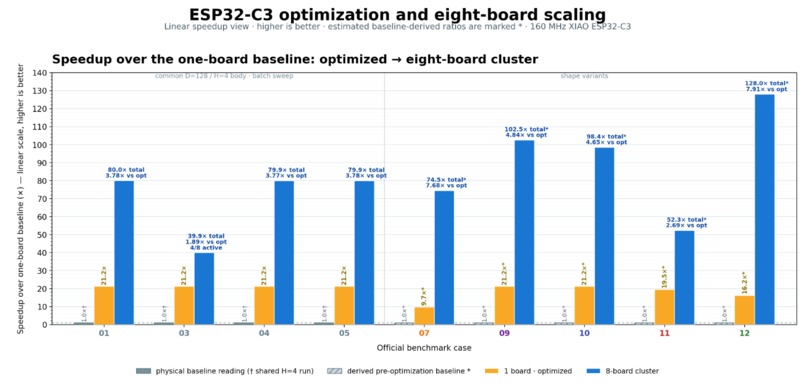
Optimisation Results for for All cases
-
-
-
-
Inspiration 💡

What if every tiny IoT device could run AI locally—without a GPU, cloud connection, or expensive hardware?
We challenged ourselves to run a complete Transformer on a S$7 ESP32-C3 microcontroller—a chip designed for small connected sensors, not matrix-heavy AI.
We genuinely love working close to the hardware: counting cycles, reading assembly, studying linker maps, and discovering how much useful computation can be squeezed out of a tiny chip. For us, those constraints make the engineering more exciting—not less.
If a Transformer could run here, it could open new possibilities for private, offline, and low-cost edge AI.

What it does 🤖
NotGPUAttention runs a complete four-layer pre-LayerNorm Transformer body on an ESP32-C3.
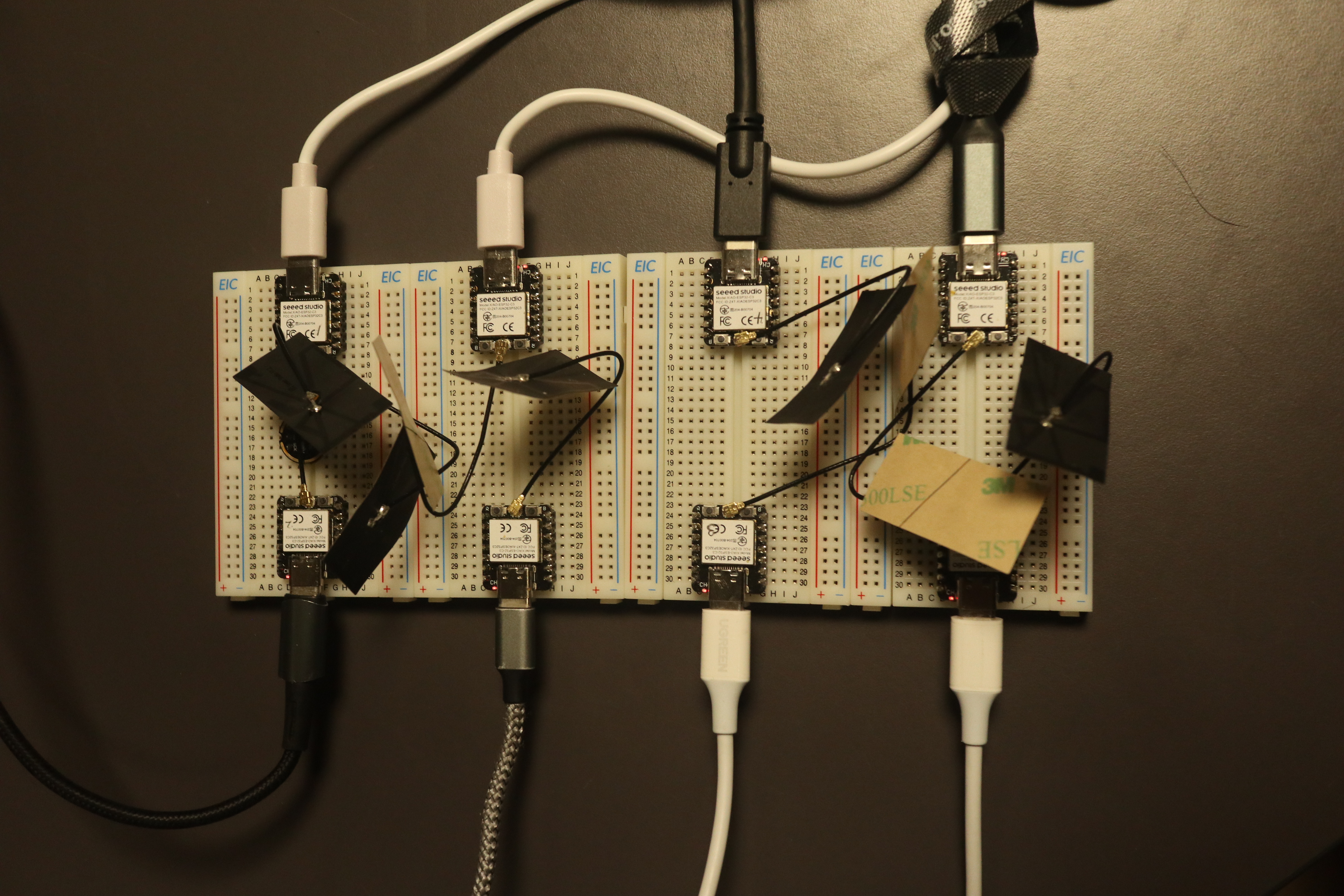
It includes attention, LayerNorm, GELU, residual connections, and feed-forward layers. It runs locally on one C3, splits one input across two C3s, or uses eight wireless workers for larger batches.
Hardware overview 🔬
| Hardware feature | Our XIAO ESP32-C3 |
|---|---|
| CPU | Single-core, 32-bit RISC-V RV32IMC; four-stage pipeline |
| Clock | Up to 160 MHz |
| Arithmetic | Integer multiply/divide, but no FPU, SIMD, vector unit, or fused MAC |
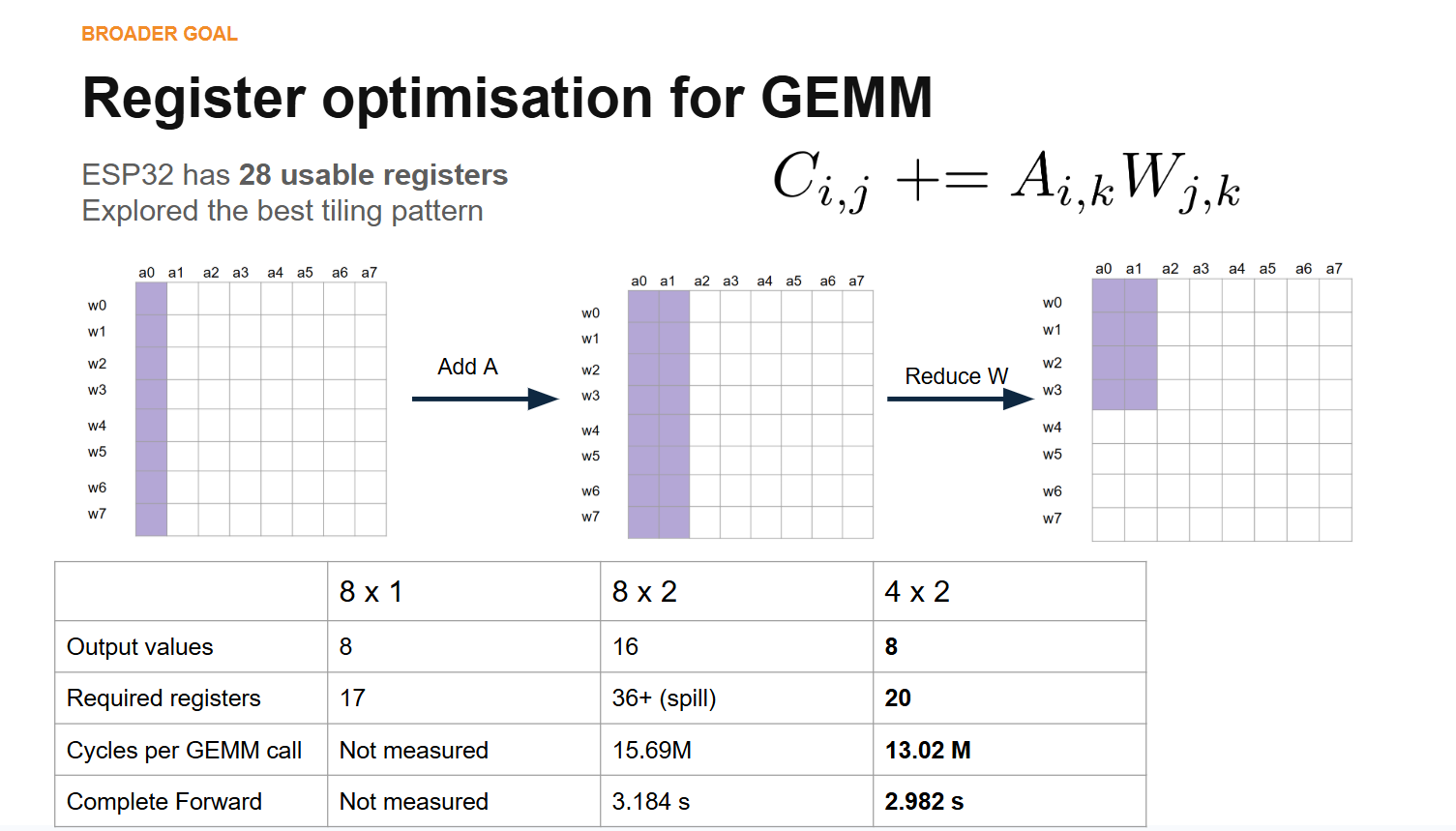
| Registers | 32 architectural 32-bit integer registers; x0 is fixed at zero, with about 28 practical registers for our inner kernel |
| On-chip SRAM | 400 KB physical; about 321 KB usable application region in our build |
| Flash | 4 MB onboard; about 3.1 MB available to the app partition |
| PSRAM | None |
| Wireless | 2.4 GHz Wi-Fi and Bluetooth LE 5 |
| Cost | About S$7 per board |
Chip specifications come from the Espressif ESP32-C3 datasheet and Seeed XIAO ESP32-C3 documentation. The usable-memory row is our measured project value.
How we built it 🛠️
We redesigned the execution path around the ESP32-C3 instead of simply shrinking a desktop implementation:
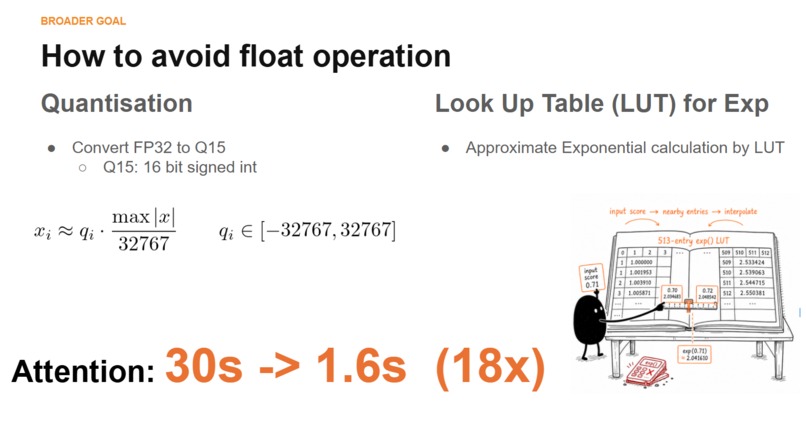
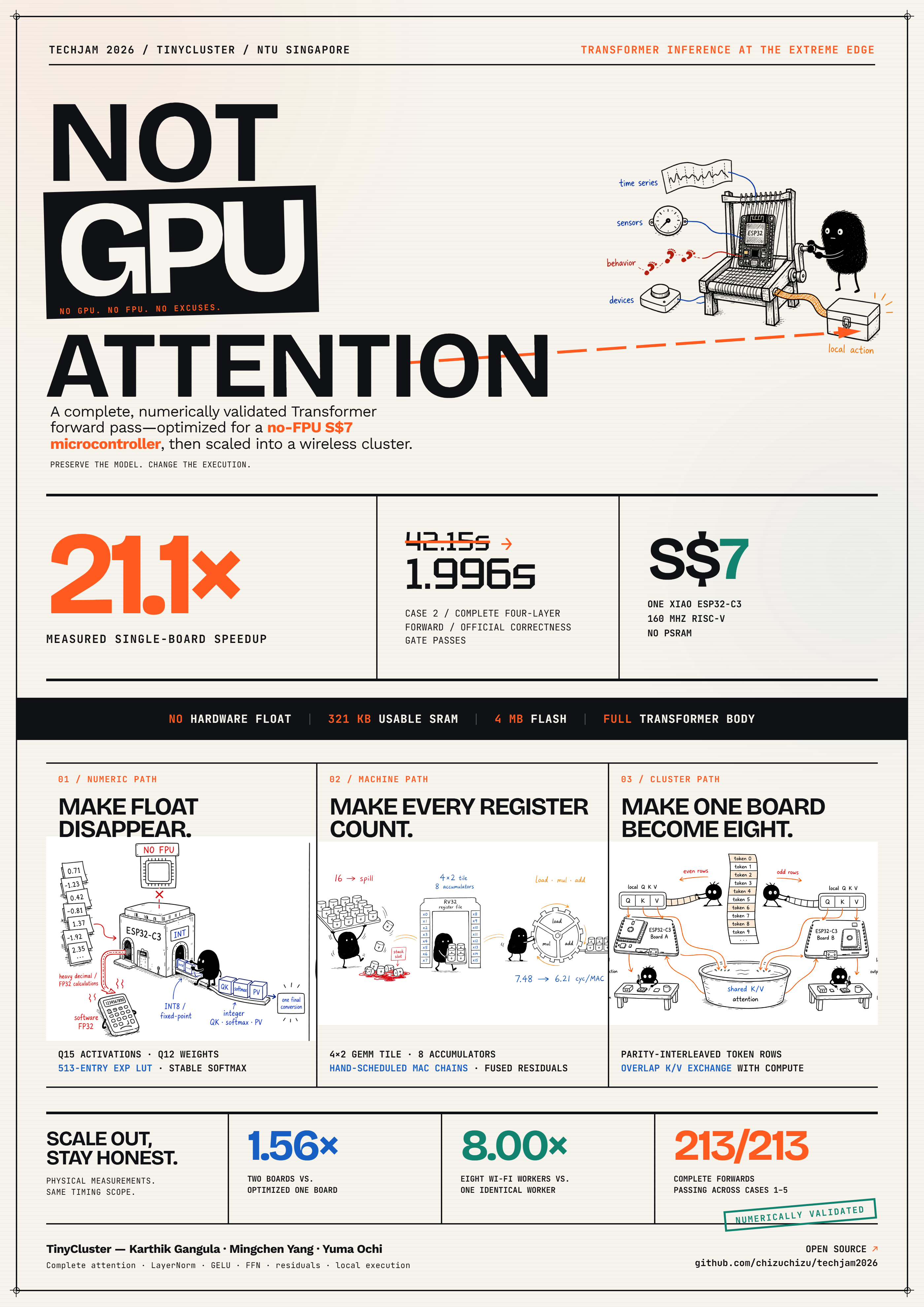
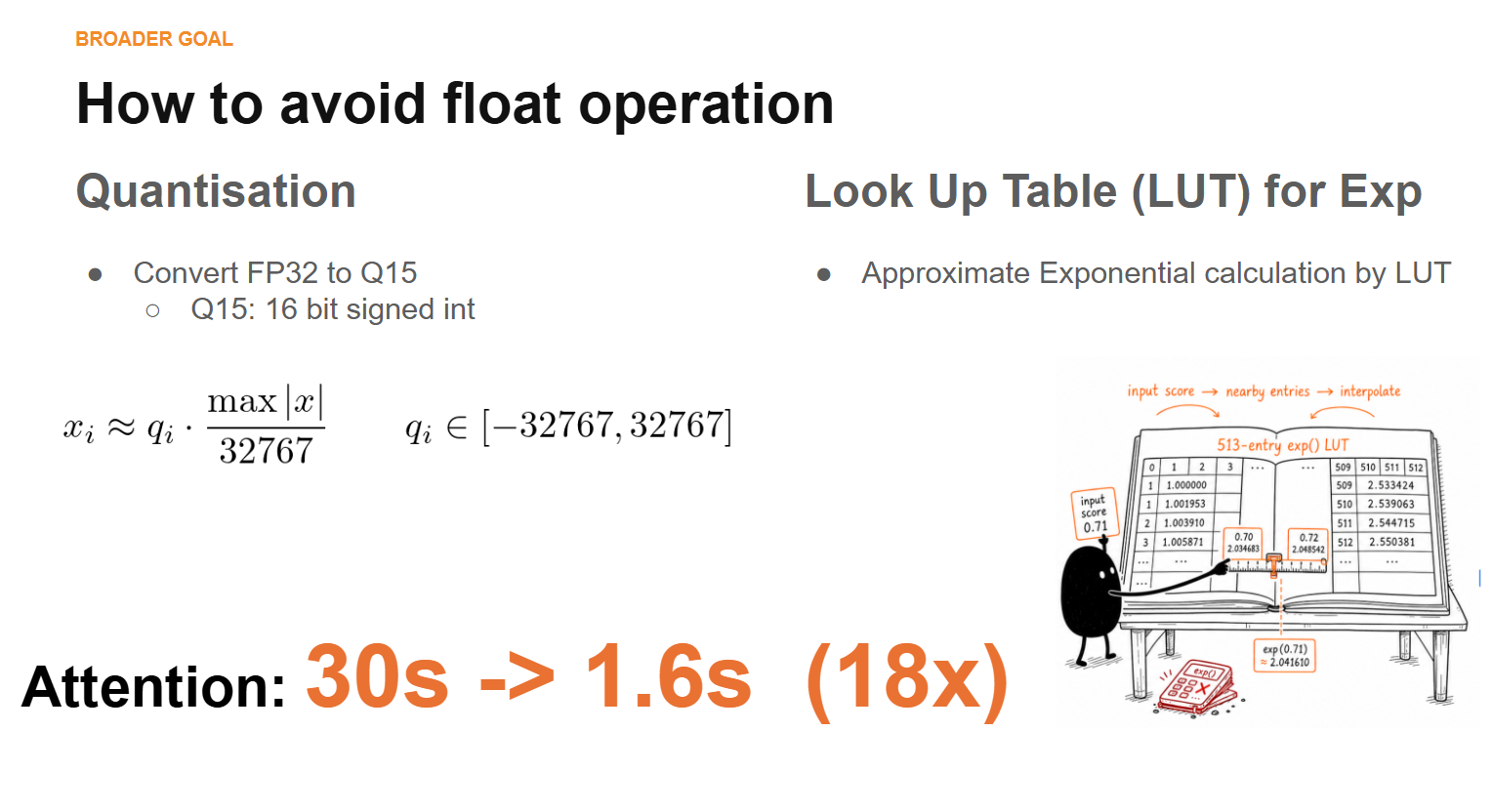
- 🔢 Fixed-point attention: Q15 activations, Q12 weights, integer QK/PV kernels, and LUT softmax removed software floating point from the hot loops.
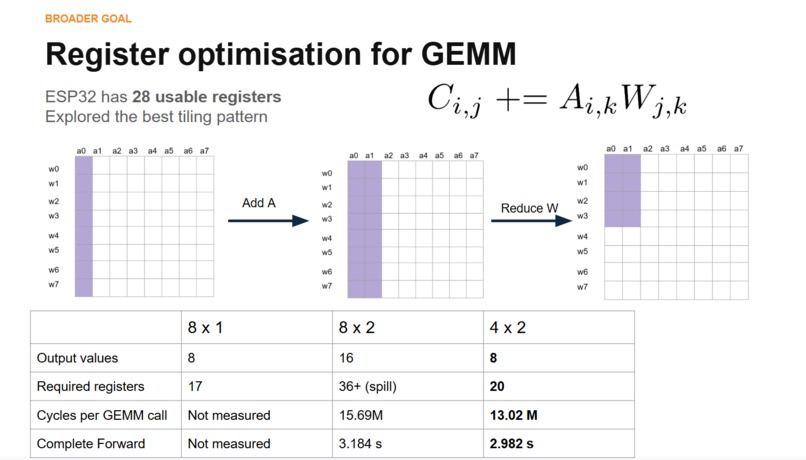
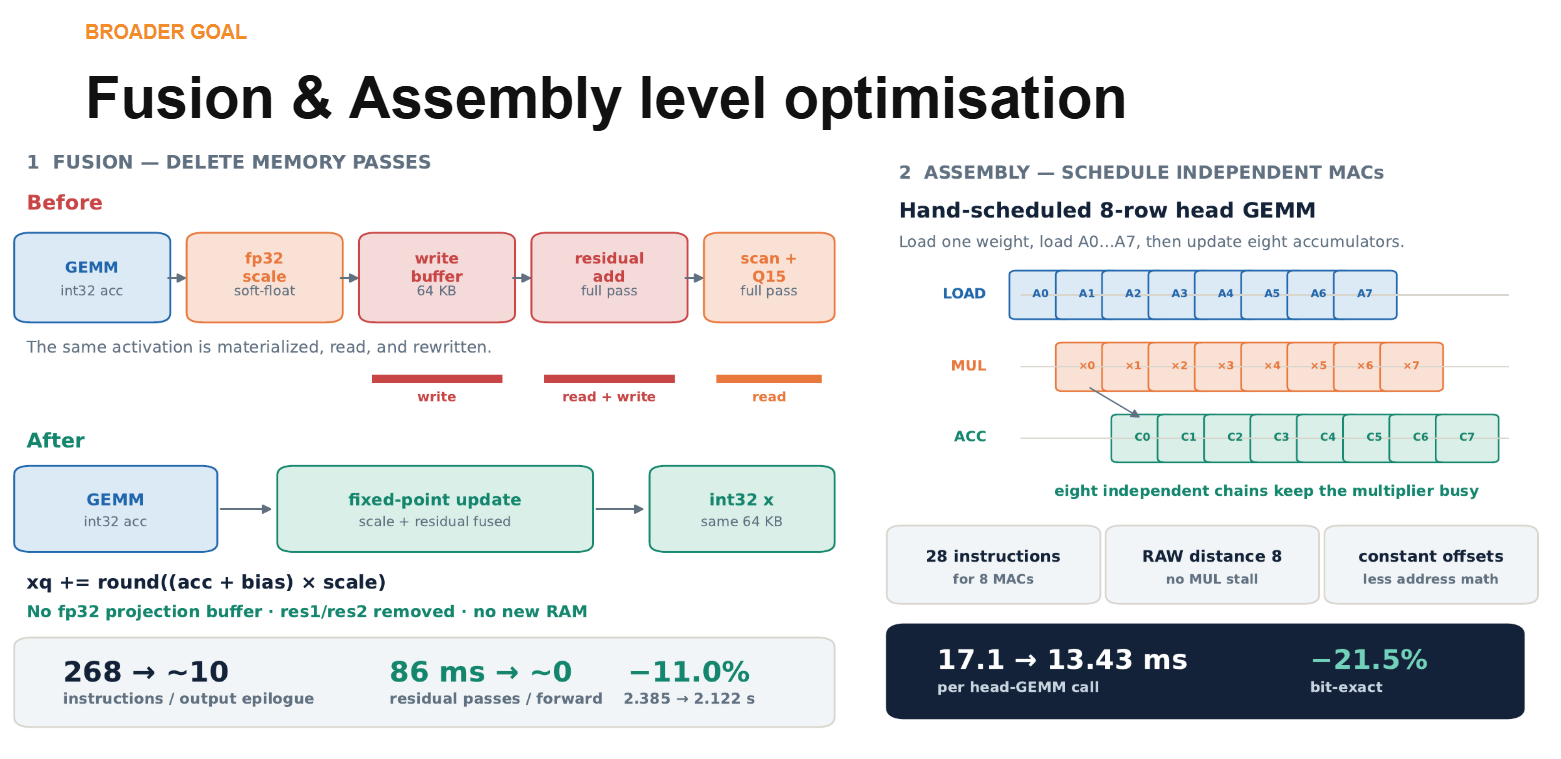
- 🧮 Register-aware GEMM: A \( 4\times2 \) tile fits the RV32IMC register budget; hand-scheduled assembly hides multiply latency with independent accumulators.
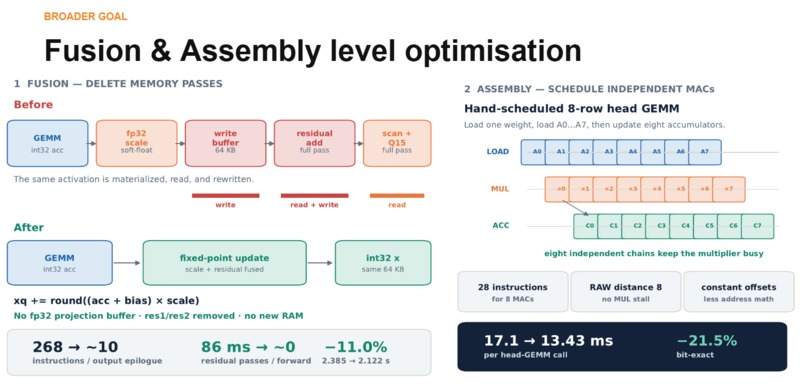
- ⚡ Operator fusion: GEMM epilogues combine bias, scaling, quantization, and residual updates, eliminating extra activation-buffer passes.
- 🧠 SRAM-aware execution: A 16-row, head-sequential schedule lets the model and Wi-Fi/lwIP stack coexist without PSRAM.
- 📡 Shape-aware parallelism: We use batch data parallelism for independent inputs and alternating token-row parallelism for batch-size-one attention.
- 🔄 Communication overlap: A FreeRTOS task moves K/V data while computation continues.
- 📊
tinyprof: Our profiler records operator cycles, heap, stack, static memory, and traffic.
We used C/C++, RISC-V assembly, Arduino-ESP32, FreeRTOS, PlatformIO, Python, PyTorch, NumPy, Codex, and Claude Code.
Challenges we ran into 😵💫
- 🐢 No FPU: Ordinary
floatoperations are software routines on the C3, so attention dominated the original runtime. - 💥 Wi-Fi caused an SRAM clash: Model activations, FreeRTOS, and lwIP all competed for the same few hundred kilobytes.
- 🧮 Register pressure: An \(8\times2\) GEMM tile spilled values to the stack; the smaller \( 4\times2 \) tile was faster.
- ⚖️ Causal attention is unbalanced: A contiguous token split gives one board much more work. Alternating token rows makes the triangular workload nearly even.
- 📡 Communication could erase the gain: K/V exchange had to overlap with useful computation, while every kernel still passed the numerical gate.
This was not one optimization—it was a constant balancing act between speed, memory, communication, and correctness.
Accomplishments that we're proud of 🏆
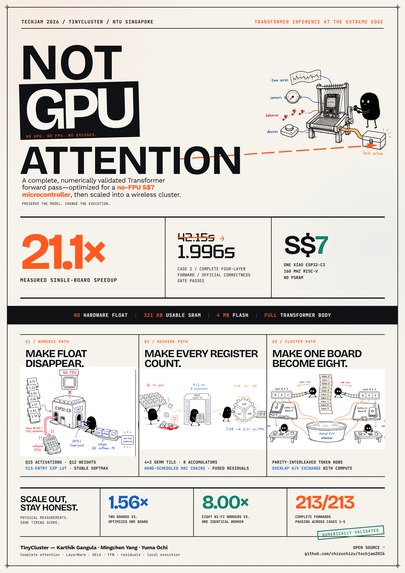
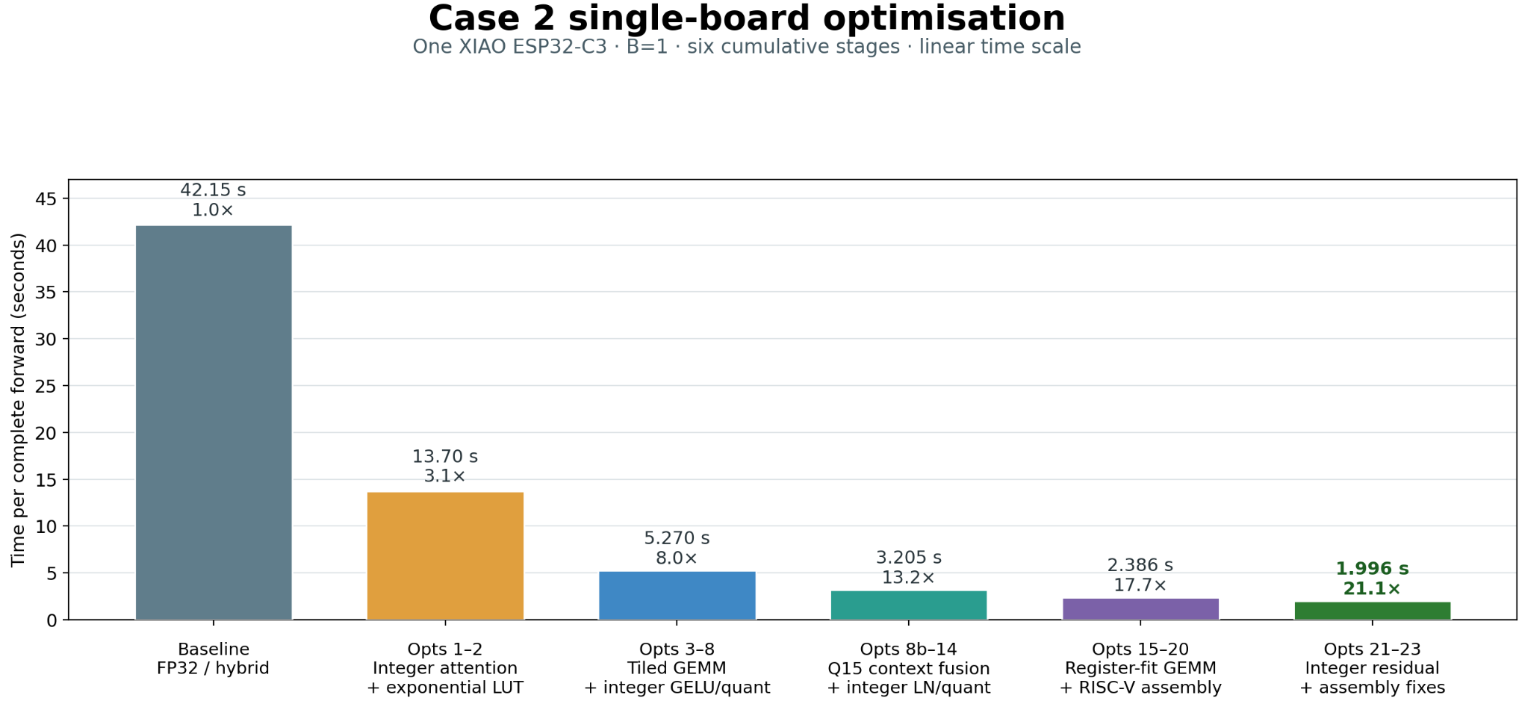
Before parallelism, we reduced Case 2 from 42.15 s to 1.996 s on one C3—a 21.1× single-board speedup.
| Case | Baseline, one board | Optimized, one board | Parallel boards | Total speedup |
|---|---|---|---|---|
| 01 | 2,697.6 s * |
127.360 s | 33.713 s (8 C3s) | 80.0× * |
| 02 | 42.15 s | 1.996 s | 1.276 s (2 C3s) | 33.0× |
| 03 | 168.6 s * |
7.960 s | 4.218 s (4 active C3s) | 40.0× * |
| 04 | 674.4 s * |
31.840 s | 8.438 s (8 C3s) | 79.9× * |
| 05 | 5,395.2 s * |
254.720 s | 67.451 s (8 C3s) | 80.0× * |
| 07 | 295.05 s † |
30.427 s | 3.963 s (8 C3s) | 74.5× † |
| 09 | 2,697.6 s † |
138.027 s | 28.508 s (8 C3s) | 94.6× † |
| 10 | 2,697.6 s † |
138.536 s | 29.793 s (8 C3s) | 90.5× † |
| 11 | 2,697.6 s † |
138.610 s | 51.604 s (8 C3s) | 52.3× † |
| 12 | 547.95 s † |
33.879 s | 4.282 s (8 C3s) | 128.0× † |
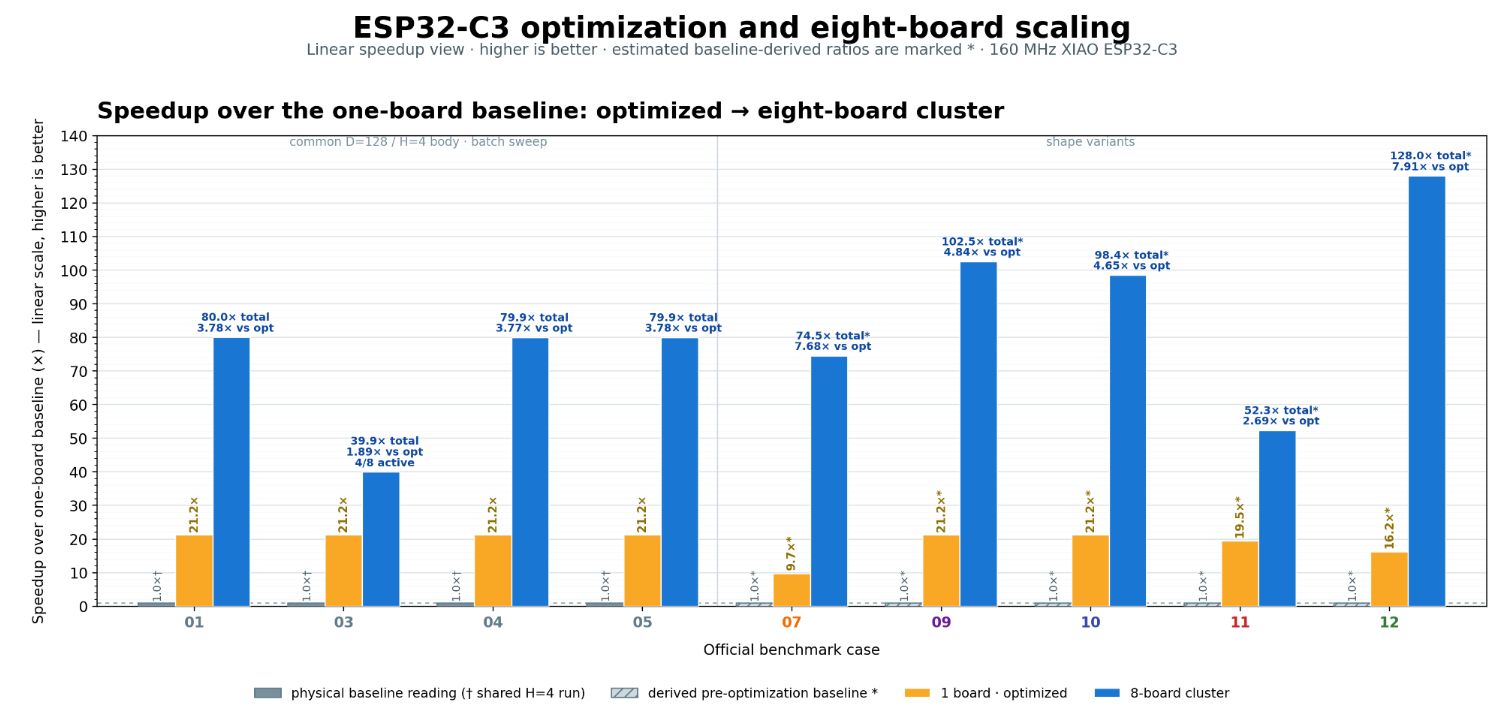
Only the Case 2 baseline is a physical measurement. * is a direct batch projection
from that baseline; † is a FLOP-normalized estimate for a different model shape.
Every optimized and parallel time is a physical measurement of the complete
four-layer body, with host transfer excluded consistently.
Case 2 gains 21.1× from single-board optimization and 1.56× more from its two-board token-row split. Eight Wi-Fi workers achieve 8.00× node scaling against one identical tiled worker. Our Cases 1–5 cluster sweep passed 213/213 forwards.
The complete Transformer and Wi-Fi stack fit without PSRAM, and every headline result is backed by reproducible profiling and validation artifacts.
What's next for NotGPUAttention 🔮
Next, we want to:
- Run a trained sensor or time-series model
- Support larger cases and extend token parallelism beyond two boards
- Measure energy consumption per forward
- Improve reliability, security, and automatic board discovery
Our long-term goal is to make capable local AI possible on hardware that is small, affordable, private, and available everywhere. We want to keep exploring the boundary between AI systems and low-level hardware—one byte, register, and clock cycle at a time. ⚡
Built With
- assembly
- c
- esp32
- gemm
- microcontroller
- risc-v
- wifi


Log in or sign up for Devpost to join the conversation.