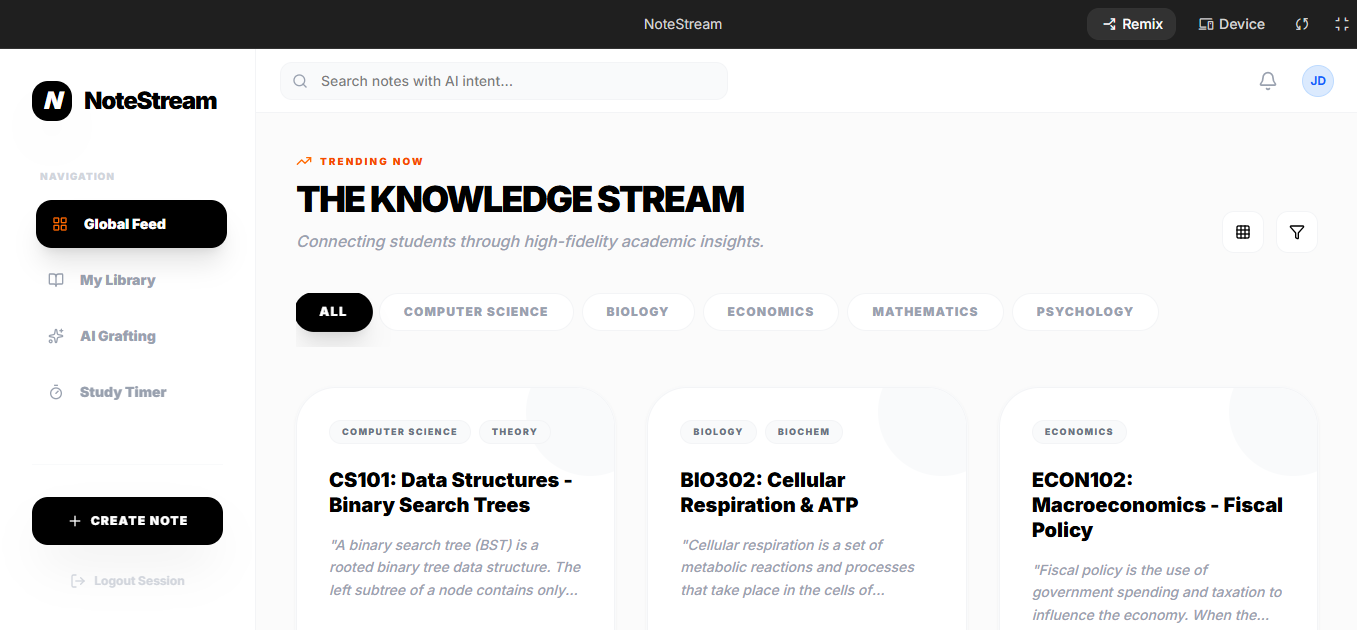
Inspiration The idea for this project came from a simple, frustrating reality: traditional note-sharing is broken. During exam season, thousands of students download peer-written PDFs, only to find themselves trapped in "digital graveyards" of messy handwriting, confusing shorthand, and outright factual errors. Worse yet, students suffer from the "Learning Gap"—they read someone else's notes without actually knowing what foundational pieces they are missing from their own memory.
We wanted to build something that moves beyond passive storage. Our vision was to create a hyper-simple, distraction-free environment that leverages advanced AI to turn static, shared files into an active, gap-closing study ecosystem.
What it does: Our platform transforms how students consume and share knowledge using a clean, ultra-intuitive interface. Instead of just hosting files, it functions as an intelligent bridge for student learning:
Knowledge Grafting: When a student opens a peer's shared notes, our system automatically cross-references it with their existing study materials, instantly highlighting critical learning gaps and generating a customized bridge guide.
Contextual Translation Layer: It instantly deciphers chaotic, shorthand-heavy lecture notes, translating them into beautifully structured Markdown files.
AI-Moderated Truth Threads: If a note contains an error, the community can flag it, and our automated system acts as a peer-reviewer to add correction cards without altering the original author's text.
Instant Active Recall: With just a single click, any shared note is instantly transformed into interactive flashcards and study quizzes.
How we built it: We aimed for a lightweight architecture that emphasizes speed and a seamless user experience, adhering to a strict "three-click rule" for all major user actions.
Frontend: Built using Next.js and Tailwind CSS to deliver a responsive, clean layout reminiscent of Google Keep meets Notion.
Backend & Database: Powered by a fast, modular backend architecture using Node.js alongside a flexible database structure to map user nodes and note relationships.
AI Engine: Deeply integrated the Gemini API. We utilized structured JSON outputs and tailored system instructions to handle real-time note synthesis, translation, and text-cross-referencing.
Challenges we faced: The biggest technical hurdle was implementing the Knowledge Grafting engine. Comparing two entirely different styles of note-taking—one highly detailed, one entirely shorthand—and accurately mapping out semantic "gaps" required intense prompt engineering and token management.
We initially faced high latency when sending massive note files to the model. We solved this by implementing text chunking strategies and designing optimized background workers so that the AI analysis happens seamlessly without freezing the user interface.
What we learned: Building this project taught us that AI shouldn't just be an "add-on" feature; it should redefine the core user workflow. We learned how to handle complex multi-modal data streams and translate chaotic human inputs into clean, normalized knowledge sets. Most importantly, we learned that true innovation in EdTech doesn't come from making platforms more sophisticated or bloated, but from making powerful tools completely frictionless for the end user.
Built With
- gemini
- google-ai-studio

Log in or sign up for Devpost to join the conversation.